

Submitted:
29 December 2023
Posted:
03 January 2024
You are already at the latest version
Abstract
Abstract:Background: Foot ulcers, especially dorsal foot ulcers caused by straps in footwear, can lead to discomfort, pain, and severe complications, particularly in individuals with diabetes and leprosy. While plantar foot pressure measurements have been extensively studied, research on the impact of strap-induced pressure on the dorsal foot aspect remains limited.Research question: The main research question of this prospective study is: Does the implementation of a rolled inner seam strap design (RIS) in flip-flops result in reduced pressure at the toehold area compared to traditional strap designs (Control) in healthy volunteers?Methods: We studied healthy female volunteers, with 10 feet (5 left and 5 right) per arm of the study. Two types of flip-flops, RIS and Control, were compared in a standardized 5-step walk trial on a hardwood floor. Pressure at the toehold was measured using Pressure Sensitive Switches with portable, accurate, ultra-thin pressure sensors. Paired t-tests compared the maximum pressure at the toehold between RIS and Control flip-flops (p < 0.05).Results: The study revealed a statistically significant difference in pressure at the toehold between the RIS and Control flip-flops (p = 0.0014). The mean difference of -40.90 grams (95% CI: -61.22 to -20.58) indicated that the RIS exerted significantly lower pressure than the Control flip flops. The RIS group had a mean pressure of 29.30 grams. The Control group had a mean pressure of 70.20 grams at the toehold area.Significance: The findings of this study have significant clinical implications for individuals at risk of foot ulcers, particularly those with neuropathic conditions such as diabetes and leprosy. The implementation of the RIS design in flip-flops may offer a practical and cost-effective solution to reduce strap-induced pressure and mitigate the risk of strap-related foot ulcers, especially in resource-limited settings where comprehensive foot care is lacking.
Keywords:
Foot ulcers
; Dorsal foot
; Flip-flops
; Strap design
; Pressure distribution
Introduction:
Footwear plays a critical role in the prevention and management of foot ulcers, particularly dorsal foot ulcers caused by straps, which can lead to discomfort, pain, and potentially serious complications [1]. Dorsal foot ulcers can occur as a result of excessive pressure and friction from straps, leading to tissue damage and breakdown. Individuals with diabetes and leprosy are particularly vulnerable to these ulcers due to factors such as sensory loss, peripheral neuropathy, and altered foot biomechanics [2].
While there is a considerable body of literature on pressure measurements for the plantar foot, there is a paucity of research specifically investigating strap-induced pressure on the dorsal aspect of the foot [3]. Most studies in the field of foot pressure analysis have focused on plantar pressure distribution, neglecting the potential impact of straps on dorsal foot regions. This research gap highlights the need to investigate the pressure characteristics specifically associated with strap design and their potential role in dorsal foot ulcer development.
Flip-flops, a type of open-toe footwear characterized by a flat sole and a Y-shaped strap, are among the most commonly used footwear in the world [1,4]. Their popularity can be attributed to factors such as simplicity, convenience, and breathability, making them a popular choice in warm climates and for casual wear. However, the design of flip flops, particularly the straps, can contribute to increased pressure and friction on the dorsal foot, potentially leading to the development of ulcers [1].
Strap-related foot ulcers have been reported in individuals with diabetes and leprosy [1,5]. In a study by Ramaswamy et al. (2017) [1], it was found that 15.7% of individuals with diabetes-related foot ulcers had ulcers specifically caused by the straps of their footwear. Kesav et al. (2013) [5] reported cases of non-trophic cutaneous ulcers in leprosy patients resulting from friction and pressure exerted by straps. These findings highlight the importance of examining the impact of strap design on the development of dorsal foot ulcers.
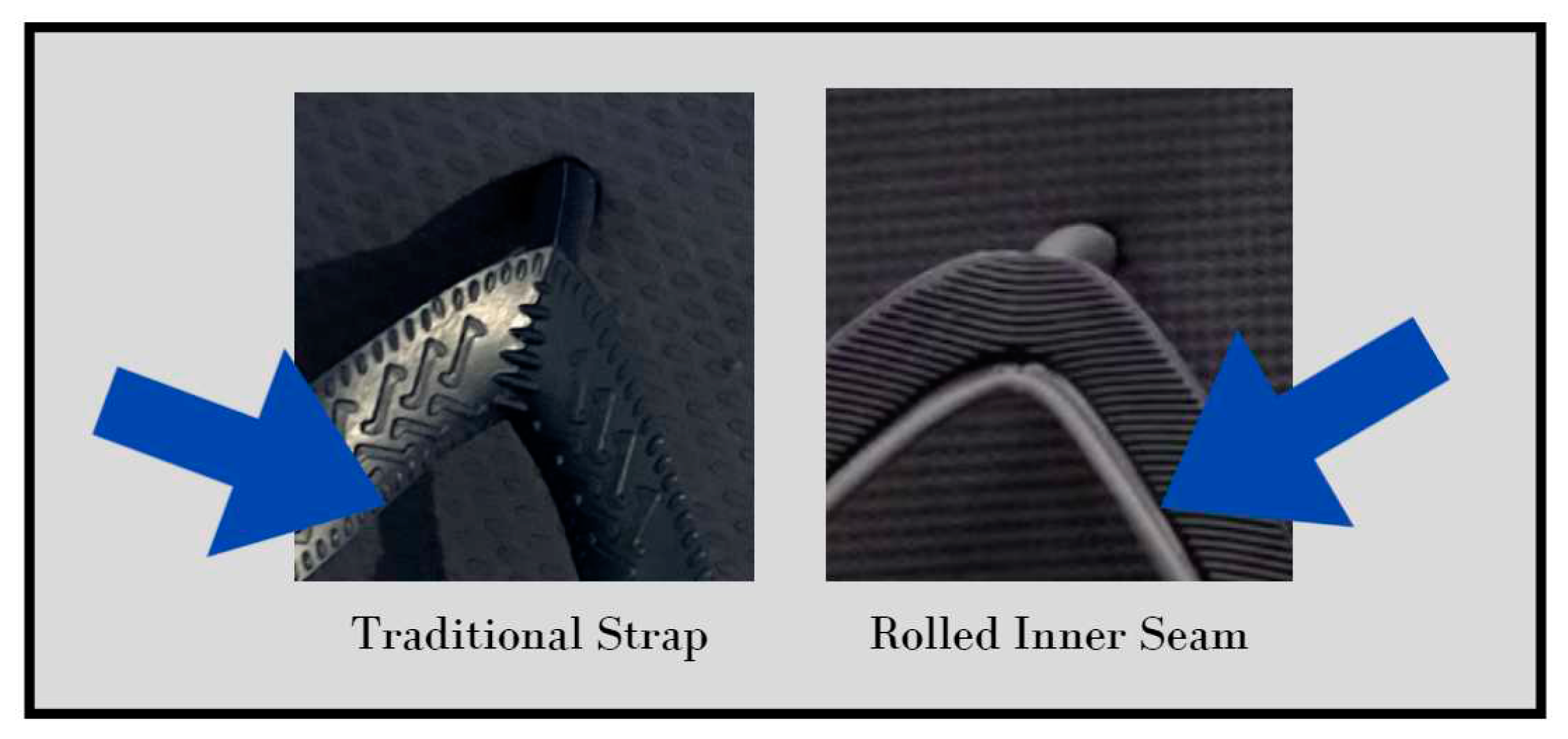
Rolling the inner strap of the flip-flop is a simple solution that can reduce the pressure and friction on the top of the foot. The rolled inner strap increases the surface area in contact with the skin, thus distributing the pressure evenly across the skin. It also reduces the contact area between the strap and the skin, leading to less friction and reducing the risk of skin breakdown.
We conducted a study on this design innovation, a rolled inner seam strap, compared to a traditional straight edge strap in healthy volunteers. By evaluating the pressure distribution and assessing the impact of different strap designs, this study seeks to identify footwear features that can reduce pressure and friction, thereby minimizing the risk of dorsal foot ulcers.
Methods:
The study recruited 5 female volunteers for a total of 10 feet (5 left and 5 right) per arm of the study. All participants were healthy individuals without any known foot conditions or injuries. Informed consent
Two types of flip-flops were compared in this study: rolled inner seam flip-flops (RIS) and traditional well-known brand flip-flops(Control). Both types of flip-flops were made of standard materials, Rubber/PVC blends commonly used in flip flop manufacturing.
Each participant performed a standardized 5-step walk trial wearing both types of flip-flops (Figure 2). The order of flip flop conditions (RIS and Control) was counterbalanced across participants to minimize any potential order effects. For each trial, the participant walked the predefined distance on a hardwood floor.
Figure 1.
Comparison of traditional straight edge strap and Rolled inner seam strap.
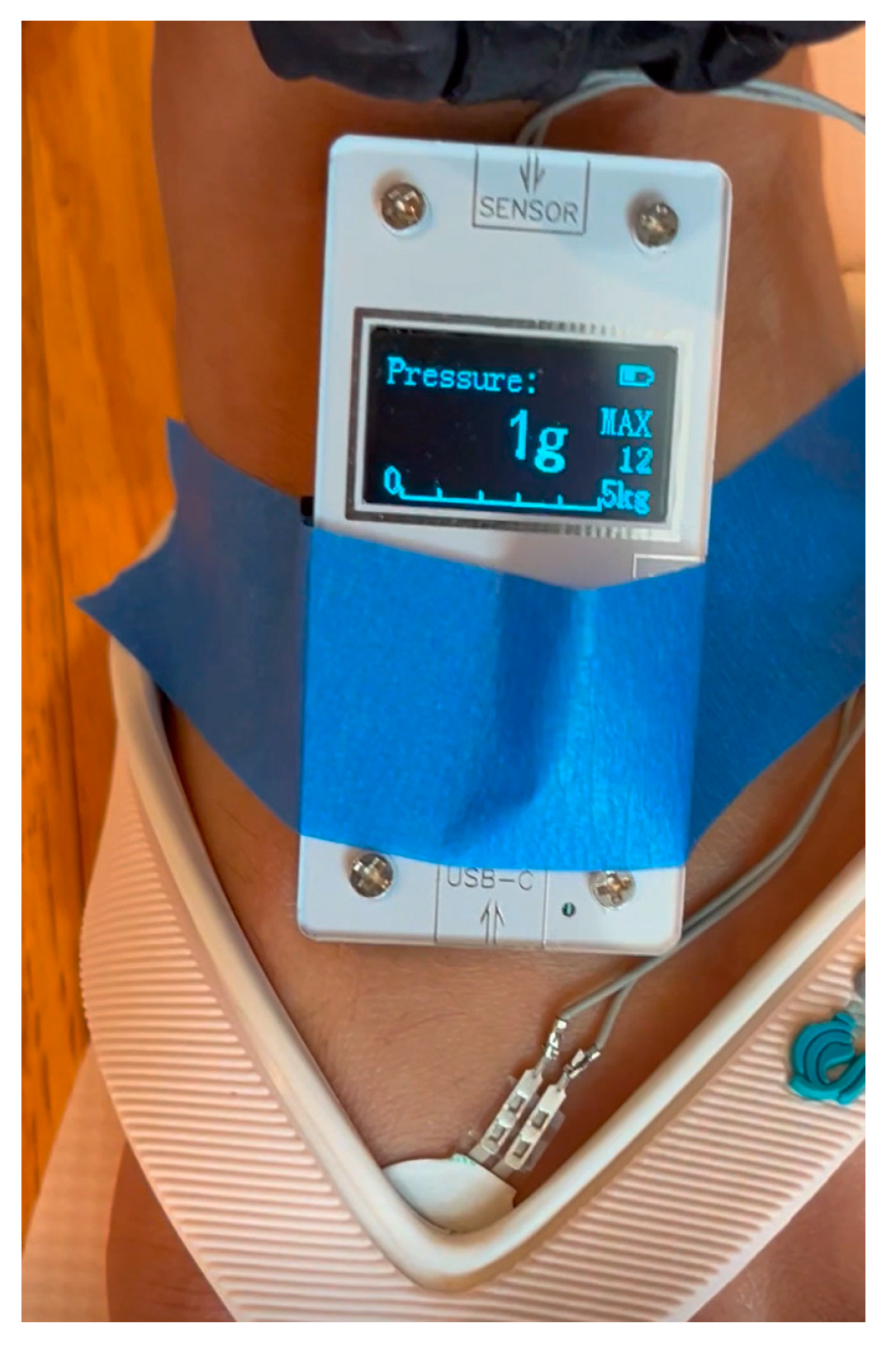
Pressure at the toehold was measured using a Pressure Sensitive Switch equipped with portable, accurate, ultra-thin pressure sensors. (Figure 2) The pressure sensors were positioned at the toehold area of the flip-flops and securely attached to ensure reliable data collection.
Figure 2.
Pressure sensor with switch.
During the walking trial, the pressure data from the sensors was continuously recorded. The maximum pressure recorded by the device during the walking trial was used as the primary outcome measure for comparing the RIS and Control flip-flops. Each foot served as its own control, with pressure measurements obtained separately for each flip-flop condition.
Paired t-tests were performed to compare the maximum pressure at the toehold between the RIS and Control flip-flops. The mean difference, 95% confidence intervals, t-values, degrees of freedom, and standard error of the difference were calculated. The statistical significance level was set at p < 0.05.
Results:
A paired t-test was performed to compare the pressure recorded at the toehold between rolled inner seam flip-flops(RIS) and traditional well-known brand flip-flops(Control) in a sample of 10 feet (5 right and 5 left). See Table 1.
The analysis using a paired t-test revealed a statistically significant difference in the pressure at the toehold between RIS and Control flip flops. The two-tailed p-value was 0.0014, indicating strong evidence of a highly significant difference. According to conventional criteria, this observed difference is considered to be very statistically significant.
The mean difference between RIS and Control was calculated to be -40.90 (all measures reported as grams), indicating that the pressure exerted at the toehold was significantly lower in the RIS flip-flops compared to the Control flip flops. The 95% confidence interval for this difference ranged from -61.22 to -20.58.
Intermediate values used in the calculations included a t-value of 4.5523 and a degrees of freedom (df) value of 9. The standard error of the difference was found to be 8.984.
The mean pressure with RIS was 29.30, with a standard deviation (SD) of 11.22 and a standard error of the mean (SEM) of 3.55. The RIS group and the control group each consisted of 10 observations in 5 right and 5 left feet (N = 10). The Control group had a mean pressure of 70.20, with an SD of 27.94 and an SEM of 8.83.
These results demonstrate a significant difference in pressure at the toehold between the RIS and Control flip flops. RIS flip-flops result in significantly lower pressure compared to the traditional well-known brand flip-flops. The results suggest the RIS design may offer benefits in terms of pressure redistribution and potentially reducing the risk of dorsal foot ulcers, particularly at the toehold area.
Discussion:
While numerous studies have investigated pressure measurements on the plantar surface of the foot, there is limited literature specifically addressing strap-induced pressure on the dorsal foot. This study examining the pressure at the toehold area induced by straps in flip-flops with rolled inner seam (RIS) compared to a more traditional strap design fills an important gap in the existing knowledge by exploring the impact of strap design on pressure distribution at the dorsal foot/toehold area.
The results revealed a significant difference in pressure at the toehold between the RIS and Control flip-flops with a two-tailed p-value of 0.0014 . The mean difference of -40.90 (95% CI: -61.22 to -20.58) suggests that the RIS exerted significantly lower pressure compared to the traditional strap design. This finding indicates that the rolled inner seam design effectively reduces pressure on the dorsal foot at the toehold area.
The study utilized a paired design, which allowed for direct comparisons between the RIS and Control conditions within the same 10 feet. This design choice strengthens the internal validity of the study, as individual foot characteristics and other potential confounding factors are accounted for by pairing the measurements.
The implications of these findings are particularly relevant for individuals with neuropathic conditions such as diabetes and leprosy, as foot ulcers in these populations often result from increased pressure and shear forces, including those caused by footwear. In developing nations where flip-flops are the preferred footwear and healthcare access is limited, the occurrence of foot ulcers can have devastating consequences. The reduction of blisters and abrasions resulting from strap-induced pressure can significantly mitigate the risk of foot ulcers and subsequent complications, especially in vulnerable populations.
The use of RIS flip-flops may offer a practical solution to address the issue of strap-induced pressure and its associated risks. By implementing the rolled inner seam design (patent pending), footwear manufacturers can potentially improve foot comfort and reduce the incidence of strap-related foot ulcers. This is particularly important in resource-limited settings where access to comprehensive foot care is often lacking.
However, it is important to note the limitations of this study. The relatively small sample size of healthy volunteers may limit the generalizability of the findings to larger populations. Additionally, the study focused solely on measuring pressure at the toehold area, and other factors such as foot structure and gait patterns were not considered. Further research with larger sample sizes and diverse populations especially in populations with chronic conditions such as diabetes is needed to confirm and extend these findings.
Conclusion:
This study provides valuable insights into the impact of strap design on pressure distribution at the toehold area of flip flops. The significant difference in pressure observed between the rolled inner seam (RIS) and traditional strap designs highlights the potential benefits of RIS flip-flops in reducing strap-induced pressure on the dorsal foot. This has significant implications, particularly in populations where flip-flops are primary footwear and foot ulcers pose a major concern. Further research is warranted to explore the long-term effects of RIS flip-flops and their efficacy in preventing foot ulcers and related complications.
Declaration of Interest
Design Patent Pending Rolled Inner Seam 29/791,616.
Acknowledgements
Karl Schaefer, Leyf Starling, William Edwards and Shayn Peirce-Cottler contributed advice for the design of the study.
References
- Ramaswamy, P., Rajan, P., Rima, J., & Richard, J. (2017). Footwear in the causation and prevention of foot ulcers in diabetes mellitus. The National Medical Journal of India, 30(5), 255-259. [CrossRef]
- Volmer-Thole M, Lobmann R. Neuropathy and Diabetic Foot Syndrome. Int J Mol Sci. 2016 Jun 10;17(6):917. PMID: 27294922; PMCID: PMC4926450. [CrossRef]
- Razak AH, Zayegh A, Begg RK, Wahab Y. Foot plantar pressure measurement system: a review. Sensors (Basel). 2012;12(7):9884-912. Epub 2012 Jul 23. PMID: 23012576; PMCID: PMC3444133. [CrossRef]
- https://www.universityofcalifornia.edu/news/guilt-free-flip-flop.
- Kesav, P., Vy, V., & Prabhakar, S. (2013). Non-trophic cutaneous ulcers in lepromatous leprosy. The American Journal of Tropical Medicine and Hygiene, 89(5), 1038-1039. [CrossRef]

Table 1.
Maximal Pressure readings in grams. RIS (Rolled Inner Seam).
| Measure | Foot | RIS (g) | Control (g) |
|---|---|---|---|
| 1 | Left | 32 | 102 |
| 2 | Left | 29 | 122 |
| 3 | Left | 37 | 42 |
| 4 | Left | 27 | 41 |
| 5 | Left | 12 | 71 |
| 6 | Right | 45 | 93 |
| 7 | Right | 46 | 63 |
| 8 | Right | 27 | 44 |
| 9 | Right | 16 | 50 |
| 10 | Right | 22 | 74 |
Disclaimer/Publisher’s Note: The statements, opinions and data contained in all publications are solely those of the individual author(s) and contributor(s) and not of MDPI and/or the editor(s). MDPI and/or the editor(s) disclaim responsibility for any injury to people or property resulting from any ideas, methods, instructions or products referred to in the content. |
© 2024 by the authors. Licensee MDPI, Basel, Switzerland. This article is an open access article distributed under the terms and conditions of the Creative Commons Attribution (CC BY) license (http://creativecommons.org/licenses/by/4.0/).
Copyright: This open access article is published under a Creative Commons CC BY 4.0 license, which permit the free download, distribution, and reuse, provided that the author and preprint are cited in any reuse.


