
Submitted:
17 December 2023
Posted:
20 December 2023
You are already at the latest version
Abstract
We propose a toy model of a spherical universe made up of an exotic dark gas with temperature $T$ in thermal equilibrium with a black-body. Each particle of this exotic gas mimics a kind of particle of dark energy. So, each dark particle occupies a very small area of space so-called Planck area $L_p^{2}$, which represents the minimum area of the whole space-time given by the spherical surface with area $4\pi R_H^2$, where $R_H$ is the Hubble radius. We realize that such spherical surface is the surface of the black-body for representing the dark universe as if it were the surface of an expanding balloon. Thus, we are able to derive the law of universal gravitation, thus leading us to understand the cosmological anti-gravity. We estimate the tiny order of magnitude of the cosmological constant and the acceleration of expansion of the dark sphere. In this toy model, as the dark universe can be thought of as a large black body, when we obtain its power and frequency of emission of radiation, we find very low values. We conclude that such radiation and frequency of the black body made up of dark energy is a background gravitational wave with very low frequency in the order of $\sim 10^{-17}$Hz due to the slight stretching of the fabric of space-time.
Keywords:
gravitational waves
; dark energy
; cosmological constant
; Planck length
1. Introduction
In the early 2000s a series of works flourished combining General Relativity, Scalar Fields and extra dimensions [1,2,3,4,5,6]. All these works are based on Action S in D dimensions whose structure is composed of curvature, scalar fields and corresponding momentum energy tensor, i.e., , where and the metric is . Although these works had a certain importance in dark energy modeling, the dynamics of the dark energy is still a puzzle.
It is known that the dark energy acts as a tenuous uniform distribution of energy and with property of having a negative pressure, thus leading to the accelerated expansion of the universe.
Although the true nature of the dark energy is unknown, there are some models that seek to understand its nature. Simpler candidates include the cosmological term (cosmological constant) introduced by Einstein to modify the field equations of the General Theory of Relativity, or a scalar field that is extremely weak and has properties that are consistent with repulsive macroscopic behavior.
The universe is approximately billion years old with Hubble radius m. It is composed of about ordinary matter (such as hydrogen, helium, etc.), dark matter, which gravitationally attracts, and dark energy, whose nature is mysterious and acts as a constant energy density associated with the vacuum energy and with negative pressure, working like a cosmological anti-gravity.
The toy model treated in this paper allows us to make a connection between Unruh effect and gravity, which can be extended to the cosmological anti-gravity in view of the fact that we consider a black body made of dark energy. This issue will be explored in the Section 2.
The thermodynamical aspect of gravitation is also another puzzle that should be deeper explored. Recent investigations have shown that gravitational field equations in a wide class of models can be interpreted with a thermodynamical origin. This idea, originally due to Sakharov [7], has different forms of implementation [7,8,9,10,11,12,13,14,15,16,17,18,19,20,21,22] and also other approaches [23,24,25].
In the Section 3, we use the toy model of an expanding dark sphere given in the Section 2 for representing the current universe with . Due to the Unruh effect treated in this frontier , we will be able to obtain a very low thermal energy whose associated frequency is of an order of magnitude far below the Cosmic Microwave Background (CMB). Due to the small acceleration of the universe, such a very low frequency (Hz) will be interpreted as being the frequency of a gravitational wave emitted by the dark energy due to the expansion of the fabric of space-time.
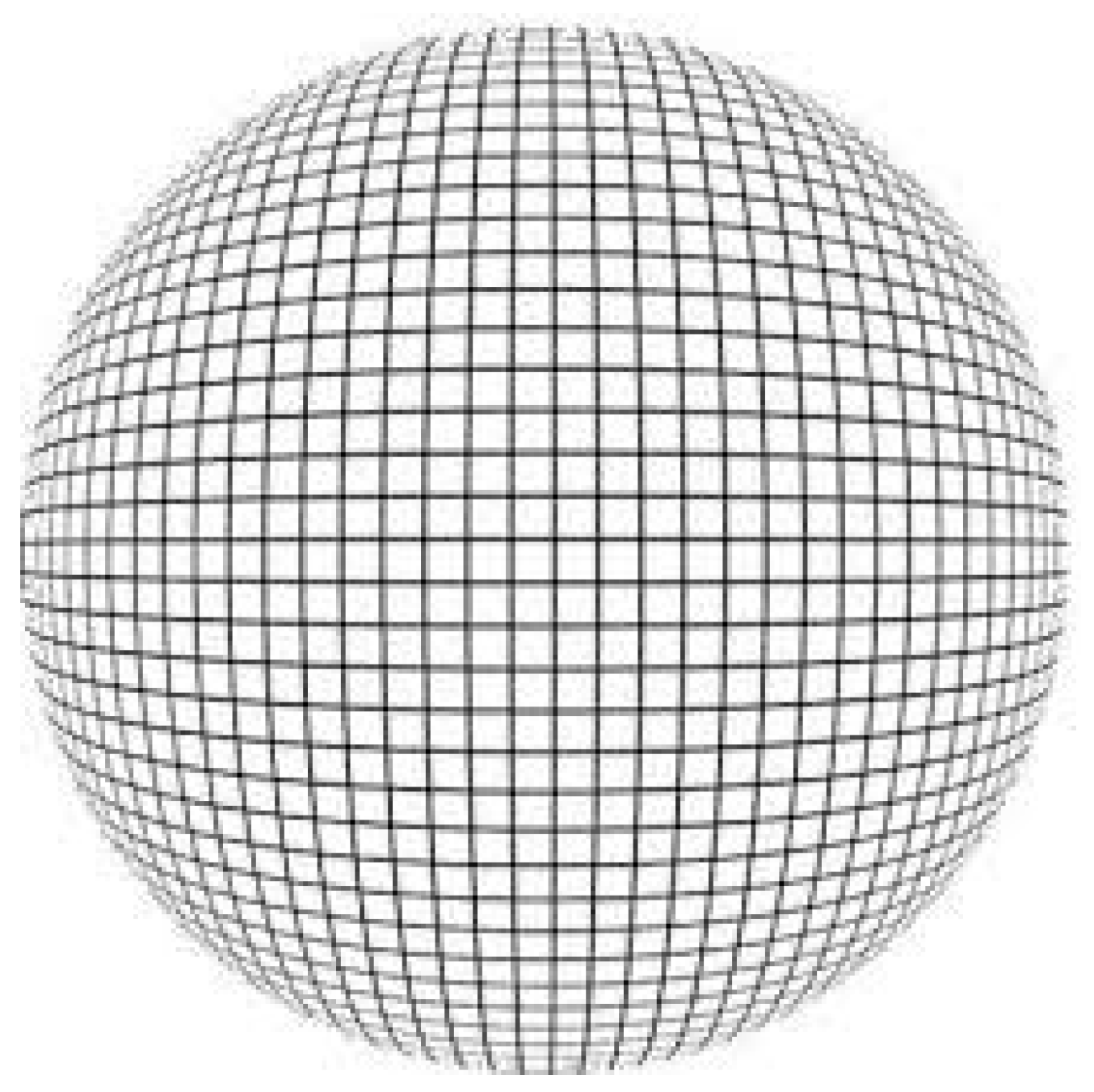
In the Section 4, as the present toy model deals with the dark universe as being the spherical surface in Figure 1 with an extremely low temperature, we will apply the Planck law for black body in order to obtain the power of emission of the background radiation with a frequency of approximately Hz. However, such frequency is far outside the electromagnetic spectrum, and thus it represents a gravitational wave emitted by the own dark energy. Dark energy does not emit any kind of electromagnetic wave. Hence the fact that such energy is dark, but it has a gravitational wave signature.
2. Unruh Effect and Anti-Gravity
In the early universe, space-time was confined to the Planck area . This area has expanded very quickly as described by cosmic inflation. After inflation, it continued to expand much slower until reaching the current area , being the Hubble radius.
The present toy model uses a dimensional compaction that preserves some physical properties like the universal gravitation law. This means that the expanding universe works like a spherical surface with area . The reason for such model of compactation is that it is considering a spherical surface for representing the fabric of space-time .
In this toy model, let us consider the universe made up of an exotic gas of N particles in a thermal equilibrium with the particles on the surface of the cavity of a spherical black-body, which represents a background frame for the fabric of space-time.
As the cavity of the black-body represents the space-time, we should consider that each particle of the exotic gas is inside the tiny Planck area () of the big dark cavity with area . So we conclude that the spherical surface with radius can be divided in N areas of Planck with N exotic dark particles. So we obtain , where N is the number of dark particles over this spherical surface, m being the Hubble radius with about Gyears.
We estimate the large number N of exotic particles of dark energy inside each Planck area of the spherical surface that represents the tissue of the space-time, namely (Figure 1).
We know that the Planck length is given by .
Each particle of such an exotic dark gas over the spherical surface is expanding radially in only one direction r. So its total thermal energy is , where , with . Such equation represents the total dark energy of a dark exotic gas made up of about dark particles that governs the accelerated expansion of the universe.
By using , , we rewrite the thermal energy of the gas as follows:
where is the Hubble radius and .
We should stress that such an exotic gas is not a true gas with its particles moving randomly over a 2-dimensional surface. Actually, this exotic gas is a mimic of a gas, as we have considered only one degree of freedom represented by the radial direction r of motion of the N particles.
The proof particle of matter is over the spherical surface. Such particle is in thermal equilibrium with the sphere. So, as this particle has a radial acceleration (), the Unruh effect [27] states that such a particle experiences a thermal bath with the same temperature T of the sphere, i.e., .
Due to the thermal equilibrium between the accelerated proof particle and the spherical surface with temperature T, we use the Unruh effect in Equation (1), so that we obtain
from where we get
Equation (3) is the law of universal gravitation. It was obtained within a scenario of quantum-gravity (dark energy), i.e., we have a dark mass made up of an exotic gas that fills the whole space-time (Figure 1). This gas is expansive, which leads to the accelerated expansion of the spherical surface (fabric of the space-time), working like an anti-gravitational acceleration.
In a recent important paper [26], as it was shown from first principles that the equation of state of vacuum (EOS) shows an anti-gravity due the negative pressure , being the vacumm energy density associated with a preferred reference frame of an invariant minimum speed V of a modified relativity [26], we conclude that the Equation (3) represents the universal gravitation law applied to the accelerated expansion of the universe by avoiding its collapse. In view of this, we should interpret Equation (3) working like a cosmological anti-gravity. So, let us just rewrite Equation (3) as , where the negative sign “” shows that the acceleration is repulsive for a given proof particle of matter on the surface of the dark sphere. is the Hubble radius and is the dark mass associated with the dark energy . This represents of the whole universe.
According to recent observations [28], the density of matter in the universe is about . Such density includes the contribution of dark matter plus the density of luminous matter as stars and galaxies. This represents about of the whole universe, where is the dark matter and is the luminous matter.
The visible universe has about Gyears. By considering the density associated with luminous and dark matter, which represents of the whole universe, we find a mass of about g. However, as the dark energy is of the universe, we compute about g. This leads us to conclude that the entire energy content can be estimated as being the own dark energy of the order of g. Thus, by making Kg, m and in the law of universal gravitation for representing anti-gravity, we obtain the acceleration of anti-gravity for a proof particle on the surface of the dark sphere, namely . Such result is expected as the current acceleration of expansion of the universe (anti-gravity) is very low.
We must stress the fact that the equation for obtaining the negative acceleration of a proof particle on the surface of the sphere of radius is the Newtonian law of gravitation. This is a good approximation once the dark mass in the order of is uniformly distributed in a big sphere with volume in the order of , giving a too low density, i.e., we have or . Such very low density of the dark sphere is in good agreement with observations. So it justifies the use of the Newtonian approximation for a weak anti-gravity. However, if this mass in the order of has a too small volume, so that the sphere presents a high density, so this result cannot be used for the approximation of classical gravitation. However, as we are only interested in the current state of the universe with an extremely low density of vacuum energy (), the Newtonian approach works well for obtaining the tiny value of the cosmological constant given by the derivative of acceleration for , namely .
The cosmological constant is the acceleration rate per unit of distance r ( in SI units). Thus we have . So, for , we get its current value , namely:
where is repulsive. As , we have an anti-gravity as expected.
We have obtained . This is the order of magnitude of the cosmological constant in agreement with the current observational data [29,30,31,32,33,34,35].
We must be aware of the fact that the very high values obtained for the cosmological constant and the vacuum energy density by using the Quantum Field Theory (QFT) for describing the quantum vacuum energy have a high discrepancy of about 120 orders of magnitude beyond their observational values. This puzzle is well-known as the “Cosmological Constant Problem” [36,37], and it is deeply investigated in a modified relativity with an invariant minimum speed V by representing vacuum in such a modified space-time with the presence of the cosmological constant [26].
3. Gravitational Waves as a Signature of the Dark Energy Due to Accelerated Cosmic Expansion
According to the present toy model, a proof particle of matter over the dark spherical surface experiences a thermal equilibrium with the sphere with a temperature T, which is proportional to its radial acceleration (), i.e., . This is the so-called Unruh effect, from where we can obtain the very low thermal energy, namely:
where for , Kg and K.
The Very Low Thermal Energy from the Dark Energy Far below the Electromagnetic Range as a Signature of Gravitational Waves
There is a very low thermal energy associated with the dark energy; however, as we will show that such energy is too low, in fact it is unable to emit a frequency within the well-kown electromagnetic range. Therefore, it is not a frequency of eletromagnetic origin.
From Equation (5), we see that
As , we find K. Such temperature is too low, so that the predominant frequency emitted by the black body of dark energy (Figure 1) is
where . We have used and Equation (5), where .
Here it is important to stress that the visible universe is also treated as a model of black body, since it is permeated by a cosmic microwave background (CMB) radiation with a temperature of about K associated with a peak frequency of GHz, which corresponds to a wavelength of mm. Such electromagnetic radiation is practically isotropic with very small fluctuations and comes from all directions of space.
The present model of dark sphere (dark universe) given by a black body is analogous to the first one; however it emits an isotropic background radiation of gravitational origin, since its frequency is about Hz, being far below the lowest electromagnetic frequency. Thus it is not an electromagnetic wave, being a background gravitational wave emitted by the dark energy permeating the whole space, as the dark energy leads to an accelerated expansion of the fabric of space-time represented by the surface of the dark sphere (Figure 1).
We realize that the background gravitational wave emitted by the dark energy with an extremely low frequency has a cosmological wavelength , which represents a super giant background gravitational wave. It has a very weak signal and it is the remnant of the cosmic inflation in the current universe.
The CMB cloaks the effects of the dark energy. What this means is that if we just assume the absence of CMB, the background temperature would be much lower in the order of K. Although this is not true due to the predominance of CMB, even so the present model predicts a gravitational wave of frequency approximately Hz emitted by the dark energy permeating isotropically the whole expanding universe. This lowest frequency of gravitation origin is the fossil of the inflationary phase given in the current universe.
A curved signature in the cosmic microwave background (CMB) provides proof of inflation and spacetime ripples. A CMB imprint from primordial gravitational waves would be indirect evidence, like the high-water mark left by a receding tide, but what of detecting the waves themselves? At present, the instruments most sensitive to locally produced gravitational waves are interferometers such as the dual Laser Interferometer Gravitational Wave Observatory (LIGO) installations. Each sends laser light down four-kilometer arms to look for interference effects that would be caused by passing gravitational waves stretching space in one direction and compressing it in the other. In future decades, space-based interferometers could use the same principles on much larger scales, bouncing laser light across the solar system, to directly detect the fainter primordial gravitational waves like the background gravitational waves with frequency Hz.
Recently, a body of works has devoted interest in the dynamics of dark energy by the emission of gravitational waves [38,39]. This line of investigation is important since it can contribute to the innovation of studies involving dark energy, its cosmological role, phase of inflation and the relationship with the cosmological constant.
4. The Power of Emission of the Black Body Associated to the Dark Sphere with Hubble Radius
According to the Planck law of the black body, the power of emission of radiation of a black body is given, namely:
where A is the area of the surface of the black body associated with the own surface of the dark sphere, i.e., . So, we rewrite Equation (8), as follows:
The emission power P depends on . In order to obtain also such a dependency in the distribution factor , let us write Equation (9) in its equivalent form based on the toy model of dark energy sphere, since we are applying the idea of a gravitational analogue of black body to such a dark spherical surface () representing the fabric of the space-time in this model of dimensional compactation.
So, in doing this, let us first begin from Equation (1), from where we obtain
from where we get
where and .
By using Equation (11), we can write the ratio , which appears in Planck’s law for black body in its equivalent form for representing the dark energy sphere, namely:
Thus, according to Equation (12), the Planck distribution factor applied to the dark sphere with radius is as follows:
where we can now see that the Planck distribution factor depends on the radius of the dark sphere.
Finally, substituting the equivalent distribution given by Equation (13) in Equation (9), we obtain
Let us make the computational resolution of the integral in Equation (14). So we write it as follows:
where and , being and .
So, based on computational calculation, the power P obtained for in the integral given in Equation (15) is . This power of emission of the dark energy of the whole universe is extremely low, being a very weak gravitational signal.
Dark energy does not emit electromagnetic waves. However, it is important to call attention to the fact that such radiation with power in the order of is of gravitational nature (gravitational wave power), since its frequency is outside of the electromagnetic spectrum, being very low in the order of , which represents an isotropic background radiation of gravitational origin due to the accelerated expansion of the space-time. This means that when the fabric of space-time undergoes a stretching, background gravitational waves emerge on this dark fabric, i.e., the dark energy emits gravitational waves.
It was shown that the cosmological constant is too small according to the observations, i.e., , being related to a small acceleration, namely . So, it is naturally expected that the frequency of the background gravitational wave is too low about Hz and with a wavelength of the order of m. This means that such too low frequency has cosmological origin, thus being the lowest gravitational frequency within the wide range of frequencies of gravitational waves, i.e., [40]. This frequency of the order of Hz obtained by the present model is in agreement with data in the literature [40].
It is well-known that gravitational wave signals are expected over a wide range of frequencies, from [40] in the case of ripples in the cosmological background to Hz from the formation of neutron stars in supernova explosions. So, we notice that the present simple model was able to reproduce the order of magnitude of the lowest gravitational frequency based on the Unruh effect () applied to the dark sphere (Figure 1) with a proof particle on its surface presenting a negative acceleration .
5. Conclusions and Prospects
In this paper, we were able to propose a toy model to represent the dark sector of the universe (dark energy) by means of a spherical shell of dark energy with Hubble radius . Such a spherical surface behaves like a black body with a very low temperature (a gravitational analogue of black body), having a dark energy emitting a frequency of approximately Hz, which is in the same order of magnitude of the frequency of background gravitational waves as being a fossil of the inflationary period. Such frequency is emitted due to the acceleration of the cosmic expansion (expansion of the spherical surface representing the tissue of space-time like a balloon that grows up) generated by the cosmological constant whose small order of magnitude was also obtained by this model acoording to the observations.
As we made an analogy of the dark sphere with a black body, we were also able to obtain the emission power of the dark energy sphere, which is a very low power by indicating that the gravitational wave signal emitted by the fabric of space-time is extremely weak. So, this would make it difficult to detect.
Although the present model has used the Newtonian approximation for obtaining Equation (3) in the current scenario of the universe, the early universe had a too large acceleration associated with a very large value of , which leads to the cosmic inflation. This issue can be explored in the future, since recently it was discovered that in the exotic conditions of the early universe, gravitational waves may have shaken the space-time so hard that they spontaneously created electromagnetic radiation [41].
Here it is important to stress that the model based on an expanding two-dimensional surface is related to the bulk (3-dimensional volume) relating and conserving all the corresponding dimensional physical properties (e.g: the universal gravitational law and anti-gravity connected to the gases properties by mean of the Unruh effect). This concept is explored in Brane models that predict extra dimensions in the Universe by describing physical properties and conservation laws that are not compromised or invalidated by the dimensional reduction of the Manifold. In other words, physical properties and laws remain unchanged when the manifold is dimensionally reduced. These foundations were substantially explored in works inspired by Cosmological Branas Models [42,43], which reinforces the validity of the dimensional compaction toy model we are using.
References
- R. Maartens, J. Phys.: Conf. Ser. 68 012046 (2007).
- N. Arkani-Hamed, S. Dimopoulos, N. Kaloper and R. Sundrum, Phys.Lett.B 480,193 (2000).
- D. Langlois, M. Rodrigues-Martinez, Phys.Rev. D64 123507 (2001).
- W. D. Goldberger and M. B. Wise, Phys. Rev. D 60, 107505 (1999).
- O. DeWolfe, D. Z. Freedman, S.S. Gubser and A. Karch, Phys.Rev.D62:046008,2000.
- D. Bazeia, C. Furtado and A. R. Gomes, JCAP 0402 002 (2004).
- A. D. Sakharov, Sov. Phys. Dokl. 12, 1040 (1968).
- T. Jacobson, Phys. Rev. Lett. 75, 1260 (1995).
- G. E. Volovik, Phys. Rep. 351, 195 (2001).
- M. Visser, Mod. Phys. Lett. A 17, 977 (2002).
- C. Barcelo et al, Int. J. Mod. Phys. D 10, 799 (2001).
- G. E. Volovik, “The Universe in a Helium Droplet” (Oxford Uni. Pres, 2003).
- G. Jannes, arXiv:0907.2839.
- H. S. Yang am M. Sivakumar, arXiv:0908.2809.
- J. Makela, arXiv:0805.3952.
- E. Elizalde and J. S. Pedro, Phys. Rev. D 78, 061501 (2008).
- C. J. Hogan, Phys. Rev. D 77, 104031 (2008).
- K. Bamba et al, arXiv:0909.4397.
- G. Chirco and S. Liberati, arXiv:0909.4194.
- L. Sindoni, F. Girelli and S. Liberati, arXiv:0909.5391.
- K. Bamba, C. Cheng and S. Tsujikawa, arXiv:0909.2159.
- C. Barcelo, S. Liberati and M. Visser, arXiv:gr-qc/0505065.
- T. Padmanabhan, Class. Quantum. Grav. 19, 5387 (2002).
- T. Padmanabhan, Phys. Rep. 406, 49 (2005).
- T. Padmanabhan, Gen. Rel. Grav. 40, 2031 (2008).
- C. Nassif and A. C. Amaro de Faria Jr, Reviews in Physics 11, 100088 (2023).
- W. G. Unruh, Physics meets Philosophy at the Planck Scale, 152-173, April (2001).
- S. M. Carroll, arXiv:astro-ph/0107571.
- M. Carmeli and T.Kuzmenko, arXiv:astro-ph/0102033.
- B. P. Schmidt, et al.,Astrophys. J.507, 46 (1998).
- A. G. Riess, et al., Astronom. J.116, 1009 (1998).
- P. M. Garnavich, et al., Astrophys. J.509, 74 (1998).
- S. Perlmutter, et al., Astrophys. J.517, 565 (1999).
- M. S. Turner and L. M. Krauss, Gen. Rel. Grav. 27, 1137 (1995), arXiv:astro-ph/9504003.
- Y. Wang and M. Tegmark, Phys. Rev. Lett.92, 241302 (2004).
- C. Nassif, Int. Journal of Modern Physics D, Vol.25, No. 10, 1650096 (2016).
- Ya.B. Zeldovich, JETP Lett.6, 316 (1967); S. Weinberg, Rev. Mod. Phys. 61, 1 (1989); T. Padmanabhan, Phys. Rept.380, 235 (2003).
- A. E. Romano, The effects of dark energy on the propagation of gravitational waves, arXiv:2211.05760 [gr-qc] (2023).
- A. Singh, Phys. Letters B 802 135226 (2022).
- S. Rowan and J. Hough, “The detection of gravitational waves”, https://cds.cern.ch/record/454173/files/open-2000-258.pdf.
- S. Kanno, J. Soda and K. Ueda, Physical Review D 106, 083508 (2022).
- L. Randall and R. Sundrum, “A Large Mass Hierarchy from a Small Extra Dimension”, Phys. Rev. Lett. 83: 3370-3373, (1999). [CrossRef]
- L. Randall and R. Sundrum, “An Alternative to Compactification”, Phys. Rev. Lett. 83:4690-4693, (1999). [CrossRef]
Figure 1.
The surface of the dark sphere has a number of Planck areas . Each one of them is connected to a dark infinitesimal energy as being a dark particle of vacuum. The total mass M in Equation (1) is the total dark mass . A baryonic proof particle over the surface of the sphere experiences an acceleration based on the Unruh effect. As the sphere is made up of dark energy, we have an anti-gravitational acceleration associated with the cosmological constant. Thus such a proof particle of matter is pushed out of the dark sphere due to the anti-gravity.
Figure 1.
The surface of the dark sphere has a number of Planck areas . Each one of them is connected to a dark infinitesimal energy as being a dark particle of vacuum. The total mass M in Equation (1) is the total dark mass . A baryonic proof particle over the surface of the sphere experiences an acceleration based on the Unruh effect. As the sphere is made up of dark energy, we have an anti-gravitational acceleration associated with the cosmological constant. Thus such a proof particle of matter is pushed out of the dark sphere due to the anti-gravity.
Disclaimer/Publisher’s Note: The statements, opinions and data contained in all publications are solely those of the individual author(s) and contributor(s) and not of MDPI and/or the editor(s). MDPI and/or the editor(s) disclaim responsibility for any injury to people or property resulting from any ideas, methods, instructions or products referred to in the content. |
© 2023 by the authors. Licensee MDPI, Basel, Switzerland. This article is an open access article distributed under the terms and conditions of the Creative Commons Attribution (CC BY) license (http://creativecommons.org/licenses/by/4.0/).
Copyright: This open access article is published under a Creative Commons CC BY 4.0 license, which permit the free download, distribution, and reuse, provided that the author and preprint are cited in any reuse.


