

Submitted:
06 December 2023
Posted:
06 December 2023
You are already at the latest version
Abstract
The COST Action ‘PED-EU-NET’, JPI Urban Europe, IEA EBC Annex 83 and EERA JP Smart Cities can be considered as the main promoters and pioneer initiatives of the research on Positive Energy Districts (PEDs), that collaborated to develop a tool called 'PED Database'. The tool aims to map, filter, sort, and compare PED experiences, providing a balanced overview of the technological and non-technological solutions adopted in different PED projects and case studies around Europe and beyond. The paper aims to present the collaborative step-by-step process leading to the PED DB implementation, describing the adopted methodology, the current results and potentials of the online version platform and introducing its future possible developments towards a more user-friendly and stakeholders-tailored tool.
Keywords:
positive energy districts (peds)
; climate neutral cities
; database
; urban sustainability
; energy transition
; renewable energy
; resilience
1. Introduction
Cities represent areas especially vulnerable to the effects of climate change modifying their activity and inhabitants quality of life. Extreme meteorological phenomena together with urban micro-climatic conditions have an impact on energy, environment, society and economy of cities. In addition, this impact is not homogeneous due to a combination of factors: local climatic conditions, morphology of the city, distribution and properties of materials and human activity itself. To alleviate these effects and achieve more sustainable, efficient and resilient cities, new urban models are required that meet the Sustainable Development Goals (SDG) [1]. These models should be based on efficient and affordable buildings, local renewable energy production and flexibility, efficient and sustainable transport, green public spaces, local employment or global urban management [2]. In this context, several international actions have been boosted, such as the New Urban Agenda [3], which promotes more efficient urbanisation and sustainable urban development, or the Strategic Energy Technology - SET Plan 3.2 of the European Union [4], which inspired the discussions on the deployment of 100 Positive Energy Districts (PED) throughout Europe by 2025. In this context, a PED means an urban area that connects energy-efficient and energy-flexible buildings, producing zero net greenhouse gas emissions and actively managing an annual local or regional surplus of renewable energy production. In addition, a PED should secure the energy supply and wellbeing considering social, economic and environmental sustainability aspects. These districts require the integration of different systems and infrastructures as well as the interaction between buildings, users and local energy networks, mobility and ICT systems, while ensuring energy supply and a high quality of life for citizens. The correct implementation of this type of urban solutions lead to the development of a roadmap to achieve the objectives set, identifying priority action plans based on local resources, existing regulations, infrastructures or economic-financial models. However, the successful implementation of these roadmaps will depend on a wide range of knowledge - e.g., the urban structures performance, or the distribution and boundary conditions, allowing the definition of the most appropriate strategies to mitigate and adapt cities to overcome sustainability and energy poverty needs. At the same time, this type of urban model needs a high level of innovation and includes a number of challenges to be addressed in order to achieve a successful implementation. On this topic, Krangsås et al. [5] identified seven interconnecting challenges needed for the deployment of PED, carried out through the Delphi method and surveys with experts in different urban issues, and thus to be considered as the most relevant for PEDs implementation: good governance, right incentives, support from local community, integrated planning and decision-making, balance between supply and demand, business model and contextual differences.
Castillo et al. [6] developed a methodology that offers a highly valuable quantitative assessment of future urban scenarios, designed to aid urban planners, investors, and government decision-making. This methodology defines the PED as the primary functional unit for urban design and treats its key components - i.e., buildings, streetlights, vehicles, PV, etc.- as agents capable of evolving and making decisions about their future using a fuzzy logic engine. These agents create transition pathways that outline the long-term destiny of districts as they strive to meet European commitments set for 2020, 2030, and 2050.
The PED-ID project [7] enhances decision-makers' access to improved information regarding PED solutions and methods that bolster project development, particularly focusing on the early stages of development and establishing a knowledge-based participation process. These methods were formulated based on data and insights gathered from Living Labs and workshops involving different stakeholders with the objective to empower PED designers and developers in employing these data-driven tools and methods in the decision-making process, thus enabling decisions based on data and the identification of optimal scenarios for each location. To further this objective, a criteria catalogue for PED is being developed to assist stakeholders in describing different PEDs using a holistic approach.
Koutra et al. [8] literature review exposed gaps in governance mechanisms, citizen participation processes, and grassroots approaches to fostering synergies and co-creative standards for the conception and implementation of PEDs. Additionally, the analytical process framework highlighted the need for strategic planning that aligns with social, technical, financial, and regulatory dimensions. It also underscored the considerable challenge of ensuring data accessibility and interoperability.
Therefore, the systematization of a series of data, information, barriers and enabling factors are fundamental to support the planning of district-scale interventions in an efficient, resilient and climate-neutral perspective, fostering the acceleration towards the ambitious objectives of the SET Plan 3.2. - i.e. 100 pilot PEDs by 2025 [4] and tackling the challenges of climate neutrality at urban level - i.e. 100 pioneer zero-emissions cities by 2030 [9].
In this perspective, the PED Database (PED DB) [10] is the result of a collaborative research led by the Working Group (WG) no. 1 of the COST Action (CA) ‘PED-EU-NET’ [11] in strict connection with two further international initiatives working on PEDs concept - i.e., JPI UE ‘Positive Energy Districts and Neighbourhoods for Sustainable Urban Development’[12] and IEA EBC ‘Annex 83 - Positive Energy Districts’ [13] - and accordingly with the aims of the European Energy Research Alliance Joint Programme on Smart Cities (EERA JPSC) [14] and the Driving Urban Transition (DUT) Partnership [15], whose mission is to contribute to research and innovation in smart cities by promoting research actions, at building, district and city level, that facilitate the transformation of the European built environment towards climate neutrality. .
1.1 State of the Art in PED Databases
As the PED concept was introduced in 2018 [4], still not many tools that allow to deepen the knowledge and characterization of this model are currently available. Recent studies and researches focusing on PEDs [16,17,18,19,20,21] highlight the emerging need to pass from isolated best practices - i.e., pilot districts - to innovative, systematic, holistic and integrated approaches supporting the planning of green, healthy, efficient, liveable and resilient districts, working in strict connection with the local planning instruments - such as SECAPs, SUMPs, City or District Plans, etc. - and relying on stakeholders expectations and citizens' needs.
In 2020, JPI Urban Europe published the PED Booklet [22] as a catalogue of PEDs case studies, structured in two main sections: ‘PED Projects’ - i.e., cases that have the proper ambition to achieve a positive annual energy balance - and ‘Towards PED Projects’ - i.e., cases that, even without aiming at an energy surplus, adopt innovative approaches and solutions for efficient and high-quality districts. The PED Booklet represents the first paper-based attempt of systematic collection and mapping of PEDs at international level, but also of multi-level characterization of PEDs through interdisciplinary parameters and indicators.
The study carried out by Zhang et al. [23], moving from the projects mapped in the PED Booklet, builds an innovative matrix for an interoperable and updatable platform (i.e., Knime dashboard) able to compare the characteristics and peculiarities of the PEDs model according to some relevant and specific parameters (e.g., project start year, geographical distribution, project phase, size of interventions, type of financing, etc.) and to ensure a cross overview of the analysed cases towards the definition of a series of PED archetypes or models.
Derkenbaeva et al. [24] conducted a comparative analysis of PEDs at various geographical scales, identifying defining elements and metrics that offer insights into how to conceptualize and put PEDs into practice. The study showcases 11 representative examples of PEDs already implemented in Europe and reveals that real-life PEDs frequently extend beyond the boundaries defined by existing definitions, highlighting significant knowledge gaps and limitations within the concept. The study adopts a Complex Adaptive System approach, incorporating the doughnut view to present a holistic system perspective and it addresses the limitations of the PED concept, identifying key issues - e.g. electric mobility - that warrant further attention. Once again moving from the best practices investigated in the PED Booklet, but with a particular focus on the Italian context, an interactive filing system was designed targeting municipalities interested in systematically integrating the PED model into their planning tools [25,26].
At the same time starting from the experience gained in the EERA Joint Program on Smart Cities initiative [14], the study conducted by Soutullo et al. [27] focused on the mapping of PED Labs - meant as pilot experiences acting as context-specific laboratories to catalyse the grounding of PEDs at local level. Through a SWOT analysis, the research identifies the main strengths, weaknesses, opportunities and threats linked to the 16 investigated laboratories and highlights the need to test solutions in the real environment, in order to evaluate the replicability potential for these experiences in different geographical, social and economic contexts.
As part of the European Citie4PEDs project [28], a catalogue, called 'PED Atlas' [29], was defined. Starting from the identification of 25 PEDs cases, then seven pilots were selected - three new construction and four regeneration interventions - and for each of them an interviews-based storytelling was drawn highlighting the perspectives of key involved actors, underlying the main lessons learned, barriers and success factors, and extrapolating some recurring PEDs approaches and dynamics.
Still investigating the PED topic, further studies and publications work on the systematic collection and cataloguing of the following key aspects: (1) technologies and solutions for PED effective implementation [30,31,32], (2) financing tools and business models to support PED technical feasibility and economic affordability [33,34] and (3) social tools to facilitate stakeholders mapping, to foster citizens' awareness on environmental issues and to support community engagement [35,36] broadening the scope beyond the environmental dimension to encompass energy justice-related aspects emphasizing the need to integrate opportunity spaces, well-being concerns [37] and energy vulnerability mitigation [38], and (4) criteria and Key Performance Indicators (KPIs) to monitor and evaluate PEDs impacts on the built environment [39,40,41,42].
By shifting the focus of cataloguing tools on Energy Community (EC) - a transition model in many respects considered similar to PED concept [43,44], the Joint Research Center (JRC) of the European Commission, following the two Directives that define the EC model at international level [45,46], has published a preliminary report tracing an overview of 24 Communities distributed in 9 EU countries [47]. The Commission is currently developing an interactive platform, called 'Energy Communities Repository' [48], with the aim of incrementally mapping community ongoing experiences in the European context [49]. Currently the first available online version of the platform consists of a map connected to a detailed sheet for each case study that allows to display the information collected divided in thematic sections - i.e., overall information, activities, governance, energy, economy, social impact and useful links.
Moreover, PED-ACT project [50] extracts the main characterization of PEDs automatically by machine learning approaches, through standardisation of the PED DB for existing PEDs. PED-ACT further learns from the PED DB and creates digital PED references by mapping stakeholders’ needs and priorities in cities of Borlänge (Sweden), Umeå (Sweden), Ankara (Turkey), Karsiyaka (Turkey) and the county of Lower Austria (Austria). This interaction of PED DB and PED-ACT project also aroused interactions for a more appropriate architecture of the PED DB in accordance with the identified stakeholders’ needs in PED-ACT. PED-ACT will also cover data visualisation by AI technologies and utilisation/storage across handovers among design, construction, demonstration, management and dissemination stages of PEDs that will be integrated into the PED DB. The above-mentioned studies represent key resources and insights adopted in the PED DB conceptualisation and the definition of its relevant contents (e.g., sections, parameters, answers options, etc.), but also for the selection of the most relevant cases studies and projects to be mapped and analysed.
Finally, in continuity with the above mentioned research, the PED DB has the objective to work towards the dissemination of PEDs practices and it is structured as a comprehensive tool that, thanks to an implementable structure and updatable contents, brings together case studies, projects, solutions, KPIs, policies and strategies to support the large-scale development of innovative pilot districts, working both on the implementation of new interventions and on the large-scale renovation of existing urban areas.
2. Aim and Methodology
According to the CA ‘PED-EU-NET’ Memorandum of Understanding [51], the PED DB development is conceived as a central task for the WG 1 ‘PED Mapping, Characterisation and Learning’ that, specifically under Task 1.1 activities, aims at “creating a comprehensive PED Database by mapping existing concepts, strategies, projects, technological and non-technological innovations related to PEDs in Europe” [51] (p.12). Indeed, the PED DB has the ambition to become a common knowledge pool on the state-of-the-art development in PEDs practices, fostering the sharing of knowledge, competences, methods and lessons learnt towards a large-scale spread of this innovative urban model, intended as one of the possible thrust towards climate-neutral cities. Unlike previous experiences on PED mapping, this time its implementation takes place in the form of an interoperable web platform [10]. The choice to implement the PED DB as an online interoperable platform is linked to a twofold order of reasons: on the one hand, given also the rather recent introduction of the PEDs concept itself [4], the wish to map in a flexible and updatable way the grounding of the first pilot PED experiences and, on the other hand, the need for future upgrades of the platform towards a more digital and user-friendly tool, collecting multiple functionalities according to the evolving features and challenges characterising PED models large-scale deployment. Actually, thanks to the digital PED DB, users (e.g., municipalities, practitioners, researchers, etc.) can easily take advantage of the database as a tool to browse different practices, search for similar examples and access practical information and insights. Likewise, researchers and professionals, such as architects, urban planners, engineers and economists, can use the database to search for technical solutions and other information, compare and analyse data, learn and identify patterns and narratives, and share knowledge. So, the commitment to scenario analysis and energy and climate optimization at the building and city scale aligns perfectly with the goal of facilitating data-driven decision-making in urban energy supply planning. Furthermore, these insights have paved the way for effective climate-neutral mitigation strategies, addressing PED objectives in the future case study cities in the future.
2.1. DB Phase-by-Phase Development Process
The CA PED-EU-NET has meticulously covered different facets of the research journey on the PED DB, spanning from the initial framework design phase (Phase 1) to its subsequent development (Phase 2). The culmination of this work is observed in the practical application of data collection, used to evaluate, facilitate and optimize urban areas to enhance the implementation of PEDs (Phase 3).
As mentioned above, the PED Database framework has been developed within the WG1 - Task 1.1 activities of the CA ‘PED-EU-NET’ [52,53] but it involved also the support of all CA Working Groups - i.e., WG2 ‘PED Guides and Tools’, WG3 ‘PED Laboratories, Monitoring and Replication’ and WG4 ‘Dissemination, Outreach and Exploitation’ - along with the collaboration of other international initiatives focused on Positive Energy Districts - i.e., JPI UE and IEA-EBC Annex83.
In the tricky development of a widely recognized PED Database, a methodological and systematized approach was required, also recognizable in the different phases characterizing the entire DB creation process. In fact, the PED DB is not limited to defining the requirements, the general structure and the fields of the database itself, but it has the ambition of creating an organized framework for future collection of multiple data related to PEDs. The implementation process required other additional features useful for easy database population – i.e., a guiding glossary and an online form to be shared between the so called ‘PED DB editors’ and supporting actors among others. Basically, a methodological approach was adopted for the PED DB design that, built upon the above, comprises three primary development steps (Figure 1): Phase 1 - DB general framework and categories (Subparagraph 2.1.1), Phase 2 - DB implementation process (Subparagraph 2.1.2) and Phase 3 - Next steps and functionalities from Web DB (Subparagraph 2.1.3).
2.1.1. Phase 1—DB General Framework and Categories
Phase 1 involved the definition of the general framework and inputs categories of the PED-Database. As widely explained in the previous publications describing the DB general framework [52,53], the first step consists in a comparative analysis of existing databases and platforms to understand the possible structure and content requirements for the PED-Database (see Appendix A in [53]). It was noted that there was no digital and interactive database focused on PED available online, but there were mainly databases related to sustainability, energy efficiency and adaptation district-scale practices - e.g., Urban Nature Atlas [54], Stories from the Neighbourhood [55], C40 case studies [56], etc. - or interactive platforms mapping EU funded projects on PED/ PED-similar concept - e.g., CORDIS Datalab [57], Smart City Marketplace [58], Portico urban knowledge platform [59], etc. Only the PED Booklet [22] emerged as an open-access catalogue of PED/PED similar cases published in paper format. Based on these analyses and on multiple contributions from WGs within the ‘PED-EU-NET’ COST Action, the overarching structure of the PED DB and its related sections were defined and, consequently, PED-relevant projects and initiatives along with key information about them were collected from CA partners. PED-relevant projects and initiatives were categorized into PED-focused - i.e., projects/initiatives directly focused on Positive Energy Districts implementation - and PED-supporting - i.e., projects/initiatives that collected experiences related to the PED concept (see Appendix B in [53]).
2.1.2. Phase 2—DB implementation process
Phase 2 led to the concrete PED DB implementation, involving three consecutive and strictly-related steps: (1) the definition of the parameters list following an iterative alignment process and the definition of the related glossary (see Annex A), (2) the implementation of two online easy-to-use questionnaires for data collection - called ‘input forms’ and (3) the realization of an open access platform for the Database widespread use. Proceeding into the detail of each step:
- Parameters alignment and glossary - according to the PED DB overall structures and related sections (as defined in Phase 1), the relevant parameters characterizing PED concept were identified through a multiple rounds of contributions involving all CA WGs, but also enlarging the discussion and contributions to two further international initiative working on PEDs deployment - i.e., JPI UE ‘Positive Energy Districts and Neighbourhoods for Sustainable Urban Development’ initiative and the IEA EBC ‘Annex 83 - Positive Energy Districts’. In order to build on the experiences and lessons learned of the already published PED Booklet [22], the involvement of JPI EU initiatives was of fundamental relevance. In particular, several workshops were organized between the ‘PED DB core team’ of the CA PED-EU-NET and JPI UE to review, check, analyse, benchmark and fine-tune the already defined parameters in both approaches. As shown in Table 1, this process consists in a one-by-one parameter comparison and related discussion in order to align and improve the necessary inputs to fully describe the PED concept in the Database. At the same time, the alignment with IEA EBC Annex 83, also thanks to its global scale of action, was crucial in identifying the main success factors, drivers, barriers and challenges related to PED implementation and to gain a world-wide perspective on the PED concept. The first selection of the PED DB parameters was made from the information available in the different European initiatives, refined with the information available in the literature on sustainable neighbourhoods, smart cities or urban living labs and PED oriented projects. Subsequently, this information was expanded and agreed upon by the different researchers from the involved initiatives and the representatives of Public Administrations, resulting in a list of variables required in different sections to characterize each element of a PED or PED Lab. Finally, these entries were validated by groups outside the development of the PED Database according to the information from their real cases. These groups evaluated the questions in each section of the survey form for possible gaps or redundancies. This review led to a refinement of the survey in each section, providing more precise and concise questions adopted in the online form questionnaires.
- 2.
- Online form questionnaires - were compiled according to different sections and related parameters. In particular, two different input forms were developed following the DB structure - i.e., one for PED/PED relevant case study and PED labs, collecting the information related to section A, B and C (see Paragraph 3.1 for details) and one for funded projects/initiatives collecting the information related to section D (see Paragraph 3.1 for details). The questionnaires (Figure 2) were developed with the fundamental support of IT experts and they allowed to: (1) integrate the glossary - i.e., both the definitions of parameters and the related filling instruction (see Appendix A); (2) save the inputs and continue later with the filling option; and (3) be easily accessible through a link provided by DB Editors - i.e., DB Editors are people responsible for facilitating the inputs collection by contacting the reference person for each PED case studies and PED labs, supporting them with advice when needed, reviewing the completeness and correctness of the input data and validating the online publication.
- 3.
- Web platform - once the input forms are filled in and reviewed by the DB Editors, the online platform allows publishing both PED cases/labs and PED projects. As for the realization of the input forms, the design of the online platform foresaw the fundamental collaboration with a team of IT experts. Thanks to their valuable support, two key operational tools were developed: (1) backend web platform (Figure 3) - for the DB administration allowing to generate input forms to be filled in by data providers, to review all the input data and to publish the case studies and project once fully ready, and (2) frontend web platform, for data visualization and additional functionalities, that is structured into three open-access web pages - i.e., the map view, the table view and the projects list (Figure 4).
2.1.3. Phase 3—Next Steps and Functionalities from Web DB
As explained above, the PED DB is focused on the creation of a structured digital repository of information and data, aiming at driving urban transformations across the whole complexity of urban challenges, empowering the creation of capacity and community building as key aspects of the decision-making process, implementation, and replication of PEDs. Therefore, gathering data and addressing the systematization of enabling factors, stakeholders and lessons learnt by mapping PEDs experiences abroad, is the necessary first step to support the entire process and/or promote replication by an advanced database.
Each input collected in the DB questionnaires is a key PED indicator that will be individually shown in the web platform and that can be also adopted for the further calculation of the different KPIs according to multiple purposes and needs - e.g., UBEM, Digital Twins, interactive planning tool, simulation software, etc.
Indeed, according to the different feedbacks and comments gathered during DB presentation and workshops at multiple international events - i.e., COST Action PED-EU-NET ‘Urban Stakeholders Workshop’ [60], PED Conference ‘Experiences and Guidance for Design and Implementation’ in Amsterdam [61], EURAC Conference ‘Smart and Sustainable Planning for Cities and Regions’ in Bolzano [62], ENEA Conference ‘Urban Transition Pathway’ in Bergamo [63], COST Action PED-EU-NET and EERA JPSC Conference ‘Energy in Built Environment: Climate-Driven Solutions for Next Generation EU Cities’ in Lisbon [64] - it emerged that the DB aims to collect a consistent number of information - i.e., fair data collection for a comprehensive DB -, but not all the inputs are relevant for all stakeholders. Likewise, the interests and perspective of potential stakeholders, such as the promoters and the constructors in the districts or the Public Administration, have to be addressed in a specific way because different needs and expectations exist and have to be balanced through the complex PED process [65]. At the same time, DB users are supposed to have different backgrounds, competences and skills, meaning that the information needs to be transferred by different channels and allowing for a tailored selection of the data that better fulfils their expectations and objectives.
Therefore, the PED DB aims for a user centred and tailored-made approach allowing to select relevant parameters according to four main identified stakeholders categories - i.e., public sector, private sector, research sector and citizens & civil society - and their needs emerged during DB presentations and workshops (Table 2).
Indeed, thanks to the already achieved outcome of the PED DB and according to the above-mentioned stakeholder-tailored and user-centred perspective, a multiple outlook is provided for the Database to be considered as next steps of the implementation process, namely:
- Decision making support tools - intended as a data-driven systems, where PED information serves as the primary material for informed decision-making at the district level through computerized systems. This approach significantly enhances the effectiveness and efficiency of the decision-making process in PEDs, decreasing technical, spatial, and socioeconomic barriers in district energy planning, while also providing the flexibility to tailor reports, roadmaps and presentations to meet the specific requirements of decision makers;
- Advanced learning tool - consisting of certain technologies, such as Artificial Intelligence, Machine Learning, Blockchain, Big Data, Internet of Things, Augmented Reality, Cloud Computing, etc., that have revolutionized traditional database systems. Machine learning, with its advanced learning algorithms, stands out as a ground-breaking technology with significant implications for the future. It can provide accurate predictions based on past experiences, making its integration into the PED Database a valuable tool for stakeholders to develop more effective strategies from current conditions to the urban transition;
- Database Query - allowing to enhance the data management capabilities within the PED database through adaptive and approximate query processing. This approach emphasizes the use of runtime feedback to modify query processing, aiming to achieve better response times and more efficient CPU utilization, as opposed to the traditional 'optimize-then-execute' approach;
- Import and export updatable Database - support practical methods for backing up critical PED data or transferring these metadata between various versions. These methods provide self-service restoration capability from system-generated backups, ensuring consistently faster, interoperable and predictable import/export performance without causing throttling by the database service. Running client applications from a Virtual Machine in the same region as the PED database helps avoid performance issues related to network latency.
To sum up, the overall workflow involved collaborative efforts to define the PED Database (Figure 5), starting from the framework and categories design, to the partnership agreements, towards parameters alignment and final definition, case studies’ storytelling and data exportation according to priorities and perspectives of different targeted stakeholders.
3. Results
The following paragraphs describe the current state of the PED Database, starting from the overview of its structure and sections (Paragraph 3.1) to a first insight of the preliminary online platform, and mapped case studies or laboratories and related projects (Paragraph 3.2).
3.1. PED DB Sections and Related Parameters
As explain above, the PED Database is conceived as an implementable and updatable structure and, so far, it consists of two main parts:
- The central nucleus of the Database collecting PED/PED relevant case studies and PED Labs - constituted by section A aimed at framing the context where the PED is developed - i.e., A1 ‘Global characteristics’ (Subparagraph 3.1.1), section A2 ‘Technological aspects’ (Subparagraph 3.1.2) and section A3 ‘Non-Technological aspects’ (Subparagraph 3.1.3) - section B aimed at deepening the concept of PED Case and/or PED Lab according to the classification provided in section A - i.e., B1 ‘PED case study in detail’ (Subparagraph 3.1.4) and B2 ‘PED Lab in detail’ (Subparagraph 3.1.5) - and section C aimed at analysing the driving factors and the obstacles faced during the PED planning and implementation process - i.e., C1 ‘Drivers and Barriers’ (Subparagraph 3.1.6). The central part of the Database is available online [10] in open access mode, collecting a total of 109 parameters and 455 answer options.
- A series of supporting sections facilitating the understanding of PED concept and its replication on a larger scale - constituted by Section D ‘General Project/Initiative’ (Subparagraph 3.1.7) collecting the funded projects and initiatives experimenting PED/PED relevant concepts, section E ‘National Policies/Strategies’ mapping the national regulatory framework conditions facilitating the uptake of PED/PED relevant practices and section F ‘Technological and Non-technological solutions’ deepening the adopted innovative and context-tailored solution in each PED case/lab. Currently, Section D is fully developed and available online [10], while Sections E and F are in their definition phase and still not available online. The contents framework showed in Table 3 summarises the contents detailed in the following tables - i.e., Tables 3.1–3.7 - according to the inputs and data collected for each DB section.

Table 3.
Contents framework of the DB sections. Source: CA ‘PED-EU-NET’.
| ID | Parameter title |
Glossary | Type of answers |
Answers | Target |
|---|---|---|---|---|---|
| Section [A1, A2, A3, B1, B2, C1, D1] + N. of the parameter [e.g., P001, P002, etc.] |
Name of the specific parameter. (*) indicates mandatory parameters. |
Text description about content of each specific parameter (when needed) - see Annex A |
Open [O] insert free text, image or numbers; Close single [Cs] choose one option; Close multiple [Cm] choose one or more options; Automatic [A] generated/calculated from previous inputs. |
In case of [O] or [A], specify the type of answer - i.e., free text [txt], image [img], number [nr]. In case of [Cs] or [Cm], list the related answer options |
Public sector [Pu] Privates sector [Pr] Research sector [Re] Citizens & civil society [Ct] |
3.1.1. Section A1 ‘Global Characteristics’
The contextualisation of each ‘PED case’ or ‘PED laboratory’ (PED lab) requires the identification of the initial boundary conditions and the most important factors describing each type. Indeed, it is important to know: (a) what type of PED it is, (b) for what purposes it has been defined, (c) what information is available, and (d) whose ownership it is. This information makes it possible to identify the main characteristics of the PED implemented in the Database, allowing to find similarities, differences between case studies, as well as to establish statistics, and trends.
Section A1 can be seen as the introductory part that allows to frame the ‘PED/PED relevant case study’ or ‘PED lab’ according to its main characteristics. This section, in fact, categorises the PED site according to three level of classification - i.e., PED case, PED relevant case or/and PED lab -, defines its phase and period of implementation, identify the localisation, the related climate zone and the extension of the projects, underlines the adopted financial schemes and overall costs and, finally, provides the contacts for the person responsible for the case study or laboratory.
Table 3.1 summarizes the most relevant Global characteristics emerged during the alignment process and then to be collected in the Database. It can be noted that most of the parameters are relevant for all targeted stakeholders - i.e., public sector, private sector, research sector, and citizens and civil society. This is strictly related to the main scope of section A1: framing the case study/lab by providing a first cognitive overview.
Table 3.1.
Section A1 ‘Global characteristics’. Source: CA ‘PED-EU-NET’.
| ID | Parameter title | Type of answer | Answers | Target | ||||||
|---|---|---|---|---|---|---|---|---|---|---|
| O | Cs | Cm | A | Pu | Pr | Re | Ct | |||
| A1 P001 |
Name of the PED case study / PED Lab (*) | • | [txt] | • | • | • | • | |||
| A1 P002 |
Map/aerial view/photos /graphic details/leaflet (*) | • | [img] | • | • | • | • | |||
| A1 P003 |
Categorisation of the PED site (*) | • | •PED case study; •PED relevant case study; •PED Lab. | • | • | • | • | |||
| A1 P004 |
Targets of the PED case study / PED Lab (*) | • | •Air quality and urban comfort; •Circularity; •Climate neutrality; •Electrification; •Energy Community; •Net-zero emission; •Net zero energy cost; •Annual energy surplus; •Self-sufficiency (energy autonomous); •Maximise self-sufficiency. | • | • | • | • | |||
| A1 P005 |
Phase of the PED case study / PED Lab (*) | • | •Planning stage; •Implementation stage; •Completed; •In operation. | • | • | • | • | |||
| A1 P006 |
Start Date | • | [nr] | • | • | |||||
| A1 P007 |
End Date | • | [nr] | • | • | |||||
| A1 P008 |
Reference Project | • | [txt] | • | • | • | ||||
| A1 P009 |
Data availability | • | •Monitoring data available within the districts; •Open data city platform; •Meteorological open data; •General statistical dataset; •GIS open datasets; •Vehicle registration datasets. | • | • | |||||
| A1 P010 |
Sources | • | [txt] | • | • | • | ||||
| A1 P011 |
Geographic coordinates (*) | • | [nr] | • | • | • | • | |||
| A1 P012 |
Country (*) | • | [txt] | • | • | • | • | |||
| A1 P013 |
City (*) | • | [txt] | • | • | • | • | |||
| A1 P014 |
Climate Zone - Köppen Geiger classification (*) | • | •Af; •Am; •As; •Aw; •BSh; •BSk; •BWh; •BWk; •Cfa; •Csa; •Csb; •Csc; •Cwa; •Cwb; •Cwc; •Dfa; •Dfb; •Dfc; •Dfd; •Dsa; •Dsb; •Dsc; •Dwa; •Dwb; •Dwc; •Dwd; •EF; •ET | • | • | • | • | |||
| A1 P015 |
District boundary | • | •Functional; •Geographic; •Off-Grid; •Virtual; •Other - specify | • | • | |||||
| A1 P016 |
Ownership of the case study/PED Lab (*) | • | •Private; • Public; •Mixed | • | • | • | • | |||
| A1 P017 |
Ownership of the land / physical infrastructure (*) | • | •Single Owners; •Multiple Owners | • | • | • | • | |||
| A1 P018 |
Number of buildings in PED | • | [nr] | • | • | |||||
| A1 P019 |
Conditioned space | • | [nr] | • | • | |||||
| A1 P020 |
Total ground area | • | [nr] | • | • | |||||
| A1 P021 |
Floor area ratio: conditioned space / total ground area | • | [nr] | • | • | |||||
| A1 P022 |
Financial schemes (*) | • | •Private, Real estate; •Private, ESCO scheme; •Private, Other, please specify; •Public, EU structural funding; •Public, National funding; •Public, Regional funding; •Public, Municipal funding; •Public, Other, please specify; •Research funding, EU; •Research funding, National; •Research funding, Local/regional; •Research funding, Other, please specify. - Add the value in €, if available | • | • | • | • | |||
| A1 P023 |
Economic Targets | • | •Job creation; Positive externalities; •Boosting local businesses; •Boosting Local and sustainable production; •Boosting consumption of local and sustainable products; •Other, please specify. | • | • | |||||
| A1 P024 |
More comment | • | [txt] | • | • | • | • | |||
| A1 P025 |
Estimated PED case study / PED LAB costs | • | [nr] | • | • | • | • | |||
| A1 P026 |
Contact person for general enquiries – name (*) | • | [txt] | • | • | • | • | |||
| A1 P027 |
Contact person for general enquiries – organization (*) | • | [txt] | • | • | • | • | |||
| A1 P028 |
Contact person for general enquiries – affiliation (*) | • | •Research Center/University; •Municipality/Public Bodies; •SME/Industry; •Other, please specify | • | • | • | • | |||
| A1 P029 |
Contact person for general enquiries - e-mail (*) | • | [txt] | • | • | • | • | |||
| A1 P030 |
Contact person for other special topics - name | • | [txt] | • | • | • | • | |||
| A1 P031 |
Contact person for other special topics - e-mail | • | [txt] | • | • | • | • | |||
(*) Mandatory parameters
3.1.2. Section A2 ‘Technological aspects’
Section A2 focuses on the technological aspect of PEDs. In the first part, it aims to collect a series of quantitative data on the annual energy demand - for building (both thermal and electrical), for infrastructure and for e-mobility -, on the annual energy production - from renewable and non-renewable sources (both thermal and electrical, and both on-site and/or imported from outside the district boundary). In the second part of section A2, technological solutions and innovations are mapped according to three main PED energy concerns - i.e., energy generation, energy efficiency and energy flexibility [4,30] - and mobility services.
According to Table 3.2, the PED technological aspects are particularly important to reach one of the key elements characterising a PED: the fulfilment of a positive energy balance on an annual basis. For this reason, the collected quantitative data are relevant both for practitioners and researchers involved in the planning of the positiveness of the district, but also for the public sector – e.g., municipalities, policy makers, etc. - trying to foster the energy transition at urban level moving from district-scale innovative models such as positive energy districts, climate neutral neighbourhoods and energy communities.
Table 3.2.
Section A2 ‘Technological aspects’. Source: CA ‘PED-EU-NET’.
| ID | Parameter title | Type of answer | Answers | Target | ||||||
|---|---|---|---|---|---|---|---|---|---|---|
| O | Cs | Cm | A | Pu | Pr | Re | Ct | |||
| A2 P001 |
Fields of application | • | •Energy efficiency; •Energy flexibility; •Energy production; •E-mobility; •Urban management; •Urban comfort and air quality; •Digital technologies; •Water use; •Waste management; •Air quality; •Construction materials; •Other, please specify | • | • | |||||
| A2 P002 |
Tools/strategies/methods applied | • | [txt] | • | • | |||||
| A2 P003 |
Application of ISO52000 | • | •Yes; •No | • | • | |||||
| A2 P004 |
Appliances included in the calculation of the energy balance | • | •Yes; •No | • | • | • | ||||
| A2 P005 |
Mobility included in the calculation of the energy balance | • | •Yes; •No | • | • | |||||
| A2 P006 |
Description of how mobility is included (or not included) in the calculation | • | [txt] | • | • | |||||
| A2 P007 |
Annual energy demand in buildings / Thermal demand | • | [nr] | • | • | |||||
| A2 P008 |
Annual energy demand in buildings / Electric demand | • | [nr] | • | • | |||||
| A2 P009 |
Annual energy demand for e-mobility | • | [nr] | • | • | |||||
| A2 P010 |
Annual energy demand for infrastructure | • | [nr] | • | • | |||||
| A2 P011 |
Annual renewable electricity production on-site during target year | • | •PV; •Wind; •Hydro; •Biomass_el; •Biomass_peat_el; •PVT_el; •Other, please specify. - Add the value in GWh/y, if available- | • | • | • | ||||
| A2 P012 |
Annual renewable thermal production on-site during target year | • | •Geothermal; •Solar Thermal; •Biomass_heat; •Waste heat+HP; •Biomass_peat_heat; •PVT_th, •Biomass_firewood_th, •Other, please specify. - Add the value in GWh/y, if available | • | • | • | ||||
| A2 P013 |
Renewable resources on-site - Additional notes | • | [txt] | • | • | • | ||||
| A2 P014 |
Annual energy use | • | [nr] | • | • | |||||
| A2 P015 |
Annual energy delivered | • | [nr] | • | • | |||||
| A2 P016 |
Annual non-renewable electricity production on-site during target year | • | [nr] | • | • | |||||
| A2 P017 |
Annual non-renewable thermal production on-site during target year | • | •Gas; •Coal; •Oil; •Other, please specify - Add the value in GWh/y, if available - |
• | • | |||||
| A2 P018 |
Annual renewable electricity imports from outside the boundary during target year | • | •PV; •Wind; •Hydro; •Biomass_el; •Biomass_peat_el; •PVT_el; •Other, please specify. - Add the value in GWh/y, if available - | • | • | |||||
| A2 P019 |
Annual renewable thermal imports from outside the boundary during target year | • | •Geothermal; •Solar Thermal; •Biomass_heat; •Waste heat+HP; •Biomass_peat_heat; •PVT_th; •Biomass_firewood_th; •Other, please specify.- Add the value in GWh/y, if available | • | • | |||||
| A2 P020 |
Share of RES on-site / RES outside the boundary | • | [nr] | • | • | |||||
| A2 P021 |
GHG-balance calculated for the PED | • | [nr] | • | • | |||||
| A2 P022 |
KPIs related to the PED case study / PED Lab | • | •Safety & Security; •Health; •Education; •Mobility; •Energy; •Water; •Waste; •Economic development; •Housing and Community - Specify the associated KPIs | • | • | |||||
| A2 P023 |
Technological Solutions / Innovations - Energy Generation | • | •Photovoltaics; •Wind turbines; •Solar thermal collectors; •Geothermal energy system; •Waste heat recovery; •Waste to energy; •Polygeneration; •Co-generation; •Heat Pump; •Hydrogen; •Hydropower plant; •Biomass; •Biogas; •Other, please specify | • | • | • | • | |||
| A2 P024 |
Technological Solutions / Innovations - Energy Flexibility | • | •Information and Communication; •Technologies (ICT); •Energy management system; •Demand-side management; •Smart electricity grid; •Thermal Storage; •Electric Storage; •District Heating and Cooling; •Smart metering and demand-responsive control systems; •P2P – buildings; •Other, please specify | • | • | • | • | |||
| A2 P025 |
Technological Solutions / Innovations - Energy Efficiency | • | •Deep Retrofitting; •Energy efficiency measures in historic buildings; •High-performance new buildings; •Smart Public infrastructure (e.g., smart lighting); •Urban data platforms; •Mobile applications for citizens; •Building services (HVAC & Lighting); •Smart irrigation; •Digital tracking for waste disposal; •Smart surveillance; •Other, please specify | • | • | • | • | |||
| A2 P026 |
Technological Solutions / Innovations - Mobility | • | •Efficiency of vehicles (public and/or private); •Measures to reduce traffic; •e-Mobility; •Soft mobility infrastructures and last mile solutions; •Car-free area; •Other, please specify | • | • | • | • | |||
| A2 P027 |
Mobility strategies - Additional notes | • | [txt] | • | • | |||||
| A2 P028 |
Energy efficiency certificates | • | •Yes; •No | • | • | |||||
| A2 P029 |
Any other building / district certificates | • | •Yes; •No | • | • | |||||
3.1.3. Section A3 ‘Non-Technological Aspects’
Since PEDs are first of all communities acting in a sustainable way, they have a significant impact on the environment, the economy, and the social well-being of a community as a whole. Therefore, non-technological aspects of PED, such as stakeholder engagement, social and cultural acceptance, financial viability, and regulatory feasibility, are essential for their successful implementation.
Table 3.3 summarises the most relevant Non-Technological aspects emerged during the alignment process and their target stakeholders. Those aspects are mainly related to the Public Sector such as municipalities, policymakers, public technicians, etc. Furthermore, many Non-Technological aspects are also relevant for citizens and the civil society in general. While some Non-Technological aspects are relevant for the research sector, the private sector has the least interest in Non-Technological aspects. Only when it comes to identifying available funding, understanding economic leverages and costs or comparing technical and non-technical solutions, this is considered as an important topic.
Table 3.3.
Section A3 ‘Non-Technological aspects’. Source: CA ‘PED-EU-NET’.
| ID | Parameter title | Type of answer | Answers | Target | ||||||
|---|---|---|---|---|---|---|---|---|---|---|
| O | Cs | Cm | A | Pu | Pr | Re | Ct | |||
| A3 P001 |
Relevant city/national strategy | • | •Smart cities strategies; •Urban Renewal Strategies; •Energy master planning (SECAP, etc.); •New development strategies; •Promotion of energy communities; •Climate change adaptation plan/strategy; •National / international city networks addressing sustainable urban development and climate neutrality | • | • | |||||
| A3 P002 |
Quantitative targets included in the city / national strategy | • | [txt] | • | X | |||||
| A3 P003 |
Strategies towards decarbonization of the gas grid | • | •Electrification of Heating System based on Heat Pumps; •Electrification of Cooking Methods; •Biogas; •Hydrogen; •Other, please specify | • | • | |||||
| A3 P004 |
Identification of needs and priorities | • | [txt] | • | • | |||||
| A3 P005 |
Sustainable behaviour | • | [txt] | • | • | |||||
| A3 P006 |
Economic strategies | • | •Open data business models; •Innovative business models; •Life Cycle Cost; •Circular economy models; •Blockchain; •Demand management; •Living Lab; •Local trading; •Existing incentives; •Other, please specify | • | • | • | • | |||
| A3 P007 |
Social models | • | •Strategies towards (local) community-building; •Co-creation / Citizen engagement strategies; •Behavioural Change / End-users engagement; •Citizen Social Research; •Policy Forums; •Social incentives; •Quality of Life; •Strategies towards social mix; •Affordability; •Prevention of energy poverty; •Digital Inclusion; •Citizen/owner; •Involvement in planning and maintenance; •Educational activities and trainings; •Other, please specify | • | • | • | ||||
| A3 P008 |
Integrated urban strategies | • | •Strategic urban planning; •Digital twinning and visual 3D models; •District Energy plans; •City Vision 2050; •SECAP Updates; •Building / district Certification; •Other, please specify | • | • | |||||
| A3 P009 |
Environmental strategies | • | •Energy Neutral; •Low Emission Zone; •Net zero carbon footprint; •Carbon-free; •Life Cycle approach; •Pollutants reduction; •Greening strategies; •Sustainable Urban drainage systems (SUDS); •Cool Materials; •Nature Based Solutions (NBS); •Other, please specify | • | • | |||||
| A3 P010 |
Legal / Regulatory aspects | • | [txt] | • | • | • | ||||
3.1.4. Section B1 ‘PED Case studies in detail’
This section needs to be filled in if the PED site - according to parameter P003 in section A1- is classified as a ‘PED/PED relevant case study’.
The parameters collected are mainly meant to deepen the reason beyond the choices that led the district transformation and to map the type of intervention according to some specific characteristics describing the context, the year of construction/renovation, the population involved, the buildings and land uses, etc.
As highlighted in Table 3.4, these parameters resulted to be particularly relevant for the Public Sector; in fact, municipalities and policymakers often need to understand which areas to prioritize - e.g., Urban or suburban? Mixed-use or residential? New construction or renovation?, etc. - to test a pilot project in a PED/PED relevant perspective. Also Citizens and Civil Society have a quite strong interest in understanding the environment of the PED development.
Table 3.4.
Section B1 ‘PED Case studies in detail’. Source: CA ‘PED-EU-NET’.
| ID | Parameter title | Type of answer | Answer options | Target | ||||||
|---|---|---|---|---|---|---|---|---|---|---|
| O | Cs | Cm | A | Pu | Pr | Re | Ct | |||
| B1 P001 |
PED/PED relevant concept definition | • | [txt] | • | • | • | ||||
| B1 P002 |
Motivation behind PED/PED relevant project development | • | [txt] | • | • | |||||
| B1 P003 |
Environment of the case study area | • | •Rural; •Rurban; •Suburban area; •Urban area | • | • | • | • | |||
| B1 P004 |
Type of district | • | •New construction; •Renovation | • | • | • | • | |||
| B1 P005 |
Case Study Context | • | •Re-use Transformation Area; •New Development; •Retrofitting Area; •Preservation Area | • | • | • | • | |||
| B1 P006 |
Year of construction | • | [nr] | • | X | |||||
| B1 P007 |
District population before intervention – Residential | • | [nr] | • | ||||||
| B1 P008 |
District population after intervention – Residential | • | [nr] | • | ||||||
| B1 P009 |
District population before intervention - Non-residential | • | [nr] | • | ||||||
| B1 P010 |
District population after intervention - Non-residential | • | [nr] | • | ||||||
| B1 P011 |
Population density before intervention | • | [nr] | • | ||||||
| B1 P012 |
Population density after intervention | • | [nr] | • | ||||||
| B1 P013 |
Building and Land Use before intervention | • | •Residential; •Office; •Industry and utility; •Commercial; •Institutional; •Natural areas; •Recreational; •Dismissed areas; •Other, please specify - Add the value in m2, if available | • | • | • | • | |||
| B1 P014 |
Building and Land Use after intervention | • | •Residential; •Office; •Industry and Utility; •Commercial; •Institutional; •Natural areas; •Recreational; •Dismissed areas; •Other, please specify - Add the value in m2, if available | • | • | • | • | |||
3.1.5. Section B2 ‘PED Lab in Detail’
Based on the definition proposed by the Set Plan Action 3.2 [4], ‘PED Labs’ are pilot actions that provide opportunities to experiment with planning and deployment of PEDs, as well as provide seeding ground for new ideas, solutions and services to develop. Under this framework, PED labs are considered as urban laboratories where these new proposals, technologies and services could be developed, modelled and monitored according to place-based needs and local context baseline. These research infrastructures allow defining integrative solutions that include technological, spatial, regulatory aspects, financial, legal, social and economic perspectives.
The assessment of this type of urban living labs requires high flexibility in the facilities, allowing the implementation of several integrative configurations. The quantification of the urban flows involves the use of models, tools and equipment to measure the target KPIs. Therefore, with the objective of mapping the facilities, resources and characteristics of the available laboratories, a series of questions are formulated that make it possible to classify the PED labs.
The section B2 needs to be filled in if the PED site - according to parameter P003 in section A1 - is classified as a PED Lab. As shown in Table 3.5, researchers, coming both from academia and R&I centres, seem to be the main interested stakeholders in testing PED labs as infrastructures properly focused on innovation, experimentation and monitoring aspects. At the same time, also public and private sectors expressed a strong interest in testing PED Labs as they allow pilots grounding of different innovative solutions and approaches in a controlled and experimental environment.
Table 3.5.
Section B2 ‘PED Lab in detail’. Source: CA ‘PED-EU-NET’.
| ID | Parameter title | Type of answer | Answer options | Target | ||||||
|---|---|---|---|---|---|---|---|---|---|---|
| O | Cs | Cm | A | Pu | Pr | Re | Ct | |||
| B2 P001 |
Scale of action | • | •Building; •City; •District; •Campus; •Virtual; •Semi-virtual | • | • | • | • | |||
| B2 P002 |
Motivation for developing the PED Lab | • | •Strategic; •Private; •Civic; •Grassroots; •Other, please specify | • | • | • | ||||
| B2 P003 |
Lead partner that manages the PED Lab | • | •Research center / University; •Municipality; •Industry / Company; •Other, please specify | • | • | • | ||||
| B2 P004 |
Collaborative partners that participate in the PED Lab | • | •Academia; •Private; •Industrial; •Citizens, •Public, •NGO; •Other, please specify | • | • | • | ||||
| B2 P005 |
Incubation capacities of the PED Lab | • | •Monitoring and evaluation infrastructure; •Pivoting and risk-mitigating measures; •Tools for prototyping and modelling; •Tools, spaces, events for testing and validation; •Other, please specify | • | • | • | • | |||
| B2 P006 |
Available facilities to test urban configurations in PED Lab | • | •Buildings; •Demand-side management; •Prosumers/P2P; •Renewable generation; •Non-renewable generation; •Energy storage; •Energy networks; •Efficiency measures; •Waste management; •Water treatment; •Lighting; •E-mobility; •Green areas; •User interaction/participation; •Information and Communication Technologies (ICT); •Ambient measures; •Social interactions; •Sustainability processes; •Blockchain; •Business models; •Financial models; •Circular economy models; •Other, please specify | • | • | • | • | |||
| B2 P007 |
Synergies between facilities in the PED Lab | • | [txt] | • | • | |||||
| B2 P008 |
Available tools | • | •Energy modelling; •Social models; •Business and financial models; •Sustainable models; •Decision making models; •Fundraising and accessing resources; •Matching actors; •Other, please specify; | • | • | • | • | |||
| B2 P009 |
Monitoring capabilities | • | •Execution plan; •Available data; •Type of measured data; •Equipment; •Restricted access to facilities; •Other, please specify | • | • | • | ||||
| B2 P010 |
Any accredited laboratory services? | • | •Yes; •No | • | • | • | ||||
| B2 P011 |
Replication and scalability framework in the PED Lab | • | [txt] | • | • | • | ||||
| B2 P012 |
Stakeholders accessing the facilities | • | •Academy and students; •Industry; •Research; •Associations; • Other, please specify | • | • | • | • | |||
| B2 P013 |
Stakeholders’ accessibility framework to facilities | • | •Under contract; •Collaborative project; •Internships allowed; •Other (open text) | • | • | • | • | |||
3.1.6. Section C1 ‘Drivers and Barriers’
The implementation of PED and PED Labs will be subject to different types of factors and situations that can facilitate or block their installation and operation. It is therefore necessary to ask a series of questions that allow identifying key aspects such as existing challenges and needs, as well as the main barriers.
A barrier is defined as an obstacle or impediment that requires a change in mindset, priorities, management or otherwise to overcome the difficulty. This requires technological progress, regulatory or administrative changes, increased political commitment, greater social support or increased economic and financial resources, although a certain degree of adaptation to the local context must always be considered [66]. On the other hand, a driver is defined as a stimulus, activity or process that facilitates political change, technological exchange, increased social support, environmental improvement or increased resources, resulting in positive incentives [66] in the process of implementing a PED. While there may be a similar set of barriers and drivers for all cases, it should be noted that this will not always be the case. Drivers and barriers may arise at the local level or with different levels of influence, as they are conditioned by the regional and national context of the case study.
Based on experiences in the implementation of Smart Cities projects, a list of questions is formulated to identify the main barriers as well as the main driving and unlocking factors [22,67,68,69,70,71]. For each of the answer options a five-point likert scale needs to be filled in order to evaluate the impact on PED implementation from level 1 - i.e., the factor/barrier is not important - to level 5 - i.e., the factor/barrier is very relevant.
As shown in Table 3.6, the public sector, in particular municipalities, expressed a strong interest in mapping the driving and unlocking factors as well as barriers related to PEDs development, as they can support a better understanding of the state of city readiness towards this kind of innovative urban models. The other stakeholders showed interest in specific categories - e.g., private sector seems particularly interested in legal/regulatory, technical, financial and market barriers, while the research sector appreciates the focus on technical but also environmental, social/cultural barriers and citizens and civil society are particularly sensitive to social/cultural, information/awareness, financial and market barriers. Lastly, the stakeholder involvement for each stage of the district transformation process was evaluated relevant for all the targeted stakeholders.
Table 3.6.
Section C1 ‘Drivers and Barriers’. Source: CA ‘PED-EU-NET’.
| ID | Parameter title | Type of answer | Answer options | Target | |||||||
|---|---|---|---|---|---|---|---|---|---|---|---|
| O | Cs | Cm | A | Pu | Pr | Re | Ct | ||||
| C1 P001 |
Unlocking Factors | • | •Recent technological improvements for on-site RES production; •Innovative, integrated, prefabricated packages for buildings envelope / Energy efficiency of building stock; •Energy Communities, P2P, Prosumers concepts; •Storage systems and E-mobility market penetration; •Decreasing costs of innovative materials; •Vinancial mechanisms to reduce costs and maximize benefits; •The ability to predict Multiple Benefits; •The ability to predict the distribution of benefits and impacts; •Citizens improved awareness and engagement on sustainable energy issues (bottom-up); •Social acceptance (top-down); •Improved local and national policy frameworks (i.e., incentives, laws etc.); •Presence of integrated urban strategies and plans; •Multidisciplinary approaches available for systemic integration; •Availability of grants (from EC or other donors) to finance the PED Lab projects; •Availability of RES on site (Local RES); •Ongoing or established collaboration on Public Private Partnership among key stakeholders; •Any other UNLOCKING FACTORS – please specify - rank on the scale (1-5) | • | |||||||
| C1 P002 |
Driving Factors | • | •Climate Change mitigation need •Climate Change mitigation need (local RES production and efficiency); •Climate Change adaptation need; •Rapid urbanization trend and need of urban expansions; •Urban re-development of existing built environment; •Economic growth need; •Territorial and market attractiveness; •Improved local environmental quality (air, noise, aesthetics, etc.); Energy autonomy/independence; • Any other DRIVING FACTOR - please specify - rank on the scale (1-5) | • | |||||||
| C1 P003 |
Administrative barriers | • | •Difficulty in the coordination of high number of partners and authorities; •Lack of good cooperation and acceptance among partners; •Lack of public participation; •Lack of institutions/mechanisms to disseminate information; •Long and complex procedures for authorization of project activities; •Time consuming requirements by EC or other donors concerning reporting and accountancy; •Complicated and non-comprehensive public procurement; •Fragmented and or complex ownership structure; •City administration & cross-sectoral attitude/approaches (silos); •Lack of internal capacities to support energy transition; •Any other Administrative BARRIER - please specify - rank on the scale (1-5) | • | |||||||
| C1 P004 |
Policy barriers | • | •Lack of long-term and consistent energy plans and policies; •Lacking or fragmented local political commitment and support on the long term; •Lack of Cooperation & support between national-regional-local entities; •Any other Political BARRIER - please specify - rank on the scale (1-5) | • | |||||||
| C1 P005 |
Legal and Regulatory barriers | • | •Inadequate regulations for new technologies; •Regulatory instability; •Non-effective regulations; •Unfavorable local regulations for innovative technologies; •Building code and land-use planning hindering innovative technologies; •Insufficient or insecure financial incentives; •Unresolved privacy concerns and limiting nature of privacy protection regulation; •Shortage of proven and tested solutions and examples; •Any other Legal and Regulatory BARRIER - please specify - rank on the scale (1-5) | • | • | ||||||
| C1 P006 |
Technical barriers | • | •Lack of skilled and trained personnel; •Deficient planning; •Lack of well-defined process; •Retrofitting work in dwellings in occupied state; •Inaccuracy in energy modelling and simulation; •Lack/cost of computational scalability; •Grid congestion, grid instability; •Negative effects of project intervention on the natural environment; •Energy retrofitting work in dense and/or historical urban environment; •Difficult definition of system boundaries; •Any other Technical BARRIER - please specify - rank on the scale (1-5) | • | • | • | |||||
| C1 P007 |
Environmental barriers | • | •Yes + [txt]; •No | • | • | ||||||
| C1 P008 |
Social and Cultural barriers | • | •Inertia; •Lack of values and interest in energy optimization measurements; •Low acceptance of new projects and technologies; •Difficulty of finding and engaging relevant actors; •Lack of trust beyond social network; •Rebound effect; •Hostile or passive attitude towards environmentalism; •Hostile or passive attitude towards energy collaboration; •Exclusion of socially disadvantaged groups; •Non-energy issues are more important and urgent for actors; •Any other Social BARRIER - please specify - rank on the scale (1-5) | • | • | • | |||||
| C1 P009 |
Information and Awareness barriers | • | •Insufficient information on the part of potential users and consumers; •Lack of awareness among authorities; •Perception of interventions as complicated and expensive, with negative socio-economic or environmental impacts; •Information asymmetry causing power asymmetry of established actors; •High costs of design, material, construction, and installation; •Any other Information and Awareness BARRIER - please specify - rank on the scale (1-5) | • | • | ||||||
| C1 P010 |
Financial barriers | • | •Hidden costs; •Insufficient external financial support and funding for project activities; •Limited access to capital and cost disincentives; •Economic crisis; •Risk and uncertainty; •Lack of consolidated and tested business models; •Any other Financial BARRIER - please specify - rank on the scale (1-5) | • | • | • | |||||
| C1 P011 |
Market barriers | • | •Split incentives; •Energy price distortion; •Energy market concentration, gatekeeper actors (DSOs); •Any other Market BARRIER - please specify - rank on the scale (1-5) | • | • | • | |||||
| C1 P012 |
Stakeholders involved | • | •Government/Public Authorities; •Research & Innovation; •Financial/Funding; •Analyst, ICT and Big Data; •Business process management; •Urban Services providers; •Real Estate developers; •Design/Construction companies; •End-users/Occupants/Energy Citizens; •Social/Civil Society/NGOs; •Industry/SME/eCommerce; •Other - please specify - Choose options (1-5) | • | • | • | • | ||||
3.1.7. Section D1 ‘General Projects/Initiatives’
The following section collects information about the funded projects or initiatives that promote the research and development in the PED field. It allows a brief insight of the project or initiative by framing the timeframe, the type of funding programme or financing model and the estimated total costs. The section D1 is aimed at deepening the objectives and concepts beyond the projects/initiative development, describing its upscaling potential, expected impacts and standardisation efforts. Moreover, each Project can have one or more PED case study or PED lab that refer to them. According to Table 3.7, section D1 results in being particularly relevant for public authorities interested in better understanding the mechanism behind R&I fundings and also for research centres and academia, representing central actors in the European funded projects. At the same time, private sectors, citizens and civil society are also expressing an increasing interest in being involved in the innovative and challenging environment of PED/PED similar projects.
Table 3.7.
Section D1 ‘General Projects/Initiatives’. Source: CA ‘PED-EU-NET’.
| ID | Parameter title | Type of answer | Answer options | Target | ||||||
|---|---|---|---|---|---|---|---|---|---|---|
| O | Cs | Cm | A | Pu | Pr | Re | Ct | |||
| D1 P001 |
Name of the project (*) | • | [txt] | • | • | • | • | |||
| D1 P002 |
Project assigned code | • | [nr] | • | ||||||
| D1 P003 |
Start date | • | [nr] | • | • | |||||
| D1 P004 |
End date | • | [nr] | • | • | |||||
| D1 P005 |
Ongoing project | • | •Yes; •No | • | • | • | ||||
| D1 P006 |
Funding programme/financing model | • | •FP7/H2020/HEU; •Interreg; •National funding; •Public-Private Partnership; •Other, please specify - Specify the call, If available. | • | • | • | ||||
| D1 P007 |
Estimated project costs | • | [nr] | • | • | • | ||||
| D1 P008 |
Description of project objectives/concepts | • | [txt] | • | • | • | ||||
| D1 P009 |
Description of project upscaling strategies | • | [txt] | • | • | |||||
| D1 P010 |
Number of PED case studies in the project | • | [nr] | • | ||||||
| D1 P011 |
Case Study | • | [txt] | • | • | • | • | |||
| D1 P012 |
Description of project expected impact | • | [txt] | • | • | |||||
| D1 P013 |
Standardisation efforts | • | [txt] | • | ||||||
| D1 P014 |
Sources | • | [txt] | • | • | • | • | |||
| D1 P015 |
Contact person within PED project (*) | • | [txt] | • | • | • | • | |||
(*) Mandatory parameters
3.2. Preliminary Report on Mapped Case Studies (PED/PED Relevant & PED Labs) and Projects
The web PED-DB homepage is structured as an opening section to the Database (see Figure 4). In this page an interactive map of PED case studies and PED labs is shown, the so-called ‘Map view’. According to different filters options it is possible to customize the visualisation of PED case studies, PED-relevant case studies or PED Labs, but also to filter them according to some features - i.e., the implementation phase (in planning, in implementation, completed or in operation) and according to the overarching reference Projects (SPARCS, POCITYF, and the others that will be gradually implemented). Similarly to the PED cases, a summary table view is also available for the Projects (see Figure 6).
Clicking on one of the placeholders on the map the location and the name of the chosen case study/lab appears and two options are available: ‘open’ or ‘compare’. By selecting ‘open’, the DB allows to visualise the detailed information in table format where, in the left column, parameter titles are listed and, on the right side, the specific input data for the selected case are shown. By clicking on ‘compare’, the Database allows to relate characteristics across the different cases/labs: further columns with the data for the new selected cases/labs appear and, in that way, the comparison between different practices is very immediate and effective.
Another way to display each type of PED is according to ‘Table view’. In this type of visualisation, the cases are listed and, for each of them, the following parameters are shown: (1) name of the case study/lab, (2) general project to which the case study/PED lab refers to and (3) each type of PED - i.e., PED Case studies, PED relevant case studies or PED Labs. As for the map view, the same filtering options are available and a search by free text is also possible.
Currently, 23 PED cases - including both PED/PED-relevant cases and PED Labs – and 7 PED related PED projects are available online (Figure 7).
There are two export options available for case studies, namely the .pdf format and the .csv format. According to the .csv export option and building on the methodologies adopted in previous research on similar topics [72,73], a preliminary analysis of the mapped cases has been sketched out, and future analysis and insights are expected.
As mentioned in Section 2, the DB input collection process started a short time ago and is currently ongoing with the aim of reaching 100 cases by 2025. For this reason, the analyzed cases presented above must be considered as preliminary and will be further developed - both in terms of data input and analyzed parameters - once the DB expands its coverage.
4. Discussion
Since 2020, several initiatives - i.e., EERA JP Smart Cities, the Smart Cities Marketplace, the Driving Urban Transitions Partnership and SET-Plan Action 3.2, the COST Action PED-EU-NET, IEA EBC Annex 83, the SCC01 TG Replication and SCALE - are aligned to discuss how to cooperate and complement each other towards a European integrated PED definition and framework on Positive Energy Districts. This collaboration facilitates a harmonious representation of multiple nationalities and disciplines, while also ensuring a balance between different stakeholders’ approach, including scientific and political viewpoints among others. This close collaboration has streamlined and accelerated the development process of the PED Database across all its partners, in order to make the PED DB not only the main reference for a PED cases collection, but also to set the PED DB as a strategic instrument for the European objectives under the Strategic Research and Innovation Agenda (SRIA). For this purpose, the SRIA 2022-2025, in cooperation with the SET-Plan 3.2 to create 100 PEDs by 2025, will expand towards Climate Neutral Cities (CNCs), and the EU Cities Mission to create 100 CNCs by 2030. It will therefore continue to work on the implementation of Positive Energy Districts (PEDs), annually updating the Action Plans, which are based on the specific priorities, projects and activities of the members, as well as on opportunities for transversal and convergent cooperation to strengthen the implementation of the PED approach. This allows for a more coordinated and comprehensive approach to PED DB development, which can help to reach the Sustainable Development Goals (SDGs) more effectively. Therefore, PED database will help to spread the examples and identify the key success factors of planning, implementation and monitoring of PEDs.
4.1. Benchmarking the Preliminary Cases
The number of PED cases collected so far and the filling rate of the web form is not enough to provide a clear overview of PED case studies and lab in Europe. Nevertheless, the PED case collection means a continuous process that at this stage has been successfully tested in the last 2 months, since the functionality of the web form was completed.
As first result from the collection of the PED cases already populating the PED DB is that they are located in 13 different Europe countries (see Figure 8/b): 10 of them are PED Cases studies, 6 of them were classified as PED relevant, while 6 are PED Labs and 2 of them can be classified as both PED relevant and PED lab (see Figure 8/a). Finland and Spain are currently presented with 4 PED case studies each, while Sweden, Austria, Portugal, and the Netherlands each have 2 case studies. Norway, the Czech Republic, Turkey, Estonia, Italy, Germany, and Greece each have a single PED case study. Therefore, to achieve a broader overview from a statistical point of view, a wider mapping of at least 3 case studies for each of the European countries is expected in the future.
In addition, according to the question A1-P005 in the DB form, is acknowledged that only 5 of the mapped PED cases are already operative, while 16 of them are in planning or implementation phase (see Figure 9a). At the same time, according to parameter A1_P018, it is possible to deduce that first PED experiences result in having a rather contained dimension: 10 of the 23 examined case studies involved less than 10 buildings (see Figure 9b).
The average filling rate of questions answered is acceptable due to the complexity of the survey itself which includes technical, social, political, and financial questions. The less answered questions are the more detailed and technical ones. Of the 82 questions (mostly non-mandatory) that form the PED survey, only 55% of the questions were answered (see Figure 10 black bar). This percentage indicates an average value across sections (A1, A2, A3, B1, B2, C1) as detailed in Figure 10. The less answered questions are in the section A2 (Technical Aspects) and B1 (Case studies in details) that covered an average of 37% and 31% respectively. The reason is that these questions require technical and detailed information that may not be easy to answer for a single DB editor and therefore take more time to handle. Indeed, the collaboration with different experts may be necessary, which reduced the rate of questions filled out in the form. Therefore, specific support will be provided in the future by DB editors to increase the filling rate of these questions.
4.2. Gaps and Needs for an Overarching PED DB Update
Before embarking on the design and planning of a Positive Energy District (PED), it is necessary to formulate a series of questions that aim to highlight the key factors to consider. In the implementation of PED, what changes and benefits would we achieve in our cities?; what potentials and impacts does it generate?; what factors block or drive its development? or what are the main challenges? The availability of a PED Database like the one proposed in this paper represents the opportunity to map the current situation in Europe with respect to existing PEDs and PED laboratories as well as the cases in the development or design phase. This mapping makes it possible to identify the most common technical and non-technical characteristics, showing which technologies are the most frequent, main fields of action, positivity methods, financial models or main actors involved in each phase. Nevertheless, the PED database also provides information related to the main unlocking factors, driving factors and barriers encountered when approaching the design of this type of urban solutions, and that can be used as decision-support tools in city decision-making processes.
In order to set the right features and to cover all the potentialities from the PED DB, a workshop (world-café format) was held in the SSPCR Conference [62] under the IEA EBC Annex 83 – STA and STD dedicated sessions, to collect answers related to specific questions on PED DB, specifically focusing on stakeholders’ involvement for the utilization and the need for an overarching PED DB. These questions were directed to all audience consisting of a diverse set of stakeholders involved in PED developments at EU Level, who provided answers to the following questions:
- How would you use a database tool to learn about PED development process (i.e., using static information for dynamic decision-making)?
- What would be your main interest on consulting the Database?
Regarding the first question, three clusters were developed based on the answers of the participants. The first cluster of responses were basically about the use of the DB, upon features to be added to the DB interface - such as mapping information, filtering with a few parameters. On the other hand, clustering the options, grouping different cases into characteristics, benchmarking with different cases and a benchmarking scale that can be generated to assign a label for each PED case study or PED relevant case study to standardize the processes to be a PED, were also stated. The second cluster of options were grouped under the suggestions on parameters. In addition to the existing parameters regarding Building uses, Energy Balance calculations, carbon footprint, areas, developments and characteristics, it was highly suggested to include the barriers, success factors, experiences from different projects, energy parameters and technologies, motivations for PED developments. Open questions aligned with climate vulnerability and how to overcome the disadvantages and energy poverty reduction were also suggested. The third cluster was about the things as next steps. Most of the participants highlighted the importance of learning from each other: the case studies are compiled by the researchers or municipalities directly but citizen/inhabitant point of views/social responses are also very important to motivate PED implementations. For this reason, a participatory approach (i.e. workshops, or Living Labs supporting new interactions) and an interactive usage of the PED DB between researchers / experts / practitioners and municipalities/ users is expected to be integrated in the PED DB platform.
The second question and the responses were grouped into nine categories, i.e. Lessons learned, Results, Set of technologies & solutions, Economic parameters, Citizen engagement, Definition and boundaries, Contact persons, Regulatory framework, Challenges. The most highlighted comments were focusing on adding special references to real life implementations - e.g., data analysis and potential research on the field, metadata and benchmarking to compare PEDs - together with the need to normalize results depending on a number of factors - e.g., size, location, etc. - to really compare different initiatives and benchmarking – e.g. different technologies, energy poverty analysis, methods adopted to calculate the energy balance, etc. – to create awareness and empowerment instead of just engagement, and to have an updated reference framework to establish the energy positiveness, drivers and enablers to overcome administrative, technical, economic or functional barriers.
On that issue, additional workshops were organized by the PED-ACT project [50] during the SSPCR Conference, with its pilots (Karsiyaka, Ankara – Turkey, Borlange, Umea – Sweden and Schönbüchel-Aggsbach – Austria) to understand the need for a PED DB. The PED-ACT project aims to innovate the early-stage design of a PED by improving the process for stakeholder cooperation and reinforced decision-making. PED replication is not simple, so it is important to plan and model the possibility of PED replication in the early design stages, by learning the characteristics of existing PEDs (which can be derived from the PED DB) for tailor-made solutions in local contexts, and by adopting a digitized and standardized PED database for the exchange of information through machine learning. A survey has been conducted with the stakeholders, to understand the needs and priorities, and to create a common understanding with regards to the general structure and the components of the final product, through the following questions:
- How do you prioritise the basic functions of a digital tool/PED DB?
- How do you prioritise the basic properties/features of a digital tool/PED DB?
- What are the components/dimensions that need to be included in a PED DB? (in four categories – General, Quantitative – Energy & Emissions, Human/Social and Lessons-Learnt and recommendations)
With regards to the basic functions of a digital tool/PED DB, “Access to thoroughly collected & well-organized quantitative and qualitative data sets”, “Knowledge/experience sharing component/platform”, and “Data exchange opportunity” are respectively the most preferred dimensions of a digital tool/PED DB, while “User-friendly interface”, “Facilitated storage, representation, import/export, modification, and deletion of data”, and “Data integrity management” respectively reflect the top-level features that the digital tool/PED DB needs to have in terms of its basic features/properties. According to the results of the survey, the top-priority general components/dimensions that need to be included in a PED DB are “Techniques and technologies (applied/to be applied)”, “Identified measures/opportunities, targets and timeframes, including energy flexibility”, and “Geographical boundaries and map of the PED”, respectively. The most required quantitative components/dimensions appear as “Renewable energy production (targeted/realized”, “Emission reductions (targeted/realized”, and “Energy savings (targeted/realized). In social/human aspects, “Lessons-learned and recommendations for PED designers and implementers” is the leading component, while “Awareness raising and knowledge sharing activities” and “Improvements in quality of life” share the second rank, and “Behavioural changes” and “Improvement of skills needed to plan, realized, monitor, and replicated the PED” are considered the least priorities.
4.2. Storytelling and Roadmap: A Stakeholders Tailored Approach
In addition to the above-mentioned objectives and future insights of the PED DB, what emerged from the workshops and calibration meetings has been the importance of involving a wide range of stakeholders in the planning and development of a PED that includes residents, businesses, government agencies, and non-profit organizations.
Stakeholder engagement helps to ensure that the needs and interests of all stakeholders are taken into account, but also that several obstacles can be overcome to develop and operate a PED, as it is important to collaborate with government agencies to identify and address any regulatory barriers. This could involve changes to zoning laws, building codes, and energy efficiency standards. So, PEDs can have a significant impact on the lives of residents and businesses in a community. It is important to consider the social and cultural implications of PEDs and to work with stakeholders to ensure that they are accepted by the community. This could involve education and outreach programs, community benefits, and financial assistance programs for low-income residents. Furthermore, PEDs can be expensive to develop and operate. It is important to develop a financial model for the PED that is viable and sustainable in the long term. This could involve government subsidies, tax breaks, and public-private partnerships.
A broad mapping of solutions and configurations enables the identification of key factors to be taken into account depending on the boundary conditions, providing tools to assist in replicating such solutions in other contexts. To harness the power of the PED Database as an impactful learning tool it needs to offer the stakeholder experience from the PED cases/labs in an appropriate form, i.e. going beyond the presentation of information, benchmarking and data. For the upcoming phase of the PED Database development it has been discussed that a story-telling approach can enable faster and more effective learning by the target groups [64]. The stories can bring new dynamic element to the PED Database, describing the PED design and implementation process through experience of particular stakeholder(s). Such approach complements the already available static element of collected available data and information on PED cases/labs [19,22,74].
A preliminary story-telling framework (currently in its design phase) to be implemented as an add-on to the PED Database fulfils the following aims: 1) define the general framework and formal design of the PED case story for collection and reposition, 2) define the communication strategy and architecture of the story, containing clear instruction on how to further disseminate, present and interpret the story beyond the scope of the PED Database itself. The first aim focuses on critical questions: i) Which barriers appeared in the process of PED design and/or implementation?; ii) Who were the stakeholders, what were their motivations?; iii) Which specific dilemmas were present?; iv) How were the barriers tackled: which tools, methods were applied in the process?; v) Are there any recommendations stemming from the story?
The second aim focuses on: i) Who tells the story?; ii) Where is the story presented to reach the desired audience?; iii) How is the story contextualized?; iv) Which story-telling techniques are applied to deliver desired learning effect with the audience?
Further refinement of the story-telling framework within the scope of the Task 1.4 of the CA PED-EU-NET is envisaged before in-depth stories’ collection starts.
4.3. Next Steps for Data Collection: Digitalization and Future Application Potential
Data auditing plays a crucial role in aligning the data collection process with the objectives of the PED Database, enabling stakeholders to make more informed decisions and reap greater benefits by focusing on relevant information and stakeholder perspective. Therefore, collecting feedback and updating existing information on stakeholders is also valuable to support story-telling and upcoming meetings in Living Labs, workshops or world-café initiatives. To achieve this goal, assessing potential stakeholders engagement can be achieved through website and social media digital analytics. These analytics can track stakeholder interactions and behavioural data in PED database, such as clicks, mouse movement, pages visited, and time spent on pages, providing insights into the stakeholder journey. This information can help to assess how stakeholders discover the PED Database website, their navigation paths, and the points where they convert or exit. Additionally, website heat maps can be employed to identify areas of the PED website with the most and least interaction. Tracking this data is essential for identifying what is and isn't working and improving the overall PED database user experience.
Another aspect to consider is the re-evaluation of current data capture forms based on what the users have been willing to provide in the preliminary PED cases. Adjusting these forms based on stakeholder preferences and usefulness while maintaining transparency about data collection, informing users about what data is collected and why, is important. Additionally, an effective strategy involves automating as much of the data collection process as possible using apps and tools, such as optical character recognition systems, allowing users to input part of the information directly into the PED Database.
Definitely, to enhance the benefits of contributing data to the PED Database, it is crucial to establish a clear and personalized advantage for stakeholders. This fosters trust and encourages stakeholders to share their information, alongside a transparent process.
5. Conclusions
PEDs are still a relatively new concept, but they are gaining traction around the world. As PEDs become more popular, they are likely to play an increasingly important role in the global transition to a clean and sustainable energy future. Overall, PEDs offer a number of advantages over building-level and city-level approaches to sustainable development. Indeed, PEDs take a holistic approach that considers the needs of the entire community. Starting from this consideration, the design of the PED database arises from two preliminary existential questions shared within the research group:
- Will our database tool be designed following a systemic approach, able to support cities in taking advantage of this rapid and challenging technological and non-technological change and to reach the global commitments of the 2030 Agenda in cities?
- Can we achieve learning and awareness goals through ontological reasoning using big data and machine learning, without losing contact with real world and local context?
With regards to the first question, we believed that PED data collected and exponential growth in processing power due to distributed computing can be adopted as reference information for cities to clarify if they are aligned and heading in the right direction toward sustainable goals or if they are not; on the other hand, as the World Economic Forum Global Future Council on Cities of Tomorrow identified in its 2022 reports on climate resilience, digital technologies, city finance and urban inclusion [73,74], a systemic approach is essential if cities aim to achieve their goals for people and the planet. Indeed, the second answer was also ‘yes’, because data can support to leverage awareness of Citizens, Public and Practitioners about future scenarios, and they can address vexing and seemingly intractable problems of urban governance. In addition, big data, or data in general, has currently fueled rapid advances in the field of artificial intelligence, and will increase in the future. So, this is why we decided to start collecting data in a systematic way before we can accomplish everything, we can do with it. Indeed, the way and the framework we adopted to collect data in .csv format is designed according to an incorporated ontology able to maximize semantic interoperability, thus differently from other existing PED collection/DB on similar experiences. Among the expected future development, the ambition is to create python package - e.g., to automatically populate the dashboards (e.g., interoperable dashboard from Zhang et al. [19] or to calculate KPIs and mapping experience (e.g. Advanced learning/storytelling tool) - and creating friendly report for different stakeholders. The stakeholder-related key to the project will be, through the Decision Support System (DSS), the element that can outline shared strategies and actions to maximize the project's impact on the PED implementation area. As an example, the algorithms will be able to weigh the various parameters in relation to each stakeholder group and identify the best strategy with related synergistic actions.
Furthermore, the gathered information can be used to evaluate the effectiveness of the strategies and of any solution adopted in the mapped case studies. Additionally, data can be dynamically updated to incorporate new data sources and ontologies, ensuring its relevance and usefulness as the projects progress, or to generate archetypes or "library concepts" to evaluate each scenario.
The three methodological steps that led to the definition of the structure of the PED DB, also enabled a process of harmonization and rationalization of data fields and the outlined glossary may form the basis for the subsequent interoperability of PED data to other systems. Starting from the project experiences, as also the work done in the PED Booklet and EU Energy Community, we went on to break down each experience, each project into the prime factors and identified the enabling facts, as well as the challenges and barriers.
Through the compilation of the DB each stakeholder in the PED world is able to get a broader reading of the experiences already done because of the parameters identified and the level of detail of them, and will be able to replicate future ones.
6. Patents
The intellectual property strategy has been consistent from the outset of the CA PE-EU-NET (See the Deliverable 1.1 [52]) which stressed the open access to all information and data of the PED database and suggested the Creative Commons Attribution 4.0 (CC-BY-NC 4.0) International license that allows users to copy, modify and distribute data in any format only for non-commercial activities. Users are only obligated to give appropriate credit (attribution) and indicate if they have made any changes, including translations. This license applies to all data that are published, i.e. once they have been cleaned for publication by respective PED Database Editor. The full list of authors of the PED Database framework and contributors remains open for updates as the PED Database grows constantly. The list is updated regularly and is accessible directly at the PED Database website, therefore it should be referenced together with the last date of access [10].
Supplementary Materials
The following supporting information can be downloaded at: https://pedeu.net/map/
Author Contributions
Conceptualization, P.C., G.T., B.A. and M.K.; methodology, P.C., G.T., B.A. and M.K.; software, P.C., G.T., B.A., M.K., S.S., M.N.S., O.S.; validation, P.C., G.T., B.A., M.K., S.S., M.N.S., S.B., M.H., G.M., and C.G.; formal analysis, P.C., G.T., B.A., M.K., S.S., M.N.S., S.B., M.H. and C.G.; investigation, P.C., G.T., B.A., M.K., S.S., M.N.S., S.B., M.H.; resources, P.C., G.T., B.A. and M.K.; data curation, P.C., G.T., B.A., M.K., S.S., M.N.S., O.S., S.B., M.H. and C.G.; writing—original draft preparation, P.C., G.T., B.A., M.K., S.S., M.N.S., S.B., M.H. and G.M.; writing—review and editing, P.C., G.T., B.A., M.K., S.S., M.N.S.; visualisation, P.C., G.T., B.A. and S.B.; supervision, P.C. and G.T.; project administration, P.C., G.T., B.A., M.K., S.S. and O.S.; funding acquisition, P.C., G.T., B.A., M.K., S.S., M.N.S., O.S., S.B., M.H., G.M. and C.G.. All authors have read and agreed to the published version of the manuscript.
Funding
The research leading to these results has received funding COST (European Cooperation in Science and Technology) under the Action 19126 Positive Energy Districts European Network (PED-EU-NET). The APC was funded by the European Energy Research Alliance Joint Programme on Smart Cities (EERA JPSC).
Acknowledgments
This article is based upon work from COST Action 19126 Positive Energy Districts European Network PED-EU-NET (https://pedeu.net/ accessed on 14 November 2023), supported by COST (European Cooperation in Science and Technology, www.cost.eu accessed on 14 November 2023). The authors acknowledge COST Action 19126 WGs and other international initiatives - in particular the IEA Annex 83, JPI Urban Europe, Smart Cities Marketplace and EERA Joint Programme on Smart Cities - for the fruitful and continuous collaboration in PED-Database development. Michal Kuzmic acknowledges the funding received from the European Union’s Horizon 2020 research and innovation programme under the SPARCS grant agreement No 864242. Beril Alpagut acknowledges the funding received from the European Union’s Horizon 2020 research and innovation programme under the MAKING-CITY project agreement No 824418. Matthias Haase acknowledges the funding received from the project “DECARB” of ZHAW, CIEMAT acknowledge the funding received from European Union’s Horizon Europe research and innovation program for project CO2NSTRUCT [grant agreement No. 101056862].
Conflicts of Interest
The authors declare no conflict of interest.
Nomenclature
| CA | COST Action |
| COST | European Cooperation in Science and Technology |
| DUT | Driving Urban Transition |
| EERA JPSC | European Energy Research Alliance Joint Programme on Smart Cities |
| EIP-SCC | European Innovation Partnership on Smart Cities and Communities |
| ERRIN | European Regions Research and Innovation Network |
| EU | European |
| GHG | Greenhouse Gasses |
| IEA-EBC | International Energy Agency’s Energy in Buildings and Communities |
| IT | Information Technology |
| JPI UE | Joint Programming Initiative Urban Europe |
| KPIs | Key Performance Indicators |
| NECPs | National Energy and Climate Plans |
| PED | Positive Energy District |
| SCIS | Smart Cities Information System |
| SCM | Smart Cities Marketplace |
| SDGs | Sustainable Development Goals |
| SEAPs | Sustainable Energy Action Plans |
| SECAPs | Sustainable Energy and Climate Action Plans |
| SET | Strategic Energy Technology |
| SMEs | Small and Medium Enterprises |
| SRIA | Strategic Research and Innovation |
| WGs | Working Groups |
Appendix A. PED Database Glossary
Table A1.
Section A1 - Global Characteristics.
| ID | Parameter title | Parameter Definition / Answer options definition | Instruction |
|---|---|---|---|
| A1 P001 |
Name of the PED case study / PED Lab (*) | N/A | Name the city, neighborhood/district where the case study is located. |
| A1 P002 |
Map/aerial view/photos /graphic details/leaflet (*) | N/A | Please upload at least one file (min 150 DPI). |
| A1 P003 |
Categorisation of the PED site (*) | See individual answer options’ definitions below: •PED case study: district-level project with high level of aspiration in terms of energy efficiency, energy flexibility and energy production. The project has to address most of the aspects listed in the JPI UE PED Framework Definition, including the ambition to achieve annual energy positive balance; •PED relevant case study: district-level project with high level of aspiration in terms of energy efficiency, energy flexibility and energy production. The project does not necessarily have to meet annual energy positive balance, but it has to address some aspects listed in the JPI UE PED Framework Definition; •PED Lab: PED Labs are pilot actions that provide opportunities to experiment with planning and deployment of PEDs, as well as provide seeding ground for new ideas, solutions and services to develop. PED Labs follow an integrative approach including technology, spatial, regulatory, financial, legal, social and economic perspectives. |
What is the categorisation of your PED? |
| A1 P004 |
Targets of the PED case study / PED Lab (*) | See individual answer options’ definitions below: •Air quality and urban comfort: the objective of improving air quality is aimed in reducing the concentration of the 5 main pollutants: O3, NO2, SO2, PM2.5 and PM10; •Circularity: circular systems employ reuse, sharing, repair, refurbishment, remanufacturing and recycling to create a closed-loop system, minimizing the use of resource inputs and the creation of waste, pollution and carbon emissions. In the case of PED, the revalorization of waste (such as residues from the different sectors) for the energy production is prioritized, but many other pathways could be taken, considering the cycle of water, food, etc; •Climate neutrality: climate neutrality means that on a period basis the carbon dioxide emissions within the limits of the district are compensated with the exported energy or by carbon capture; •Electrification: electrification is the process in which the supply of any energy needs of a district and/or city, such as the heating needs or the mobility sector, are supplied by electricity-driven technologies; •Energy Community: energy community refers to a wide range of collective energy actions that involve citizens’ participation in the energy system. Energy communities can be understood as a way to ‘organize’ collective energy actions around open, democratic participation and governance and the provision of benefits for the members or the local community; •Net-zero emission: a net-zero emissions building produces at least as much emissions-free renewable energy as it uses from emissions-producing energy sources. •Net zero energy cost: the amount of money the utility pays the building owner for the energy the building exports to the grid is at least equal to the amount the owner pays the utility for the energy services and energy used over the year; •Annual energy surplus: the total annual energy balance is positive, therefore the area will deliver, on average, an energy surplus to be shared with other urban or peri-urban zones; •Self-sufficiency (energy autonomous): self-sufficiency means that within a year, the district will never import energy from outside the boundaries (e.g. consume electricity or gas from the grids); •Maximise self-sufficiency: maximise self-sufficiency means that within a year, the district is allowed to import energy from outside the boundaries, however the energy content of the imported energy products to the district should be less than (or equal to) the energy content of the energy products exported from the district. Thus, the "net imports" is zero or negative. |
Check all that apply. |
| A1 P005 |
Phase of the PED case study / PED Lab (*) | See individual answer options’ definitions below: •Planning stage: Case Study or Lab is being designed; •Implementation stage: Case Study or LAB is being deployed; •Completed:Case Study or LAB is already finalized; •In operation. Case Study or LAB is being used. |
Choose one of the following answers. |
| A1 P006 |
Start Date | N/A | Please specify starting date from planning (month/year) |
| A1 P007 |
End Date | N/A | Please specify the end date to commissioning (month/year). If not available, provide estimate. |
| A1 P008 |
Reference Project | N/A | Indicate if the case study/PED lab is part of any publicly funded project (e.g. Horizon 2020 project, Interreg project, etc..). Please choose from existing projects in the drop-down menu. If your project is not available there, please fill in the Input form on General Projects/Initiatives first (Section D). |
| A1 P009 |
Data availability | N/A | Please indicate which data sets would you be willing to share with the research and practitioner community in the future? |
| A1 P010 |
Sources | Any publication, link to website, deliverable referring to the PED/PED Lab | Please provide any additional resources with details about your case study / PED Lab. |
| A1 P011 |
Geographic coordinates (*) | Geographic coordinate system, latitude and longitude | You can learn the coordinates by clicking on a map on Google Maps or another map portal. Please, consider the district's central point. |
| A1 P012 |
Country (*) | N/A | N/A |
| A1 P013 |
City (*) | N/A | N/A |
| A1 P014 |
Climate Zone - Köppen Geiger classification (*) | The most widely used climate classification system. It divides climates into five main climate groups based on seasonal precipitation and temperature patterns. •Af: Tropical-Rainforest •Am: Tropical-Monsoon •Aw: Tropical-Savanna •BSh: Arid-Steppe-Hot •BSk: Arid-Steppe-Cold •BWh: Arid-Desert-Hot •BWk: Arid-Desert-Cold •Cfa: Temperate-Without_dry_season-Hot_Summer •Cfb: Temperate-Without_dry_season-Warm_Summer •Cfc: Temperate-Without_dry_season-Cold_Summer •Csa: Temperate-Dry_Summer-Hot_Summer •Csb: Temperate-Dry_Summer-Warm_Summer •Cwa: Temperate-Dry_Winter-Hot_Summer •Cwb: Temperate-Dry_Winter-Warm_Summer •Dfa: Cold-Without_dry_season-Very_Cold_Winter •Dfb: Cold-Without_dry_season-Warm_Summer •Dfc: Cold-Without_dry_season-Cold_Summer •Dsa: Cold-Dry_Summer-Hot_Summer •Dsb: Cold-Dry_Summer-Warm_Summer •Dsc: Cold-Dry_Summer-Cold_Summer •Dsd: Cold-Dry_Summer-Very_Cold_Winter •Dwa: Cold-Dry_Winter-Hot_Summer •Dwb: Cold-Dry_Winter-Warm_Summer •Dwc: Cold-Dry_Winter-Cold_Summer •Dwd: Cold-Dry_Winter-Very_Cold_Winter •EF: Polar-Frost •ET: Polar-Tundra |
Choose one of the following answers. |
| A1 P015 |
District boundary | See individual answer options’ definitions below: •Functional: buildings are not close to each other, but they are interconnected, thanks to a gas, electric, or heating network. •Geographic: the boundaries are delimited by spatial–physical limits, including delineated buildings, sites, and infrastructures. •Off-Grid: district is self-sufficient or autonomous, that means it is not connected to any utility grids (e.g., electricity, water, gas, and sewer networks). This is advantageous in isolated locations where normal utilities cannot reach and is attractive to those who want to reduce environmental impact and cost of living. •Virtual: energy demand is covered by a generation unit (e.g., a wind turbine), which is typically shared with other consumption points and located outside the geographical boundaries of the district, then it could be considered a virtual boundary •Other - specify: N/A |
Choose one of the following answers. |
| A1 P016 |
Ownership of the case study/PED Lab (*) | See individual answer options’ definitions below: •Private: Ownership of a private individual or organization; •Public: Ownership of an industry, asset, or enterprise by the state or a public body representing a community as opposed to a private party. •Mixed: Ownership of the assets within the PED by both public and private entities. |
Choose one of the following answers. |
| A1 P017 |
Ownership of the land / physical infrastructure (*) | N/A | Choose one of the following answers. |
| A1 P018 |
Number of buildings in PED | N/A | Only numbers may be entered in this field |
| A1 P019 |
Conditioned space | Closed building area, where there is intentional control of the space thermal conditions within defined limits by using natural, electrical, or mechanical means | Only numbers may be entered in this field |
| A1 P020 |
Total ground area | The ground space includes green areas and streets within the defined physical boundaries. | Only numbers may be entered in this field |
| A1 P021 |
Floor area ratio: conditioned space / total ground area | N/A | This parameter is automatically calculated |
| A1 P022 |
Financial schemes (*) | N/A | Please select the adopted funding scheme and if available, add the value in EUR. |
| A1 P023 |
Economic Targets | N/A | Check all that apply. |
| A1 P024 |
More comment | N/A | Include any additional comments about general characteristics that you wish to share. |
| A1 P025 |
Estimated PED case study / PED LAB costs | N/A | Mil. EUR |
| A1 P026 |
Contact person for general enquiries – name (*) | Name of the person who filled in the form | N/A |
| A1 P027 |
Contact person for general enquiries – organization (*) | Organization of the person who filled in the form (e.g., Municipality of..., University of..) | N/A |
| A1 P028 |
Contact person for general enquiries – affiliation (*) | Affiliation of the person who filled in the form | Choose one of the following answers. |
| A1 P029 |
Contact person for general enquiries - e-mail (*) | Contact e-mail of the person who filled in the form | N/A |
| A1 P030 |
Contact person for other special topics - name | Name of the project manager of the site | N/A |
| A1 P031 |
Contact person for other special topics - e-mail | Contact e-mail of the project manager of the site | Fill in only when you have consent of the person/if the e-mail address is publicly available. |
Table A2.
Section A2 - Technological solutions
| ID | Parameter title | Parameter Definition / Answer options definition | Instruction |
|---|---|---|---|
| A2 P001 |
Fields of application | See individual answer options’ definitions below: •Energy efficiency: energy efficiency simply means using less energy to perform the same task – that is, eliminating energy waste •Energy flexibility: in the electricity system, flexibility helps to maintain or restore the stability of a system, because only by reacting flexibly to constantly changing conditions - fluctuating electricity consumption, fluctuating electricity generation – the system is balanced. •Energy production: In terms of Renewable Energy production •E-mobility: e-mobility refers to clean and efficient transport, using electric vehicles, powered either by batteries or by hydrogen fuel cells. •Urban management: N/A •Urban comfort and air quality: N/A •Digital technologies: digitalization can be thought of as the increasing interaction and convergence between the digital and physical worlds. Digital technologies are set to make energy systems around the world more connected, intelligent, efficient, reliable and sustainable. Stunning advances in data, analytics and connectivity are enabling a range of new digital applications such as smart appliances, shared mobility, and 3D printing. Digitalized energy systems in the future may be able to identify who needs energy and deliver it at the right time, in the right place and at the lowest cost; •Water use: water use refers to water actually used by end users (e.g. households, services, agriculture, industry) within a territory for a specific purpose such as domestic use, irrigation or industrial processing. •Waste management: the new agenda for waste management thus focuses upon the development of more appropriate, sustainable definitions so that what is now commonly perceived as being waste will in fact be increasingly seen as resource-rich, 'non-waste'. The role of waste management is explained as control of all waste-related activities, with the aim of preventing, minimizing or utilizing waste. •Air quality: in order to protect human health and the environment as a whole, it is particularly important to combat emissions of pollutants at source and to identify and implement the most effective emission reduction measures at local, national and Community level. Therefore, emissions of harmful air pollutants should be avoided, prevented or reduced and appropriate objectives set for ambient air quality taking into account relevant World Health Organisation standards, guidelines and programmes •Construction materials: N/A •Other, please specify: N/A |
Check all that apply. |
| A2 P002 |
Tools/strategies/methods applied | N/A | Which tools/strategies/methods do you apply? |
| A2 P003 |
Application of ISO52000 | ISO 52000-1:2017 establishes a systematic, comprehensive and modular structure for assessing the energy performance of new and existing buildings (EPB) in a holistic way. | Do you apply ISO 52000? |
| A2 P004 |
Appliances included in the calculation of the energy balance | N/A | Are appliances included in the calculation of the energy balance? |
| A2 P005 |
Mobility included in the calculation of the energy balance | N/A | Is mobility included in the calculation of the energy balance? |
| A2 P006 |
Description of how mobility is included (or not included) in the calculation | N/A | How is mobility included (or not included) in the calculation? |
| A2 P007 |
Annual energy demand in buildings / Thermal demand | National standards, national statistical data (with estimated energy demand per square meter dependent on the climate zone of the area, etc.), measured data (if available), or bills can be used to calculate the thermal demand. Furthermore, when structural data of the building and data from the existing system are available, an energy modelling tool can be useful to estimate the demand. | Only numbers may be entered in these fields. |
| A2 P008 |
Annual energy demand in buildings / Electric Demand | National standards, national statistical data (with estimated energy demand per square meter dependent on the climate zone of the area, etc.), measured data (if available), or bills can be used to calculate the thermal demand. Furthermore, when structural data of the building and data from the existing system are available, an energy modelling tool can be useful to estimate the demand. | Only numbers may be entered in these fields. |
| A2 P009 |
Annual energy demand for e-mobility | N/A | Only numbers may be entered in these fields. |
| A2 P010 |
Annual energy demand for infrastructure | N/A | Public infrastructure (all except building and mobility). Only numbers may be entered in this field. |
| A2 P011 |
Annual renewable electricity production on-site during target year | After identifying which solutions will be considered for a certain district, energy systems can be listed and the connections between each other (schematics) and the renewable energy source that is supplied to it can be identified. Renewable sources for electricity production include wind, solar (solar photovoltaic and hybrid PVT), tide, wave and other ocean energy, hydropower, and biomass. | Only numbers may be entered in these fields. Please, specify production in GWh/annum. |
| A2 P012 |
Annual renewable thermal production on-site during target year | Renewable sources for thermal production include solar (solar thermal hybrid PVT), geothermal energy, biomass, landfill gas, sewage treatment plant gas, and biogas. | Only numbers may be entered in these fields. Please, specify production in GWh/annum. |
| A2 P013 |
Renewable resources on-site - Additional notes | N/A | According to the previous question, if some clarification is needed, please include them in this space. |
| A2 P014 |
Annual energy use | Annual sum of thermal energy use and electric energy use. Thermal Energy Use (TEU) refers to energy input into the heating, cooling or hot water system to satisfy the energy needs for heating, cooling or hot water respectively. Electric Energy Use (EEU) refers to electricity directly consumed by buildings and e-vehicle charging (from grid or local RES as PV, wind…) to be delivered to cover the energy needs (for DHW, heating and cooling when an electricity-driven system is used; and ventilation, appliances and lighting). | Only numbers may be entered in these fields. Please, specify production in GWh/annum. |
| A2 P015 |
Annual energy delivered | Energy supplied to the district (thermal and electricity) that is produced outside the district boundaries. Usually comes from heating/cooling networks, gas or electric grids and feeds the energy systems available on-site in the district. Some of these energy flows can be quantified based on the meters, and in case of gas consumption, which is usually measured in m3, a conversion factor will be needed. (The conversion factors shall be coherent with the choice of referring to gross calorific value or net calorific value). | Only numbers may be entered in these fields. Please, specify production in GWh/annum. |
| A2 P016 |
Annual non-renewable electricity production on-site during target year | N/A | Please specify, if non-renewable on-site production exists. In case, specify production in GWh/annum. |
| A2 P017 |
Annual non-renewable thermal production on-site during target year | N/A | Please specify, if non-renewable on-site production exists. In case, specify production in GWh/annum. |
| A2 P018 |
Annual renewable electricity imports from outside the boundary during target year | Similar to energy delivered definition, but just RES for electricity. | Only numbers may be entered in these fields. Please, specify production in GWh/annum. |
| A2 P019 |
Annual renewable thermal imports from outside the boundary during target year | Similar to energy delivered definition, but just RES for thermal. | Only numbers may be entered in these fields. Please, specify production in GWh/annum. |
| A2 P020 |
Share of RES on-site / RES outside the boundary | N/A | Automatic calculation |
| A2 P021 |
GHG-balance calculated for the PED | N/A | Is a GHG-balance calculated for the PED? If yes, provide the calculated value in tCO2/annum |
| A2 P022 |
KPIs related to the PED case study / PED Lab | N/A | Do you have any KPIs related to the PED case study/PED Lab? If yes, please specify the associated KPIs next to each relevant category. |
| A2 P023 |
Technological Solutions / Innovations - Energy Generation | N/A | Check all that apply. |
| A2 P024 |
Technological Solutions / Innovations - Energy Flexibility | See individual answer options’ definitions below: •Information and Communication: Information and Communication Technologies (ICTs) is a broader term for Information Technology (IT), which refers to all communication technologies, including the internet, wireless networks, cell phones, computers, software, middleware, video-conferencing, social networking, and other media applications and services enabling users to access, retrieve, store, transmit, and manipulate information in a digital form. •Technologies (ICT): N/A •Energy management system: N/A •Demand-side management: DSM is the concept of influencing consumers’ energy demand in respect to the consumed amount of energy in general and the time dependent consumption behaviour, with the purpose of changing the load-shape according to the concurrent availability of electricity in the grid. the typical DSM concept was extended towards the idea of Dual Demand Side Management (2DSM), a concept controlling electrical and thermal energy flows on the local and on the city district level in a holistic way •Smart electricity grid: N/A •Thermal Storage: N/A •Electric Storage: N/A •District Heating and Cooling; N/A •Smart metering and demand-responsive control systems: N/A •P2P – buildings: N/A •Other, please specify |
Check all that apply. |
| A2 P025 |
Technological Solutions / Innovations - Energy Efficiency | See individual answer options’ definitions below: •Deep Retrofitting: •Energy efficiency measures in historic buildings: •High-performance new buildings: high performance buildings can thus deliver on the climate challenge by reducing the energy requirements of buildings to a point at which residual needs can be met by no or low-carbon energy sources; •Smart Public infrastructure (e.g., smart lighting): •Urban data platforms: •Mobile applications for citizens: a self-contained program or piece of software designed to fulfil a particular purpose. It is an application, especially as downloaded by a user to a mobile device; •Building services (HVAC & Lighting): •Smart irrigation: •Digital tracking for waste disposal: •Smart surveillance: •Other, please specify |
Check all that apply. |
| A2 P026 |
Technological Solutions / Innovations - Mobility | N/A | Check all that apply. |
| A2 P027 |
Mobility strategies - Additional notes | N/A | Please share any additional notes about the applied strategy in mobility |
| A2 P028 |
Energy efficiency certificates | N/A | If present, please specify and/or enter notes. |
| A2 P029 |
Any other building / district certificates | N/A | If present, please specify and/or enter notes. |
Table A3.
Section A3 - Non-Technological solutions
| ID | Parameter title | Parameter Definition / Answer options definition | Instruction |
|---|---|---|---|
| A3 P001 |
Relevant city/national strategy | City and national level approaches favouring energy transition and climate targets | Please explain the city strategy behind PED Development. To which city /national strategy is the case study / PED Lab refering to? Check all that apply. |
| A3 P002 |
Quantitative targets included in the city / national strategy | N/A | Does the city / national strategy include quantitative targets? If yes, please specify. |
| A3 P003 |
Strategies towards decarbonization of the gas grid | N/A | Check all that apply. |
| A3 P004 |
Identification of needs and priorities | N/A | Please explain the needs and priorities behind PED Development. |
| A3 P005 |
Sustainable behaviour | N/A | Please explain what kind of sustainable behaviours are present behind PED Development. |
| A3 P006 |
Economic strategies | N/A | Check all that apply. |
| A3 P007 |
Social models | N/A | Check all that apply. |
| A3 P008 |
Integrated urban strategies | N/A | Check all that apply. |
| A3 P009 |
Environmental strategies | N/A | Check all that apply. |
| A3 P010 |
Legal / Regulatory aspects | N/A | Please name the relevant legal / regulatory aspects dealt with in your PED/PED Lab. |
Table A4.
Section B1 - PED case study and PED relevant case study in detail
| ID | Parameter title | Parameter Definition / Answer options definition | Instruction |
| B1 P001 |
PED/PED relevant concept definition | N/A | Specify why the district should be considered a PED/PED-relevant case study. |
| B1 P002 |
Motivation behind PED/PED relevant project development | N/A | Specify what is the purpose for implementing the PED Project and what were the reasons that led the initiator to start with PED development. |
| B1 P003 |
Environment of the case study area | See individual answer options’ definitions below: •Rural: / •Rurban: land in the countryside on the edge of a town or city, on which new housing, businesses, etc. are being built; •Suburban area: mixed-use or residential area, existing as part of a city/urban area, or as a separate residential community within commuting distance of one; •Urban area: area characterised by human settlement with a high population density and infrastructure of built environment. |
Choose one of the following answers. |
| B1 P004 |
Type of district | N/A | Check all that apply. If the district combines new construction and renovated buildings, please check both options. |
| B1 P005 |
Case Study Context | See individual answer options’ definitions below: •Re-use Transformation Area: / •New Development: / •Retrofitting Area: / •Preservation Area: Protected areas or conservation areas are locations which receive protection because of their recognized natural, ecological or cultural values. |
Choose one of the following answers. |
| B1 P006 |
Year of construction | N/A | If the PED has already been implemented, provide information about the date of construction. |
| B1 P007 |
District population before intervention – Residential | N/A | Only numbers may be entered in this field. |
| B1 P008 |
District population after intervention – Residential | N/A | Only numbers may be entered in this field. |
| B1 P009 |
District population before intervention - Non-residential | N/A | Only numbers may be entered in this field. |
| B1 P010 |
District population after intervention - Non-residential | N/A | Only numbers may be entered in this field. |
| B1 P011 |
Population density before intervention | Calculated as Population Before Intervention/(Conditioned Area + Total Land Area) | This field is calculated automatically. |
| B1 P012 |
Population density after intervention | Calculated as Population Before Intervention/(Conditioned Area + Total Land Area) | This field is calculated automatically. |
| B1 P013 |
Building and Land Use before intervention | N/A | Check all that apply and, if possible, specify the sqm. |
| B1 P014 |
Building and Land Use after intervention | N/A | Check all that apply and, if possible, specify the sqm. |
Table A5.
Section B2 - PED Lab in detail
| ID | Parameter title | Parameter Definition / Answer options definition | Instruction |
|---|---|---|---|
| B2 P001 |
Scale of action | The scale of action defined for the PED Lab determines the type of experiments that can be done. Four options are available: building, campus, district and virtual. The differences between them are based on the dimensions, boundary conditions and the energy fluxes that can be evaluated by these facilities. | Choose one of the following answers. |
| B2 P002 |
Motivation for developing the PED Lab | See individual answer options’ definitions below: •Strategic: strategic motivation driven by governments or large commercial actors. Host by multiple projects; •Private: private motivation driven by private companies or industries. Host by private initiatives; •Civic: civic motivation driven by local urban actors such as universities, cities or urban developers. Host by stand-alone projects or city-districts; •Grassroots: grassroots motivation driven by urban actors in civic society or not for profit actors. Host by micro-projects or single projects. • Other, please specify |
Check all that apply. |
| B2 P003 |
Lead partner that manages the PED Lab | N/A | Choose one of the following answers. |
| B2 P004 |
Collaborative partners that participate in the PED Lab | N/A | Check all that apply. |
| B2 P005 |
Incubation capacities of the PED Lab | N/A | Check all that apply. |
| B2 P006 |
Available facilities to test urban configurations in PED Lab | See individual answer options’ definitions below: •Buildings: buildings with different profiles: residential, offices, schools, industrial, etc.; •Demand-side management: combination of permanent and non-permanent techniques through Demand-side management; •Prosumers/P2P: customers that can produce and supply electricity and thermal energy; •Renewable generation: such as PV, wind, solar thermal collectors (low, medium and high temperature), biomass, geothermal, etc.; •Non-renewable generation: Non-renewable generation means energy production based on fossil sources such as coal, oil, gas, etc.; •Energy storage: thermal and/ electrical storage systems; •Energy networks: heating, cooling and grid networks; •Efficiency measures: integration of efficient measures in the fields of buildings, generation and distribution systems or storage systems. •Waste management: management of the waste treatments; •Water treatment: management of the water treatments; •Lighting: efficient lighting technologies; •E-mobility: sustainable transport and e-mobility; •Green areas: integration of innovative actions by using nature based solutions; •User interaction/participation: integration of different models that consider the user involvement in the laboratory such us the influence of the user behavior; •Information and Communication Technologies (ICT): implementation of technical innovation for technologies of communication in the fields of energy, buildings, lighting or mobility; •Ambient measures: ambient measures such as thermal monitoring, urban heat island, air quality, noise, lighting measures, etc.; •Social interactions: interactions between users, stakeholder involvement, etc.; •Sustainability processes: sustainable process that consider smart capabilities such as prioritisation algorithms, sensitivity analysis or decisions making process; •Blockchain: blockchain technology based on: environmental sustainability, data protection, digital Identity, cybersecurity and interoperability; •Business models: viable business models implemented in the laboratory •Financial models: financial models such as demand side management, market prices; •Circular economy models: measures covering the whole life cycle: from production and consumption to waste management and the market for secondary raw materials; •Other, please specify |
Check all that apply. |
| B2 P007 |
Synergies between facilities in the PED Lab | Identification of synergies between the different fields of activities in the laboratory. The full implementation of a complete PED requires analysing, in a combined way, different activities in the laboratory such as energy, market, economic aspects or social aspects. The combination of these activities requires the optimization of resources, capacities, evaluation and analysis tools | N/A |
| B2 P008 |
Available tools | See individual answer options’ definitions below: •Energy modelling: description of the available tools used to model the energy performance of the studied solutions. •Social models: description of the available tools used to model social processes. •Business and financial models: description of the available tools to test business and financial models. •Sustainable models: description of the available tools used to model sustainable solutions. •Decision making models: description of the available tools to test decision making models. •Fundraising and accessing resources: description of the tools available to raise funds and access resources for the implementation and improvement of the laboratory. •Matching actors: Description of the available tools for matching actors. •Other, please specify |
Describe available tools to use the facilities for external people. |
| B2 P009 |
Monitoring capabilities | See individual answer options’ definitions below: •Execution plan: execution plan for the monitoring process; •Available data: information about the available data: measured, simulated or statistics; •Type of measured data: information about the type of measured data: variables measured, periodicity, storage of data, etc.; •Equipment: information about the equipment used in the laboratory; •Restricted access to facilities: / •Other, please specify |
Check all that apply. |
| B2 P010 |
Any accredited laboratory services? | N/A | Choose one of the following answers. |
| B2 P011 |
Replication and scalability framework in the PED Lab | Identification of the basic pre-conditions to replicate the necessary procedure in the laboratory deployment. | N/A |
| B2 P012 |
Stakeholders accessing the facilities | N/A | Choose one of the following answers. |
| B2 P013 |
Stakeholders’ accessibility framework to facilities | Modality of the external accessibility to the laboratory | Choose one of the following answers. |
Table A6.
Section C1 - Drivers and Barriers
| ID | Parameter title | Parameter Definition / Answer options definition | Instruction |
|---|---|---|---|
| C1 P001 |
Unlocking Factors | 1 - Unimportant; 2 - Slightly important; 3 - Moderately important; 4 - Important; 5 - Very important | Please rate from 1 to 5 |
| C1 P002 |
Driving Factors | 1 - Unimportant; 2 - Slightly important; 3 - Moderately important; 4 - Important; 5 - Very important | Please rate from 1 to 5 |
| C1 P003 |
Administrative barriers | 1 - Unimportant; 2 - Slightly important; 3 - Moderately important; 4 - Important; 5 - Very important | Please rate from 1 to 5 |
| C1 P004 |
Policy barriers | 1 - Unimportant; 2 - Slightly important; 3 - Moderately important; 4 - Important; 5 - Very important | Please rate from 1 to 5 |
| C1 P005 |
Legal and Regulatory barriers | 1 - Unimportant; 2 - Slightly important; 3 - Moderately important; 4 - Important; 5 - Very important | Please rate from 1 to 5 |
| C1 P006 |
Technical barriers | 1 - Unimportant; 2 - Slightly important; 3 - Moderately important; 4 - Important; 5 - Very important | Please rate from 1 to 5 |
| C1 P007 |
Environmental barriers | 1 - Unimportant; 2 - Slightly important; 3 - Moderately important; 4 - Important; 5 - Very important | Please rate from 1 to 5 |
| C1 P008 |
Social and Cultural barriers | 1 - Unimportant; 2 - Slightly important; 3 - Moderately important; 4 - Important; 5 - Very important | Please rate from 1 to 5 |
| C1 P009 |
Information and Awareness barriers | 1 - Unimportant; 2 - Slightly important; 3 - Moderately important; 4 - Important; 5 - Very important | Please rate from 1 to 5 |
| C1 P010 |
Financial barriers | 1 - Unimportant; 2 - Slightly important; 3 - Moderately important; 4 - Important; 5 - Very important | Please rate from 1 to 5 |
| C1 P011 |
Market barriers | 1 - Unimportant; 2 - Slightly important; 3 - Moderately important; 4 - Important; 5 - Very important | Please rate from 1 to 5 |
| C1 P012 |
Stakeholders involved | 1 - Unimportant; 2 - Slightly important; 3 - Moderately important; 4 - Important; 5 - Very important | Please rate from 1 to 5 |
Table A7.
Section D1 ‐ General Projects/Initiatives
| ID | Parameter title | Parameter Definition / Answer options definition | Instruction |
|---|---|---|---|
| D1 P001 |
Name of the project (*) | A project is the overarching structure where one or more case studies implementation processes occur at international/national level. (E.g., Smart Cities and Communities SCC projects may involve 2 or more case studies). | N/A |
| D1 P002 |
Project assigned code | N/A | Reference to official Project Code assigned |
| D1 P003 |
Start date | N/A | Please specify project starting date (month/year) |
| D1 P004 |
End date | N/A | Please specify project ending date (month/year) |
| D1 P005 |
Ongoing project | N/A | Is the project currently ongoing?Choose one of the following answers. |
| D1 P006 |
Funding programme/financing model | Funding programmes and financial models are intended as tools that support the research, experimentation and implementation processes in the field of energy transition and urban sustainability | Please, if possible, specify the programme call. |
| D1 P007 |
Estimated project costs | N/A | Please specify the estimated project cost |
| D1 P008 |
Description of project objectives/concepts | What are the technical, social, economic, political, environmental objectives of the project? How is the concept defined to achieve PEDs in this project? | N/A |
| D1 P009 |
Description of project upscaling strategies | Which methodology the project/initiative is adopting in order to upscale, replicate and adapt solutions and strategies to different social, geographical and economic contexts? (i.e., Lighthouse cities and Replicator cities in H2020 projects) | N/A |
| D1 P010 |
Number of PED case studies in the project | 'How many PED/PED-relevant case studies (demonstrations, pilots) are in the project? | N/A |
| D1 P011 |
Case Study | List all case studies within the project. | Choose from the list. |
| D1 P012 |
Description of project expected impact | What effect took place because of the project / higher level strategic goals. The impact is generated by the project’s results. | List quantitative / qualitative impacts and add all that apply |
| D1 P013 |
Standardization efforts | Standards can relate to either people or things and serve a wide range of functions. Associated functions are awarding, filtering, ranking and differentiating. The process of standardisation required the definition of indicators, targets and thresholds to meet the standard and procedures for measuring, testing and examining the subject. In addition, standards are commonly revised in order to keep them up to date. | List indicators, targets and thresholds eventually adopted in the project |
| D1 P014 |
Sources | Any publication, link to website, deliverable referring to project | N/A |
| D1 P015 |
Contact person within PED project (*) | N/A | N/A |
References
- United Nations. Times of crisis, times of change: Science for accelerating transformations to sustainable development. Global Sustainable Development Report 2023. Available online: https://sdgs.un.org/sites/default/files/2023-09/FINAL%20GSDR%202023-Digital%20-110923_1.pdf (accessed on 10th October 2023).
- United Nations Environment Programme. Annual report 2015. Available online: https://wedocs.unep.org/bitstream/handle/20.500.11822/7544/-UNEP_2015_Annual_Report-2016UNEP-AnnualReport-2015-EN.pdf.pdf?sequence=8&%3BisAllowed=y%2C%20Chinese%7C%7Chttps%3A//wedocs.unep.org/bitstream/handle/20.500.11822/7544/-UNEP_Annual_Report_2015-2016cs6_UNEP (accessed on 10th October 2023).
- United Nations, Habitat III Secretariat. New Urban Agenda 2017. Available online: https://habitat3.org/wp-content/uploads/NUA-English.pdf (accessed on 10th October 2023).
- European Commision. SET-Plan Working Group, SET-Plan Action No 3.2 Implementation Plan-Europe to Become a Global Role Model in Integrated, Innovative Solutions for the Planning, Deployment, and Replication of Positive Energy Districts. 2018. Available online: https://setis.ec.europa.eu/document/download/f2eaa6f2-66da-4021-b3a8-9d5d07ed6ea3_en?filename=setplan_smartcities_implementationplan.pdf (accessed on 25th September 2023).
- Krangsås, S.G.; Steemers, K.; Konstantinou, T.; Soutullo, S.; Liu, M.; Giancola, E.; Prebreza, B.; Ashrafian, T.; Murauskaitė, L.; Maas, N. Positive Energy Districts: Identifying Challenges and Interdependencies. Sustainability 2021, 13, 10551. [Google Scholar] [CrossRef]
- Castillo-Calzadilla, T.; Garay-Martinez, R.; Martin Andonegui, C. Holistic fuzzy logic methodology to assess positive energy district (PathPED). Sustainable Cities and Society 2023, 89, 104375. [Google Scholar] [CrossRef]
- PED-ID project. Available online: https://jpi-urbaneurope.eu/project/ped-id/ (accessed on 10th October 2023).
- Koutra, S.; Terés-Zubiaga, J.; Bouillard P.; Becue, V. ‘Decarbonizing Europe’ A critical review on positive energy districts approaches. Sustainable Cities and Society 2023, 89, 104356. [CrossRef]
- European Commission. 100 Climate-neutral and smart cities by 2030. Implementation Plan. 2020. Available online: https://research-and-innovation.ec.europa.eu/system/files/2021-09/cities_mission_implementation_plan.pdf (accessed on 25th September 2023).
- PED Database Map. Available online: https://pedeu.net/map/ (accessed on 25th September 2023).
- COST Action ‘PED-EU-NET’. Available online: https://pedeu.net/ (accessed on 25th September 2023).
- JPI Urban Europe ‘Positive Energy Districts and Neighbourhoods for Sustainable Urban Development’. Available online: https://jpi-urbaneurope.eu/ped/ (accessed on 25th September 2023).
- IEA EBC ‘Annex 83 - Positive Energy Districts’. Available online: https://annex83.iea-ebc.org/ (accessed on 25th September 2023).
- EERA ‘Joint Programme on Smart Cities’. Available online: https://www.eera-sc.eu/ (accessed on 25th September 2023).
- Driving Urban Transitions (DUT) Partnership. Available online: https://dutpartnership.eu/ (accessed on 25th September 2023).
- Urrutia-Azcona, K.; Tatar, M.; Molina-Costa, P.; Flores-Abascal, I. Cities4ZERO: Overcoming Carbon Lock-in in Municipalities through Smart Urban Transformation Processes. Sustainability (Switzerland) 2020, 12. [Google Scholar] [CrossRef]
- Hedman, Å.; Rehman, H.U.; Gabaldón, A.; Bisello, A.; Albert-Seifried, V.; Zhang, X.; Guarino, F.; Grynning, S.; Eicker, U.; Neumann, H.M.; Tuominen, P.; Reda, F. IEA EBC Annex83 Positive Energy Districts. Buildings 2021, 11. [Google Scholar] [CrossRef]
- Sareen, S.; Albert-Seifried, V.; Aelenei, L.; Reda, F.; Etminan, G.; Andreucci, M.B.; Kuzmic, M.; Maas, N.; Seco, O.; Civiero, P.; et al. Ten Questions Concerning Positive Energy Districts. Build Environ 2022, 216. [Google Scholar] [CrossRef]
- Marotta, I.; Guarino, F.; Longo, S.; Cellura, M. Environmental Sustainability Approaches and Positive Energy Districts: A Literature Review. Sustainability (Switzerland) 2021, 13. [Google Scholar] [CrossRef]
- Clerici Maestosi, P.; Andreucci, M.B.; Civiero, P. Sustainable Urban Areas for 2030 in a Post-Covid-19 Scenario: Focus on Innovative Research and Funding Frameworks to Boost Transition towards 100 Positive Energy Districts and 100 Climate-Neutral Cities. Energies (Basel) 2021, 14. [Google Scholar] [CrossRef]
- Boorsboom-van Beurden, J.; Bisello, A.; Vettorato, D.; Vacha, T. Systemic Changes in Governance. Equipping local governments for realising climate-neutral and smart cities. 2023. Available online: https://smart-cities-marketplace.ec.europa.eu/sites/default/files/2023-01/HZ-04-23-005-EN-C.pdf (accessed on 25th September 2023).
- JPI Urban Europe, PED Booklet. Europe Towards Positive Energy Districts. A compilation of projects towards sustainable urbanization and the energy transition. 2020. Available online: https://jpi-urbaneurope.eu/wp-content/uploads/2020/06/PED-Booklet-Update-Feb-2020_2.pdf (accessed on 25th September 2023).
- Zhang, X.; Penaka, S.R.; Giriraj, S.; Sánchez, M.N.; Civiero, P.; Vandevyvere, H. Characterizing Positive Energy District (Ped) through a Preliminary Review of 60 Existing Projects in Europe. Buildings 2021, 11. [Google Scholar] [CrossRef]
- Derkenbaeva, E.; Halleck Vega, S.; Jan Hofstede, G.; van Leeuwen, E. Positive energy districts: Mainstreaming energy transition in urban areas. Renewable and Sustainable Energy Reviews 2022, 153, 111782. [Google Scholar] [CrossRef]
- Ferrante, T.; Villani, T. Positive Energy Districts and Energy Efficiency in Buildings: An Innovative Technical Communication Sheet to Facilitate Policy Officers’ Understanding to Enable Technologies and Procedure. Energies (Basel) 2021, 14. [Google Scholar] [CrossRef]
- Ferrante, T.; Romagnoli, F.; Villani, T. SUSTAINABLE URBAN DEVELOPMENT: Organizing Information Content for the Transition to Positive Energy Districts. Agathon 2023, 13, 191–204. [Google Scholar] [CrossRef]
- Soutullo, S.; Aelenei, L.; Nielsen, P.S.; Ferrer, J.A.; Gonçalves, H. Testing Platforms as Drivers for Positive-Energy Living Laboratories. Energies (Basel) 2020, 13. [Google Scholar] [CrossRef]
- Citie4PEDs project. Available online: https://energy-cities.eu/project/cities4peds-resources/#:~:text=The%20Cities4PEDs%20project%20has%20investigated,the%20consortium%20for%20further%20investigation. (accessed on 25th September 2023).
- Cities4PEDs project, Atlas from 7 case interviews to recurring strategies and PED relevant aspects. Available online: https://energy-cities.eu/wp-content/uploads/2021/11/Cities4PEDs-Atlas-Nov.-2021.pdf.pdf (accessed on 25th September 2023).
- Ahlers, D.; Alpagut,B.; Cerna, V.; Cimini, V.; Haxhija, S.; Hukkalainen, M.; Kuzmic, M.; Livik, K.; Padilla, Marije Poel, M., Sanz Montalvillo, C.; Schouten, S.; Teigen Myrstad, M.; van Wees, M.; Williams, K.; Wyckmans, A.; Gabaldon, A.; Fernandez Perez, N.; Hirvonen Kantola, S.; Dourlens, S.; Struiving, E. Positive Energy Districts Solution booklet. EU Smart Cities Information System. 2020. Available online: https://cityxchange.eu/scis-positive-energy-districts-solution-booklet/ (accessed on 25th September 2023).
- Alpagut, B.; Sanz Montalvillo, C.; Vélez Jaramillo, J.F.; Hernandez Iñarra, P.; Brouwer, J.; Hirvonen-Kantola, S.; Kosunen, H., Hermoso Martinez, N.; Ahokangas, P.; Rinne, S.; de Koning, N;, Kort, J.; Xu, Y.; Gabaldon Moreno, A.; Acevedo González, E.; Prada Corral, M.; Gonzalo Orden, B.; Desmaris, R.; Dourlens Quaranta, D.; Miguel Miter, E.; Rivas Hesse, P.; Huerta, D.; Fenández, G.; Gómez, D.; Tabanoğlu, O.; Akgül, G. Deliverable 4.1. Methodology and Guidelines for PED design. 2020. MAKING‐CITY project. Available online: https://makingcity.eu/wp-content/uploads/2021/12/MakingCity_D4_1_Methodology_and_Guidelines_for_PED_design_final.pdf (accessed on 25th September 2023).
- Giourka, P.; Apostolopoulos, V.; Angelakoglou, K.; Kourtzanidis, K.; Nikolopoulos, N.; Sougkakis, V.; Fuligni, F.; Barberis, S.; Verbeek, K.; Costa, J.M.; et al. The Nexus between Market Needs and Value Attributes of Smart City Solutions towards Energy Transition. An Empirical Evidence of Two European Union (EU) Smart Cities, Evora and Alkmaar. Smart Cities 2020, 3, 604–641. [Google Scholar] [CrossRef]
- ARV project, Encyclopenergy. Available online: https://encyclopenergy.org/ (accessed on 25th September 2023).
- Cicmanova, J.; Eisermann, M.; Maraquin, T. A step-by-step guide for local authorities and Energy Agencies developed within the Horizon 2020 Innovate Project. Available online: https://energy-cities.eu/wp-content/uploads/2020/07/INNOVATE_guide_web.pdf (accessed on 25th September 2023).
- van Wees, M.; Revilla, B.P.; Fitzgerald, H.; Ahlers, D.; Romero, N.; Alpagut, B.; Kort, J.; Tjahja, C.; Kaiser, G.; Blessing, V.; et al. Energy Citizenship in Positive Energy Districts— Towards a Transdisciplinary Approach to Impact Assessment. Buildings 2022, 12. [Google Scholar] [CrossRef]
- Cheng, C.; Albert-Seifried, V.; Aelenei, L.; Vandevyvere, H.; Seco, S.; Sánchez, M.N.; Hukkalainen, M. A systematic approach towards mapping stakeholders in different phases of PED development – Extending the PED toolbox’. In: Sustainability in Energy and Buildings 2021. Smart Innovation, Systems and Technologies, Littlewood, J.R., Howlett, R.J., Jain, L.C. (eds), vol 263. Springer, Singapore. [CrossRef]
- Hearn, A. X.; Sohre, A.; Burger, P. Innovative but unjust? Analysing the opportunities and justice issues within positive energy districts in Europe. Energy Research & Social Science 2021, 78, 102127. [Google Scholar] [CrossRef]
- Hearn, A. X. Positive energy district stakeholder perceptions and measures for energy vulnerability mitigation. Applied Energy 2022, 322, 119477. [Google Scholar] [CrossRef]
- Bosch, P.; Jongeneel, S.; Rovers, V.; Neumann, H.M.; Airaksinen, M.; Huovila, A. CITYkeys Indicators for Smart City Projects and Smart Cities. 2017. [CrossRef]
- Angelakoglou, K.; Kourtzanidis, K.; Giourka, P.; Apostolopoulos, V.; Nikolopoulos, N.; Kantorovitch, J. From a Comprehensive Pool to a Project-Specific List of Key Performance Indicators for Monitoring the Positive Energy Transition of Smart Cities—An Experience-Based Approach. Smart Cities 2020, 3, 705–735. [Google Scholar] [CrossRef]
- European Commission, Smart Cities Marketplace Self-Reporting Guide. 2023. Available online: https://smart-cities-marketplace.ec.europa.eu/sites/default/files/2023-02/SCM%20Self%20Reporting%20Guide%2020%20feb%202023.pdf (accessed on 25th September 2023).
- Salom, J.; Tamm, M.; Andresen, I.; Cali, D.; Magyari, Á.; Bukovszki, V.; Balázs, R.; Dorizas, P.V.; Toth, Z.; Zuhaib, S.; Mafé, C.; Cheng, C.; Reith, A.; Civiero, P.; Pascual, J.; Gaitani, N. An Evaluation Framework for Sustainable Plus Energy Neighbourhoods: Moving beyond the Traditional Building Energy Assessment Energies (Basel) 2022, 15, 1-25. [CrossRef]
- Hearn, A.X.; Castaño-Rosa, R. Towards a Just Energy Transition, Barriers and Opportunities for Positive Energy District Creation in Spain. Sustainability (Switzerland) 2021, 13. [Google Scholar] [CrossRef]
- Tuerk, A.; Frieden, D.; Neumann, C.; Latanis, K.; Tsitsanis, A.; Kousouris, S.; Llorente, J.; Heimonen, I.; Reda, F.; Ala-Juusela, M.; Allaerts, K.; Caerts, C.; Schwarzl, T.; Ulbrich, M.; Stosch, A.; Ramschak, T. Integrating plus Energy Buildings and Districts with the Eu Energy Community Framework: Regulatory Opportunities, Barriers and Technological Solutions. Buildings 2021, 11. [Google Scholar] [CrossRef]
- European Commission, Directive (EU) 2018/844 of the European Parliament and of the Council of 30 May 2018 amending Directive 2010/31/EU on the energy performance of buildings and Directive 2012/27/EU on energy efficiency. Available online: https://eur-lex.europa.eu/legal-content/EN/TXT/PDF/?uri=CELEX:32018L0844&from=EN (accessed on 25th September 2023).
- European Commission, Directive (EU) 2019/944 of the European Parliament and of the council of 5 June 2019 on common rules for the internal market for electricity and amending Directive 2012/27/EU. Available online: https://eur-lex.europa.eu/legal-content/EN/TXT/PDF/?uri=CELEX:32019L0944 (accessed on 25th September 2023).
- Shnapp, S.; Paci, D.; Bertoldi, P. Enabling Positive Energy Districts across Europe: energy efficiency couples renewable energy. 2020. EUR 30280 EN, Publications Office of the European Union, Luxembourg, 2020, ISBN 978-92-76-21043-6.
- Energy Communities Repository. Available online: https://energy-communities-repository.ec.europa.eu/energy-communities-repository-energy-communities/energy-communities-repository-map_en (accessed on 25th September 2023).
- Wierling, A.; Schwanitz; V.J.; Zeiss, J.P. et al. A Europe-wide inventory of citizen-led energy action with data from 29 countries and over 10000 initiatives. Sci Data 2023, 10, 9. [CrossRef] [PubMed]
- PED-ACT project. Available online: https://ped-act.com/ (accessed on 25th September 2023).
- Memorandum of Understanding for the implementation of the COST Action “Positive Energy Districts European Network” (PED-EU-NET) CA19126. Available online: https://www.cost.eu/actions/CA19126/ (accessed on 25th September 2023).
- Alpagut, B.; Civiero, P.; Kuzmic, M.; Pagliula, S.; Turci, G.; Longo, D. Deliverable 1.1. Database of existing PED projects and innovations. 2022. COST Action PED-EU-NET. Available online: https://pedeu.net/wp-content/uploads/2022/10/D1.1_Database-of-existing-PED-projects.pdf (accessed on 25th September 2023).
- Turci, G.; Alpagut, B.; Civiero, P.; Kuzmic, M.; Pagliula, S.; Massa, G.; Albert-Seifried, V.; Seco, O.; Soutullo, S. A Comprehensive PED-Database for Mapping and Comparing Positive Energy Districts Experiences at European Level. Sustainability 2022, 14, 427. [Google Scholar] [CrossRef]
- Urban Nature Atlas. Available online: https://una.city/ (accessed on 18th October 2023).
- Stories from the Neighbourhood. Available online: https://justcommunities.info/case-studies-stories-from-the-neighborhood/ (accessed on 18th October 2023).
- C40 Case Studies. Available online: https://www.c40.org/case-studies/ (accessed on 18th September 2023).
- CORDIS Datalab. Available online: https://cordis.europa.eu/datalab/p2co.php?lv=en (accessed on 18th October 2023).
- Smart Cities Marketplace Platform. Available online: https://smart-cities-marketplace.ec.europa.eu/projects-and-sites/projects (accessed on 18th October 2023).
- Portico platform. Available online: https://portico.urban-initiative.eu/what-is-portico (accessed on 18th October 2023).
- COST Action PED-EU-NET and ENEA, Urban Stakeholders Workshop, Rome, Italy, October 2021. Available online: https://pedeu.net/ped-eu-net-rome-workshop/ (accessed on 27th October 2023).
- COST Action PED-EU-NET, Amsterdam University of Applied Sciences and Platform 31, PED Conference ‘Experiences and Guidance for Design and Implementation’, Amsterdam, Netherlands, June 2022. Available online: https://duurzamewijkenineuropa.nl/programma-s-en-netwerken/ped-conference-an-impression (accessed on 27th October 2023).
- EURAC Research, Conference ‘Smart and Sustainable Planning for Cities and Regions’, Bolzano, Italy, July 2022. Available online: https://www.sspcr.eurac.edu/ (accessed on 27th October 2023).
- ENEA, Conference ‘Urban Transition Pathway’, Bergamo, Italy, November 2022. Available online: https://smartitalygoal.enea.it/sessions/percorsi-di-transizione-per-le-citta-e-i-territori/ (accessed on 27th October 2023).
- LNEG, COST Action PED-EU-NET and EERA JPSC, ‘Energy in Built Environment: Climate-Driven Solutions for Next Generation EU Cities’, Lisbon, Portugal, June 2023. Available online: https://ebe.lneg.pt/ (accessed on 27th October 2023).
- Civiero, P.; Pascual, J.; Arcas Abella, J.; Salom, J. Innovative PEDRERA Model Tool Boosting Sustainable and Feasible Renovation Programs at District Scale in Spain. Sustainability 2022, 14, 9672. [Google Scholar] [CrossRef]
- Reckien, D.; Flacke, J.; Olazabal, M.; Heidrich, O. The Influence of Drivers and Barriers on Urban Adaptation and Mitigation Plans—An Empirical Analysis of European Cities. PLOS ONE 2015, 10. [Google Scholar] [CrossRef] [PubMed]
- Mosannenzadeh, F.; Di Nucci, M.R.; Vettorato, D. Identifying and prioritizing barriers to implementation of smart energy city projects in Europe: An empirical approach. Energy Policy 2017, 105, 191–201. [Google Scholar] [CrossRef]
- Veselitskaya, N.; Karasev, O.; Beloshitskiy, A. Drivers and Barriers for Smart Cities Development. Theoretical and Empirical Researches in Urban Management 2019, 14, 85–110. [Google Scholar]
- Vettorato, D.; Bukovszki, V.; Soutullo, S. Deliverable 3.1. Review of existing urban laboratories (Review existing concept, projects and facilities that are relevant to PED Labs) 2022. COST Action PED-EU-NET. Available online: https://pedeu.net/wp-content/uploads/2022/10/D3.1_Review_existing-urban-laboratories.pdf (accessed on 27th September 2023).
- Fatima, Z.; Vacha, T.; Swamygowda, K.; Qubailat, R. Getting Started with Positive Energy Districts: Experience until Now from Maia, Reykjavik, Kifissia, Kladno and Lviv. Sustainability 2022, 14, 5799. [Google Scholar] [CrossRef]
- Haselsteiner, E.; Rizvanolli, B.V.; Villoria Sáez, P.; Kontovourkis, O. Drivers and Barriers Leading to a Successful Paradigm Shift toward Regenerative Neighborhoods. Sustainability 2021, 13, 5179. [Google Scholar] [CrossRef]
- Clerici Maestosi, P.; Civiero, P.; Massa, G. European Union funding Research Development and Innovation projects on Smart Cities: the state of the art in 2019. International Journal of Sustainable Energy Planning and Management 2019, 24, 07–20. [Google Scholar] [CrossRef]
- Bossi, S.; Gollner, C.; Theierling, S. Towards 100 Positive Energy Districts in Europe: Preliminary Data Analysis of 61 European Cases. Energies 2020, 13, 6083. [Google Scholar] [CrossRef]
- Leone, F.; Reda, F.; Hasan, A.; Rehman, H.u.; Nigrelli, F.C.; Nocera, F.; Costanzo, V. Lessons Learned from Positive Energy District (PED) Projects: Cataloguing and Analysing Technology Solutions in Different Geographical Areas in Europe. Energies 2023, 16, 356. [Google Scholar] [CrossRef]
- World Economic Forum, Delivering Climate-Resilient Cities Using a Systems Approach, Insight Report, 2022. Available online: https://www3.weforum.org/docs/WEF_C4IR_GFC_on_Cities_Climate_Resilience_2022.pdf (accessed on 18th October 2023).
- World Economic Forum, Rethinking City Revenue and Finance, Insight Report, 2022. Available online: https://www3.weforum.org/docs/WEF_C4IR_GFC_on_Cities_Finance_2022.pdf (accessed on 18th October 2023).
Figure 1.
The PED DB framework is drawn according to a step-by-step methodological approach development that consists of three main phases. Source: CA ‘PED-EU-NET’.
Figure 1.
The PED DB framework is drawn according to a step-by-step methodological approach development that consists of three main phases. Source: CA ‘PED-EU-NET’.
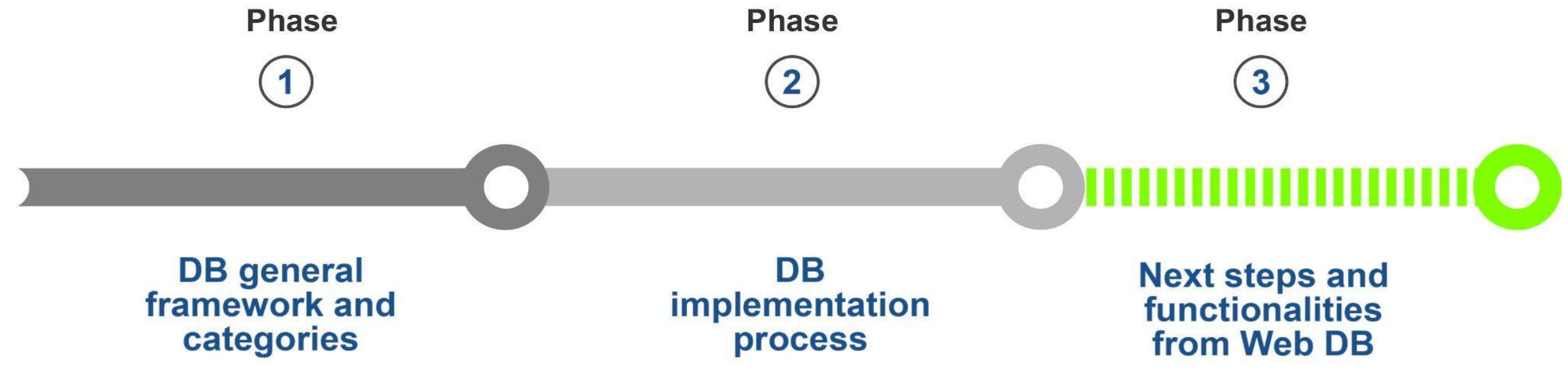
Figure 2.
Online form questionnaires (Screenshot extraction). Source: CA ‘PED-EU-NET’.
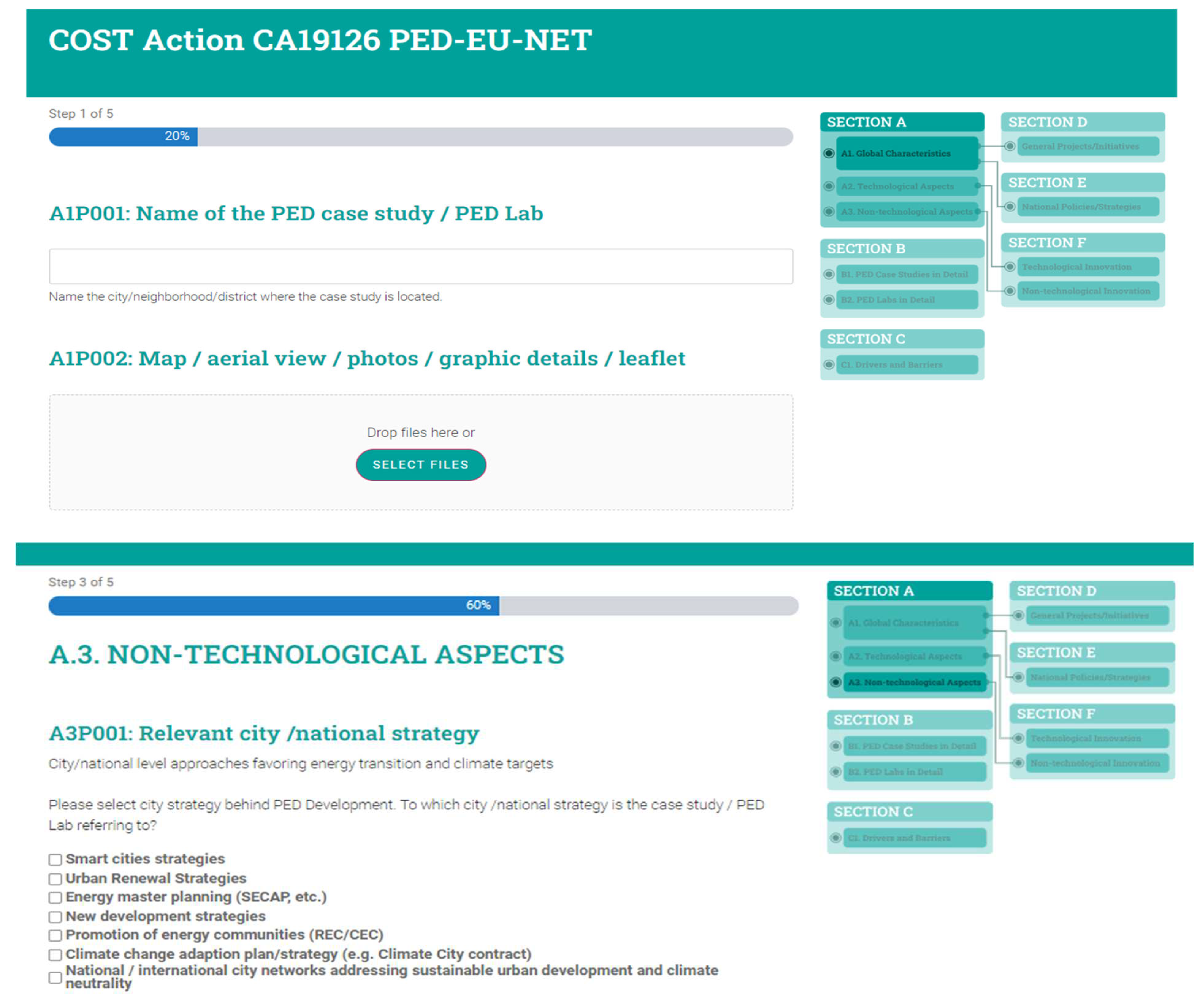
Figure 3.
Web platform - backend (Screenshot extraction). Source: CA ‘PED-EU-NET’.
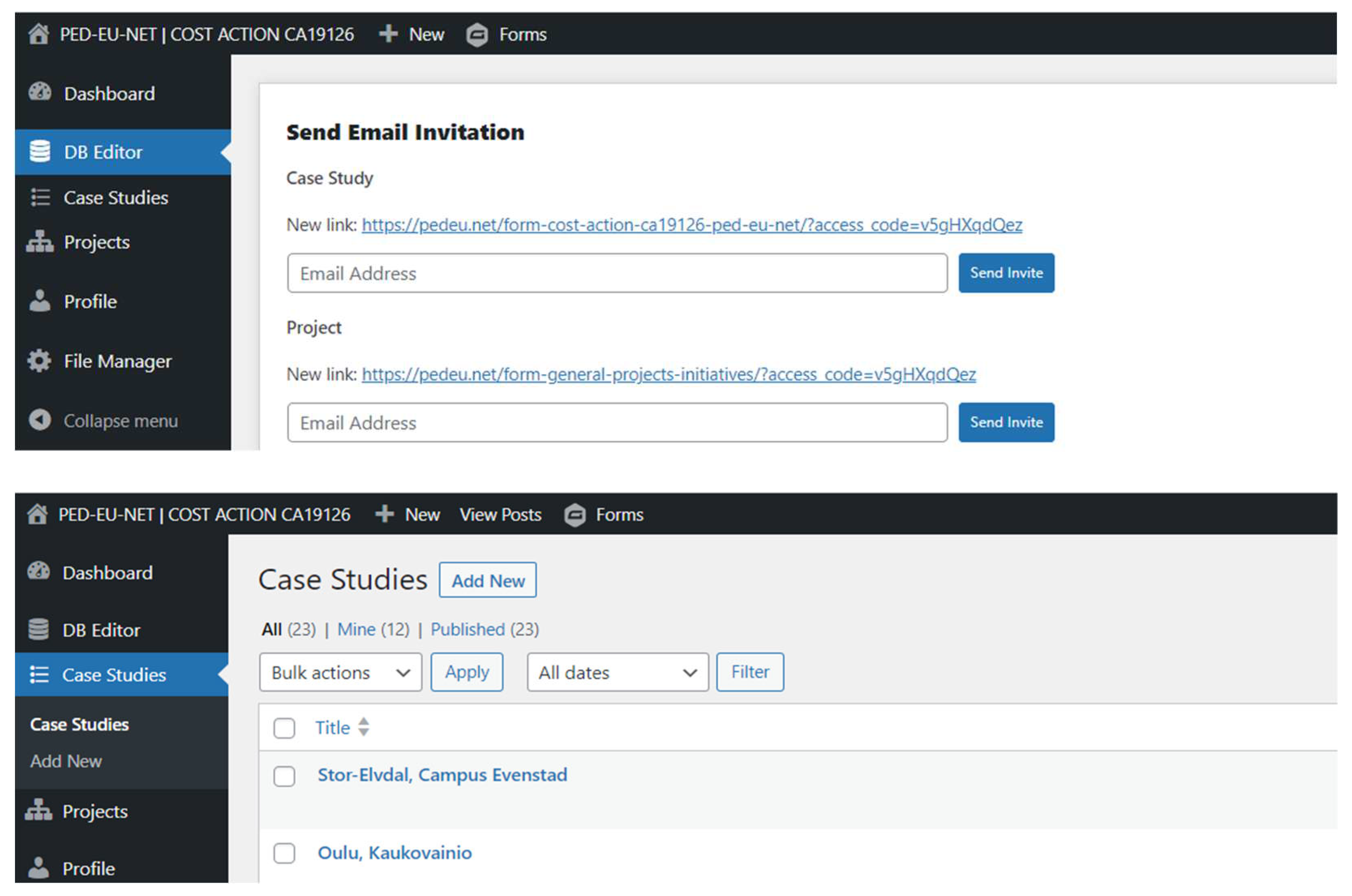
Figure 4.
Web platform - frontend (Screenshot extraction). Source: CA ‘PED-EU-NET’.
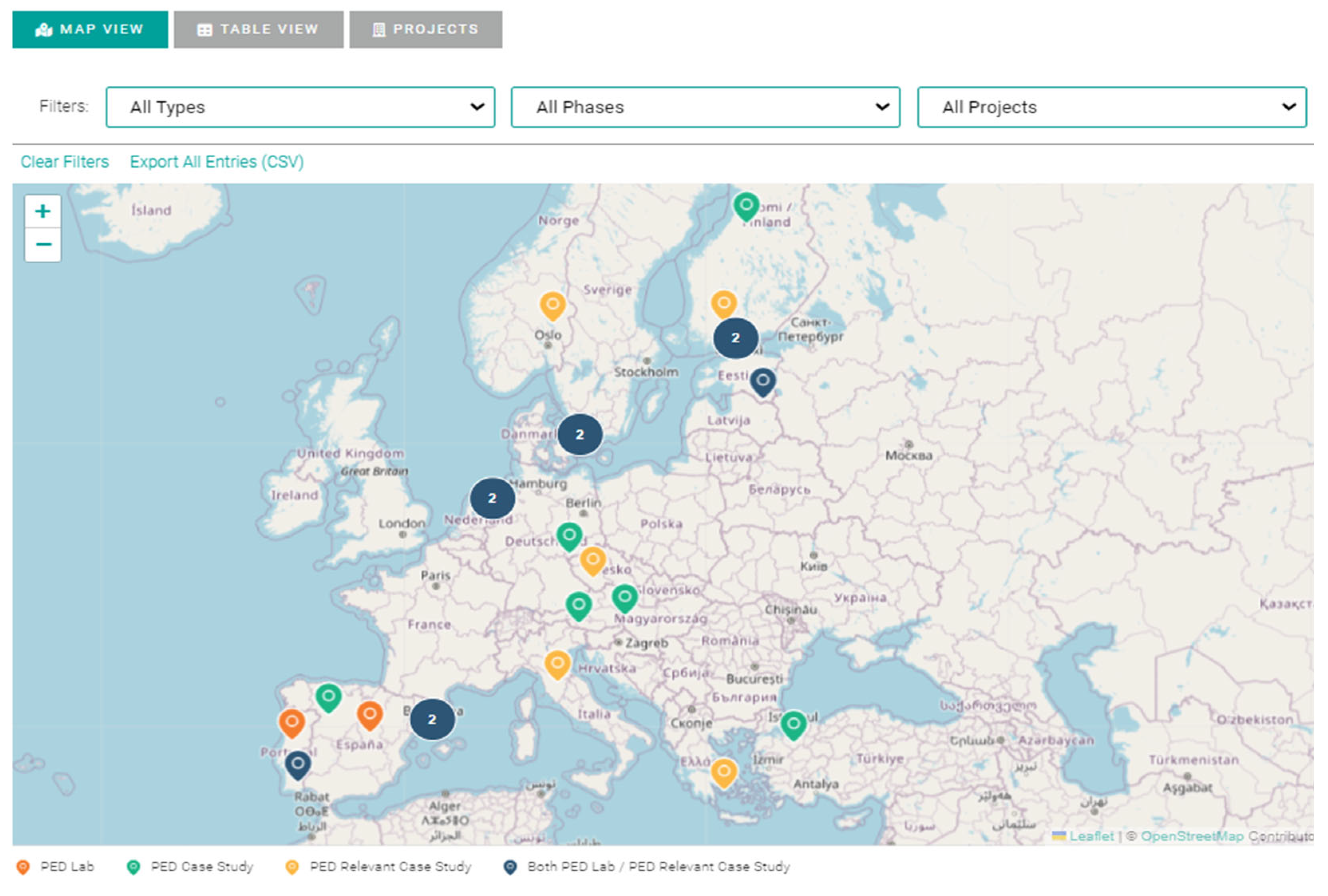
Figure 5.
The phase-by-phase approach and insights of the PED Database development. Source: CA ‘PED-EU-NET’.
Figure 5.
The phase-by-phase approach and insights of the PED Database development. Source: CA ‘PED-EU-NET’.
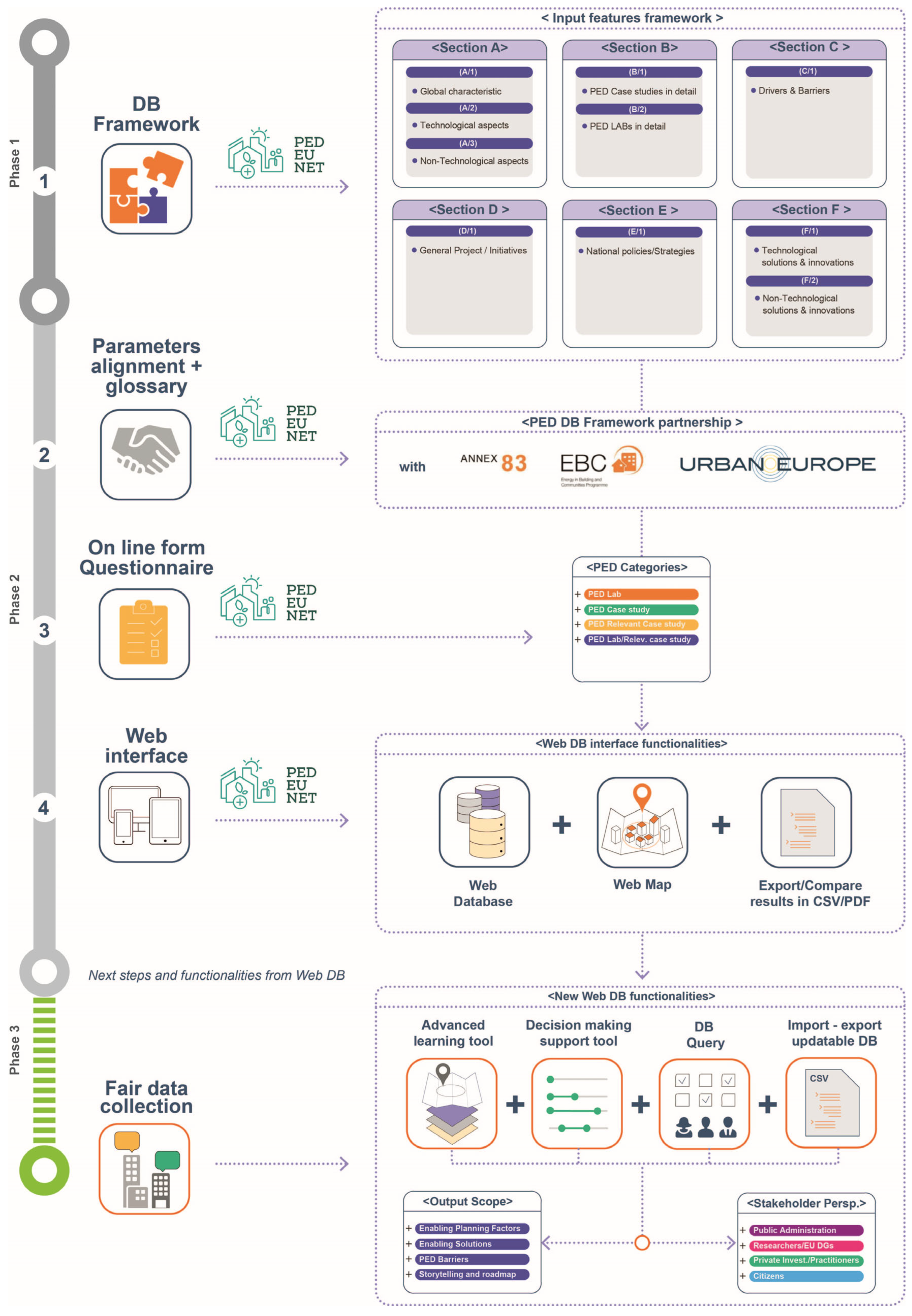
Figure 6.
PED reference Projects, based on the 23 PED cases already present in the DB at the date.
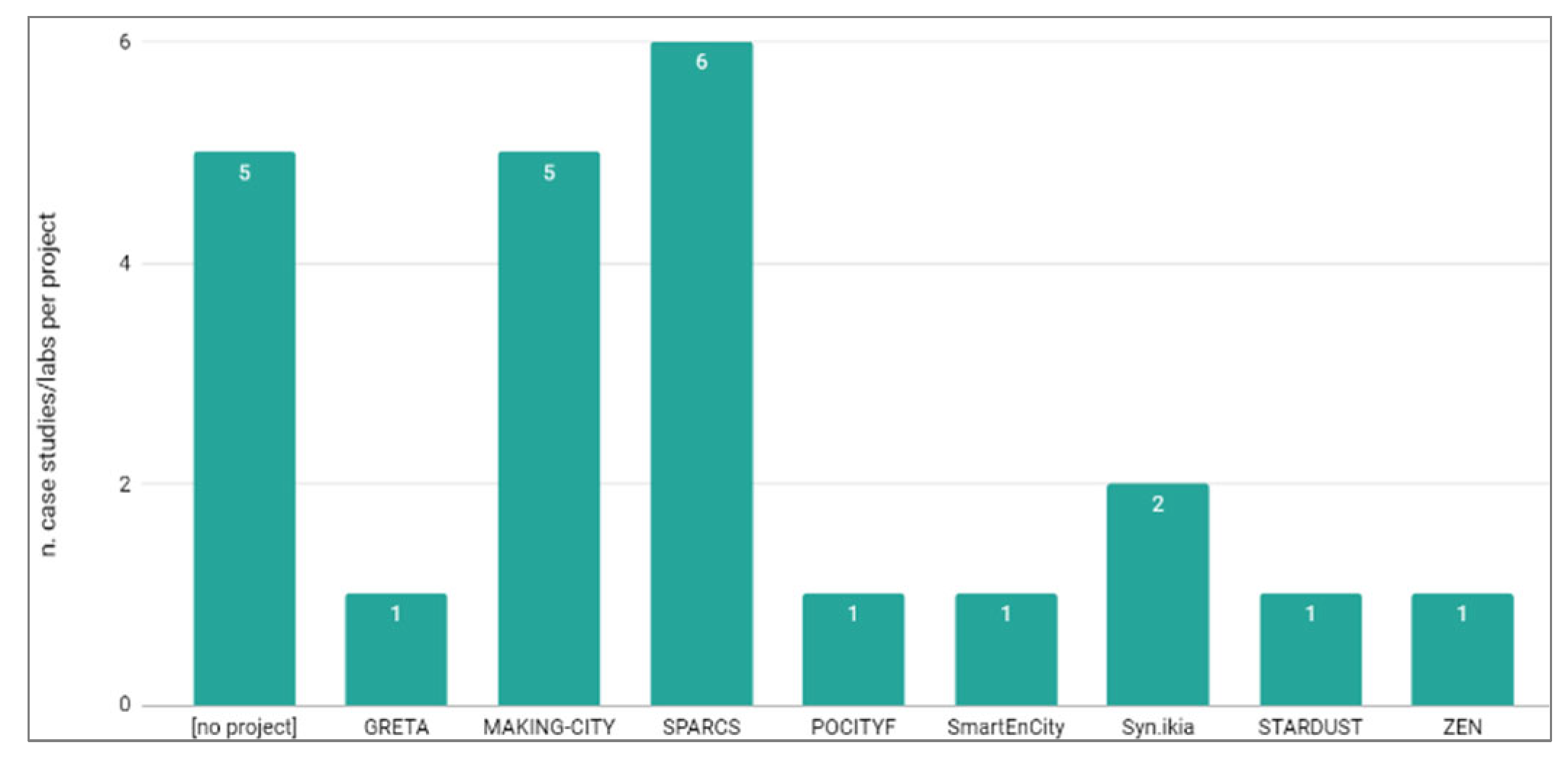
Figure 7.
Referenced Case studies/Labs linkage to general Projects/Initiatives’.
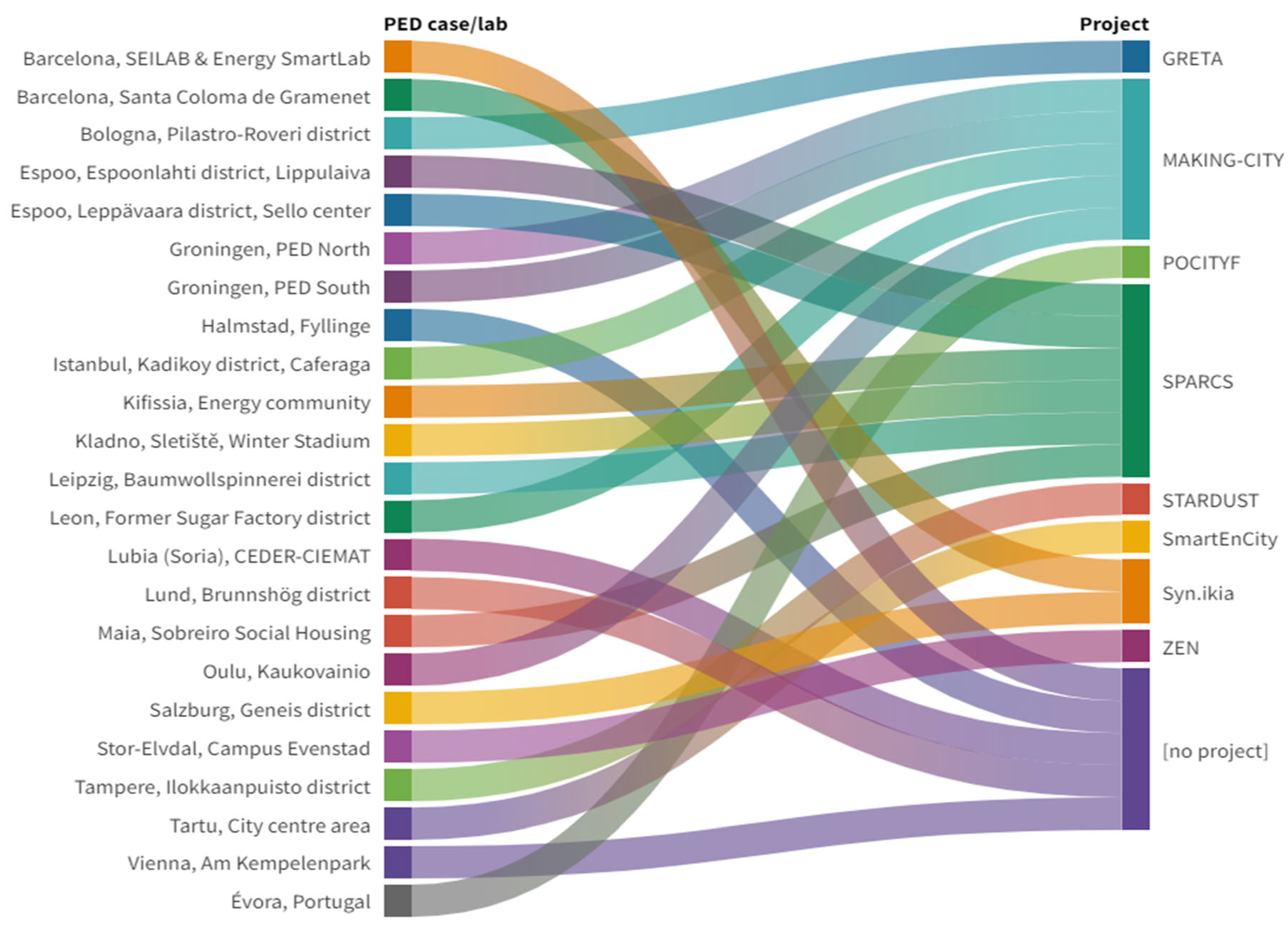
Figure 8.
Figure 8. (a) Categorization of the surveyed PED case studies; (b) Geographic distribution of surveyed PED case studies.
Figure 8.
Figure 8. (a) Categorization of the surveyed PED case studies; (b) Geographic distribution of surveyed PED case studies.
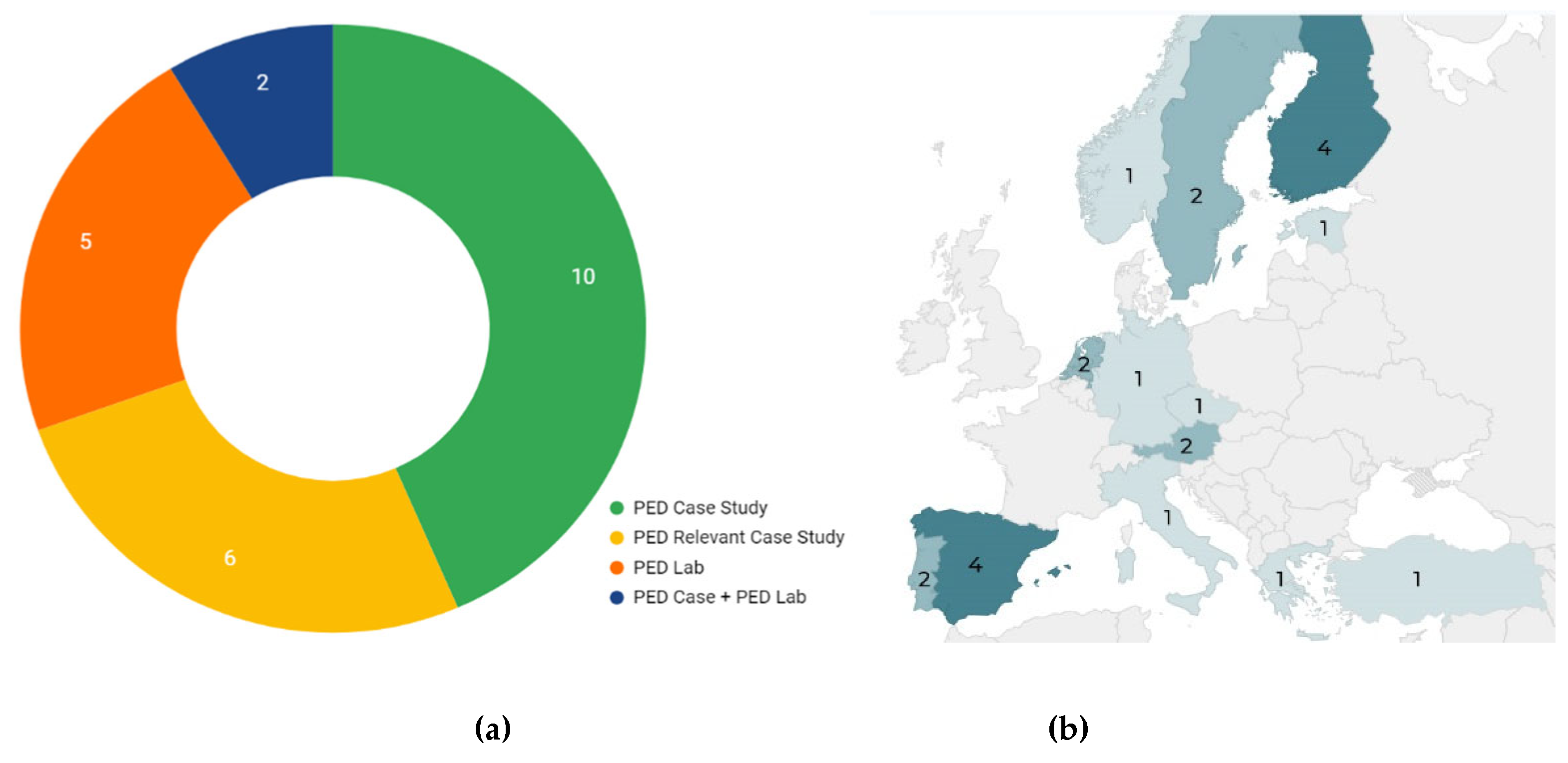
Figure 9.
(a) Stage of the PED phase reported in the DB form; (b) N. of buildings involved in each PED case/lab.
Figure 9.
(a) Stage of the PED phase reported in the DB form; (b) N. of buildings involved in each PED case/lab.
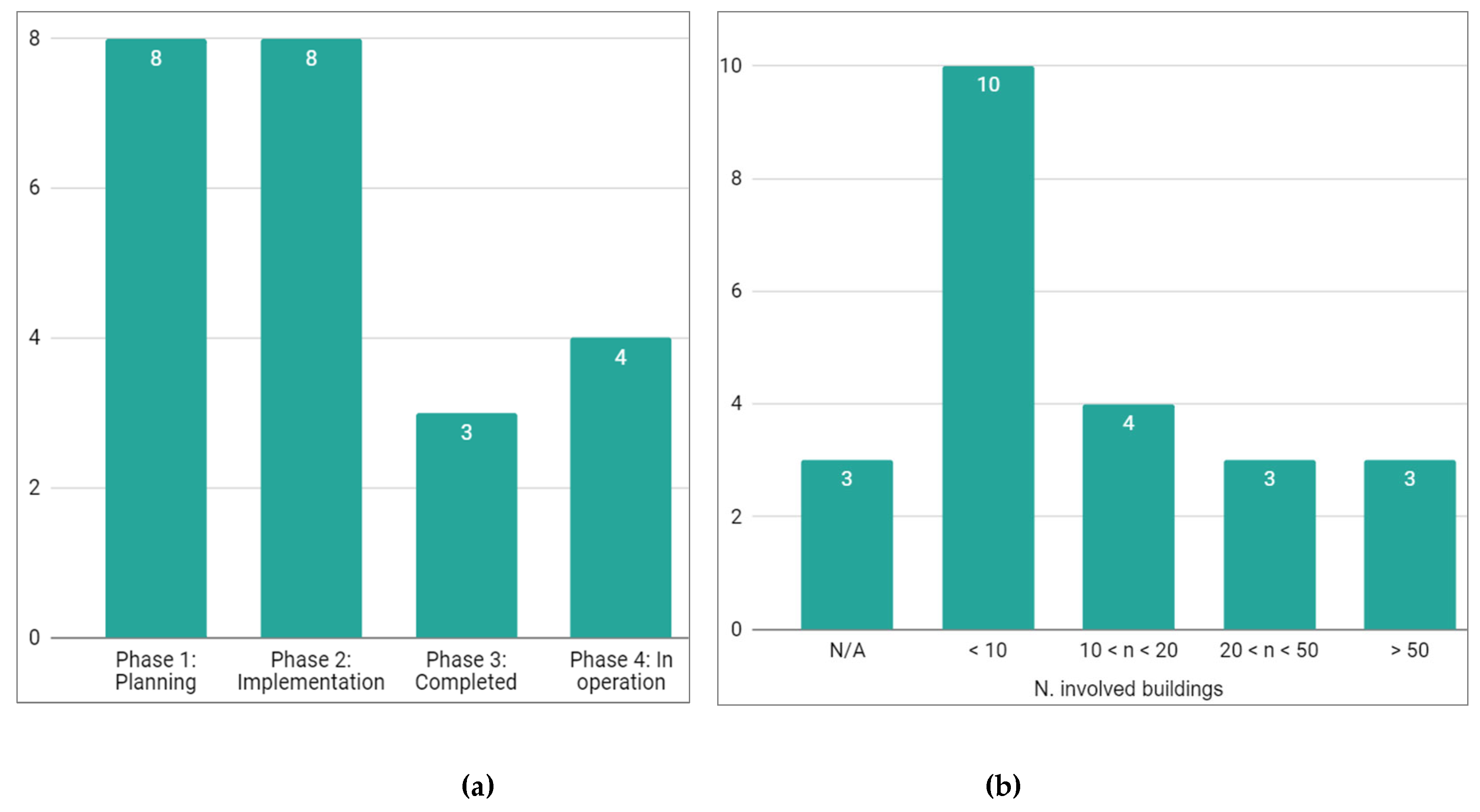
Figure 10.
Average filling rate of all the questions of the survey (TOT) and of each single section.
Figure 10.
Average filling rate of all the questions of the survey (TOT) and of each single section.
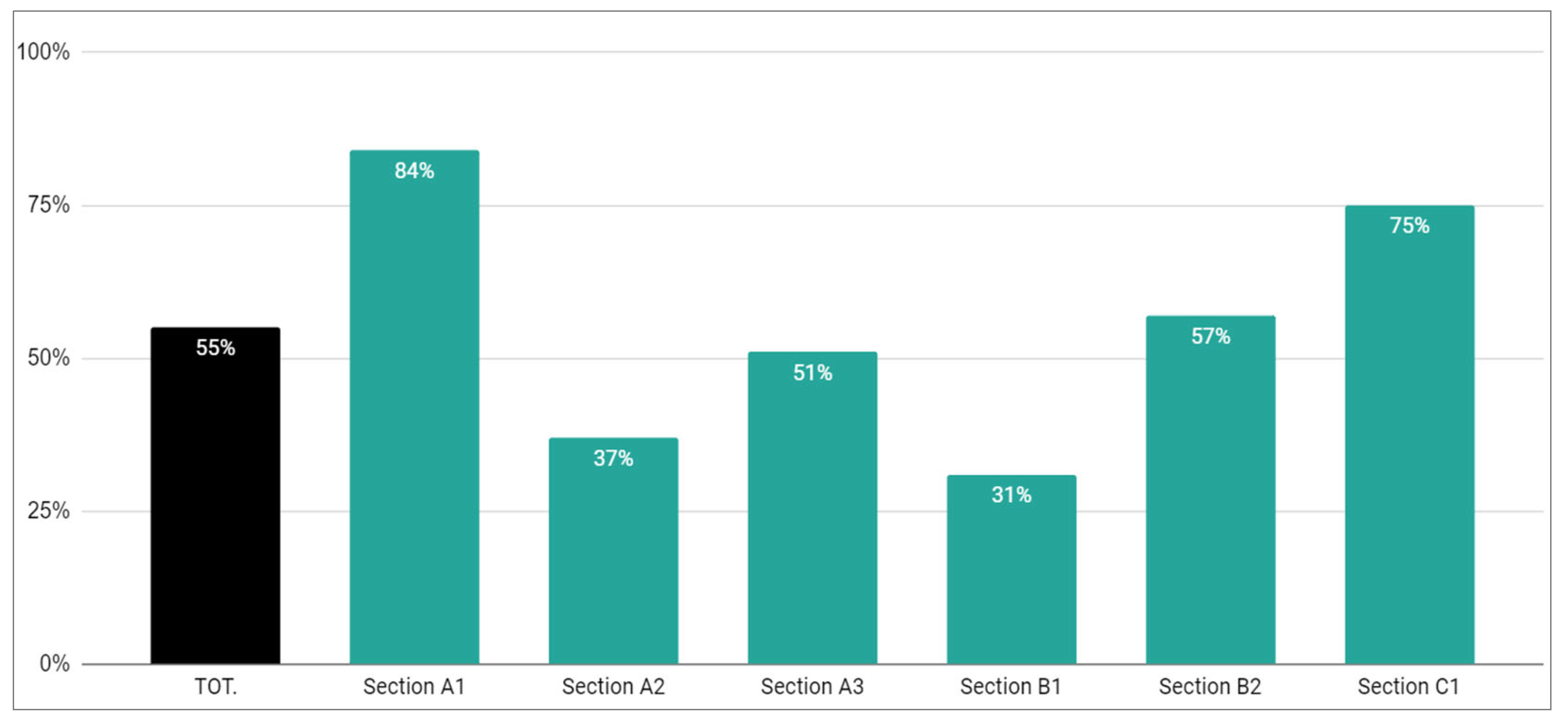
Table 1.
Comparative/alignment table: PED Booklet vs PED DB (in grey the direct correspondences among Booklet and DB). Source: CA ‘PED-EU-NET’.
Table 1.
Comparative/alignment table: PED Booklet vs PED DB (in grey the direct correspondences among Booklet and DB). Source: CA ‘PED-EU-NET’.
| PED Booklet [22] | PED DB [10] | |||||
|---|---|---|---|---|---|---|
| section* | n. | parameters | Section** | n. | parameters | |
| GI | 001 | City | A1 | P011 | Geographic coordinates | |
| A1 | P012 | Country | ||||
| A1 | P013 | City | ||||
| A1 | P014 | Climate Zone - Köppen Geiger classification | ||||
| A1 | P015 | District boundary | ||||
| GI | 002 | Project name | A1 | P001 | Name of the PED case study / PED Lab | |
| A1 | P002 | Map, aerial view, photos, graphic details, leaflet | ||||
| A1 | P003 | Categorisation of the PED site | ||||
| GI | 003 | Project status | A1 | P005 | Phase of the PED case study / PED Lab | |
| GI | 004 | Project start – end | A1 | P006 | Start Date | |
| A1 | P007 | End Date | ||||
| GI | 005 | Contact | A1 | P026 | Contact person for general enquiries - name | |
| A1 | P027 | Contact person for general enquiries - organization | ||||
| A1 | P028 | Contact person for general enquiries – affiliation | ||||
| A1 | P029 | Contact person for general enquiries - e-mail | ||||
| A1 | P030 | Contact person for other special topics - name | ||||
| A1 | P031 | Contact person for other special topics - e-mail | ||||
| GI | 006 | Project website | A1 | P008 | Reference Project | |
| D1 | P001 | Name of the project | ||||
| D1 | P002 | Project assigned code | ||||
| D1 | P003 | Start date | ||||
| D1 | P004 | Operator of the installation | ||||
| D1 | P005 | Ongoing project | ||||
| D1 | P006 | Funding programme/financing model | ||||
| D1 | P007 | Estimated project costs | ||||
| D1 | P008 | Description of project objectives/concepts | ||||
| D1 | P009 | Description of project upscaling strategies | ||||
| D1 | P010 | Number of PED case studies in the project | ||||
| D1 | P011 | Case Study | ||||
| D1 | P012 | Description of project expected impact | ||||
| D1 | P013 | Standardization efforts | ||||
| D1 | P014 | Project Sources | ||||
| D1 | P015 | Contact person regarding the PED project | ||||
| A1 | P009 | Data availability | ||||
| A1 | P010 | Case study/lab sources | ||||
| GI | 007 | Size of project area | A1 | P018 | Number of buildings in PED | |
| A1 | P019 | Conditioned space | ||||
| A1 | P020 | Total ground area | ||||
| A1 | P021 | Floor area ratio: conditioned space/total ground area | ||||
| B1 | P007 | District population before intervention - Residential | ||||
| B1 | P008 | District population after intervention - Residential | ||||
| B1 | P009 | District population before intervention - Non-residential | ||||
| B1 | P010 | District population after intervention - Non-residential | ||||
| B1 | P011 | Population density before intervention | ||||
| B1 | P012 | Population density after intervention | ||||
| GI | 008 | Building structure | B1 | P003 | Environment of the case study area | |
| B1 | P004 | Type of district | ||||
| B1 | P005 | Case Study Context | ||||
| B1 | P006 | Year of construction | ||||
| GI | 009 | Land use (%) | A1 | P016 | Ownership of the case study/PED Lab | |
| A1 | P017 | Ownership of the land / physical infrastructure | ||||
| B1 | P013 | Building and Land Use before intervention | ||||
| B1 | P014 | Building and Land Use after intervention | ||||
| GI | 010 | Financing | A1 | P022 | Financial schemes | |
| A1 | P023 | Economic Targets | ||||
| A1 | P024 | More comment | ||||
| A1 | P025 | Estimated PED case study / PED LAB costs | ||||
| OV | 011 | Overview description of the project | B1 | P001 | PED/PED relevant concept definition | |
| B1 | P002 | Motivation behind PED project development | ||||
| ST | 012 | Goals/ambition | A1 | P004 | Targets of the PED case study / PED Lab | |
| ST | 013 | Indicators | A2 | P022 | KPIs related to the PED case study / PED Lab | |
| ST | 014 | Overall strategies of municipality connected with the project | A3 | P001 | Relevant city /national strategy | |
| A3 | P002 | Quantitative targets in the city/national strategy | ||||
| A3 | P003 | Strategies towards decarbonization of the gas grid | ||||
| A3 | P004 | Identification of needs and priorities | ||||
| ST | 015 | Which factors have been included in implementation strategies? | A2 | P005 | Mobility included in the energy balance | |
| A2 | P006 | Description of how mobility is included (or not) | ||||
| A2 | P026 | Technological Solutions / Innovations - Mobility | ||||
| A2 | P027 | Mobility strategies - Additional notes | ||||
| A3 | P005 | Sustainable behaviour | ||||
| A3 | P006 | Economic strategies | ||||
| A3 | P008 | Integrated urban strategies | ||||
| A3 | P009 | Environmental strategies | ||||
| A3 | P010 | Legal / Regulatory aspects | ||||
| ST | 016 | Innovative stakeholder involvement strategies | A3 | P007 | Social models | |
| B2 | P001 | Scale of action of the PED Lab | ||||
| B2 | P001 | Motivation for developing the PED Lab | ||||
| B2 | P001 | Lead partner that manages the PED Lab | ||||
| B2 | P001 | Collaborative partners that participate in the PED Lab | ||||
| B2 | P001 | Incubation capacities of the PED Lab | ||||
| B2 | P001 | Available facilities to test configurations in PED Lab | ||||
| B2 | P001 | Synergies between facilities in the PED Lab | ||||
| B2 | P001 | Available tools | ||||
| B2 | P001 | Monitoring capabilities | ||||
| B2 | P001 | Any accredited laboratory services? | ||||
| B2 | P001 | Replication and scalability framework in the PED Lab | ||||
| B2 | P001 | Stakeholders accessing the facilities | ||||
| B2 | P001 | Stakeholders’ accessibility framework to facilities | ||||
| ST | 017 | Typology of energy supply | A2 | P001 | Fields of application | |
| A2 | P002 | Tools/strategies/methods applied | ||||
| A2 | P003 | Application of ISO52000 | ||||
| A2 | P004 | Appliances included in the energy balance | ||||
| A2 | P007 | Annual energy demand in buildings / Thermal | ||||
| A2 | P008 | Annual energy demand in buildings / Electric | ||||
| A2 | P009 | Annual energy demand for e-mobility | ||||
| A2 | P010 | Annual energy demand for infrastructure | ||||
| A2 | P011 | Annual renewable electricity production on-site/year | ||||
| A2 | P012 | Annual renewable thermal production on-site/year | ||||
| A2 | P013 | Renewable resources on-site - Additional notes | ||||
| A2 | P014 | Annual energy use | ||||
| A2 | P015 | Annual energy delivered | ||||
| A2 | P016 | Annual non-renewable electricity production on-site/year | ||||
| A2 | P017 | Annual non-renewable thermal production on-site/year | ||||
| A2 | P018 | Annual renewable electricity imports from outside/year | ||||
| A2 | P019 | Annual renewable thermal imports from outside/year | ||||
| A2 | P020 | Share of RES on-site / RES outside the boundary | ||||
| A2 | P021 | GHG-balance calculated for the PED | ||||
| A2 | P023 | Technological Solutions - Energy Generation | ||||
| A2 | P024 | Technological Solutions - Energy Flexibility | ||||
| A2 | P025 | Technological Solutions - Energy Efficiency | ||||
| A2 | P028 | Energy efficiency certificates | ||||
| A2 | P029 | Any other building / district certificates | ||||
| SCB | 018 | Success factors | C1 | P001 | Unlocking Factors | |
| C1 | P002 | Driving Factors | ||||
| SCB | 019 | Challenges/Barriers | C1 | P003 | Administrative barriers | |
| C1 | P004 | Policy barriers | ||||
| C1 | P005 | Legal and Regulatory barriers | ||||
| C1 | P006 | Technical barriers | ||||
| C1 | P007 | Environmental barriers | ||||
| C1 | P008 | Social and Cultural barriers | ||||
| C1 | P009 | Information and Awareness barriers | ||||
| C1 | P010 | Financial barriers | ||||
| C1 | P011 | Market barriers | ||||
| C1 | P012 | Stakeholders involved | ||||
* PED Booklet: Global Information (GI), Overview (OV). Strategies (ST) and Success factors, challenges and barriers (SCB). ** PED Database: Global Characteristics (A1), Technological aspects (A2), Non-Technological aspects (A3), Case studies in detail (B1), PED LABs in detail (B2), Drivers and Barriers (C1), General Projects/Initiatives (D1).
Table 2.
PED DB target stakeholder and main emerged needs. Source: Authors
| Target Stakeholders | Main emerged needs | |
|---|---|---|
|
Public Sector (Pu) e.g., government, municipalities, policymakers, public technicians, etc. |
|
|
|
Private Sector (Pr) e.g., practitioners (architects, engineers, urban planners, etc.), developers, real estate, construction companies, energy companies, SMEs, etc. |
|
|
|
Research Sector (Re) e.g., academia, R&I centres, EU Commission, DGs, etc. |
|
|
|
Citizens & civil society (Ct) e.g., inhabitants, local communities, city users, local associations, etc. |
|
Disclaimer/Publisher’s Note: The statements, opinions and data contained in all publications are solely those of the individual author(s) and contributor(s) and not of MDPI and/or the editor(s). MDPI and/or the editor(s) disclaim responsibility for any injury to people or property resulting from any ideas, methods, instructions or products referred to in the content. |
© 2023 by the authors. Licensee MDPI, Basel, Switzerland. This article is an open access article distributed under the terms and conditions of the Creative Commons Attribution (CC BY) license (http://creativecommons.org/licenses/by/4.0/).
Copyright: This open access article is published under a Creative Commons CC BY 4.0 license, which permit the free download, distribution, and reuse, provided that the author and preprint are cited in any reuse.


