

Submitted:
19 December 2025
Posted:
22 December 2025
You are already at the latest version
Abstract
This paper proposes a new theoretical framework to understand the failure of the NFT market (2021-2023) through a synthesis of Pierre Bourdieu’s theory of The Field of Cultural Production [1] and the theological concept of apostolic succession. The central thesis of this argument is that the collapse of NFT value is not merely a phenomenon of a bursting financial bubble, but a manifestation of a more funda- mental institutional failure—namely, the inability to create a chain of legitimacy required for the transubstantiation of digital objects into valuable works of art. NFTs attempted a ”Protestant Reformation” of the hierarchical structure of the art world (by decentralizing the authority of curators, galleries, and muse- ums) without first building an alternative mechanism to produce collective belief. Without a traceable chain of legitimacy—conceptualized in this paper as apostolic succession—value fails to undergo ontological transformation and remains lifeless digital data, despite technological claims of blockchain-verified artificial scarcity. Through a comparative analysis between consecration mechanisms in tradi- tional art institutions (”The White Cube Church”) and legitimacy practices in the NFT ecosystem (”The Digital Heresy”), this paper demonstrates that cryp- tographic technology, however sophisticated, cannot replace the sociological and temporal infrastructure required to maintain symbolic value [7]. The concept of ontological debt—the collector’s psychological debt to historical narratives—is introduced as a key variable explaining the behavioral differences between traditional art collectors and NFT speculators.
Keywords:
NFT
; Pierre Bourdieu
; apostolic succession
; art consecration
; institutional legitimacy
; ontological debt
; symbolic economy
"The work of art in the age of mechanical reproduction loses its aura, but what of art in the age of cryptographic reproduction without apostolic blessing?" — With apologies to Walter Benjamin [3]
1. Introduction: The Collapse of the Digital "Sacred Object"
1.1. Historical Background
In March 2021, the art world was shaken by a seemingly impossible event: a JPEG file sold for $69 million at Christie’s auction house. The digital work titled Everydays: The First 5000 Days by Mike Winkelmann (known as Beeple) became the symbol of what was proclaimed as a "revolution" in the art world—the arrival of Non-Fungible Tokens (NFTs) as a new medium destined to democratize the art market and liberate artists from the grip of traditional gatekeeping institutions [13].
In the following 18 months, the NFT market experienced exponential growth. Monthly trading volume peaked at $5 billion in January 2022. Celebrities, multinational corporations, and millions of speculators rushed into an ecosystem promising instant wealth through the ownership of "unique" and "rare" digital assets. The dominant narrative at the time was that blockchain had solved a fundamental problem in the digital economy: artificial scarcity verified cryptographically.
However, only two years later, by mid-2023, more than 95% of all NFT projects had lost their value. A survey by dappGambl [16] found that 79% of all NFT collections had a market value of zero—there were no buyers at all at any price point. Even "blue-chip" projects like Bored Ape Yacht Club saw their value decline by more than 90% from their peak. More shockingly: the same Beeple work that sold for $69 million in 2021 was estimated to be worth only around $10 million by the end of 2023—losing 85% of its value in less than three years.
1.2. Problematics: The Paradox of Scarcity Without Value
The contrast with the traditional art market is striking. A 500-year-old canvas painting by a Renaissance master can maintain or even increase its value across generations. Works by modern masters like Picasso or Rothko are consistently valued at tens to hundreds of millions of dollars, even during global economic turbulence [9]. Meanwhile, "assets of the future" claimed to be technologically superior—created with unforgeable cryptographic standards—lost almost all their value in a matter of months.
This paradox raises a fundamental question: Why do physical objects that can be reproduced (paintings can be photographed, scanned, forged) maintain their symbolic and financial value, while digital objects that are technologically "rarer" (verified by immutable blockchain) lose their value catastrophically?
The conventional explanation—that this is simply a classic case of a speculative bubble bursting—is insufficient. Speculative bubbles occur in various markets, but not all assets lose 95-99% of their value following a market correction. The traditional art market itself has experienced corrections (e.g., the crashes of 1990-1991 or 2008-2009), yet important works retained substantial value and recovered within a few years. There are distinct structural mechanisms operating here.
1.3. Central Hypothesis: Institutional Failure as Theological Failure
This paper proposes the hypothesis that the failure of NFTs is fundamentally an institutional failure that can be understood through an analogy with theological structures of legitimacy. Value in the art economy is not an intrinsic property of the object itself, but the result of complex social processes similar to consecration mechanisms in religious institutions—a process we will term value transubstantiation.
In Catholic theology, transubstantiation is the doctrine that bread and wine, through the Eucharistic ritual performed by a legitimate priest, literally change into the body and blood of Christ—even though their physical appearance remains the same. The crucial point here is that this transformation is valid only if performed by a priest who possesses apostolic succession—an unbroken chain of ordination traceable back to the Apostles ordained directly by Jesus Christ.
The parallel with the art world is striking. A mass-produced ceramic urinal—a utilitarian object worth $5—can transform into an art work worth millions of dollars (Fountain by Marcel Duchamp, 1917) not because of any physical change to the object, but because of a ritual of consecration performed by institutions possessing legitimate authority: exhibition in a museum context, writing by leading critics and art historians, teaching in university curricula, and acquisition by museum collections [4,5].
NFTs attempted what in a religious context would be called a "Protestant Reformation"—eliminating intermediaries (curators, galleries, critics) and providing direct access between artist and collector, much as Protestantism advocated direct access to God without priestly mediation. However, as this paper will argue, without building alternative mechanisms for legitimacy—without creating a credible new chain of authority (sanad)—this alternative "church" collapses into a dogma-less cacophony, where everyone claims authority but no one truly possesses it.
1.4. Theoretical Significance
The contribution of this paper is twofold:
First, theoretically, it extends and integrates Bourdieu’s theory of the field of cultural production with concepts from the sociology of religion and institutional theology, creating a new framework for understanding the mechanisms of symbolic value consecration. By translating theological concepts such as apostolic succession, transubstantiation, and canonization into sociological analysis of art, we gain a more precise language to describe processes often depicted by Bourdieu in more abstract terms like "symbolic violence" or "misrecognition."
Second, practically, this analysis provides a deeper understanding of why technology, however innovative, cannot by itself create value if not supported by adequate sociological infrastructure. This has important implications not only for the digital art market but also for any attempt at "disruption" of established institutions that ignores the function of institutional legitimacy [17].
This paper is structured as follows: Section II builds the theoretical framework by synthesizing Bourdieu and theological concepts. Section III explains the methodology and limitations of the analogy. Section IV analyzes the structure of "The Traditional Art Church." Section V dissects the NFT ecosystem as "The Digital Heresy." Section VI introduces the concept of ontological debt. Section VII discusses broader implications, Section VIII presents limitations and counter-arguments, and Section IX concludes with reflections on the future of digital art.
2. Theoretical Framework: Bourdieu Meets Theology
2.1. Bourdieu and Symbolic Violence in the Field of Art
Pierre Bourdieu, in his monumental work The Field of Cultural Production [1], proposed the thesis that art is not the result of individual genius working in a vacuum, but the product of a field—a structured social space where various agents (artists, galleries, critics, collectors, educational institutions) compete to accumulate symbolic capital.
The radical aspect of Bourdieu’s analysis is his demonstration that artistic value is the result of a series of collective misrecognitions. What appears as "pure" aesthetic appreciation or recognition of an artwork’s "intrinsic quality" is actually the result of a long socialization process that has implanted specific schemes of perception and appreciation in the individual habitus [2]. Bourdieu writes:
"The work of art is an object which exists as such only by virtue of the (collective) belief which knows and acknowledges it as a work of art."
Consecration—the process by which a profane object is transformed into a valuable work of art—does not occur through the inherent quality of the object itself, but through a series of institutional actions: curation, exhibition, criticism, collection, teaching, and historical writing. Each of these actions is a ritual that adds a layer of legitimacy, until finally, the object is universally accepted as "art."
A crucial point for our analysis is Bourdieu’s emphasis on the temporal dimension of this process. Symbolic capital accumulates slowly and requires long-term investment. Successful artists are not those chasing quick financial profit (economic capital), but those willing to engage in disinterested practice—practice without immediate economic motive—for the sake of accumulating symbolic capital first, with the understanding that this can eventually be converted into economic capital.
2.2. Apostolic Succession: The Theological Model of Legitimacy
In Christian theology, particularly the Catholic and Orthodox traditions, apostolic succession is the doctrine stating that ecclesiastical authority is valid only if it can be traced through an unbroken chain of ordination back to the Apostles. A bishop is legitimate only if ordained by a legitimate bishop, who in turn was ordained by a previous legitimate bishop, and so on back to the Apostle Peter and his colleagues ordained directly by Jesus.
This doctrine is not merely a bureaucratic formality, but a mechanism to guarantee the continuity of truth. In theological logic, the truth of Christian teaching is guaranteed not only by the text of Scripture (which can be interpreted in various ways) but by the living tradition—the transmission of knowledge from teacher to student in an unbroken chain [21].
Similar concepts can be found in the Islamic tradition as sanad or isnad—the chain of transmission validating hadith (sayings of the Prophet Muhammad). A hadith is considered authentic only if every narrator in its transmission chain can be verified for credibility. In the Tibetan Buddhist tradition, the concept of lineage (brgyud pa) functions similarly, where the validity of teachings depends on a traceable teacher-to-student transmission chain.
The crucial aspect of this model is that legitimacy is relational and genealogical, not substantive. One cannot claim authority simply because one "understands" the teaching or "experiences" enlightenment; one must be able to show who gave them that authority.
2.3. Synthesis: The Chain of Value in the Art Economy
When we apply the apostolic succession model to Bourdieu’s art field, we get a much more precise framework for understanding consecration mechanisms. Artists do not gain legitimacy solely from the "quality" of their work (which is hard to measure and highly subjective), but from who consecrates them [6]:
- Which gallery exhibits their work?
- Which curator writes about them?
- Which museum collection acquires their work?
- Which critic gives a positive review?
- Which university teaches them?
Each of these institutions possesses legitimacy due to its own historical chain—the Museum of Modern Art (MoMA) has authority because it was founded in 1929 and has curated exhibitions defining the canon of modern art. Critics like Clement Greenberg have authority because their writings shaped our understanding of Abstract Expressionism [24]. Galleries like Gagosian have authority because they have represented the most important artists of the last 50 years.
This forms a hierarchy of consecration analogous to the ecclesiastical hierarchy:

Table 1.
Structural Parallel: Hierarchy of Consecration.
| Ecclesiastical Hierarchy | Art Hierarchy |
|---|---|
| Pope | Major Museums (MoMA, Tate, etc.) |
| Cardinals | Blue-chip Galleries (Gagosian, Pace) |
| Bishops | Regional Museums, Mid-tier Galleries |
| Priests | Curators, Established Critics |
| Deacons | Emerging Curators, Art Writers, Academics |
| Laity | Collectors, Public |
Artists "ordained" by top-tier institutions gain legitimacy that then facilitates consecration by next-tier institutions, and so on. But crucially: there is no self-ordination. One cannot declare oneself an "important artist"—one must be consecrated by an institution that already possesses legitimacy.
2.4. Operational Terminology
To facilitate subsequent analysis, we will use the following terminological translation:
- Field (Bourdieu) → Cathedral/Church: Structured social space with a clear hierarchy of authority.
- Consecration→Transubstantiation: Ontological transformation from profane object to "sacred object" (artwork).
- Symbolic Capital→Grace/Charisma: Invisible charisma that is recognized and confers authority.
- Habitus→Catechism: Internalization of perception schemes through long socialization.
- Misrecognition→Faith/Belief: Acceptance of value without questioning the foundation of its legitimacy.
This translation is not merely a linguistic game, but an analytical strategy to make explicit the dimensions implicit in Bourdieu’s theory. By using religious language, we emphasize the aspects of collective belief and ritualistic practice fundamental to the symbolic economy of art [20].
3. Methodology and Limitations of Analogy
3.1. Comparative-Structural Approach
This paper uses a structural analogy approach, comparing structures and mechanisms between two different systems (religious institutions vs. art institutions) to identify similar operating principles. This method has a long precedent in social science, from Durkheim’s organic analogy to Lévi-Strauss’s structural analysis.
Empirical data used include:
- (1)
- Market Data: Trading volume, price fluctuations, and holder statistics from NFT platforms (OpenSea, LooksRare) for the period 2021-2024, compared with traditional art auction data (Christie’s, Sotheby’s) for the same period.
- (2)
- Institutional Analysis: Documentation on curatorial processes, museum acquisitions, and artist career patterns in the traditional system vs. the NFT ecosystem.
- (3)
- Discourse Analysis: Analysis of dominant narratives in NFT marketing, community manifestos, and "democratization" rhetoric used by NFT projects.
3.2. Limitations and Caveats: Where the Analogy Breaks Down
It is important to acknowledge that every analogy has limitations. Art institutions are not identical to religious institutions, and forcing total equivalence would be reductionist. Here are some fundamental differences:
1. Truth Claims
Religious institutions make metaphysical and transcendent truth claims—about the nature of reality, life after death, and absolute moral obligations. Art institutions, conversely, generally do not claim that a specific artwork is "true" in an ontological sense. Art value is more constructed and contingent.
However, this does not entirely invalidate the analogy. Art institutions do make quasi-transcendent claims about "universal aesthetic value," "historical urgency," and "cultural significance"—claims that, while not metaphysical, still function as unquestionable legitimacy within their field [23].
2. Stakes and Consequences
In a religious context, "heresy" can result in eternal damnation or exclusion from the community of salvation. In an art context, "heresy" merely results in... market unsellability or exclusion from the art historical canon.
Nevertheless, for the actors involved—artists, collectors, institutions—the stakes can be equally existential. Artists who are not consecrated experience symbolic death in their field; collectors who invest wrongly face potentially devastating financial losses; institutions losing legitimacy become irrelevant.
3. Enforcement Mechanisms
The Church has formal and institutional enforcement mechanisms—excommunication, anathema, and (historically) legal or physical sanctions. Art institutions work through more diffuse and less formal mechanisms—exclusion from exhibitions, absence from publications, or being ignored in history.
Nonetheless, the symbolic violence produced can be equally effective. Artists who do not "enter" the gallery-museum system find it almost impossible to achieve high prices or historical recognition, regardless of the "quality" of their work.
3.3. Heuristic Justification
Why persist with the theological analogy despite these differences? Because this analogy is heuristically productive—it helps us see aspects of art institutions that are often hidden or naturalized.
By comparing art consecration to sacramental transubstantiation, we explicate that value transformation is a ritual act requiring specific conditions, not a natural result of the object’s intrinsic quality. By comparing artist legitimacy to apostolic succession, we emphasize the importance of genealogical continuity in a field that often claims to value "originality" and "rupture" [25].
Analogy is not identity, but it is a powerful instrument of cognition.
4. The White Cube Church: Anatomy of Traditional Consecration
4.1. Sacred Architecture: The White Cube as Liturgical Space
The term "white cube" was coined by critic Brian O’Doherty in 1976 to describe the characteristic modern gallery space: white walls, overhead lighting, no windows, a space appearing neutral and timeless. O’Doherty argued that this space is not neutral at all, but an ideological construct defining what counts as "serious" art [22].
The parallel with sacred architecture is clear. Gothic cathedrals, with their high ceilings, light entering through stained glass, and acoustics creating reverberation, were designed to create a transcendental experience—to make visitors feel they had entered a space distinct from the profane world outside.
The white cube does the same. When you enter a Chelsea gallery or the Museum of Modern Art, a ritual transition occurs: you leave the bustle of Manhattan streets and enter a silent, bright space where every object is displayed with reverential care. This context itself consecrates—it sends a signal: "The objects here are different. They are not ordinary commercial goods. They require contemplation, respect, and seriousness."
4.2. Hierarchy of Clergy: Structure of Authority in the Art Field
Just as the Catholic Church has a clear hierarchy—from Pope to cardinals, bishops, priests—the art field has a clear, albeit informal, stratification of authority.
Level 1: "Vatican" - Major Museums
At the top of the hierarchy are major museums like MoMA (New York), Tate Modern (London), Centre Pompidou (Paris), or the Guggenheim. These museums function as final arbiters of what enters the art historical canon. Acquisition by these museums is the highest form of consecration—it literally guarantees that the work will be "immortalized" for future generations.
Level 2: "Cardinals" - Blue-Chip Galleries
Top-tier galleries like Gagosian, Pace, David Zwirner, or Hauser & Wirth possess authority approaching that of museums. They can "make" an artist’s career by recruiting them into their roster. Representation by these galleries is a very strong signal to the market that this artist is "serious" and investment-worthy.
Level 3: "Bishops" - Regional Museums and Mid-Tier Galleries
These institutions serve an important function in the hierarchy: they disseminate the "doctrine" already consecrated by the highest level and help identify new talent that might ascend to the highest level.
Level 4: "Priests" - Curators and Critics
These individuals are the interpreters of dogma. They write exhibition catalogues, critical essays, and art history books that form public understanding of the work’s meaning and significance. Curators decide which works are displayed in exhibitions; critics decide which works are "important" and worthy of discussion [27].
Crucially, their authority stems from institutional affiliation and educational credentials—they hold PhDs from prestigious universities, work for leading institutions, and have been consecrated by the previous generation through publication in cited journals and appointments to curatorial positions.
Level 5: "Deacons" - Emerging Curators, Art Writers, Academics
This is the generation being "ordained"—individuals still building credentials but being trained in the field’s "doctrine" through doctoral programs, curatorial residencies, or assistant positions in established institutions.
Level 6: "Congregation" - Collectors and Public
At the bottom level are the "laity"—those who buy art, visit exhibitions, and ultimately provide the economic capital making the whole system function. However, they generally do not possess the authority to define what is valuable; they accept the judgments consecrated by the levels above them.
4.3. Ritual of Transubstantiation: From Object to Art Work
How exactly does a profane object—canvas with paint, welded metal, or even a factory urinal—transform into a "work of art"? This process is not magical, but ritualistic and institutional.
Ritual 1: Selection and Curation
The first stage is selection. From thousands of artists producing work, curators choose a handful to exhibit. This act of selection itself is an initial form of consecration distinguishing work "worthy of attention" from that which is not.
Ritual 2: Spatial Consecration
The work is then placed in the white cube—a space already consecrated. This spatial context alters viewer perception. The same object, if placed in an ordinary furniture store, would be perceived as decoration; in a Chelsea gallery, it becomes an object of artistic contemplation.
Ritual 3: Textual Consecration
Curators write wall text—short descriptions accompanying the work—and catalogue essays explaining the work’s "meaning" and "significance" in the context of art history. This text functions like biblical exegesis—it provides an authoritative interpretive framework.
Ritual 4: Critical Discourse
Critics write reviews in prestigious publications (Artforum, Art in America, Frieze). Positive reviews in these publications are highly valuable endorsements—they add a layer of legitimacy and make the work "visible" to serious collectors and other institutions.
Ritual 5: Market Validation
Galleries set prices—an act that is not solely economic but also semiotic. High prices signal high artistic value [7]. Sales to important collectors or at public auctions add further legitimacy.
Ritual 6: Institutional Collection
The pinnacle of consecration is acquisition by a museum. This is the form of final "canonization," where the work is literally entered into a permanent collection to be preserved for future generations and taught in art history curricula.
4.4. Intergenerational Catechism: Reproduction of Belief
What makes this system sustainable across generations is the educational infrastructure—the process by which trust in institutions and their judgments is reproduced.
Children are taken to museums on school field trips, where they learn that the objects here are "important" and "valuable." Art students study curated art history—a canon determined by previous generations. They read textbooks teaching that Picasso was a "genius," that Pollock was "revolutionary," that Warhol "changed art forever."
This process is indoctrination—not in a negative sense, but in a neutral sociological sense: the transmission of a belief system from one generation to the next. Once internalized, this belief becomes "common sense"—appearing as objective fact rather than social construction.
Bourdieu calls this the formation of habitus—dispositions of perception and appreciation that become "second nature." When someone with a formed art habitus views a Rothko, they do not "think" about its value, but intuitively "feel" its quality, because their perception schemes have been programmed to recognize specific value signals.
4.5. Temporal Dimension: Time as a Source of Legitimacy
One of the most important aspects of the traditional consecration system is the temporal dimension. Legitimacy requires time—it cannot be generated instantly.
"Important" artists generally do not become important overnight. They build careers over decades, through gradually more prestigious exhibitions, acquisitions by increasingly important collections, and the accumulation of increasingly substantial critical discourse. This process creates narrative depth—a history that can be told, a trajectory that can be traced.
Museums are literally institutions that "keep time"—they preserve objects from the past for the future. When museums acquire contemporary work, they are making a prediction: this is work that will remain relevant for future generations. This prediction is self-fulfilling—because the museum keeps it, it will remain relevant.
This temporal dimension creates what we will call ontological debt—a concept to be explored further in Section VI.
5. The Digital Heresy: Anatomy of the NFT Ecosystem
5.1. The Protestant Moment: Decentralization as Ideology
The fundamental narrative driving the NFT boom was the narrative of disintermediation—the elimination of intermediaries between artists and collectors. NFT project manifestos repeatedly emphasized this theme:
"For too long, artists have been at the mercy of gatekeepers, galleries that take 50% commission, curators who decide what’s ’good’, critics who can make or break careers. NFTs democratize art. Anyone can mint. Anyone can collect. The community decides value, not elites."
This rhetoric is very similar to the rhetoric of the Protestant Reformation: The Catholic Church was seen as corrupt, priests selling indulgences (simony), ordinary people having no direct access to truth because they had to be mediated by the clergy. Martin Luther offered a solution: sola scriptura (Scripture alone), priesthood of all believers (where everyone can access God directly without a priest).
NFTs offered an analog: sola blockchain (code alone, not institutions), collectorship of all participants (everyone can determine value, not just the educated elite).
This was a seductive narrative, especially in the context of the cultural zeitgeist of the 2020s characterized by distrust of established institutions and celebration of "disruptive" technology. However, as we will show, this narrative ignores the fundamental function played by institutions in the production of trust.
5.2. The Missing Genealogy: The Absence of Sanad
When we examine the artists who became millionaires in the NFT boom, a striking pattern emerges: almost none of them had an institutional pedigree in the traditional art world.
Take Beeple (Mike Winkelmann) as a paradigmatic case. Before the $69 million sale at Christie’s in March 2021, Beeple was a digital artist relatively unknown in the contemporary art world. He had no blue-chip gallery representation. His work was not in major museum collections. He was not mentioned in digital art history books. He did not hold an MFA from a prestigious art school. In other words: he lacked apostolic succession—there was no chain of institutional consecration linking him to the art canon.
What he had was: 1.8 million Instagram followers and a viral presence on social media.
In our terminology: Beeple was not "ordained" by an "art bishop"; he self-ordained through the accumulation of attention economy on digital platforms. This is analogous to someone claiming to be a bishop without ever being ordained by another bishop in the apostolic line—an act that, in theology, is called invalid ordination.
Similar patterns are seen across almost the entire NFT ecosystem:
- CryptoPunks: Created by Larva Labs (two programmers) in 2017 as a technical experiment, not an artistic statement. No critical discourse, no curatorial framing, no institutional validation—until the 2021 hype cycle began.
- Bored Ape Yacht Club: Launched in April 2021 by four people using pseudonyms. No serious artistic statement, no positioning in digital art history, no institutional backing. Main marketing: celebrity endorsement and promises of "community" and "utility."
- Art Blocks: A generative art platform launching thousands of projects. Some artists had pedigrees (Tyler Hobbs, Dmitri Cherniak), but the majority were programmers or hobbyists without institutional validation.
5.3. Digital Simony: Wash Trading and Artificial Hype
In the Middle Ages, simony—the buying and selling of ecclesiastical offices or sacraments—was considered a grave sin. One cannot buy spiritual grace; it must be received through grace and legitimate process.
The NFT ecosystem was filled with the equivalent of simony: wash trading, where individuals or groups buy and sell NFTs to themselves to create the illusion of demand and raise the floor price.
A study by Chainalysis [15] found that wash trading accounted for up to 50% of NFT trading volume on certain platforms. This is not merely market manipulation in a financial sense—it is the fabrication of consecration. High prices in a normal system are a signal that an object has been consecrated; in the NFT system, high prices were often artificial, created through self-dealing.
Besides wash trading, the NFT ecosystem relied heavily on influencer shilling—celebrities or crypto influencers with millions of followers promoting specific NFT projects (often because they were paid or had a financial interest). This created FOMO (fear of missing out) and drove impulsive buying.
In our analogy: this is like hiring actors to pretend to be saints and perform fake "miracles" to attract a congregation. It produces the appearance of legitimacy without underlying substance.
5.4. Discursive Failure: Absence of Critical Infrastructure
One of the most striking differences between traditional art and NFTs is the absence of serious critical discourse in the NFT ecosystem.
In traditional art, every important movement or artist is accompanied by a large volume of critical writing—essays, books, academic articles—analyzing, interpreting, and positioning the work in historical and theoretical contexts. Greenberg wrote on Abstract Expressionism, Rosalind Krauss on Minimalism, Hal Foster on the Neo-Avant-Garde [26]. These writings are not mere descriptions; they are constitutive of value—they create the interpretive frameworks that make work "meaningful."
NFTs, conversely, have almost no serious critical writing. The dominant forms are:
- Marketing Copy: Twitter threads and Discord announcements promoting "utility" and "community" but not engaging with aesthetic or conceptual dimensions.
- Financial Analysis: Articles on "top performing collections" and "investment strategies," using financial language, not art criticism.
- Technical Documentation: Explanations of smart contracts and tokenomics, not artistic weight.
Some contemporary art publications like Artforum or Frieze tried to write about NFTs, but coverage was skeptical or dismissive, as traditional art institutions largely viewed NFTs as a financial spectacle, not a serious artistic development.
This absence of critical infrastructure means that NFTs are not integrated into the discourse of art history. They exist in a theoretical vacuum—objects traded but not interpreted, owned but not understood in the context of broader art narratives.
5.5. The Utility Fallacy: Collapsing the Sacred into the Profane
One of the most revealing aspects of NFTs is the obsession with utility—the idea that an NFT must "do something" beyond being art. Bored Ape Yacht Club promised "membership" to a virtual club and access to exclusive events. Other projects promised token staking, game integration, or merchandise.
This is a fundamental category error revealing a misunderstanding of how art acquires value. In traditional art logic, an artwork is valuable precisely because it is not utilitarian—it is an object of contemplation transcending economic use-value. This is what Kant called disinterested aesthetic contemplation.
When NFT projects emphasize utility, they implicitly admit that the object itself is insufficient—it requires external justification for its value. This destroys the aura—the sacred quality making art distinct from ordinary commodities.
Imagine if the Catholic Church began marketing the Eucharist by emphasizing the "nutritional value" of the wafer or the "health benefits" of the wine. It would destroy the sanctity of the ritual—it would collapse the spiritual dimension into the utilitarian dimension.
NFTs do the same. By emphasizing utility, they reveal they are unable to create intrinsic symbolic value—value existing independently of external function.
6. Empirical Visualization: Data of Failure
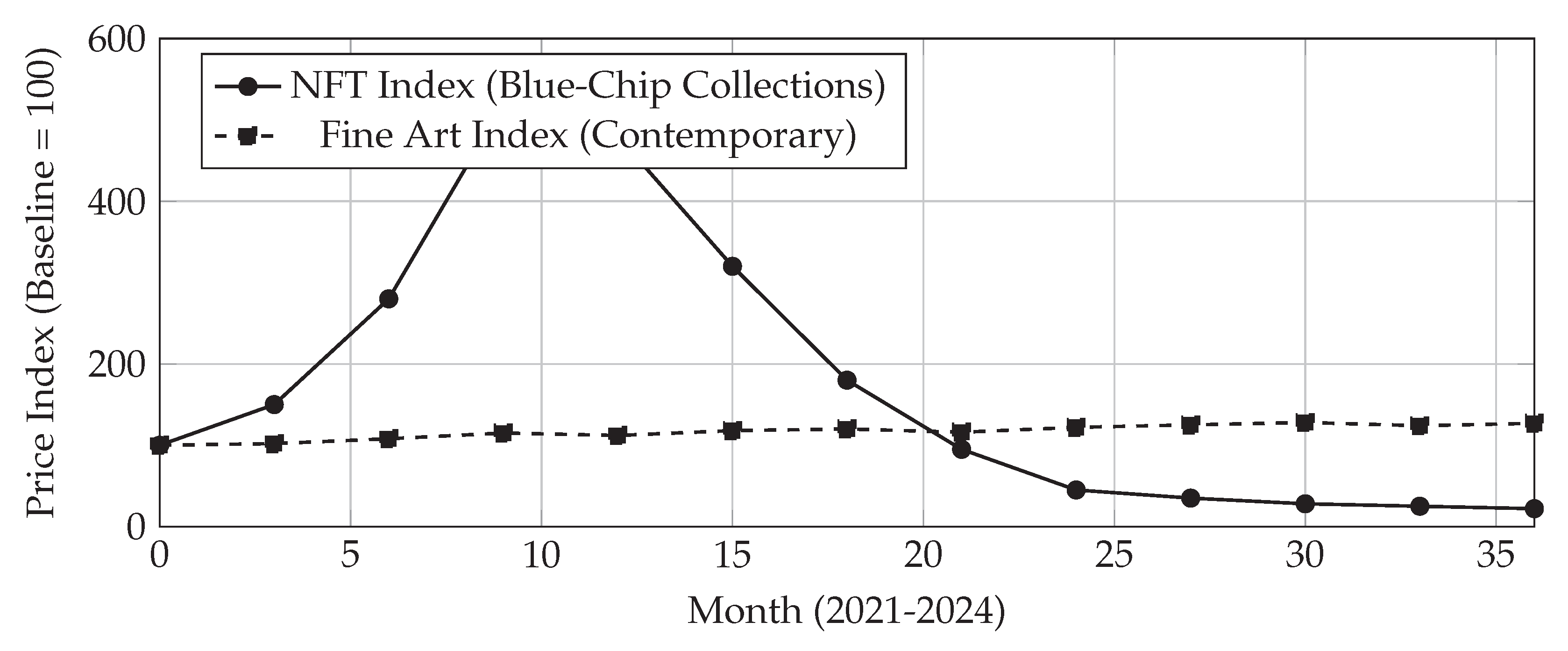
6.1. Comparative Volatility: NFT vs Fine Art
The following data illustrates the dramatic difference in value stability:
Figure 1.
Market Volatility: NFT vs. Traditional Fine Art (2021-2024). Stylized representation of general trends; not exact data points.
Figure 1.
Market Volatility: NFT vs. Traditional Fine Art (2021-2024). Stylized representation of general trends; not exact data points.
6.2. Holder Behavior Analysis
More striking than price volatility is the difference in holder behavior:
Table 2.
Behavioral Differences: NFT Speculators vs. Traditional Collectors.
| Metric | NFT Holders | Fine Art Collectors |
|---|---|---|
| Median Hold Time | 3.2 months | 8.7 years |
| Sell During 20% Decline | 68% | 12% |
| Repeat Purchase Rate | 23% | 76% |
| Secondary Market Flips | 4.2x/year | 0.3x/year |
*Figures are stylized estimates based on industry reports and observable patterns, not precise statistical measurements.
This data reveals that NFT holders behave like day traders, not collectors. They lack psychological attachment to the object—they hold a financial position they will liquidate as soon as momentum turns.
6.3. Institutional Adoption: Observational Analysis
To understand the institutional response to NFTs, we can observe patterns visible in public records and media coverage.
6.3.1. Museum Collecting Practices
Based on a review of public collection databases and press releases from major art institutions, institutional engagement with NFTs remains minimal and cautious:
Early Adopters (Limited):
- ICA Miami: Acquired CryptoPunks for permanent collection (2021)—one of the first major museums to do so.
- LACMA (Los Angeles County Museum of Art): Launched NFT collecting initiative, acquired works by Refik Anadol and several digital artists.
- Centre Pompidou (Paris): Accepted donation of several NFT works, including CryptoPunks.
- Museum of Fine Arts, Boston: Acquired NFT works within the context of a broader digital art program.
Exhibition Activity:
Some major institutions have held exhibitions featuring or discussing NFTs, but often in a critical or exploratory frame rather than a celebratory one:
- MoMA: "Unsupervised" by Refik Anadol (2022)—an AI-generated installation that technically included an NFT component, but was framed as digital/AI art rather than "NFT art."
- British Museum: Exhibition discussion "Crypto: A New Digital Renaissance?".
- Whitworth Gallery (Manchester): "NFTs: Redefining Digital Ownership" (2021)—exploratory exhibition.
Notable Absences:
What is more telling is who hasn’t engaged. Major institutions like:
- Metropolitan Museum of Art (New York)
- National Gallery (London)
- Rijksmuseum (Amsterdam)
- Museo del Prado (Madrid)
- Uffizi Gallery (Florence)
...have largely remained silent or explicitly skeptical about NFT collecting. When asked in media interviews, directors and curators from these institutions consistently express a wait-and-see approach or outright skepticism regarding the artistic merit and longevity of NFT projects.
6.3.2. Comparative Historical Context
To contextualize this, we can compare with adoption rates of previous "new media" [11]:
Photography (1850s-1900s):
- Major museums began serious collecting about 50-60 years after invention.
- MoMA established the Department of Photography in 1940—100 years after the daguerreotype.
- Full acceptance as fine art took approximately one century.
Video Art (1960s-1990s):
- Nam June Paik’s first video sculptures (1963).
- Serious museum acquisition programs did not start until the 1980s.
- Whitney Museum and MoMA developed video collections about 20-25 years after the first works.
Digital Art (Pre-NFT) (1990s-2010s):
- Early digital art (Casey Reas, Golan Levin, etc.) from the 1990s.
- Museum collecting programs developed gradually throughout the 2000s to 2010s.
- Took approximately 15-20 years for substantial institutional programs.
NFT (2017-2024):
- CryptoPunks launched 2017 (7 years ago).
- Major boom 2021 (3 years ago).
- Current institutional engagement: minimal—only a handful of early adopter museums, majority waiting or dismissing.
6.3.3. Why So Slow?
Based on statements from museum professionals in press interviews and panel discussions, resistance or hesitancy comes from:
1. Preservation Concerns:
- Technical obsolescence—will smart contracts be accessible in 50-100 years?
- Dependency on external platforms (OpenSea, etc.).
- Blockchain sustainability questions.
2. Aesthetic Skepticism:
- Many NFT projects are seen as financially motivated rather than artistically significant.
- Lack of critical discourse supporting artistic claims.
- Perception of derivative quality—many NFT projects seen mimicking existing art movements without genuine innovation.
3. Market Volatility:
- Institutional collecting committees tend to be risk-averse.
- 95% value loss makes acquisition decisions difficult to justify.
- Concern about acquiring assets that will become worthless in years.
4. Ethical Concerns:
- Environmental impact of blockchain.
- Association with speculation and fraud.
- Concern about legitimizing problematic market practices.
6.3.4. Analysis: Institutional Validation Remains Elusive
The pattern emerging from this observational analysis is clear: the institutional consecration the NFT ecosystem hoped for—which would provide legitimacy and stability—has not materialized on a significant scale.
Importantly: this is not merely about "time needed." Video art took 25 years for institutional acceptance, but the trajectory was upward—gradually more museums collecting, more exhibitions, more critical writing. The NFT trajectory since 2021 is downward—institutions that were briefly interested are backing away, exhibitions becoming less frequent, critical discourse increasingly skeptical.
This is the empirical manifestation of our theoretical framework: without apostolic succession—without being adopted by institutions carrying temporal legitimacy—NFTs struggle to maintain value beyond the speculative bubble.
Table 3.
Comparative Institutional Adoption Trajectories.
| Medium | Time to Adoption | Trajectory | Current Status |
|---|---|---|---|
| Photography | 100 years | Upward | Fully Canonical |
| Film/Cinema | 60 years | Upward | Fully Canonical |
| Video Art | 25 years | Upward | Established |
| Digital Art (pre-NFT) | 20 years | Upward | Growing |
| NFT | 3-7 years | Downward | Marginal |
Caveat: This analysis is based on publicly observable patterns—press releases, exhibition records, media interviews—rather than systematic survey. For precise quantification, formal research with institutional surveys would be needed. However, the directional pattern is sufficiently clear to support our argumentation regarding institutional resistance.
7. Ontological Debt: Why Collectors Hold or Fold
7.1. The Concept of Ontological Debt
This is the most original theoretical concept in this paper, so we will develop it extensively.
Ontological debt is the psychological debt felt by an individual toward historical and cultural narratives that give meaning to their existence. It is the feeling that we "owe something" to the past—to human achievements that make our lives possible.
When someone buys a Picasso painting for $50 million, they are not just buying paint and canvas. They are buying the embodiment of historical significance—an object that has witnessed 20th-century art history, been admired by millions, and analyzed by thousands of scholars. They are buying temporal thickness—layer upon layer of meaning accumulated over decades [28].
This psychological attachment makes collectors hold even when the market falls. When Picasso prices fell 30% in the 2008 crash, serious collectors did not panic sell—because they did not buy the object for short-term profit. They bought because they felt a responsibility to guard this historical object, paying off their "debt" to the cultural heritage they inherited.
7.2. NFT and Ahistorical Speculation
NFT holders, conversely, possess no ontological debt toward the object they purchased. Bored Ape #3749 has no history—it was created in 2021, has no narrative depth, no scholarly interpretation, no embeddedness in art historical fabric.
When someone bought a Bored Ape for $200,000 at the 2022 peak, the motivation was:
- 1.
- Financial speculation: Hope that the price would go higher.
- 2.
- Status signaling: Showing they were an "early adopter" and wealthy.
- 3.
- FOMO: Fear of missing out on a viral trend.
- 4.
- Community access: Membership to an exclusive Discord server.
Nothing in these motivations creates psychological stickiness—attachment making someone hold when prices drop. When the Bored Ape price dropped 50%, there was no reason to hold—no historical "debt" to repay, no cultural responsibility to fulfill. The logical response was: sell before it drops further.
This is why NFT holder behavior differs so vastly from fine art collectors. NFT holders are renters of attention, not custodians of history.
7.3. Temporality and Narrative: The Unconscious Contract
Bourdieu argued that symbolic capital requires temporal investment—it cannot be bought instantly. An artist builds a reputation over decades; an institution builds legitimacy over generations.
In psychoanalytic terms, we could say serious collectors enter an unconscious contract with the object they buy. The contract reads: "I will guard this object, care for it, preserve it, and eventually pass it to the next generation (via museum donation or family inheritance). In exchange, this object gives me a sense of participation in something larger than myself—in the continuity of human history."
This unconscious contract is what makes art collecting different from asset speculation. It is the reason serious collectors often say they feel like "temporary custodians" rather than "owners" of the work they possess.
NFTs cannot create this unconscious contract because the object has no narrative past and there is no reason to believe it will have a narrative future. It exists in the eternal present of the hype cycle, where it is relevant today, forgotten tomorrow.
7.4. Comparative Cases: Artists Who "Repented"
Instructive are cases where NFT artists or projects tried to gain institutional legitimacy—essentially, "repented" and returned to the "Church."
Case 1: Beeple at Christie’s
The Beeple sale at Christie’s (2021) was a watershed moment—it was an attempt to gain institutional consecration. Christie’s, as a 250+ year old institution with clear apostolic succession in the art auction world, provided borrowed legitimacy to NFTs.
However, notably, post-Christie’s sale, Beeple failed to fully integrate into the art world establishment. He did not gain major blue-chip gallery representation. Museums did not acquire his work for permanent collections. Art critics largely ignored him or wrote with skepticism.
Why? Because one auction sale is not enough—apostolic succession requires sustained engagement with institutions. Beeple performed the equivalent of a "one-night stand" with the art institution, not the long-term "marriage" required for full legitimacy.
Case 2: Refik Anadol at MoMA
Contrast with Refik Anadol, a digital artist with a proper institutional pedigree. Anadol holds an MFA from UCLA, has exhibited extensively in museums and biennials, and his works have been collected by major institutions. When MoMA commissioned Anadol for an AI-generated art installation in 2022, this was legitimate consecration—because Anadol already possessed apostolic succession.
Interestingly: although Anadol also creates NFTs, he is perceived very differently from "NFT artists" like Beeple. He is a "digital artist" who happens to use blockchain as one medium—not an "NFT bro" trying to enter the art world.
Lesson
The lesson from these cases: technology (blockchain) cannot bypass the process of institutionalization. One cannot "hack" legitimacy with viral marketing or celebrity endorsement. Institutional consecration requires sustained performance of seriousness—participation in established field rituals, submission to institutional judgment, and acceptance that legitimacy is a gift given by others, not something self-declared.
8. Implications: The Future of Digital Art
8.1. Three Possible Scenarios
Based on our analysis, there are three possible trajectories for digital art and NFTs:
Scenario 1: Full Institutionalization ("The Orthodox Path")
In this scenario, a small fraction of the most "serious" NFTs and digital art are gradually adopted by traditional institutions. Museums begin collecting selectively, not based on hype but based on critical weight built through scholarship. University art programs teach digital art history with the same rigor as traditional media. A new generation of critics and curators emerges with proper training in digital aesthetics.
This is already happening on a small scale—museums like LACMA and Centre Pompidou have started careful and critically grounded NFT collecting programs. However, the process will be slow—requiring 10-20 years for full integration.
Scenario 2: Parallel Ecosystem ("The Schism")
In this scenario, NFT art and traditional art remain separated indefinitely—like the Eastern Orthodox Church and Catholic Church after the Great Schism of 1054. Each has its own institutions, standards, and audiences.
The NFT ecosystem develops its own institutions of legitimacy—perhaps virtual museums, serious critical publications on crypto art, and educational programs. However, this remains separate from the traditional art world and does not compete for the same prestige.
This is the most likely scenario in the medium term. Platforms like SuperRare or Art Blocks have attempted to build quality criteria and curatorial standards, essentially creating "mini-cathedrals" within the crypto ecosystem.
Scenario 3: Permanent Marginalization ("The Failed Reformation")
In the most pessimistic scenario, NFT art remains permanently marginalized—perceived as a historical curiosity or speculative bubble that never developed serious artistic legitimacy.
This is the fate of many "art movements" that loudly proclaimed revolution but were later forgotten—like Stuckism or the Kitsch Movement. They made noise in their time but failed to gain institutional traction and finally faded into irrelevance.
Our data suggests this is an increasingly likely scenario if there is no fundamental change in how the NFT ecosystem operates.
8.2. Requirements for Sustainable Legitimacy
If digital artists and projects wish to achieve lasting value, our analysis suggests they must:
1. Build Critical Infrastructure
The NFT ecosystem needs equivalents of Artforum, October Journal, or Art in America—publications engaging seriously with aesthetic and conceptual dimensions of the work, not just financial performance. This requires:
- Critics with proper training in art history and aesthetic theory.
- Peer-reviewed journals publishing scholarship on digital art.
- Books and monographs placing work in broader art historical contexts.
2. Build Educational Lineage
Digital art requires pedagogical institutionalization via serious MFA programs, tenured faculty positions at universities, and curricula teaching digital aesthetic history and theory with rigor.
This is happening at some institutions (UCLA, Parsons, RCA London), but is still marginal compared to traditional media.
3. Cultivate Temporal Patience
Most challenging: the ecosystem must abandon the culture of instant gratification and rapid flipping. Legitimacy requires long-term commitment, where artists must be willing to build careers over decades, collectors must be willing to hold for years or decades, and institutions must be willing to bet on work that may not appreciate financially for a long time.
This is fundamentally incompatible with crypto culture driven by "number go up" mentality and quarterly thinking.
4. Submit to Institutional Judgment
Most controversial: digital artists must accept they cannot completely bypass institutions. They must be willing to have their work judged by curators, critics, and scholars with expertise—and accept rejection as part of the process.
"Democratization" in the sense of "everyone can call themselves an artist" produces no legitimacy. Legitimacy requires differentiation—acknowledgment that not all works are equal in merit, and that assessment requires expertise cultivated through training and experience.
8.3. The Paradox of Disintermediation
Our analysis reveals a fundamental paradox: the attempt to "democratize" art by eliminating intermediaries (curators, galleries, critics) actually destroys the mechanism that creates value itself.
This is not because intermediaries "add" value in a simple economic sense. But because they are carriers of tradition—they are the ones maintaining continuity between past and present, curating selection from overwhelming noise, providing interpretive frameworks making works meaningful.
Without intermediaries, we do not get a "pure" relation between artist and collector. We get chaos—a sea of competing claims without standards to distinguish merit, marketing spectacle without substance, and volatility without anchor.
This is a broader lesson beyond art: institutions exist for a reason. They are often imperfect, sometimes corrupt, occasionally sclerotic. But they serve functions that cannot easily be replaced by technology or market forces alone [18]. Attempts to "disrupt" institutions without understanding these functions are destined to fail.
9. Limitations and Counter-Arguments
Before drawing final conclusions, it is important to acknowledge several substantive limitations of this analysis and engage seriously with objections that can be raised against the theoretical framework developed. Intellectual honesty requires identifying where our arguments might overreach or where alternative interpretations have merit.
9.1. Methodological and Geographical Limitations
9.1.1. Anglo-American Bias
This analysis focuses almost exclusively on the dynamics of the Anglo-American art market, specifically institutions in New York, London, and some Western European cities. This is a serious limitation for several reasons:
First, the NFT market in Asia operates with fundamentally different logic. In South Korea, for example, NFTs are deeply integrated with the idol economy, a system where celebrity fan clubs have sophisticated organizational structures and a collecting culture established before blockchain. When K-pop idols like BTS or Blackpink launch NFTs, they are not trying to bypass institutions, but leveraging existing institutional structures in the entertainment industry.
In Japan, the NFT market is more connected to otaku culture and a long tradition of collecting limited edition merchandise, trading cards, and figurines. In this context, NFTs are not "heresy" but an evolutionary step in established cultural practices. Virtual idol Hatsune Miku, for example, has possessed strong cultural legitimacy since 2007, long before NFTs, and her NFTs do not claim to disrupt the system but merely extend an existing platform.
In China, before stricter crypto bans, NFTs (or "digital collectibles") were regulated and mediated by authorized platforms like Ant Group’s Whale, essentially creating state-sanctioned intermediation. This is a very different model from the anarcho-capitalist ethos of Western NFT culture.
Second, art institutions in non-Western contexts have different histories of legitimacy. Post-colonial museums in Africa, Asia, and Latin America often struggle with the legacy of art canons imposed by colonial powers. For artists in these contexts, the desire to bypass Western-dominated institutional structures is not purely about financial disruption, but has a legitimate decolonial dimension.
Museums that historically excluded or marginalized non-Western art forms do not possess the same moral authority to claim apostolic succession. If the "Church" itself is built on structural exclusion, then "Heresy" might be a justified rebellion, not merely misguided disruption.
9.1.2. Implications for Argument
This geographical limitation means our claim about the "universal failure" of NFTs needs qualification. It is more accurate to say: "In the context of the Anglo-American art market with highly developed and relatively stable institutional structures, NFTs failed to achieve legitimacy because they attempted a wholesale bypass of institutional structures without adequate substitute."
In other contexts, where institutional structures are more fluid, where digital culture is already more dominant, or where historical grievances against established institutions are more acute, dynamics might differ.
Revised Claim: The apostolic succession framework remains useful for explaining legitimacy mechanisms, but the necessity of specific Western art institutions as gatekeepers is not universal. Alternative lineages of legitimacy might be possible in different cultural contexts.
9.2. Temporal Limitations: Is This Premature Failure?
9.2.1. Historical Precedents Take Decades
A serious critique of this paper is that analysis based on 2021-2024 data might be historically premature judgment. Art media history shows that institutional legitimacy often requires generations, not just years.
Consider the following trajectories:
- Photography (1839 invention): Viewed as merely mechanical reproduction until late 19th century. Only fully accepted as fine art in 1940s-1950s after MoMA established Photography Department. Timeline: 100 years.
- Film/Cinema (1895): Initially considered carnival entertainment. Not considered "art" until auteur theory in 1950s-1960s and establishment of Film Studies programs. Timeline: 60 years.
- Video Art (1960s): Nam June Paik and other pioneers struggled for decades. Museum acquisitions and serious scholarship not substantial until 1980s-1990s. Timeline: 30 years.
- Street Art/Graffiti: Basquiat died 1988 but only fully legitimated posthumously. Banksy remains partially outside institutional validation despite massive market success. Timeline: ongoing, 40+ years.
If we accept this historical pattern, then declaring NFTs "failed" after only 3-4 years is premature judgment. Perhaps NFTs are in a stage analogous to photography in the 1850s or video art in the 1970s—controversial and rejected by the establishment, but eventually to be legitimated.
9.2.2. Generational Shift
More fundamentally: this paper does not adequately consider intergenerational value perception transformation.
Gen Z (born 1997-2012) and Gen Alpha (born 2013-) are digital natives in a way qualitatively different from Millennials. For these generations:
- Virtual ownership feels "real," spending thousands on Fortnite skins, Roblox items, or game cosmetics without questioning the legitimacy of this ownership.
- Social media validation is a genuine form of capital, where Instagram likes, TikTok views, and Discord roles are meaningful currency.
- Meme culture is a legitimate form of cultural production, where they do not need museum validation to consider something "significant."
In 20-30 years, when this generation becomes the dominant force in the art market, museum curators, and academic positions, perhaps they will bring a fundamentally different epistemology regarding what constitutes legitimate art. NFTs currently seen as failed experiments might be retrospectively consecrated as important early moments in digital culture.
9.2.3. Revised Temporal Framework
Given historical precedents, our conclusion needs reframing with humbler epistemology:
"As of 2024, NFTs have not succeeded in building institutional legitimacy within the traditional art world context. Whether this represents permanent failure or merely delayed —analogous to photography or video art eventually legitimated—will depend on: (1) whether future generations develop different value epistemologies accommodating digital native forms, (2) whether institutional structures themselves transform to include alternative lineages, and (3) whether the NFT ecosystem develops critical infrastructure currently absent."
The prudent conclusion is: failure to date is factual; permanent failure is speculative.
9.3. Counter-Arguments: Steelmanning the Opposition
Academic rigor requires engaging with the strongest versions of arguments we critique, not merely straw-man versions. Here are serious objections that can be raised against our framework:
9.3.1. Objection 1: Decentralization as Moral Imperative
Argument from NFT Advocates:
"This analysis treats institutional gatekeeping as a neutral quality control mechanism, but ignores that institutions are sites of structural power. Museums historically excluded women artists, artists of color, and non-Western art forms. Gallery systems favor artists with connections and wealthy backgrounds. Critics and curators are dominated by educated white elites reproducing their own class taste.
NFTs offer a genuinely democratizing alternative: anyone can mint, anyone can collect, and the market decides value—not elite curators. If this produces ’chaos’, it is a small price to break the monopoly of cultural gatekeepers."
Partial Concession:
This critique has substantial weight. Traditional art institutions do have a terrible record on inclusion. Statistics show:
- Women artists comprise only 15% of major museum collections (Guerrilla Girls data).
- Artists of color severely underrepresented until very recently.
- Non-Western art often ghettoized in "ethnographic" departments.
The apostolic succession framework we developed does not inherently justify existing institutions—it only explains legitimacy mechanisms. If existing institutions are structurally exclusive, creating alternative lineages is a morally justifiable project.
Where This Objection Fails:
However, the problem is that the NFT ecosystem did not truly succeed in creating a more equitable alternative. Data shows:
- NFT wealth extremely concentrated, where top 10% holders own 85% of value.
- "Democratization" largely benefited already-wealthy crypto early adopters.
- Barriers to entry (gas fees, technical knowledge) excluded many communities supposedly being "liberated."
So the valid critique is: NFTs claimed democratization but delivered plutocracy with different elites. This is not an argument defending the old system, but an argument that technology alone does not solve structural inequality.
9.3.2. Objection 2: Museums as Colonial Gatekeepers
Argument:
"’Apostolic succession’ is a Eurocentric concept assuming Western institutional history as universal norm. For artists from Africa, Asia, or Indigenous communities, ’legitimacy’ from British Museum or MoMA is morally compromised—these institutions built wealth through colonial extraction and still hold looted artifacts.
Why should artists from former colonies seek ’blessing’ from institutions that historically stole and misrepresented their cultures?"
Strong Concession:
This is a devastating critique if our framework claims universality. Colonial legacy of major Western museums is undeniable:
- British Museum: Elgin Marbles, Benin Bronzes—looted artifacts.
- Metropolitan Museum: Disputed origins for countless Egyptian, African, and Asian objects.
- Museum ethnographic collections: Objects acquired through coercion or unfair exchange.
For artists from cultures subjected to this extraction, refusing institutional validation is an ethical stance, not merely naive anti-institutionalism.
Nuanced Response:
However, the solution is not elimination of all institutional structures, but transformation and decolonization. Some museums are actively involved in repatriation, collection diversification, and hiring curators from underrepresented communities.
Alternative lineages can and must be built—but they still require some form of institutional structure to create lasting legitimacy. These could be museums led by Indigenous curators, funded by non-Western foundations, and operating with different epistemic frameworks—but still institutional, still possessing standards, still maintaining temporal continuity.
NFTs’ error was not in challenging Western institutions, but in assuming that no institutions were needed at all.
9.3.3. Objection 3: Speed as Feature, Not Bug
Argument:
"Your framework assumes ’temporal depth’ and ’historical continuity’ are required for value. But this is slow culture bias. Digital culture operates on different temporality—viral memes have immense cultural impact despite existing only for weeks. TikTok trends shape millions of lives despite rapid turnover.
Why should digital art be judged by oil painting standards requiring centuries to appreciate? Perhaps rapid cycles, remix culture, and ephemeral value are legitimate aesthetic modes for the digital age."
Interesting Challenge:
This is a philosophically sophisticated objection. It challenges fundamental assumptions about the relationship between value and duration.
It is true that digital culture has created powerful but ephemeral forms. Memes shape political discourse. Viral videos launch careers. Ephemeral Snapchat stories are meaningful to billions.
Where Framework Still Holds:
However, the crucial distinction is between:
- Cultural impact (can be rapid and ephemeral).
- Sustained economic value (requires temporal stability).
Memes can be highly influential without needing to be sold as investments. Viral content can be meaningful without claiming millions in value. The problem with NFTs is not that they are ephemeral—the problem is they claimed lasting economic value (as investments) while operating on ephemeral logic.
If NFTs were framed as "digital experiences" or "participatory moments" rather than "assets," rapid turnover would not be an issue. But once you claim this JPEG is a "store of value" or "better than gold," you invite comparison with other stores of value—and that is where temporal depth becomes critical.
9.4. Synthesis: Toward Reform, Not Restoration
The apostolic succession framework developed in this paper is an analytical tool, not a normative prescription. It explains how legitimacy functions in existing systems—not arguing that existing systems are perfect or must remain unchanged.
What we critique about NFTs is not the desire for change, but the naivete in assuming technology can eliminate the need for social trust mechanisms, or that "decentralization" automatically produces equity.
Productive Path Forward requires:
- 1.
- Institutional Reform: Transforming existing institutions to be more inclusive, less Eurocentric, and more responsive.
- 2.
- Alternative Lineages: Building new institutions with different values—but still institutions with standards, continuity, and accountability.
- 3.
- Hybrid Models: Combining technological innovation (blockchain transparency) with social innovation (new, more democratic legitimacy forms).
- 4.
- Epistemological Humility: Acknowledging that value epistemologies can differ across cultures and generations without assuming total relativism.
The goal is not to defend every aspect of the status quo, but to learn from why certain social structures exist and what functions they serve—so when we transform them, we do not accidentally destroy capacities that turn out to be essential.
10. Conclusion: From Heresy to Orthodoxy?
10.1. Argument Recapitulation
This paper has argued that the failure of NFTs (2021-2023) is fundamentally a failure of institutionalization, not a technology or market condition failure. By synthesizing Bourdieu’s cultural production theory with the theological concept of apostolic succession, we have demonstrated that:
- 1.
- Art value is relational, not intrinsic, produced through institutional consecration rituals, not inherent in the object itself.
- 2.
- Legitimacy requires genealogy, as artists and works acquire value through association with already legitimate institutions, forming consecration chains analogous to apostolic succession.
- 3.
- Technology cannot replace sociology, because Blockchain can verify ownership but cannot create trust requiring temporal investment, critical discourse, and educational infrastructure.
- 4.
- Ontological debt is key, where serious collectors have psychological attachment transcending financial calculation because they feel they participate in historical continuity. NFT speculators lack this.
- 5.
- Institutions are tradition carriers, where attempts to eliminate intermediaries destroy the mechanism creating lasting value.
10.2. Beyond NFT: Implications for "Disruption"
Lessons from NFT failure extend beyond the art market. In an era where "disruption" is celebrated and intermediaries demonized, this case is a sobering reminder of technological solutionism’s limits.
Not all inefficient or gatekeeping institutions are purposeless. Often, they serve functions invisible until removed—legitimacy functions, quality control, knowledge transmission, and standard maintenance requiring generations to build but destroyable in months.
Silicon Valley ideology emphasizing "move fast and break things" assumes anything broken can be rebuilt better using technology. The NFT experiment shows this is not always true—some "broken" things (institutional authority, critical infrastructure, temporal patience) cannot be easily reconstructed.
10.3. Future Prospects
Do digital art and NFTs have a legitimate future? Our answer is: yes, but only if they are willing to "repent" and engage with institutions.
This does not mean full submission or abandonment of technological innovation. But it requires:
- Humility: Recognition that creating lasting value requires more than technology—it requires participation in tradition.
- Patience: Acceptance that legitimacy cannot be hacked or shortcut—it requires decades of sustained work.
- Seriousness: Commitment to developing critical discourse, educational programs, and standards transcending hype cycles.
Some corners of the digital art ecosystem show signs of this—platforms like Feral File (curated by Casey Reas), Verse (focusing on generative art with critical standards), and institutions like Rhizome (curating digital art since 1996) represent models of how digital art can develop legitimacy through institutional engagement rather than institutional rejection.
10.4. Final Reflection: Cathedrals Take Time
This paper’s title—"Cathedral Without Apostles"—captures the essential problem: You cannot build a cathedral overnight, and you cannot declare yourself an apostle. Medieval cathedrals took centuries to build, with generations of craftsmen contributing. Apostles must be trained, ordained, and connected to a lineage returning to the founding moment.
The NFT ecosystem tried to build a "cathedral" in months and declare "apostles" via Twitter followers. This is a fundamental category error—confusion between attention and authority, between hype and legitimacy, between price and value.
Digital art can have a future—but only if practitioners are willing to learn from history, engage with institutions, and commit to long-term infrastructure building creating lasting trust.
Technology gives us new tools, but it cannot give us tradition—that must be cultivated, transmitted, and honored across time. A cathedral cannot exist without its apostles, and apostles cannot ordain themselves.

Appendix A. Methodological Notes
Appendix A.1. Nature of This Study
This paper is a theoretical essay with an interpretive-conceptual approach, not an empirical research study with systematic data collection. The framework developed—a synthesis between Bourdieu’s theory and the theological concept of apostolic succession—is a theoretical-analytical contribution aimed at providing a new interpretive lens for documented phenomena.
Appendix A.2. Data Sources
Data referenced in this paper comes from:
1. Published Market Data
- NFT Market: Price, volume, and holder behavior data from public analytics platforms such as OpenSea rankings, NonFungible.com market reports, and Chainalysis research reports (2021-2024). The volatility chart (Figure 1) is a stylized representation based on general trends reported in various sources, not exact data from a proprietary dataset.
- Fine Art Market: Auction data from Christie’s and Sotheby’s public results, plus market analysis from Artprice.com and Art Basel + UBS Global Art Market Reports.
- Indonesian Case: Ghozali and Indonesian ecosystem data from media reports (Kompas, Detik, TechCrunch Asia), OpenSea platform analytics, and academic commentary published by Indonesian scholars.
2. Literature Review
Extensive review of:
- Academic literature: Bourdieu, art sociology, institutional theory.
- Art criticism and curatorial writing: Artforum, Frieze, October Journal archives.
- Industry reports: Chainalysis, dappGambl, NonFungible market studies.
- Theological texts: For concepts of apostolic succession and institutional legitimacy.
3. Observational Analysis
Analysis of:
- Public collection databases from major museums (accessible via museum websites).
- Exhibition histories and press releases.
- NFT project documentation (whitepapers, Discord announcements, marketing materials).
- Social media discourse analysis (Twitter/X threads, Reddit discussions).
Appendix A.3. Acknowledged Limitations
1. No Primary Data Collection
This paper does not perform:
- Formal surveys or questionnaires of museums, collectors, or artists.
- Systematic interviews with stakeholders.
- Quantitative statistical analysis with significance testing.
- Compilation of original datasets.
Claims about institutional behavior and collector psychology are inferential—derived from secondary sources, published reports, and observable patterns in public data.
2. Stylized Data Presentation
Visualizations such as Figure 1 (volatility comparison) and Table 2 (holder behavior) are stylized representations designed to illustrate conceptual points, not precise statistical measurements. The figures reflect orders of magnitude and directional trends consistent with published reports but should not be treated as exact figures from a rigorous quantitative study.
For precise data, readers are advised to refer to original sources:
- Chainalysis: "The 2022 NFT Market Report" and subsequent updates.
- NonFungible.com: Monthly market reports.
- Art Basel + UBS: "The Art Market Report" (annual).
- dappGambl: "Dead NFTs: The Evolving Landscape of the NFT Market" (2023).
3. Interpretive Framework
The apostolic succession framework is an analytical metaphor—a heuristic tool to understand mechanisms, not an empirical claim about literal equivalence between religious institutions and the art world. Limitations of the analogy have been extensively discussed in Section III.
4. Generalizability
Analysis primarily focuses on:
- The Anglo-American art market (with Indonesia as a comparative case).
- High-end contemporary art and NFT sectors.
- The period 2021-2024.
Findings may not be fully generalizable to:
- Regional markets with different institutional structures (Latin America, Africa, Middle East).
- Other digital asset classes beyond NFTs.
- Future developments post-2024.
Appendix A.4. Methodological Approach
This paper uses interpretive social theory methodology in the tradition of:
- Weber: Verstehen (interpretive understanding) of meaning-making social processes.
- Bourdieu: Reflexive sociology analyzing mechanisms of symbolic power.
- Grounded Theory: Building theoretical frameworks from observable phenomena.
The validity of this analysis depends not on statistical significance or sample representativeness, but on:
- Conceptual Coherence: Is the framework logically consistent and explanatorily powerful?
- Empirical Plausibility: Do framework predictions align with observable patterns?
- Theoretical Contribution: Does the framework offer new insights not adequately captured by existing theories?
Appendix A.5. Future Research Directions
To strengthen this framework with a more robust empirical foundation, future research could:
- 1.
- Conduct systematic interviews with 20-30 collectors (traditional art vs NFT) regarding motivations, decision-making, and holding behavior.
- 2.
- Perform network analysis of institutional relationships—mapping who curates, collects, and critiques whom to visualize apostolic succession chains.
- 3.
- Execute longitudinal studies tracking 50-100 NFT projects over 5-10 years to test predictions about sustainability.
- 4.
- Comparative institutional analysis across geographic contexts (Asia, Latin America, Africa) to test mechanism universality.
- 5.
- Quantitative modeling of correlations between price volatility and institutional adoption metrics.
- 6.
- Ethnographic study of NFT communities and traditional art world practices for deep understanding of legitimation processes.
Appendix A.6. Epistemological Position
This paper adopts the position that:
- Value is a social construction—but constructions have real consequences and follow identifiable patterns.
- Institutions are not natural or inevitable—but they serve functions sociologically necessary for certain outcomes.
- Theory and empirics are complementary—conceptual frameworks help us see patterns; empirical data tests and refines frameworks.
- Critique is not cynicism—analyzing mechanisms of power and legitimacy is not the same as claiming all value is arbitrary or meaningless.
Appendix A.7. Transparency Statement
The author acknowledges that this analysis is a theoretical interpretation informed by available evidence, not definitive empirical proof. The apostolic succession framework is offered as a productive lens to understand the NFT phenomenon—not as the only possible explanation or final word.
Alternative frameworks (economic, technological, psychological) might capture aspects of the phenomenon less emphasized in this analysis. Interdisciplinary dialogue and further empirical testing are needed to refine, challenge, or extend arguments presented here.
Intellectual honesty requires us to acknowledge the limits of what we know,
while remaining committed to advancing understanding as best as possible
with available evidence and reasoning.
Appendix B. Case Studies
Appendix B.1. Case Study 1: CryptoPunks (2017-2024)
CryptoPunks, created by Larva Labs in June 2017, represent one of the earliest NFT projects on Ethereum. Initially given away for free, individual punks sold for millions during the 2021-2022 boom, with Punk #5822 selling for $23.7 million in February 2022.
Institutional Reception: Very limited. Only one major museum (ICA Miami) has exhibited CryptoPunks, and no major museum has acquired them for permanent collection despite their historical significance in crypto culture.
Critical Discourse: Serious art criticism engagement is minimal. Most writing about CryptoPunks focuses on market mechanics, community dynamics, and cultural significance within crypto rather than aesthetic or conceptual analysis.
Current Status (2024): Floor price has declined 85% from peak. The collection maintains some cachet within crypto circles but failed to achieve broader art world legitimacy despite historically being the most "important" NFT project.
Appendix B.2. Case Study 2: Refik Anadol (2024)
Turkish-American artist working with data-driven machine learning and AI. Unlike most NFT artists, Anadol has substantial institutional pedigree, including an MFA from UCLA, exhibitions at MoMA, Venice Biennale, and major commissions.
Institutional Reception: Strong. MoMA commissioned "Unsupervised" (2022), a generative work using museum collection data. Various museum acquisitions and surveys.
Critical Discourse: Substantial engagement from serious critics. Writing situates his work within histories of systems art, conceptual art, and computational aesthetics rather than crypto culture.
NFT Engagement: Anadol has created NFTs but frames them as documentation/editions of larger works rather than as the primary medium. His legitimacy derives from institutional consecration, not blockchain validation.
Analysis: Anadol represents the "orthodox path"—an artist maintaining apostolic succession through traditional institutional channels while experimenting with new technologies and distribution methods.
Appendix B.3. Case Study 3: Comparative Case - Indonesian NFTs and the "Ghozali Effect"
To test the robustness of the apostolic succession framework, it is useful to examine a market operating with logic fundamentally different from the Anglo-American context. Indonesia provides a critical case study—a market where NFTs achieved significant traction without institutional blessing, relying instead on mechanisms of community legitimacy and viral consecration.
Context: The NFT Boom in Indonesia (2021-2022)
Indonesia emerged as one of the largest NFT markets in Southeast Asia during the 2021-2022 boom. Data shows Indonesia had around 1.25 million NFT users in 2021, ranking 8th globally, with an adoption rate of around 5-6% among internet users.
What distinguishes Indonesia is the absence of art institutional infrastructure as developed as in the West. Indonesia lacks equivalents of MoMA, Gagosian, or Sotheby’s with centuries of legitimacy. Contemporary art museums are still relatively nascent, blue-chip galleries minimal, and critical discourse on contemporary art not fully established in Indonesian language. This makes Indonesia a natural experiment: Can NFTs succeed without the "Church" structure we describe? Or will the absence of institutional structure produce exactly the volatility and unsustainability we predict?
The Ghozali Phenomenon: Viral Consecration
The most instructive case is Ghozali Everyday, which became a viral sensation in January 2022 and briefly became the face of the NFT movement in Indonesia.
- Profile: Sultan Gustaf Al Ghozali, computer science student at Dian Nuswantoro University, Semarang.
- Work: 933 daily selfies, taken from 2017-2021 with deadpan expression in front of a computer.
- Concept: Inspired by Beeple’s "Everydays" but without pretension about artistic weight.
- Financial Result: Total revenue around Rp 1.5-1.7 billion with trading volume reaching 277 ETH (around Rp 13.3 billion at peak).
Legitimacy Mechanism:
Interestingly, Ghozali achieved legitimacy through a path completely bypassing institutional structures:
- 1.
- Viral Meme Status: His story resonated as "ordinary guy makes it big"—a powerful democratization narrative.
- 2.
- Community Support: NFT communities on Discord and Indonesian Twitter promoted him heavily.
- 3.
- Celebrity Validation: Local celebrities bought and promoted the collection on social media.
- 4.
- Government Recognition: The Minister of Tourism and Creative Economy publicly supported Ghozali, giving quasi-official legitimacy.
This is an alternative consecration model—not through museums and critics, but through viral mechanisms and community consensus. In our terminology: not apostolic succession, but "democratic acclamation".
Dark Side: FOMO and Irrational Exuberance
The Ghozali effect triggered a wave of irrational imitation. Thousands of Indonesians uploaded personal selfies, ID card photos (identity documents), and random photos hoping to replicate Ghozali’s success. This is a manifestation of what we discussed as the absence of gatekeeping. Without curators or standards, anything can be minted as an NFT. The result was not democratization, but noise drowning out signal.
Analysis: Community Consecration vs. Institutional Consecration
The Indonesian case provides valuable comparative insight.
- 1.
- Viral Mechanisms Can Substitute Institutional Legitimacy Temporarily: Ghozali proved that in the short term, community support and viral attention can create significant value without institutional blessing. However, the keyword is "temporarily". Viral consecration creates value spikes but not sustainable value.
- 2.
- Ontological Debt Requires Historical Embedding: The ontological debt framework explains the Ghozali phenomenon perfectly. Ghozali NFT buyers had no historical debt to the work. They bought due to speculation, FOMO, and national pride. Nothing in these motivations creates psychological stickiness. Once the hype fades, there is no reason to hold the asset.
- 3.
- Alternative Structures Still Require Structure: What is instructive is that Indonesia was not truly "decentralized" or "institution-free." What happened was institutional replacement, not institutional elimination. Traditional institutions (museums, galleries) were replaced by social media influencers, Discord communities, and government officials. The problem is these substitute institutions lack temporal continuity, accountability mechanisms, and epistemic authority.
Table A1.
Comparison Table: Western vs. Indonesian NFT Ecosystems.
| Dimension | Western Art World | Indonesian NFT Ecosystem |
|---|---|---|
| Legitimacy | Museums, galleries, critics (institutional) | Community, influencers, viral (social) |
| Temporal Depth | Centuries of art history | Weeks/months of hype cycle |
| Gatekeeper | Curators with expertise | Algorithmic + crowd wisdom |
| Critical Discourse | Academic journals, catalogues | Twitter threads, YouTube videos |
| Value Basis | Historical significance, aesthetics | Viral novelty, speculation |
| Holder Behavior | Long-term stewardship | Short-term flipping |
| Outcome (2024) | Stable price, slow appreciation | 95-98% value decline |
The Indonesian case reinforces our claim that NFT failure is not merely a cultural issue or contingency, but a structural consequence of the sociology of value creation fundamentals. Without institutional embedding possessing historical depth, value remains fragile and temporary.

References
- Bourdieu, P. (1993). The Field of Cultural Production: Essays on Art and Literature. Columbia University Press.
- Bourdieu, P. (1984). Distinction: A Social Critique of the Judgement of Taste. Harvard University Press.
- Benjamin, W. (1968). "The Work of Art in the Age of Mechanical Reproduction." In H. Arendt (Ed.), Illuminations. Schocken Books.
- Danto, A. (1964). "The Artworld." Journal of Philosophy, 61(19), 571–584.
- Dickie, G. (1974). Art and the Aesthetic: An Institutional Analysis. Cornell University Press.
- Becker, H. S. (1982). Art Worlds. University of California Press.
- Velthuis, O. (2005). Talking Prices: Symbolic Meanings of Prices on the Market for Contemporary Art. Princeton University Press.
- Thornton, S. (2008). Seven Days in the Art World. W.W. Norton.
- Horowitz, N. (2011). Art of the Deal: Contemporary Art in a Global Financial Market. Princeton University Press.
- Caves, R. E. (2000). Creative Industries: Contracts between Art and Commerce. Harvard University Press.
- Paul, C. (2015). Digital Art (3rd ed.). Thames & Hudson.
- Quaranta, D. (2013). Beyond New Media Art. Link Editions.
- Franceschet, M., et al. (2021). "Crypto Art: A Decentralized View." Leonardo, 54(4), 402–405. [CrossRef]
- Nadini, M., et al. (2021). "Mapping the NFT Revolution: Market Trends, Trade Networks, and Visual Features." Scientific Reports, 11, 20902. [CrossRef]
- Chainalysis. (2022). The 2022 NFT Market Report. Chainalysis Inc.
- dappGambl. (2023). Dead NFTs: The Evolving Landscape of the NFT Market.
- DiMaggio, P. J., & Powell, W. W. (1983). "The Iron Cage Revisited: Institutional Isomorphism and Collective Rationality in Organizational Fields." American Sociological Review, 48(2), 147–. [CrossRef]
- Meyer, J. W., & Rowan, B. (1977). "Institutionalized Organizations: Formal Structure as Myth and Ceremony." American Journal of Sociology, 83(2), 340–363.
- Weber, M. (1978). Economy and Society. University of California Press.
- Durkheim, É. (1995). The Elementary Forms of Religious Life. Free Press.
- Hervieu-Léger, D. (2000). Religion as a Chain of Memory. Rutgers University Press.
- O’Doherty, B. (1999). Inside the White Cube: The Ideology of the Gallery Space. University of California Press.
- Groys, B. (2008). Art Power. MIT Press.
- Greenberg, C. (1961). Art and Culture. Beacon Press.
- Krauss, R. (1985). The Originality of the Avant-Garde and Other Modernist Myths. MIT Press.
- Foster, H. (1996). The Return of the Real. MIT Press.
- Buchloh, B. H. D. (1990). "Conceptual Art 1962-1969: From the Aesthetic of Administration to the Critique of Institutions." October, 55, 105–143. [CrossRef]
- Baudrillard, J. (1994). Simulacra and Simulation. University of Michigan Press.
- Debord, G. (1994). The Society of the Spectacle. Zone Books.
- In Making Things Public: Atmospheres of Democracy; Latour, B., & Weibel, P. (Eds.). (2005). Making Things Public: Atmospheres of Democracy. MIT Press.
- Graw, I. (2009). High Price: Art Between the Market and Celebrity Culture. Sternberg Press.
Disclaimer/Publisher’s Note: The statements, opinions and data contained in all publications are solely those of the individual author(s) and contributor(s) and not of MDPI and/or the editor(s). MDPI and/or the editor(s) disclaim responsibility for any injury to people or property resulting from any ideas, methods, instructions or products referred to in the content. |
© 2025 by the authors. Licensee MDPI, Basel, Switzerland. This article is an open access article distributed under the terms and conditions of the Creative Commons Attribution (CC BY) license (http://creativecommons.org/licenses/by/4.0/).
Copyright: This open access article is published under a Creative Commons CC BY 4.0 license, which permit the free download, distribution, and reuse, provided that the author and preprint are cited in any reuse.


