
Submitted:
07 December 2025
Posted:
12 December 2025
You are already at the latest version
Abstract
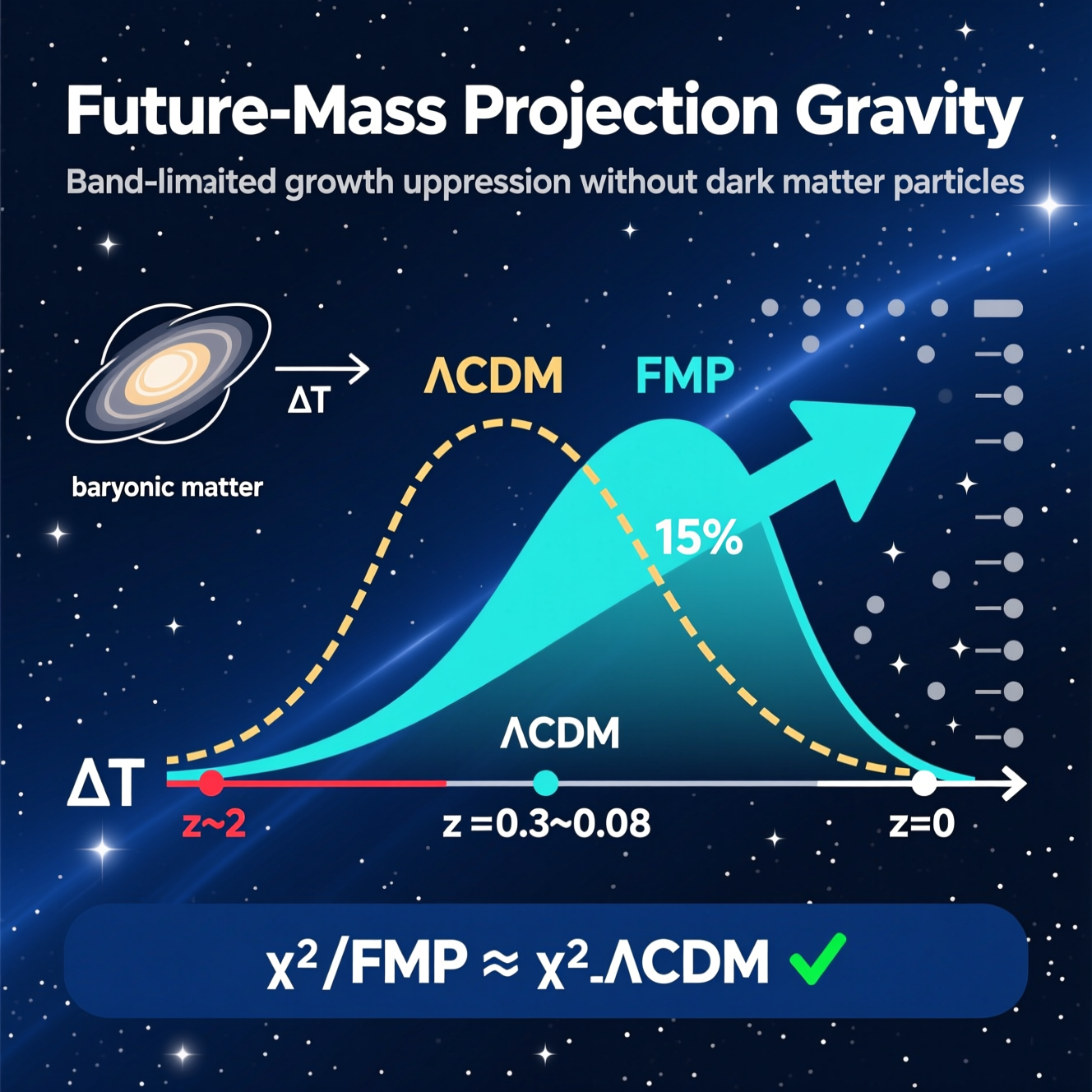
The Future–Mass–Projection (FMP) framework replaces particle dark matter by a nonlocal, entropically weighted projection of future baryonic mass distributions onto the present. In its cosmological implementation, a short-horizon, zero–DC future kernel modifies the linear growth source while keeping the homogeneous background expansion H(z) effectively indistinguishable from ΛCDM. In this work we analyse the predictions of the entropic FMP model for the linear growth observable fσ8(z) as a function of redshift and confront them with current redshift-space-distortion (RSD) measurements from 6dF, BOSS, eBOSS, WiggleZ, VIPERS and related surveys. For a finite future horizon ΔT ≃ 0.25H−1 0 and a dimensionless kernel amplitude η ≃ −4.3 (in units where H0 = 1), the band-averaged modification μ(a) induces a natural ∼ 10–15% suppression of fσ8(z) in the range z ≃ 0.3–0.8, while asymptoting back to the ΛCDM track at low and high redshift. A simple χ2 comparison, performed on a Planck-2018 background and treating current fσ8 points as uncorrelated, yields χ2 FMP ≃ 12.7 versus χ2 ΛCDM ≃ 11.8 for nine data points. Both models give statistically equivalent fits (reduced χ2 ≃ 1.4 and 1.3 respectively); ΛCDM is slightly preferred in this diagnostic sense, but the difference Δχ2 ≃ 0.9 is far below any meaningful significance. The entropic FMP model therefore passes this first cosmology-light growth test and remains a viable alternative that predicts a specific, band-limited suppression pattern for future high-precision BAO+RSD data.
Keywords:
modified gravity
; future-mass projection
; nonlocal gravity
; large-scale structure
; redshift-space distortions
; linear growth rate
; fσ8
; dark matter alternatives
; cosmological perturbations
Copyright: This open access article is published under a Creative Commons CC BY 4.0 license, which permit the free download, distribution, and reuse, provided that the author and preprint are cited in any reuse.


