Submitted:
09 December 2025
Posted:
10 December 2025
You are already at the latest version
Abstract
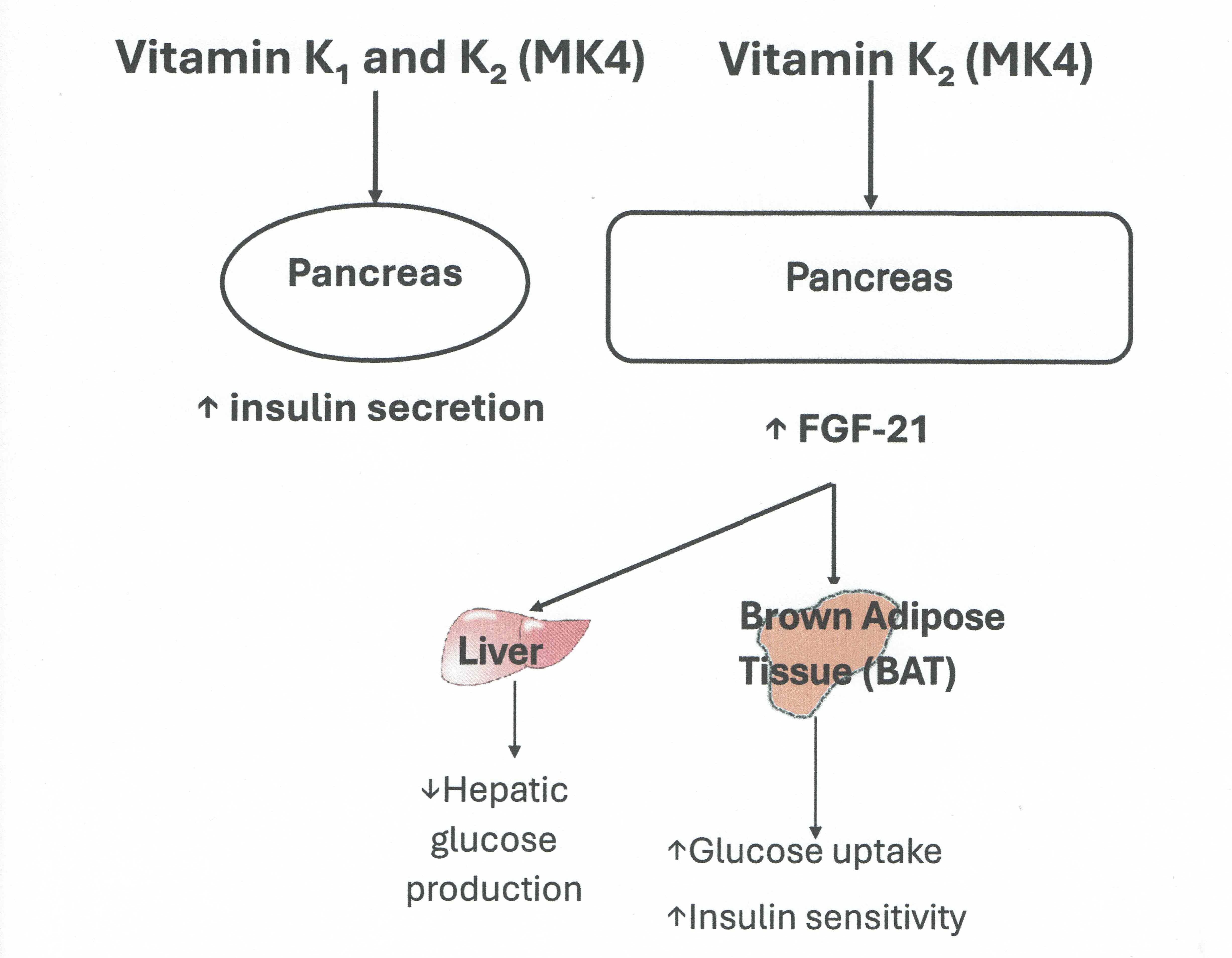
Introduction: We hypothesised that vitamin K (VK) may have potential effect on insulin secretion and FGF-19 and FGF 21 may modulate the vitamin K/insulin pathway. We investigated whether vitamin K1 or K2 supplementation for 18 months can affect insulin secretion and FGF19 and FGF21 production. Methods: We conducted exploratory analyses using stored samples from an 18-month randomised double-blind placebo controlled trial of VK1 (1 mg/day) or VK2 (menaquinone-4, MK4 45 mg/day)) in 105 post-menopausal women with osteoporosis (PMO) aged between 55-85 years which looked at the effect of VK supplementation on bone mineral density. In the current study, plasma insulin (primary outcome), FGF19 and FGF21 (secondary outcomes) were measured at baseline, 6 and 18 months. Results: Plasma insulin at 6 and 18 months increased significantly compared to baseline value in both treatment arms (VK1 and VK2 (MK4) ) (Median Insulin [IQR] VK1: baseline : 41.2 [29.3, 54.3] pmol/L, 6 months: 59.7 [37.8, 89.5] pmol/L p<0.001, 18 months: 54.3[43.5, 73] pmol/L (p= 0.05), VK2 (MK4) arm (Median Insulin [IQR]: baseline: 44.3[30.6, 60.9], 6 months: 63.2[43.5, 97] pmol/L p=0.011, 18 months: 54.2[40.7, 103.5] pmol/L p=0.05) in within-group analyses. No significant changes were seen in the placebo group. Circulating FGF21 tended to be higher at 6 months (p=0.045) compared to baseline following VK2 (MK4) only. Conclusions: Improving VK status in post-menopausal women may improve insulin secretion. Our data suggest that MK4’s effect on the insulin axis may be mediated, at least in part, by FGF21. Further studies are needed for confirmation.