

Submitted:
09 December 2025
Posted:
10 December 2025
You are already at the latest version
Abstract
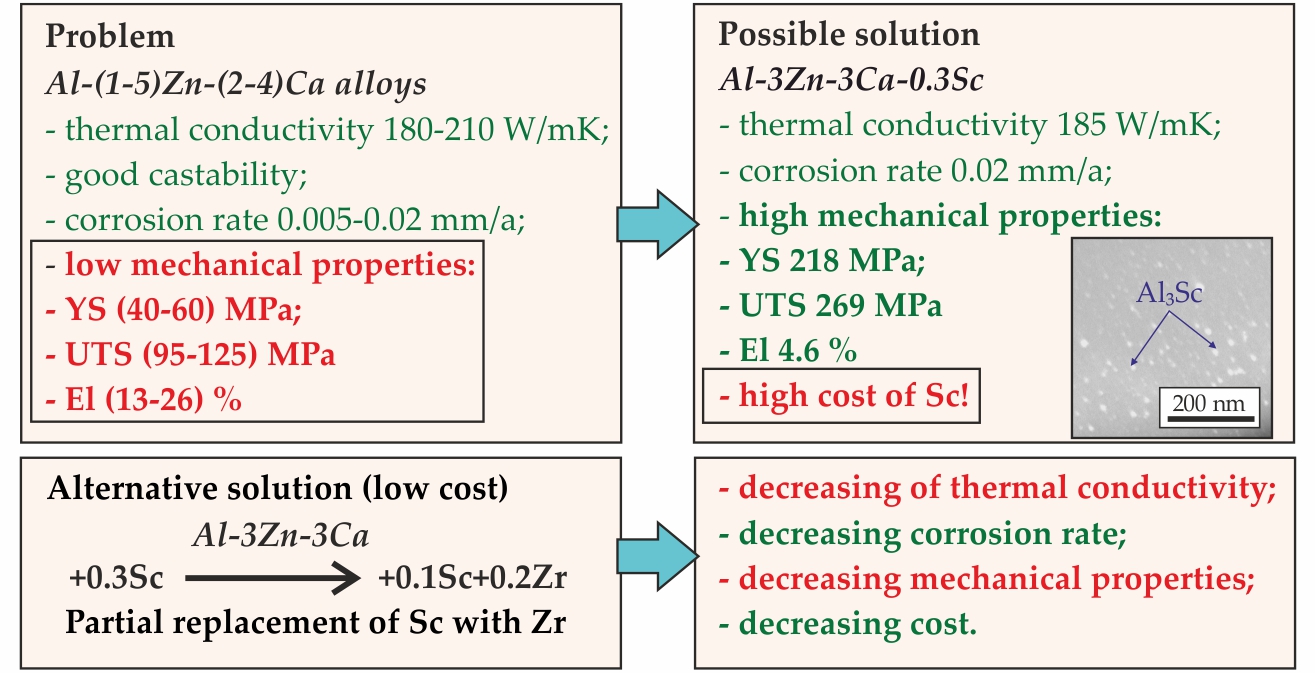
Al–Zn–Ca alloys are good candidates for industrial electronics and electric vehicles due to their high thermal conductivity, castability, and corrosion resistance, but their strength requires improvement. This study investigates how Sc and Zr additions affect the microstructure, thermal, mechanical, and corrosion properties of an Al–3wt%Zn–3wt%Ca base alloy. Microstructural analysis showed that substituting Sc with Zr did not drastically alter the phase composition but changed the elemental distribution: Sc was uniform, while Zr segregated to dendritic cores. Zr addition also refined the grain size from 488 to 338 μm. An optimal aging treatment at 300 °C for 3 hours was established, which enhanced hardness for all alloys via precipitation of Al3Sc/Al3(Sc,Zr) particles. However, this Zr substitution reduced thermal conductivity (from 184.7 to 168.0 W/mK) and ultimate tensile strength (from 269 to 206 MPa), though it improved elongation at fracture (from 4.6 to 7.1%). All aged alloys exhibited high corrosion resistance in 5.7% NaCl + 0.3% H2O2 solution, with Zr-containing variants showing a lower corrosion rate and better pitting resistance. The study confirms the potential of tuning Sc/Zr ratios in Al–Zn–Ca alloys to achieve a favorable balance of strength, ductility, thermal conductivity, and corrosion resistance.
Keywords:
aluminum alloys
; thermal conductivity
; phase composition
; Sc addition
; Zr addition
; heat treatment
; tensile test
; corrosion resistance
Copyright: This open access article is published under a Creative Commons CC BY 4.0 license, which permit the free download, distribution, and reuse, provided that the author and preprint are cited in any reuse.


