

Submitted:
09 December 2025
Posted:
10 December 2025
You are already at the latest version
Abstract
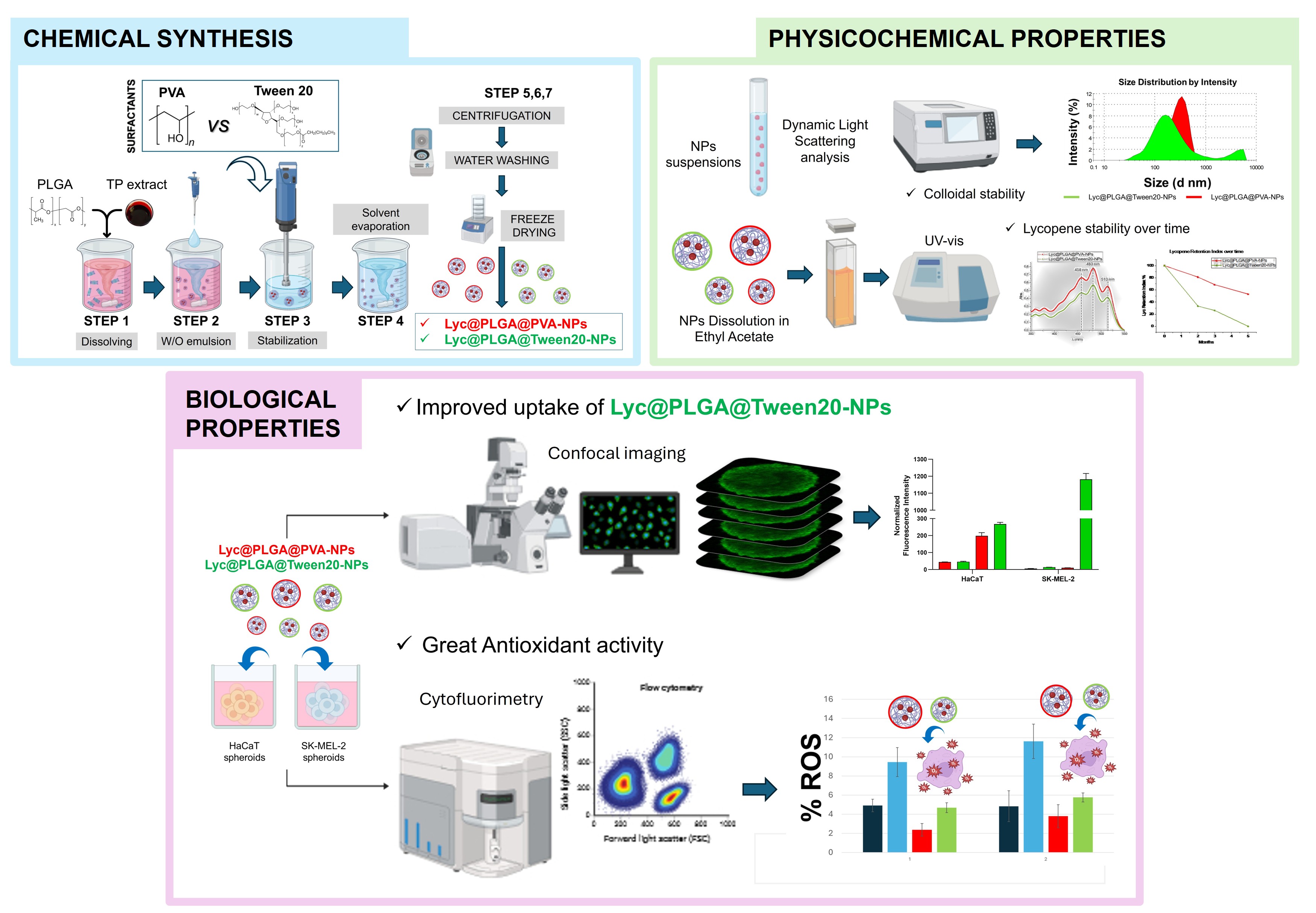
There is a growing demand for plant-derived antioxidants to replace synthetic ones in skincare applications. Phytochemicals are characterized by certain limitations, including poor bioavailability and chemical instability, which affect their industrial exploitation. Tomato peel extract has been used as a source of lycopene, which is renowned for its an-tioxidant properties. To improve the bioavailability of extracted lycopene, polymeric (Poly-lactic-co-glycolic acid) nano-carriers were synthesized by comparing two non-ionic surfactants, Polyvinyl alcohol and Tween 20. The impact of surfactants has been studied by evaluating: i) colloidal stability determined by Dynamic Light Scattering; ii) lycopene retention and bioactivity over time, as measured by spectrophotometric assays; iii) biolog-ical interactions on 2D and 3D culture keratinocytes and melanocytes cells. It was found that both surfactants enable the formation of stable lycopene-loaded nanoparticles sus-pensions; however, greater colloidal stability was exhibited by nanoparticles prepared with Tween 20. PVA, on the other hand, provided greater nanoparticles stability in terms of loaded lycopene retention and antioxidant activity. Tween 20 surfactant improves in-ternalization of lycopene-loaded nanoparticles in human skin spheroids. It was demon-strated that both surfactants provided excellent intracellular antioxidant activity of lyco-pene. This was observed in keratinocytes, melanocytes, adherent cells and spheroids, suggesting interesting skincare applications.
Keywords:
lycopene
; PLGA nanoparticles
; non-ionic surfactants
; human skin spheroids
Copyright: This open access article is published under a Creative Commons CC BY 4.0 license, which permit the free download, distribution, and reuse, provided that the author and preprint are cited in any reuse.


