

Submitted:
09 December 2025
Posted:
10 December 2025
You are already at the latest version
Abstract
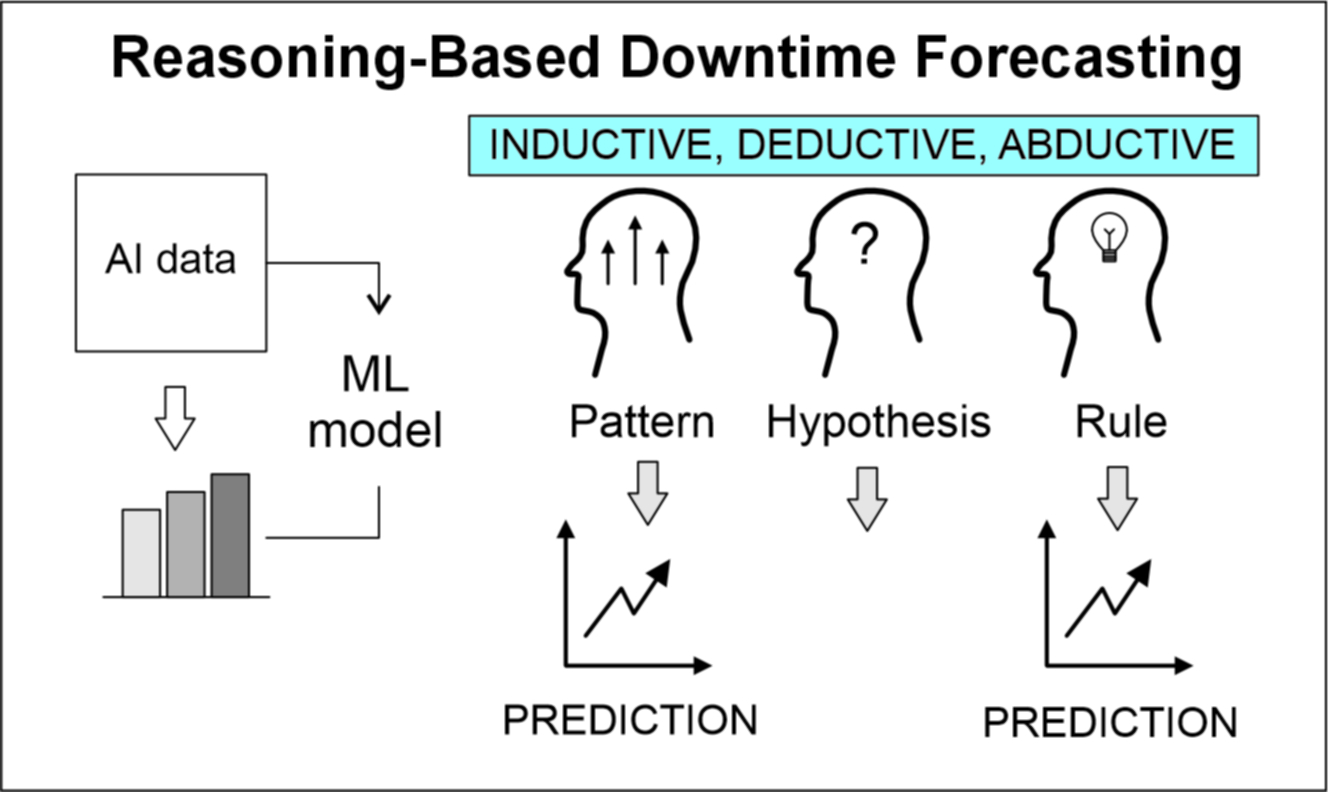
This study proposes an analytical framework that converts operational records into structured research hypotheses, offering a systematic approach to understanding failure mechanisms. The framework combines descriptive statistics, time-series analysis, linear regression, and machine-learning techniques to identify patterns, irregularities, and residual model behavior. Within the scope of this research, the framework was implemented as executable Python code and tested on a representative downtime category observed in a real industrial machine. The application demonstrated how analytical outputs can be translated into inductive, deductive, and abductive hypotheses that support deeper exploration of failure dynamics. The findings indicate the need for a comprehensive, multifaceted analytical approach to interpreting and forecasting machine downtimes, emphasizing that combining quantitative insights with the development of reasoning-based hypotheses increases the explainability and methodological rigor of the results..
Keywords:
reasoning models
; downtime forecasting
; machine systems
Copyright: This open access article is published under a Creative Commons CC BY 4.0 license, which permit the free download, distribution, and reuse, provided that the author and preprint are cited in any reuse.


