

Submitted:
03 December 2025
Posted:
10 December 2025
You are already at the latest version
Abstract
Boltzmann entropy is the central measure of microscopic disorder in thermodynamics, but it does not describe how open systems develop and maintain long-lived structure. Stars, planets, biospheres, and civilizations all undergo irreversible changes in regulation, coherence, and stability over time. These developmental paths are not captured by microstate multiplicity alone.
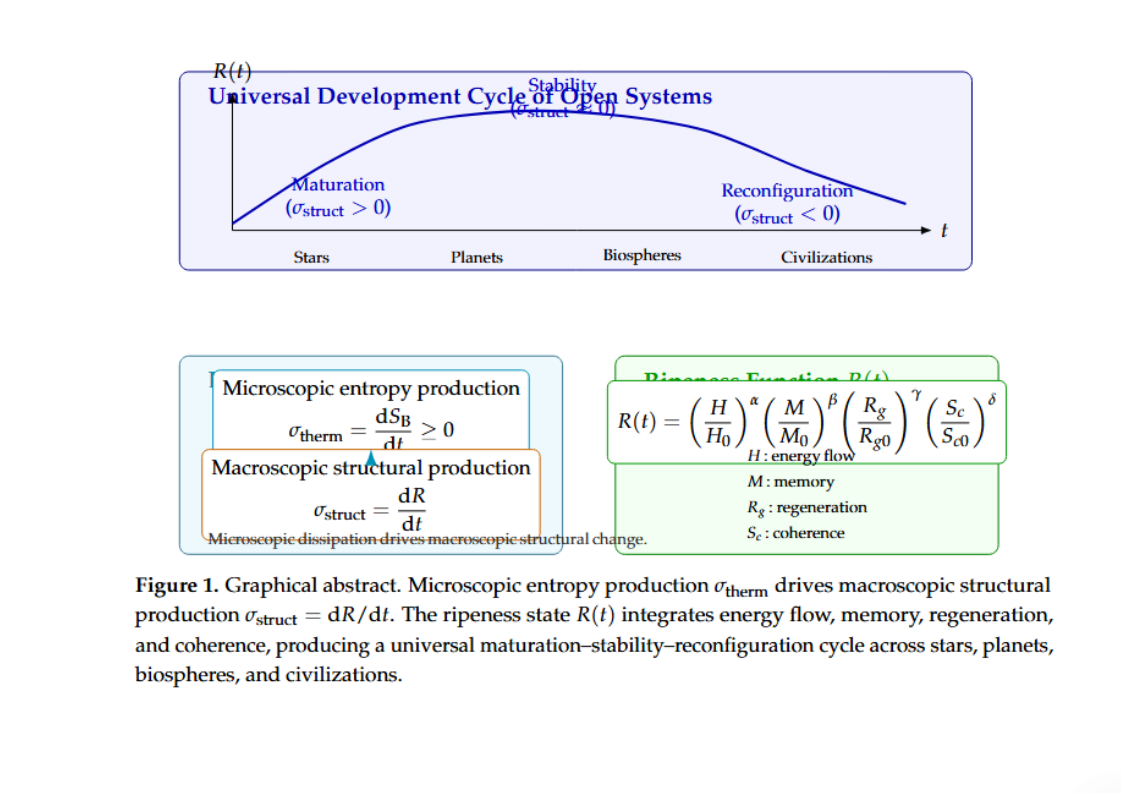
This article introduces a complementary macrodynamic quantity, the structural production rate, defined as the time derivative of a ripeness state that combines internal energy flow, structural memory, regenerative capacity, and systemic coherence. The sign of this rate identifies three universal phases across scales: maturation, stability, and reconfiguration.
The study formalizes a ripeness function for four domains: stellar evolution, planetary habitability, biospheric stability, and civilizational dynamics. Each component is mapped to measurable proxies, such as stellar oscillation properties, crustal recycling rates, genomic redundancy, and institutional memory indices. From this, the paper derived falsifiable predictions that can be tested with current and upcoming missions and datasets, including space-based asteroseismology, ice-moon plume chemistry, paleogenomic reconstructions, and long-term social coherence indices.
In this framing, entropy does not merely represent disorder. Instead, it defines the gradient that forces systems to develop, stabilize, and eventually reconfigure under persistent energy flow. The structural production framework provides a unified quantitative lens for comparative systems science and cross-domain prediction.
Keywords:
non-equilibrium thermodynamics
; entropy production
; structural production
; ripeness
; critical slowing down
; complex systems
; tipping points
; open systems
Copyright: This open access article is published under a Creative Commons CC BY 4.0 license, which permit the free download, distribution, and reuse, provided that the author and preprint are cited in any reuse.


