

Submitted:
08 December 2025
Posted:
09 December 2025
You are already at the latest version
Abstract
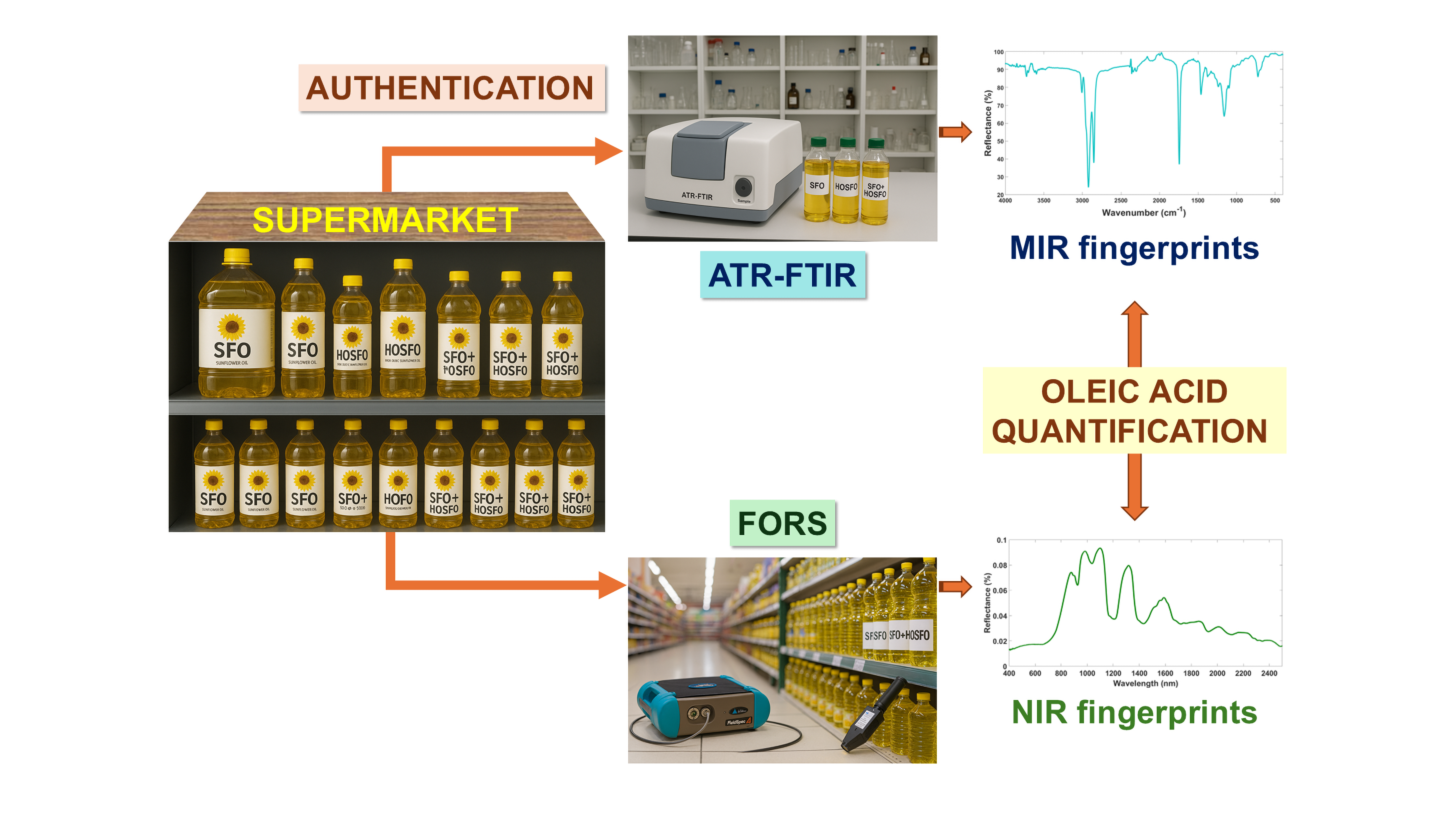
The composition of sunflower oil, rich in fatty acids, largely depends on the seed variety. Commercial sunflower oils are classified as low (SFO), medium (MOSFO), and high (HOSFO) oleic, distinguished by their oleic and linoleic acid content. Higher oleic acid levels enhance health benefits and oxidative stability. Due to their differing market values, ensuring the correct quality and authenticity of these oils is essential. Unsupervised chemometric methods have been applied to visualize the natural behaviour of sunflower oils while supervised models have been used for authentication based on Attenuated Total Reflection Fourier Transform Infrared Spectroscopy (ATR FTIR) fingerprints obtained from a benchtop spectrometer. Authentication of MOSFO is particularly challenging because of its wider oleic acid range (43.1 74.9%) and production via genetic modification or blending SFO/HOSFO. To address this, two multivariable PLS R regression models were developed using ATR FT IR and Fibre Optic Reflectance Spectroscopy (FORS) fingerprints, the latter obtained with a portable, cost-effective device. The results indicate that FORS could be used as a rapid quality control tool for on-site quantification. In contrast, ATR FT IR is a more accurate tool for confirmation and quantification, achieving excellent results (RPD = 7.09 and RER = 17.82).
Keywords:
sunflower oil
; high oleic sunflower oil
; ATR-FTIR
; FORS
; oleic acid
Copyright: This open access article is published under a Creative Commons CC BY 4.0 license, which permit the free download, distribution, and reuse, provided that the author and preprint are cited in any reuse.


