

Submitted:
06 December 2025
Posted:
09 December 2025
You are already at the latest version
Abstract
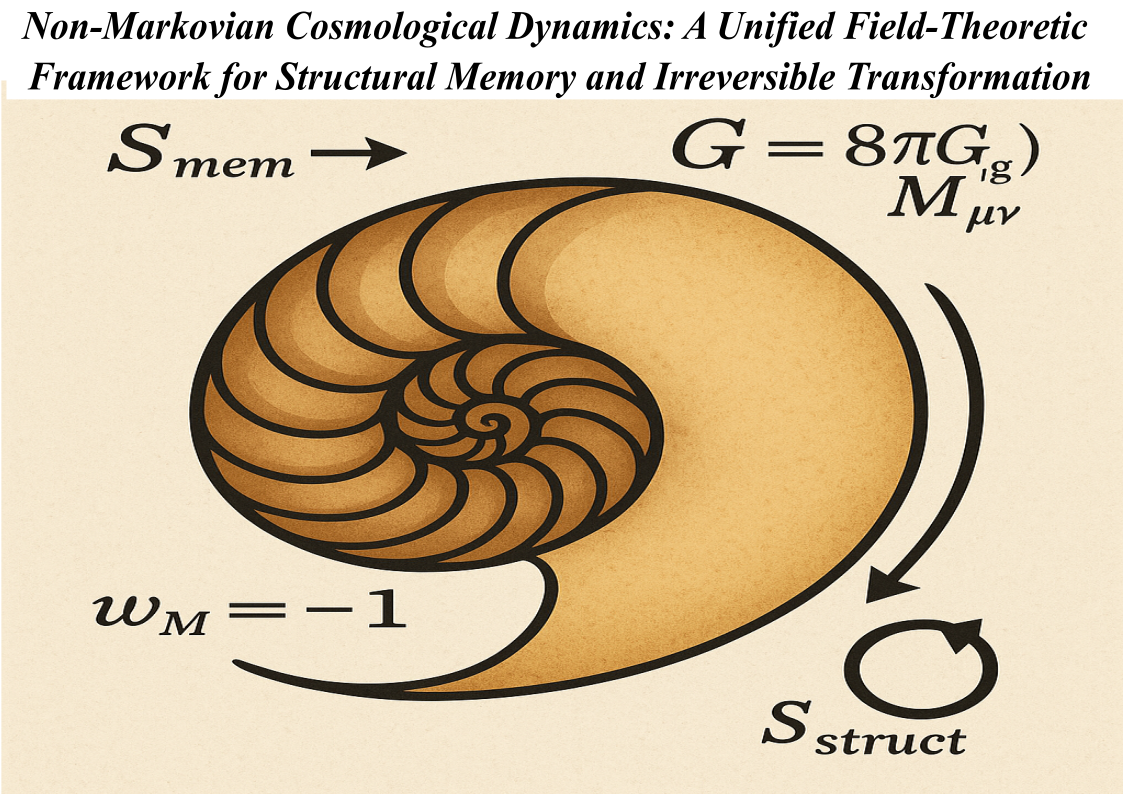
This paper presents a conservative, causal, nonlocal extension of General Relativity in which the dark sector emerges not from new particles or a fundamental cosmological constant, but from geometric memory: a history-dependent contribution to the stress--energy tensor. The action includes a covariant nonlocal functional \( S_{\mathrm{mem}} \) that couples curvature at separated spacetime points through a retarded, causal kernel \( U(\sigma) \)built from Synge's world function. This implements the principle that spacetime retains a weighted record of its past curvature configurations. Varying the full action yields modified Einstein equations \( G_{\mu\nu} = 8\pi G\bigl(T_{\mu\nu} + M_{\mu\nu}[g]\bigr) \), where the Einstein tensor is unchanged and all novel physics is confined to a new, covariantly conserved memory tensor \( M_{\mu\nu} \) that introduces no additional propagating gravitational degrees of freedom or ghosts, so the kinetic structure of GR is fully preserved. In a cosmological background, the memory contribution acts as an effective dark energy component with \( w_M(z) \approx -1 + \mathcal{O}\!\bigl(1/(H_0 \tau_c)\bigr) \) and present–day density \( \rho_M(t_0) \approx \lambda\, \alpha\, H_0^2 \). Here \( \alpha \sim 10^3$--$10^4 \) is sourced by the nonlinear growth of Weyl curvature, and \( \lambda \sim 10^{-4} \)–\( 10^{-2} \) is a single small coupling. Together, these produce the observed dark--energy scale without fine–tuning, turning the coincidence problem into a natural consequence of cosmological–scale memory. Perturbations of \( M_{\mu\nu} \) supply an effective dark–matter–like component whose clustering is tied to tidal history rather than instantaneous density, yielding specific deviations from \( \Lambda \)CDM such as suppressed \( S_8 \). Because the field equations are of Volterra type, solutions require an initial history segment rather than a single initial state, and spatial variations in this primordial history generate persistent anisotropies in \( M_{\mu\nu} \), providing a controlled geometric mechanism for large–angle CMB anomalies and Hubble–dipole signatures that reframes them as fossil information rather than statistical outliers. The framework yields explicit, quantitative falsification criteria, including measurable evolution in \( w_M(z) \), definite suppression in \( S_8 \), enhanced lensing around cosmic voids, and characteristic CMB–large–scale–structure phase correlations. The model is deliberately brittle: a single decisive failure in any of these predictions rules it out, while success would establish causal structural memory as a minimal, testable route to unifying dark–energy and dark–matter phenomenology without modifying the kinetic structure of Einstein's theory.
Keywords:
cosmology
; nonlocal gravity
; dark energy
; dark matter
; memory kernel
; structural inheritance
; CMB anomalies
Copyright: This open access article is published under a Creative Commons CC BY 4.0 license, which permit the free download, distribution, and reuse, provided that the author and preprint are cited in any reuse.


