

Submitted:
05 December 2025
Posted:
08 December 2025
You are already at the latest version
Abstract
The Chinese pavilion is a poetic architectural form, and whenever a pavilion appears in a modern architectural complex, the spirit of Chinese classical culture is displayed. This study takes seven Chinese pavilions on the campus of Jiangnan University as examples and uses field investigation and architectural phenomenology methods to analyze the architectural features of Chinese pavilions and the poetic experience they bring. This study reached three conclusions. One is that the architectural attributes of Chinese pa-vilions are manifested as the unity of natural scenery and cultural symbols. Its archi-tectural design philosophy reflects the Chinese people's pursuit of natural beauty and noble morality. The second is that the spiritual attributes of Chinese pavilions are man-ifested in the "Fourfold" structure of sky, earth, sages and mortals. Chinese pavilions integrate secular life and life beliefs, providing mortal with a lofty spiritual experience. Thirdly, the Chinese pavilion is not only a standalone building, but also an integrated space that is organically combined with the natural environment. The Chinese pavilion must be surrounded by "three elements" - trees, water and mountains. This is a typical manifestation of the artistic consistency between Chinese landscape painting and Chinese architecture. The results of this study will deepen people's understanding of Chinese pavilions and provide new theoretical perspective for researchers to further study this type of Chinese architecture.
Keywords:
Chinese pavilion
; poetic experience
; architectural phenomenology
; architectural form
; "Fourfold" structure
1. Introduction
1.1. Background
The Chinese pavilion is the most poetic form of traditional Chinese architecture, blending literary narratives with the natural environment and providing an outdoor resting place for the refinement of the soul (Figure 1). The most famous pavilions in Chinese culture are all associated with literature and poetry. They fall into two categories. One type is the pavilion described in literary works, such as the "Lanting pavilion" in Wang Xizhi's Lanting pavilion Preface of the Eastern Jin Dynasty, the " The Old Drunkard’s Pavilion" in Ouyang Xiu's The Old Drunkard’s Pavilion notes of the Song Dynasty, the "Canglang Pavilion" in Su Shunqin's Canglang Pavilion notes of the Song Dynasty, and the "Huxin Pavilion" in Zhang Dai's Viewing Snow at Huxin Pavilion of the Ming Dynasty. Another type is the pavilion named after a famous poem, such as: The "Aiwan Pavilion" is named after Du Mu's poem Mountain Walk, the "Taoran Pavilion" is named after Bai Juyi's poem Drinking Wine with Meng De and Making a Later Appointment, the "Chenxiang Pavilion" is named after Li Bai's poem Qingping Tiao, and the "Lixia Pavilion" is named after Du Fu's poem Accompanying Li Beihai to a Banquet at Lixia Pavilion.
If we look at Chinese pavilions from the perspective of Heidegger's phenomenological thought on architecture, we can discover a problem that previous researchers have not noticed, that is, the "poetic dwelling" of Chinese pavilions is derived from the "Fourfold" composed of "sky, earth, sages and men". It is similar in form to Heidegger's "Fourfold" (sky, earth, divinities, man), but differs in the transcendence of life, which is also the difference between Chinese and Western architectural cultures and philosophies. This study will illustrate this point through case studies of seven Chinese pavilions on the campus of Jiangnan University.
Jiangnan University is located in Wuxi, Jiangsu Province, China, which was part of the historical South of the Yangtze region. The design concept of South of the Yangtze region gardens is reflected in the campus environment. There are seven typical Chinese pavilions on campus, namely Qingquan Pavilion, Jing Si Pavilion, Nanyang Pavilion, Shi Ji Pavilion, Hao Shang Pavilion, Yang Wu Pavilion and Ai Xiao Pavilion. Although built in the early 21st century, these pavilions fully inherit the architectural ideas of traditional Chinese pavilions. They are specimens of Chinese pavilions located on modern university campuses and have significant research value.
1.2. Literature Review
1.2.1. Overview of Studies in China
Chinese scholars are delving deeper into Chinese pavilions. Early research focused mainly on the aesthetics of pavilions in literary texts [1,2,3,4,5], pavilions in Chinese paintings [6,7], the construction techniques of pavilions [8,9,10], the painting techniques of pavilions [11], the landscape art of pavilions [12], and comparisons between Chinese and Western pavilions [13]. The current research has further developed into the humanistic expression of pavilions [14,15,16,17], spatial narratives [18,19,20,21], digital translation of pavilion structures [22], the relationship between pavilions and human experiences [23], and studies of Chinese-style pavilions abroad [24].
Particularly notable is that one researcher has begun to interpret Chinese pavilions from a phenomenological perspective. His name is Chen Xiaowen [25], a researcher of Heidegger's phenomenological works. He interprets Ouyang Xiu's The Old Drunkard’s Pavilion notes with Heidegger's theory of "state-of-mind", revealing the emotions expressed by Ouyang Xiu in his description of the Chinese pavilion, which is the original state of man's openness to the world. He believes that The Old Drunkard’s Pavilion notes conveys the meaning of existence through poetic language, which echoes Heidegger's poetic philosophy. His research is about interpreting literary works with pavilions as the subject, but his use of phenomenological methods to describe the experience of people in pavilions is an important inspiration for this study. The significance of this study lies in summarizing the architectural form characteristics and cultural psychological structure of pavilions through the phenomenological interpretation of Chinese pavilions in reality.
In China, the study of architectural phenomenology began with the translation of Heidegger's Building, Dwelling, and Thinking. Heidegger's article was given in a lecture on "Man and Space" in Darmstadt, Germany on August 5, 1951. Not only is it widely known in philosophy, but it has also aroused great interest in architecture, initiating the study of architectural phenomenology. In the preface to his book The Spirit of Place: Towards the Phenomenology of Architecture, architect and theorist Norberg-Schulz first thanked Heidegger [26].
In the Chinese architectural community, Mr. Chen Bocong also translated Heidegger's Building, Dwelling, Thinking and published it in the 47th issue of the Architect magazine (published in August 1992), which aroused widespread interest in the architectural community, but "due to professional barriers and Heidegger's unique way of thinking and writing, most people said the article was difficult to understand but interesting." [27] As a result, Deng Xiaomang, a renowned contemporary Chinese philosopher, interpreted Heidegger's essay sentence by sentence "so that beginners can enter Heidegger's realm of thought more easily" [28].This is Heidegger's 'Building, Dwelling, Thinking' Sentence Reading (published in German Philosophy 2009 and later included in Western Philosophy Exploration: Deng Xiaomang's Self-Selected Works). Deng Xiaomang's article provides extremely favorable conditions for Chinese readers, especially those in the field of architecture, to gain a deeper understanding of Heidegger's architectural phenomenology, and also provides a theoretical basis for this study.
In Building, Dwelling, Thinking Heidegger expounded the original meaning of architecture, revealed the essence of dwelling, and initiated the phenomenological thought of architecture. Citing Holderlin's poem Man dwells poetically, he philosophically expounds the realm of man "dwells poetically on the earth", providing an understandable intellectual resource for the poetic dwelling life of modern people.
The pavilions in China are precisely the buildings that allow people to "dwell poetically on the earth". This study will show that the Chinese experience of the pavilion resonates with Heidegger's phenomenological thought of architecture, a profound exchange of Chinese and Western architectural cultures in the phenomenological perspective.
1.2.2. Overview of International Research
International research on Chinese pavilions has also begun to increase. There have been some in-depth studies in recent years. Yulia Ivashko [29] analyzed the origin of the small architectural form of the Chinese pavilion, summarized its functional, planning and artistic features, and sorted out the most representative roof forms, which she considers to be the embodiment of the national characteristics of the Chinese pavilion. The article also examines the reasons for the revival of the "Chinoiserie" style in modern landscape design. Li Sheng-cai and Tuo Song [30] analyzed a famous case, namely the Feiyun Pavilion in China. The challenging problem of correcting tilted three-dimensional historical wooden structures is discussed. Zexi Zhang [31] analyzed the Xiangming Pavilion in the Yuci area of China and summarized its architectural features of "kiln-House isomorphism" and cultural Isomerism.
But these studies did not distinguish between the two types of Chinese pavilions. In fact, the word "pavilion" in English corresponds to two types of Chinese pavilions. One is a pavilion with a roof and no walls, which is called "Ting" in Chinese, and the other is a pavilion with a roof and walls, which is called "Ge" in Chinese. The Chinese pavilion discussed in this study is the former, namely "Ting".
Moreover, few studies have been conducted from a phenomenological perspective on the relationship between Chinese pavilions and human living experience, especially the poetic experience that pavilions in modern architectural complexes offer.
In general, international research on Chinese pavilions has mainly focused on historical verification of architecture, description of architectural form, and explanation of architectural culture. Chinese scholars are making more and more achievements in the study of Chinese pavilions, but there are still certain limitations. First of all, there is a lack of attention to the real experience that Chinese pavilions offer, namely the "Fourfold" phenomenological experience. Researchers merely view the pavilion as a building and make objective analyses and judgments, rather than regarding the Chinese pavilion as a living entity where natural and human elements blend together. Secondly, it is regrettable that the current research is all about the ancient relics of pavilions, and there is a lack of research on the newly built Chinese pavilions. It is the newly built pavilions that inherit the form and spirit of the Chinese pavilions, convey the ideal poetic living realm of Chinese culture in the modern architectural environment, and achieve spiritual resonance between modern people and ancient people, which is the reason for the never-ending vitality of the Chinese pavilions.
1.3. Research Objectives and Questions
This study focuses on seven Chinese pavilions at Jiangnan University. By examining the form and meaning of each pavilion, summarize the characteristics of Chinese pavilion architecture. Then, based on the cultural symbols in the pavilions, explore the humanistic "poetic" connotations of these pavilions.
This study reveals the "Nature and Humanity" model in architectural attributes and the "Fourfold" structure of "sky, earth, sages, and mortals" in spiritual attributes of Chinese pavilions, providing research ideas for exploring similar Chinese buildings and theoretical support for modern university campus architecture to inherit the poetic realm of Chinese culture.
2. Materials and Methods
2.1. Overview of the Study Area
Jiangnan University is located in Wuxi, Jiangsu Province, China. This city connects to Taihu Lake and is a water town with a long history, beautiful natural environment and a developed economy. The campus of Jiangnan University, which covers 210 hectares, is a campus dominated by modern architecture and incorporates elements of classical Chinese architecture (Figure 2). There are seven Chinese pavilions on campus, located in the student dormitory area, the teaching area and the campus park. These pavilions, with the classical characteristics of Chinese pavilions, convey the spirit of Chinese culture and are important carriers of the campus culture of Jiangnan University.
Chinese pavilions come in square, hexagonal, octagonal and circular shapes. There are three types of pavilions on the campus of Jiangnan University, but no round ones. There are four square pavilions, namely Qingquan Pavilion, Nanyang Pavilion, Yangwu Pavilion and Haoshang Pavilion; There are two hexagonal pavilions, namely Jing Si Pavilion and Shi Ji Pavilion. There is only one octagonal pavilion, and it is called Aixiao Pavilion. The seven pavilions are different in form and cultural meaning. They express Chinese aesthetics and moral concepts from various angles. Heidegger's idea of the "Fourfold" (sky, earth, divinities, mortals) can also be used to analyze Chinese pavilions. But the difference is that the "divinities" in Heidegger's "Fourfold" are "sages" in the Chinese pavilion culture, including philosophers, historians, writers, poets and other outstanding historical figures. This study will elaborate on these features of Chinese pavilions.
2.2. Research Methodology
2.2.1. Literature-Analysis Method
At the beginning of the research, MDPI, Web of Science, CNKI and Wanfang, were used as platforms, Google Scholar were used as tools to carefully sort out literature information related to Chinese pavilions in books and journals, and to verify the historical allusions of the seven pavilions. These works provide basic information for discussing the architectural features and cultural meanings of Chinese pavilions.
2.2.2. Field-Survey Method
The geographical scope of this study is the campus of Jiangnan University. The subjects of the study were seven typical Chinese pavilions. The first step was an investigation into the technical aspects of the pavilions, with measurements taken and photographs taken to reveal their form and appearance, architectural decoration, and surrounding environment. Next, an investigation into the cultural background of these buildings was conducted by observing and documenting cultural objects such as plaques, couplets, and paintings in the pavilions, and conducting detailed research on their cultural connotations. Then there is an investigation of the visiting experience, interviewing teachers, students, tourists and other visitors to understand their personal feelings about Chinese pavilions, combining written and oral materials. Through field investigation methods, this study was able to conduct a detailed study of the architectural phenomena of the seven pavilions.
2.2.3. Inductive and Comparison Methods
In this study, the architectural features and cultural implications of these seven Chinese pavilions were compared to summarize the poetic and moral educational characteristics of Chinese pavilion architecture they embody. The seven pavilions were then compared with other famous pavilions in China to demonstrate that they fully inherited the traditional spirit of Chinese pavilions. This study systematically summarizes the architectural features, cultural implications, and living experiences of Chinese pavilions, and concludes the "Fourfold" cultural structure of Chinese pavilions. Particularly importantly, by comparing the "Fourfold" of Chinese pavilions with Heidegger's "Fourfold" idea of architecture, a comprehensive psychological model of architectural culture of Chinese pavilions was revealed.
2.2.4. Case-Analysis Method
There are many descriptions of pavilions in Chinese literary works, but to truly understand the rich experience that Chinese pavilions bring to people, empirical analysis of architectural cases is necessary. Therefore, this study takes seven Chinese pavilions on the campus of Jiangnan University as examples to analyze their architectural form characteristics and cultural significance, thereby revealing the design rules and architectural cultural psychological patterns contained in Chinese pavilions.
2.2.5. Phenomenology Method
The phenomenological approach is a qualitative research method proposed by Husserl, which focuses on the direct experience of human beings, requires facing things themselves, suspending preconceptions, being intuitive to meaning, and seeing the essence. The current architecture also employs the phenomenological method to some extent. This study, which is about the form and culture of Chinese pavilions, must start from the most direct cultural experience of the Chinese people and therefore particularly requires the phenomenology method.
3. Results
3.1. Design Rules of Chinese Pavilions: The Unity of Natural Scenery and Cultural Symbols
3.1.1. The Formal Characteristics of Chinese Pavilions
The Chinese pavilion has a roof but no walls; it relies on columns to support the roof. A person stands in the pavilion and looks around, and the view is very wide. The roofs of the Chinese pavilions involved in this study are square, hexagonal and octagonal. A square pavilion requires four pillars to support it. Likewise, a hexagonal pavilion needs six pillars, and an octagonal pavilion needs eight pillars.
- A square pavilion
The square has a moral meaning in Chinese culture, symbolizing a person of good character and fairness in doing things. The square pavilion is the basic form of Chinese pavilions (Figure 3).
There are four square pavilions on the campus of Jiangnan University, namely Qingquan Pavilion, Nanyang Pavilion, Haoshang Pavilion and Yangwu Pavilion.
- 1)
- Qingquan Pavilion
Qingquan Pavilion is located on Taishan Road in the campus, opposite the First Cafeteria of Jiangnan University. There is a forest to the south and a pond to the west. Its north side, though close to the noisy road, still gives a sense of tranquility (Figure 4).
- 2)
- Nanyang Pavilion
Nanyang Pavilion is located on the high ground of the garden north of the library of Jiangnan University. It is slightly larger than Qingquan Pavilion. Sitting in the pavilion, one can overlook the flowers and plants on campus and look up at the library. It is a place suitable for reading and communication (Figure 5).
- 3)
- Haoshang Pavilion
Haoshang Pavilion is located in the square of the northern part of the campus. To its north is the student dormitory area, and to its east, west and south are the commercial areas. It is built on a 1.5-meter high platform, next to a river with two Bridges on both sides of it. The pavilion is slightly larger in size than the Nanyang Pavilion (Figure 6).
- 4)
- Yangwu Pavilion
Yangwu Pavilion is located in Little Lihu Lake Park in the middle of the campus. It is the largest, four times the size of the Haoshang Pavilion, and can accommodate gatherings of more than 20 people. To its north is the Little Lihu Lake, and to its east, south and west are thick and quiet woods. It hides in the woods and is hard to be discovered by passers-by on the road (Figure 7).
- 2.
- Hexagonal pavilion
The number “six” is also popular in Chinese culture as it implies happiness and smoothness. Mathematically, both the regular hexagon and the square are important Mosaic figures. Hexagonal pavilions are more lively and less serious than square ones.
- 1)
- The Jingsi Pavilion
Jingsi Pavilion is located on Taishan Road, about 15 meters from Qingquan Pavilion. The pavilion is built on a rockery made of Taihu stones, which is about 4 meters high. Due to the limited space of the rockery, the Jingsi Pavilion is the smallest of the seven. But its roof is exquisite, with six eaves like bird wings. There is a clear pond at the foot of the rockery on which the pavilion stands. The pavilion, though small, is the most poetic (Figure 8). It is as described in the famous Song Dynasty literary figure Ouyang Xiu's The Old Drunkard’s Pavilion notes: "There is a pavilion that appears above the spring like the wings of a bird."
- 2)
- Shiji Pavilion
Shiji Pavilion is located in the south-central part of the campus of Jiangnan University, southwest of the library. To its north is Little Lihu Lake and Qushui Bridge. It is more than twice the size of the Jingsi Pavilion (Figure 9).
- 3)
- Octagonal pavilion
“Eight” is also an auspicious number in Chinese culture, symbolizing access to all directions. "Four directions" is also expanded in China to "eight directions", namely east, south, west, north, southeast, southwest, northwest and northeast. So the octagonal Chinese pavilion includes all eight directions of geography. The famous Lanting Pavilion in Chinese history is an octagonal pavilion.
Of the seven pavilions in this study, only the Aixiao Pavilion is an octagonal pavilion (Figure 10). It is located on the top of Little Lihu Lake Park in the campus. Standing in the pavilion, one can overlook the Little Lihu Lake. Eight pillars form eight frames, and the view looks like eight oil paintings.
The main data of the seven pavilions' forms are as follows (Table 1).
3.1.2. Cultural Symbols of Chinese Pavilions
Chinese pavilions are not only buildings for people to rest, but also places to showcase classical culture. Each pavilion has a name derived from a Chinese cultural allusion. The names of the pavilions are inscribed on plaques, which are hung under the eaves of the pavilions. In addition, some pavilions are adorned with couplets, and the lines in the couplets convey more meanings of the pavilion. Some pavilions also have stone tablets beside them, which record the origin of the pavilion's construction. The pavilion is not only a building but also a carrier of Chinese aesthetics and moral ideals.
- 1
- Chinese pavilions are cultural symbols that express the beauty of nature
- 1)
- The meaning of Qingquan Pavilion: Clear spring water
The name of the Qingquan Pavilion comes from a poem by Wang Wei, a poet of the Tang Dynasty in China, titled "Mountain Dwelling on an Autumn Evening", in which it is written: "The bright moonlight spills over the pine forest, and the clear spring water flows over the stones." Choosing the word "clear spring(qingquan)" from this line of poetry to name the pavilion (Figure 11) evokes the beauty and imagery of the poem and resonates with the ancients. The stones, ponds and trees around the Clear Spring Pavilion have become the material counterparts of the ancient poem in reality (Figure 12). Some of China's famous pavilions are named after famous lines of poetry. For example, the "Aiwan Pavilion" in Yuelu Mountain, Changsha City, Hunan Province, is named from the poem Mountain Walk by Du Mu, a poet of the Tang Dynasty, which reads, "I stop my carriage to love the maple forest at dusk, the frosted leaves are redder than the flowers in February." The natural scenery in the lines adds a touch of natural beauty to the pavilion. The Qingquan Pavilion was named in the same way.
- 2)
- The meaning of Aixiao Pavilion: Love the morning, love college days
The pavilion was funded by alumni of Jiangnan University (Figure 13). "Aixiao" has two meanings. One is literal meaning, that is, to love the early morning time; Another meaning is the alumni 'nostalgia for their youth at their Alma mater (Figure 14). There is a couplet (Figure 15) hanging in the Ai Xiao Pavilion, which describes the natural scenery of the school and the city: "Sitting on the mountain, listening to the sound of the Yangtze River, looking at the blue waves of Taihu Lake, standing between the sky and the earth; Rise with the sun, sleep with the moon, read in the clouds, move forward in the wind and rain." The mountains, waters, the sun, the moon, the sky, the clouds, the earth, the wind and the rain mentioned in the couplet are all common figures in ancient Chinese poetry, expressing people's love for nature.
- 2.
- Chinese pavilions are cultural symbols that express people's moral cultivation
- 1)
- The meaning of Jingsi pavilion: to encourage people to think quietly
Both Confucianism and Taoism in China emphasize a quiet state of mind, believing that only in quietness can one have clear thinking. In the Confucian classic The Great Learning, there is such a maxim: "When the mind is at peace, one can focus on a problem and think deeply about it." It is said in the classic Daoist book Tao Te Ching: "To reach the ultimate clarity of the mind, one must hold on to deep and constant tranquility." In Chinese culture, a person of refinement must be one who can think quietly. So the name of the Jingsi Pavilion is intended to encourage people to cultivate the quality of quiet thinking (Figure 16).
- 2)
- The meaning of Yangwu Pavilion: to nurture a person's integrity of justice
The name of the Yangwu Pavilion is derived from the famous saying of Mencius: "I am good at nurturing my noble spirit." Mencius is also a representative figure of Confucianism, and he and Confucius are collectively known as "Kongmencius". Their works were required for exams in ancient China. This statement by Mencius is well-known to all. The name of the pavilion is usually three Chinese characters, so the designer chose two characters from this sentence, "Cultivate me," to form the name of the pavilion. Outside the pavilion there is a wooden sign (Figure 17) with words on it that introduce these meanings of the pavilion and encourage people to cultivate righteousness.
- 3)
- The meaning of the Haoshang Pavilion: To be a wise and kind person
"Haoshang" is the place where Mencius debated with another philosopher, Hui Shi. They watched the fish together by the water and had an interesting discussion. Mencius exclaimed, "The fish in the water are so happy!" Hui Shi questioned him, "You are not a fish. How do you know the happiness of a fish?" Mencius asked Hui Shi in the same way: "Though I am not a fish, you are not me either. How can you suspect that I do not understand the happiness of a fish?" Hui Shi found that he could not refute Mencius because each person's feelings are only personal experiences. So he changed the question: "Where did you find the happiness of the fish?" Mencius replied, "I found it at this place on the Haoshang!" The conversation, which took place between two wise men, is so famous in Chinese history. The name of the Haoshang Pavilion reminds people of the story, as if they saw Mencius and Hui Shi debating here. Below Haoshang Pavilion there is a river with fish swimming, similar to the scenery of history. Through this historical story, the pavilion has taken on the meaning of encouraging people to cultivate wisdom. Inside the pavilion, there is a plaque with the words "Haoshang Ting" written in ancient Chinese seal script. On the pillar of the pavilion hung a couplet: "A benevolent man is like a mountain, steadfast in justice and thus unchanging; The wise man is like water, understands the principles of things and is good at changing." (Figure 18)
- 3.
- Chinese pavilions are cultural symbols that encourage people to contribute to society
Traditional Chinese culture holds that there are three ways for a person to achieve immortality. One is to become a model of morality; The second is to establish achievements for the country; The third is to leave literary works for future generations. Such outlooks on life and values are often expressed in the naming of Chinese pavilions.
- 1)
- The meaning of the Nanyang Pavilion: to enhance morality and learning and to establish achievements for the country
Nanyang is not only a place name in China, but also the residence of Zhuge Liang, a famous ancient Chinese statesman. When it comes to Nanyang, the Chinese think of this great man. Zhuge Liang is the embodiment of wisdom and morality and has made significant contributions to the country, thus being revered by people. Although Jiangnan University is geographically far from Nanyang, it still named the pavilion "Nanyang Pavilion" because the story of Zhuge Liang is a common cultural resource of the Chinese people. The Nanyang Pavilion also has a couplet: "Cultivate oneself, seek knowledge, manage the family, govern the country, and pacify the world", which is the life pattern of Zhuge Liang and also the ideal of ancient Chinese scholars (Figure 19).
- 2)
- The significance of the Grand Records Pavilion: Creating great literary works
The name "Shiji Pavilion" is derived from the works of Sima Qian, a famous historian and litterateur of the Han Dynasty in China. This great work Shiji (Records of the Grand Historian) records more than three thousand years of ancient Chinese history. It begins in the era of the legendary Yellow Emperor (around the early 30th century BC) and ends in the Taichu period of Emperor Wu of Han (104 - 101 BC). Sima Qian did his utmost to complete this work in a difficult and painful life situation. It is both a historical work and a literary one. Lu Xun, a renowned modern Chinese literary figure, praised Records of the Grand Historian as "a masterpiece of historians and a tragic poem of poets." Shiji Pavilion is to celebrate Sima Qian's great character and great works, and to inspire people to create spiritual products. The pavilion has two plaques, one inscribed with " Shiji Pavilion " and the other with "Forever Remembered" (which means that the spirit and works of Sima Qian will inspire future generations forever). In addition, there is a couplet in the pavilion inscribed with the words: "The last song of historians is passed down forever, and historical works inspire future generations like poetry." (Figure 20).
3.2. Poetic and Moral Experience of the "Fourfold" of Chinese Pavilions
3.2.1. The Difference Between the "Fourfold" of the Chinese Pavilion and Heidegger's "Fourfold"
Heidegger proposed the philosophical idea of the "Fourfold". The "Fourfold" consists of four aspects: sky, earth, Divinities, and mortals. In his article Building, Dwelling, Thinking, he proposed that the essence of architecture is to protect the simplicity of the "Fourfold" (that is, "sky, earth, divinities, mortals"). He uses this idea to interpret the poetic nature of human habitation. In a nutshell, man lives beneath the sky and above the earth, looking forward to the coming of Divinities.
Although the examples Heidegger gives in this article are the Bridges of Heidelberg and the farmhouses of the Black Forest, the phenomenological experience of human architecture he describes is an emotion that we can also experience in traditional Chinese architecture. In particular, Chinese pavilions are the most typical representation of the "Fourfold" experience of Chinese architecture. But the difference from Heidegger's "Fourfold" is that Chinese culture has replaced "divinities" with "sage". The so-called "sages" are those outstanding people who are virtuous, meritorious, and eloquent, and they are ideal role models for mortals. Therefore, the "Fourfold" of Chinese architectural culture is "sky, earth, sages, mortals".
The "Divinities" in Heidegger's "Fourfold" is an existence beyond the sky, the earth and man, so man can only hope for Divinities and listen to his hints, but not be certain whether Divinities will come or when. It is a faith in the other shore.
But the "sages" in the "Fourfold" of the Chinese pavilion are all people of secular life, only they are higher in virtue and wisdom than ordinary people. So they are the paragons of mortals and are regarded by them as "divine beings". In Chinese culture, there is no chasm between mortals and sages; there is a ladder to connect them. That ladder is reading and practice - reading the books of the sages and doing as they say.
This "Fourfold" structure is most evident in Chinese pavilions. Nine sages are involved in the seven pavilions of Jiangnan University. The Yangwu Pavilion and the Haoshang Pavilion are associated with the philosopher Mencius, the Shiji Pavilion with the historian Sima Qian, the Nanyang Pavilion with the statesman Zhuge Liang, and the Qingquan Pavilion with the poet Wang Wei. The Jingsi Pavilion, though not named by a particular sage, is associated with Confucius and Laozi. In addition, On the ceiling of the Aixiao Pavilion, there are decorative paintings (Figure 21) depicting the stories of three sages. The first is Zizhi, a great minister of the State of Wei during the Spring and Autumn Period, who established schools and trained talents; The second was Jia Dao, a famous poet of the Tang Dynasty, who was pondering over whether to use "push" or "knock" as a verb in a line of poetry. The third is Wang Anshi, a statesman and litterateur of the Song Dynasty. In the picture, he is working hard to promote the reform of the country.
With these cultural symbols of the sages, the spirit of the sages is infused into the buildings of China.
People enter the pavilion, look up at the sky and the earth, and think of these sages at the same time, thus experiencing the "Fourfold" of "sky, earth, sages, and mortals". Unlike Heidegger's anticipation or despair of Divinities in the "Fourfold", the Chinese have a sense of closeness to the sages, who are both objects of worship and friends in life. The Chinese pavilion is the place where mortals and sages communicate at any time.
Now we can compare Heidegger's "Fourfold" with the "Fourfold" of the Chinese pavilion in a pictures. The difference between the two is obvious at a glance (Figure 22).
From this, we can also discover a secret: in Chinese Confucianism, "sky, earth, and man" are all listed as the "Trio of geniuses", but why is there no "divinities"? The reason is that Confucian culture divides "man" into "sages" and "mortals", and "sages" are the "divinities" in the hearts of Chinese people. These sages are in the world, not outside of it.
3.2.2. A Phenomenological Description of the "Fourfold" Living Experience of Chinese Pavilions
- The natural experience of Chinese pavilions: There is both distinction and integration between man and nature
Chinese pavilions have roofs but no walls. Therefore, this architectural form not only defines the space for people to move around but also does not enclose them within this space. The interior and exterior of the pavilion blend together. The scenery around the pavilion is unobstructed into one's view, and the sounds of nature and human voices are unobstructed into one's ears. The pavilion provides shade from the sun and rain, but does not interfere with the communication between people and nature.
When one moves around in a pavilion, it feels like being both indoors and in a garden. If a few people talk in the pavilion together, it feels like a gathering at home or a trip outdoors. The boundary between indoors and outdoors is broken, and people return to the embrace of nature. But man is not completely exposed to the natural world; rather, he maintains a relatively independent space.
The roof and pillars of the pavilion are like human clothes, the boundary between man and nature. If there were no roof, people would seem to be exposed to nature, and there would be a sense of insecurity when exposed to the sun and rain. In the pavilion, one acquires the initiative in nature, protecting one's own existence while opening one's heart to the sky and the earth. This is the interesting experience that Chinese pavilions offer.
In addition, there must be trees, water and mountains around the Chinese pavilion. These three things are also essential elements of traditional Chinese landscape painting. With trees, water and mountains around the pavilion, it is like viewing a Chinese landscape painting in the pavilion. So when building a pavilion, all three elements need to be brought together.
If a place has existing rivers, trees and mountains, it has all the conditions for building a pavilion. But it is usually difficult to have all these conditions at once. So, when choosing a location to build a pavilion, people first consider that the site should have one of these conditions, and the other two conditions are compensated by artificial design. For example, if there are trees beside the pavilion but no water or mountain, a small river or a pond should be dug, and some natural stones (such as Taihu stones) should be piled up to form an artificial mountain, or a few mountain-like stones should be used instead. The general principle is to have trees, water flow and mountains in the environment around the pavilion.
The seven pavilions of Jiangnan University have all incorporated these three elements through the architect's design. The specific construction methods are as follows.
There were trees around Qingquan Pavilion and the Jingsi Pavilion, but there was a lack of mountains and water, so the designers built rockeries with Taihu stones and dug ponds.
Nanyang Pavilion, which has mountains and trees but lacks water, "borrowed" water from Little Lihu Lake on campus (Chinese garden art refers to this design method as "borrowing scenery", that is, incorporating scenery from other places into the view of the building).
The Shiji Pavilion and the Yangwu Pavilion have trees and water but lack a mountain, so they "borrow" the mountain of Little Lihu Lake.
Haoshang Pavilion had water and trees but lacked a mountain, so a few Taihu stones were brought and placed at the foot of the pavilion to represent the mountain.
Only Aixiao Pavilion naturally possesses these three elements. It is built on a mountain with a thick forest, and beneath it is the clear water of Little Lihu Lake.
So it can be said that Jiangnan University has the natural advantages of trees, lakes and mountains (stones) to build so many Chinese pavilions and to become the modern campus with the most Chinese pavilions.
- 2.
- Cultural Experience of Chinese pavilions: mortals and sages can engage in free dialogue beyond time and space
Chinese pavilions, though featuring cultural symbols of sages, do not cause mental stress to mortals. The spiritual dialogue between mortals and sages is free, transcending time and space, and the depth of the dialogue depends on human imagination. When one is in a pavilion and thinks of a certain sage, one can feel the spiritual inspiration from that sage. If you don't think of this sage, it doesn't matter. You can just enjoy the natural scenery, and the sage won't disturb your heart.
Therefore, the architecture of the Chinese pavilion, along with the surrounding trees, water and mountains, is the material life of the pavilion, while the symbol of the sage within it is the spiritual life. These spiritual lives can communicate with people at any time.
In this way, in the Chinese pavilion, people gain a kind of aesthetic and moral freedom. The individual does not feel inferior or insignificant, but rather gains a sense of sublimity, thinking that as long as he wishes, he can learn from the sages and have a noble life realm like the sages. This is exactly what Confucius said: "If I wish to be a man of virtue, I can do it."
In general, architectural phenomenology requires people to return to the intuitive experience of architecture in order to discover the essence of human habitation. When this study considers Chinese pavilions from a phenomenological perspective, it reveals the essential mysteries of Chinese architectural culture hidden within the material form of this architecture.
4. Discussion
This study identified the patterns of the morphological elements of Chinese pavilions and the "Fourfold" structure of architectural culture. Prior to this study, some scholars had already conducted in-depth research on the architectural culture of Chinese pavilions. Some analyzed the origins of Chinese pavilions, explored their functional and artistic figurative features, and systematically examined the most representative roof forms [29]. Some scholars have focused on the local forms of Chinese pavilions, such as the method of beam erection and the study of eaves [8]. Some scholars have studied the architectural culture of pavilions, examined the spatial narrative [4,18] and humanistic experience of traditional Chinese pavilions [2,3,17], and explored the historical and cultural elements of Chinese pavilions [6,21]. The conclusion of this study on the architectural form and historical and cultural elements of Chinese pavilions is a deepening and development of the above research.
Specifically, most current studies only focus on the architecture of Chinese pavilions themselves, while paying little attention to the factors of the surrounding environment. This study summarizes the three essential elements of the pavilion environment, namely trees, water, and mountains, which are indispensable landscape elements for Chinese pavilions. In addition, current research on Chinese pavilions has rarely been considered at the level of architectural phenomenology, and researchers have not recognized the phenomenological experience of the pavilion, that is, the pavilion is a place of dialogue between modern people and nature as well as ancient sages. This study reveals the "Fourfold" architectural cultural structure of Chinese pavilions, namely the cultural psychological model of "sky, earth, sages, and mortals", which is a key for people to experience and understand the culture of Chinese pavilions.
In addition, Chen Xiaowen was the first to study Chinese pavilion culture using Heidegger's phenomenological thought, and he used Heidegger's "state-of-mind" thought to explain Ouyang Xiu's "Drunken Master Pavilion Record". He noticed the "poetic nature" of Chinese pavilions, which is of great value. But he discovered this through the interpretation of literary works and had not yet experienced this poetic dwelling in the actual architectural form of the Chinese pavilion. This study closely combines Heidegger's ideas of architectural phenomenology with Chinese pavilion architecture and finds that Chinese pavilions are places where modern people engage in poetic dialogue with Chinese culture. Therefore, this study is a meaningful encounter between phenomenology and Chinese architecture, providing a new perspective for future researchers.
However, this study is only the beginning of the phenomenological study of Chinese pavilions and has some shortcomings. First of all, there is another very important form of Chinese pavilions - the circle, but none of the seven pavilions on the campus of Jiangnan University are circular, so this study does not cover it. Secondly, the "Fourfold" architectural culture model proposed in this study is mainly considered from the perspective of Confucian culture. In fact, there are cultures such as Taoism and Buddhism in China, which also have an influence on Chinese pavilion architecture, and further research can be conducted on these issues.
5. Conclusions
This study took seven Chinese pavilions on the campus of Jiangnan University as the research subjects and explored the architectural form characteristics and the "Fourfold" architectural cultural structure of the Chinese pavilions through quantitative analysis, qualitative analysis and phenomenological methods.
- 1)
- The architectural attributes of Chinese pavilions are manifested as the unity of natural scenery and cultural symbols. Its architectural design concept reflects the Chinese people's pursuit of natural beauty and noble morality, and is a reflection of Chinese aesthetic and ethical concepts.
- 2)
- The spiritual attributes of the Chinese pavilion are manifested in the "Fourfold" structure of sky, earth, sages and mortals. This is its architectural cultural code. Chinese pavilions blend secular life with human beliefs, providing the mortal with a lofty spiritual experience.
- 3)
- The Chinese pavilion is not just a standalone building, but an integrated space that is organically combined with the natural environment. The Chinese pavilion must be surrounded by "three elements" - trees, water and mountains. This is a typical manifestation of the artistic consistency between Chinese landscape painting and Chinese architecture.
Funding
The research was funded by the Jiangsu Provincial Social Science Fund Project "Research on the Narrative System of Visual Images of Chinese Auspicious Patterns", grant number 24YSB003.
Data Availability Statement
Data are available by request.
Conflicts of Interest
The author declares no conflicts of interest.
References
- Huang, Z. On the Aesthetic Connotation of Pavilion Imagery in Ancient Chinese Literary Texts. Social Sciences in Yunnan 2012, 1, 156–160. [Google Scholar]
- Li, J; Zhang, Y. On the Pavilion Stories among Occult and Mysterious Fictions during Han - Wei Period. Journal of Nankai University (Philosophy, Literature and Social) 2008, 3, 51–61. [Google Scholar]
- Huang, Z. The spatial consciousness and expression of poetry and prose in ancient pavilions and pavilions. Literature and Art Criticism 2015, 2, 55–58. [Google Scholar]
- Wang, T. The Cultural Signification of Caotang and Kongting in theNarrative Structure of Ancient Chinese Landscape Paintings. Art Magazine 2020, 4, 114–119. [Google Scholar]
- Qiu, C. The New Space and Time of “Qu Shui Liu Shang”: The Patterns and Moral Direction in Wen Zhengming's Lanting Painting. Art Research 2014, 2, 45–51. [Google Scholar]
- Cheng, L. A Study on the Cultural Function of Landscape in Gardens of Intelectuals in the Song Dynasty. Journal of Ocean University of China (Social Sciences) 2017, 1, 122–128. [Google Scholar]
- Li, Y; Teng, M. A Study of pavilion on relief stones during the Han Dynasty. Archaeology and Cultural Relics 2015, 2, 82–90. [Google Scholar]
- Li, J; Zeng, Y; Chen, T. Analysis of construction technology on Wangyue Pavilion of Golden Phoenix Temple in Ya'an. Building Structure 2014, 44(09), 75–78. [Google Scholar]
- Wang, J; Mo, F. Quantitative analyses of the acoustic effect of the pavilion stage in traditional Chinese theatres. Applied Acoustics 2013, 32((04), 290–294. [Google Scholar]
- He, J. The Spatial Poetic with Stone & Bamboo Architectural & Landscape Reconstruction of an Old Tea Mill. Architectural Journal 2021, 5, 51–53. [Google Scholar]
- Li, Y; Liu, M. A Study of The Materials and Techniques Used in The Polychrome Ceiling Decoration of The Linxi Pavilion in The Garden of The Cining Palace. Palace Museum Journal 2018, 6, 45–63+159. [Google Scholar]
- Zhang, S; Liu, X. Landscape Art of Jade Island’s Pavilions in Beihai Park. ZHAUNGSHI 2018, 1, 74–77. [Google Scholar]
- Zhang, B; Guo, W. Research on the Westernization of Chinese Pavilions in China and Europe in 18th Century: Case Study on Cassan Park Pavilion and Wanhuazhen Pavilion. ZHUANGSHI 2019, 3, 98–101. [Google Scholar]
- Zhang, J; Zhang, H. Smoke Waves Chasing Water Moon Language Pavilion:A Brief Analysis of the Cultural Expressions in the Historical Evolution of Jiujiang Yanshui Pavilion. Cultural Relics in Southern China 2020, 6, 283–285+301. [Google Scholar]
- Qin, Y. Lyrical Presence and Absence: Social Interactions and Emotions in the Pavilion. Art Observation 2022, 10, 54–57. [Google Scholar]
- Tang, Y; Wang, J. The Joy of "Yuyan Pavilion": Wu Kuan's Garden Pavilion for Friendship and Writing. New Arts 2023, 44(05), 77–98. [Google Scholar]
- Hao, M; Wei, X. The Subjectivity Consciousness in the Garden Poems and Proses of Song Dynasty. Journal of Shanxi University ( Philosophy & Social Science) 2023, 46(03), 50–57. [Google Scholar]
- Wang, T. The Sacred Land in the Mountains: The Spatial Narrative of “Pavilion” in Traditional Chinese Landscape Painting. Theoretical Studies in Literature and Art 2023, 43(06), 163–170. [Google Scholar]
- Yang, Y; Xu, C. A Study of the Album of the Humble Administrator’s Garden: Focusing on the Huaiyu Pavilion. Heritage Architecture 2023, 2, 1–10. [Google Scholar]
- Hu, C; Bai, Y; Wang, C. Born from Water, Transformed by Environment: Evolution of the Baihe Pavilion at Jinci Temple in Taiyuan, Shanxi Province. Heritage Architecture 2025, 2, 98–105. [Google Scholar]
- Xia, S; Yan, M; Li, Z; Cheng, G; Yang, X. Study on the Spatial Restoration and Gardening Characteristics of Wu's Garden Pavilion in Xiuning in Song Dynasty. Chinese Landscape Architecture 2024, 40(02), 138–144. [Google Scholar]
- Wen, Z; Yan, X; Ren, C. Digital Translation of Traditional Structure: A Case Study Based on Parametric Design and the Construction of Mortise and Tenon Timber Pavilions. South Architecture 2024, 5, 50–57. [Google Scholar]
- Li, Y; Yuan, X. The Flow of "Lanting": Garden Experience of Guangzhou Intellectuals through Purification Ceremonies during Late Qing Period. Chinese Landscape Architecture 2025, 41(07), 145–152. [Google Scholar]
- Chen, L; Zhang, Z. Rethinking the End of Chinoiserie: A Case Study of the Chinese Pavilion at Pillnitz Palace in Dresden. Art Magazine 2025, (10), 138–147. [Google Scholar]
- Chen, X. The Hills Surrounding Chuzhou: A Study on The Old Drunkard’s Arbour from the Perspective of Heideger’s Concept of Befindlichkeit. Journal of Tongji University(Social Science Edition) 2025, 2, 95–103. [Google Scholar]
- Christian Norberg‐Schulz. Genius Loci: Towards A Phenomenology of Architecture. Translated by Shi, Z. Huazhong University of Science and Technology Press: Wuhan, China, 2017; pp. 3‐4.
- Deng, B. Heidegger's Philosophy of Architecture and Its inspiration. Studies in Dialectics of Nature 2003, 12, 37. [Google Scholar]
- Deng, X. Exploring Western Philosophy: Selected Works by Deng Xiaomang; Shanghai Literature and Art Publishing House: Shanghai, China, 2014; p. 326. [Google Scholar]
- Ivashko, Y.; Kus ́nierz-Krupa, D.; Chang, P. History of origin and development, compositional and morphological features of park pavilions in Ancient China. Landsc. Archit. Sci. J. Latv. Univ. Agric. 2019, 15, 78–85. [Google Scholar] [CrossRef]
- Li, S.; Song, T.; Milani, G.; Abruzzese, D.; Yuan, J. An iterative rectification procedure analysis for historical timber frames: Application to a cultural heritage Chinese Pavilion. Eng. Struct. 2021, 227, 111415. [Google Scholar] [CrossRef]
- Zhang, Z.; Wang, C.; Hu, C. Kiln–House Isomorphism and Cultural Isomerism in the Pavilions of the Yuci Area: The Xiang-Ming Pavilion as an Example. Buildings 2024, 14, 3188. [Google Scholar] [CrossRef]
Figure 1.
The general form of Chinese pavilion landscape.
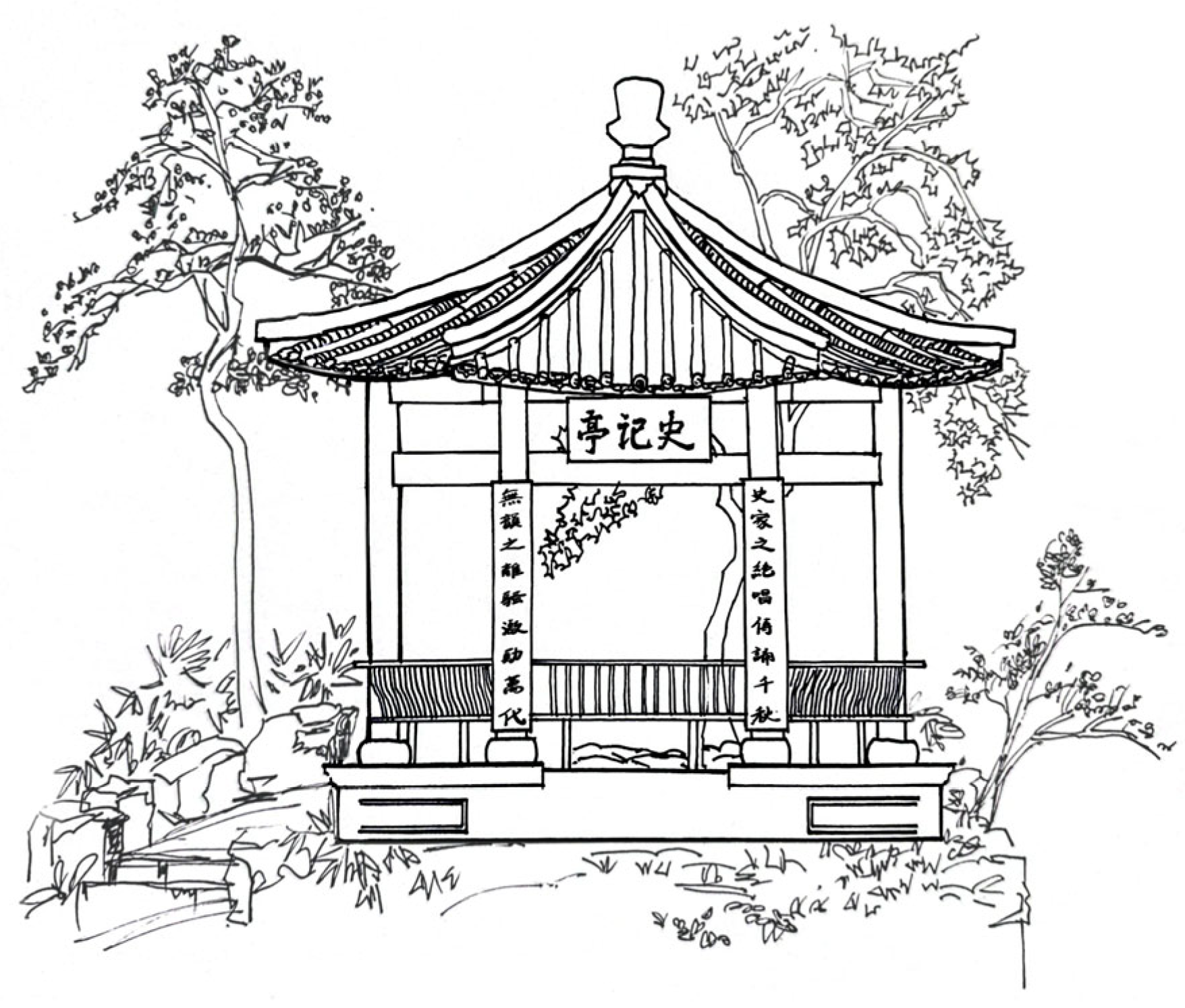
Figure 2.
Gate of Jiangnan University (shot in 2025).
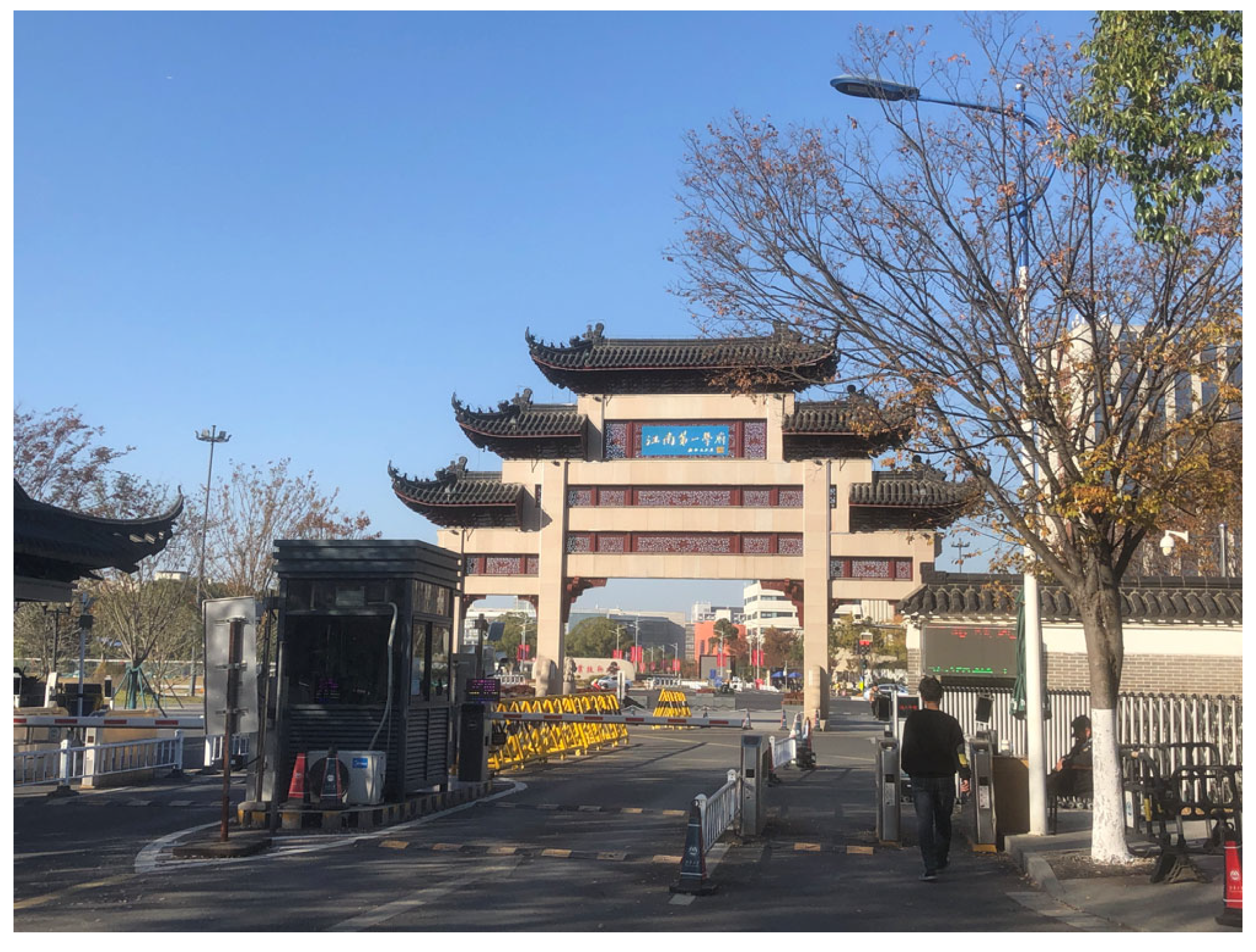
Figure 3.
The basic form of Chinese pavilions.
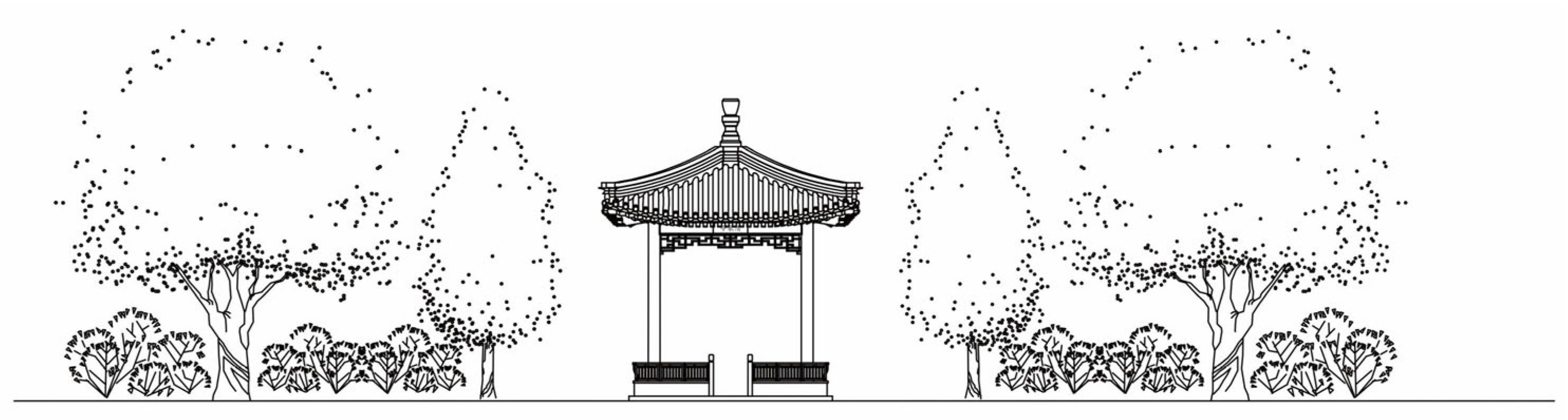
Figure 4.
Qingquan Pavilion (shot in 2025).
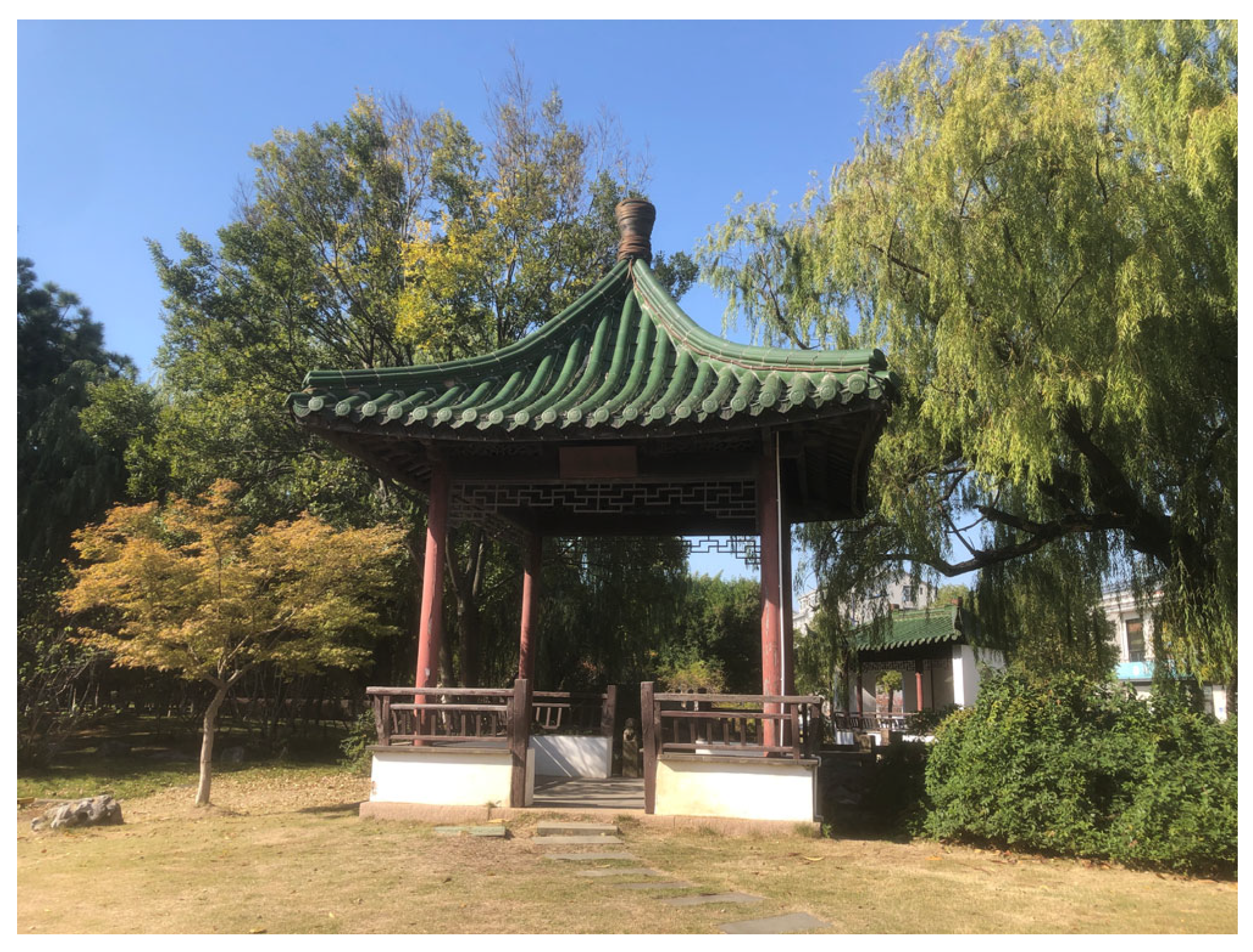
Figure 5.
Nanyang Pavilion (shot in 2025).
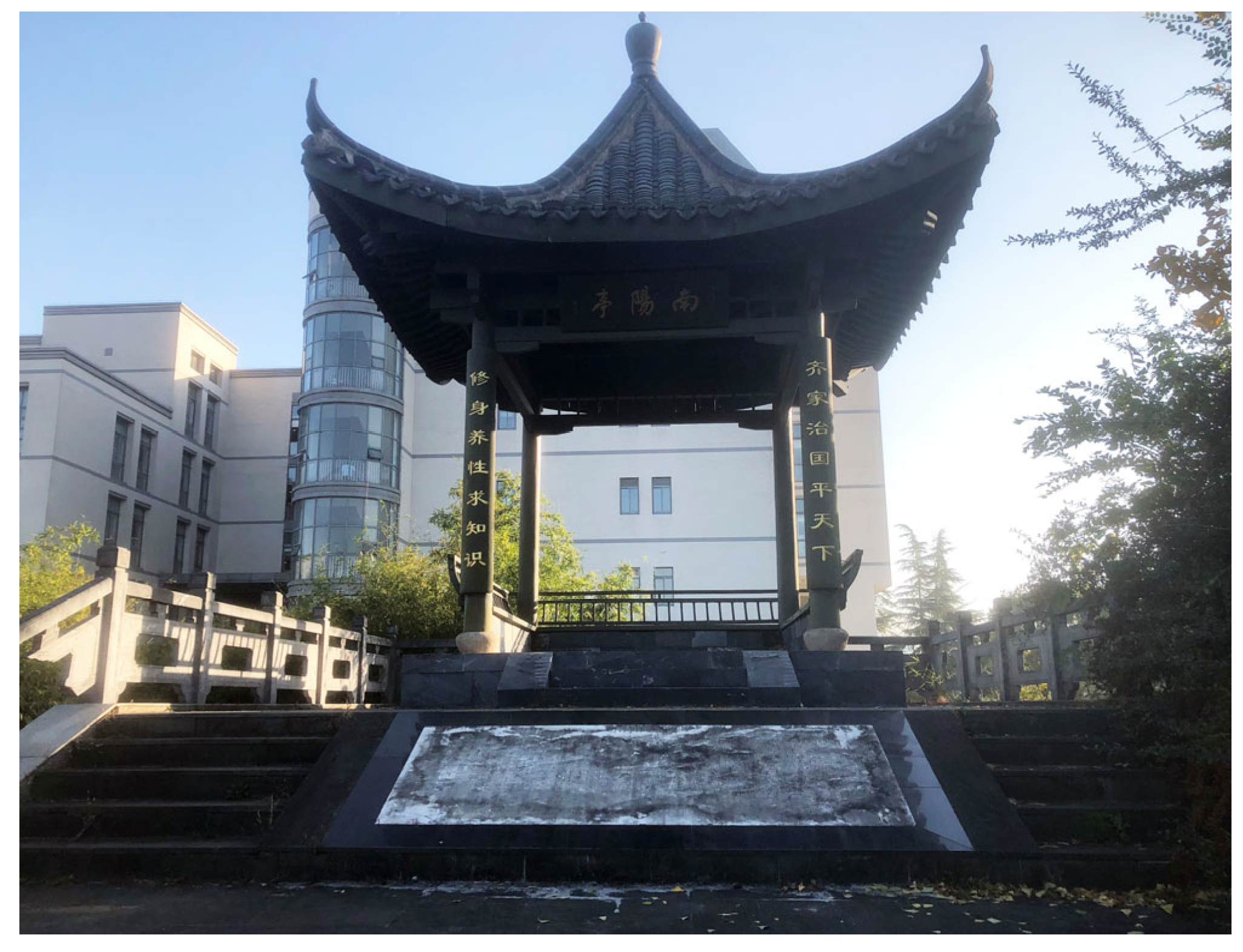
Figure 6.
Haoshang Pavilion (shot in 2025).
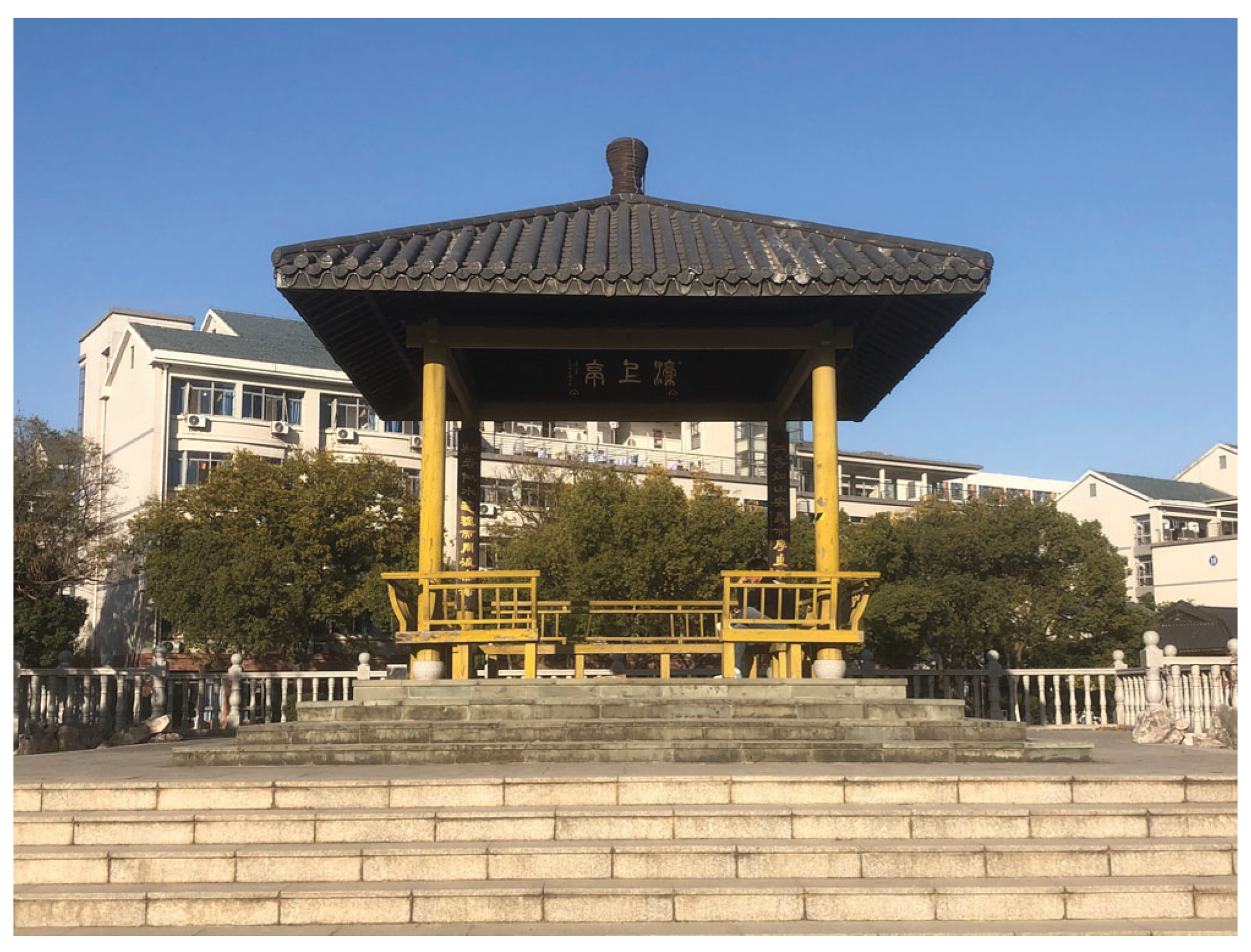
Figure 7.
Yangwu Pavilion (shot in 2025).
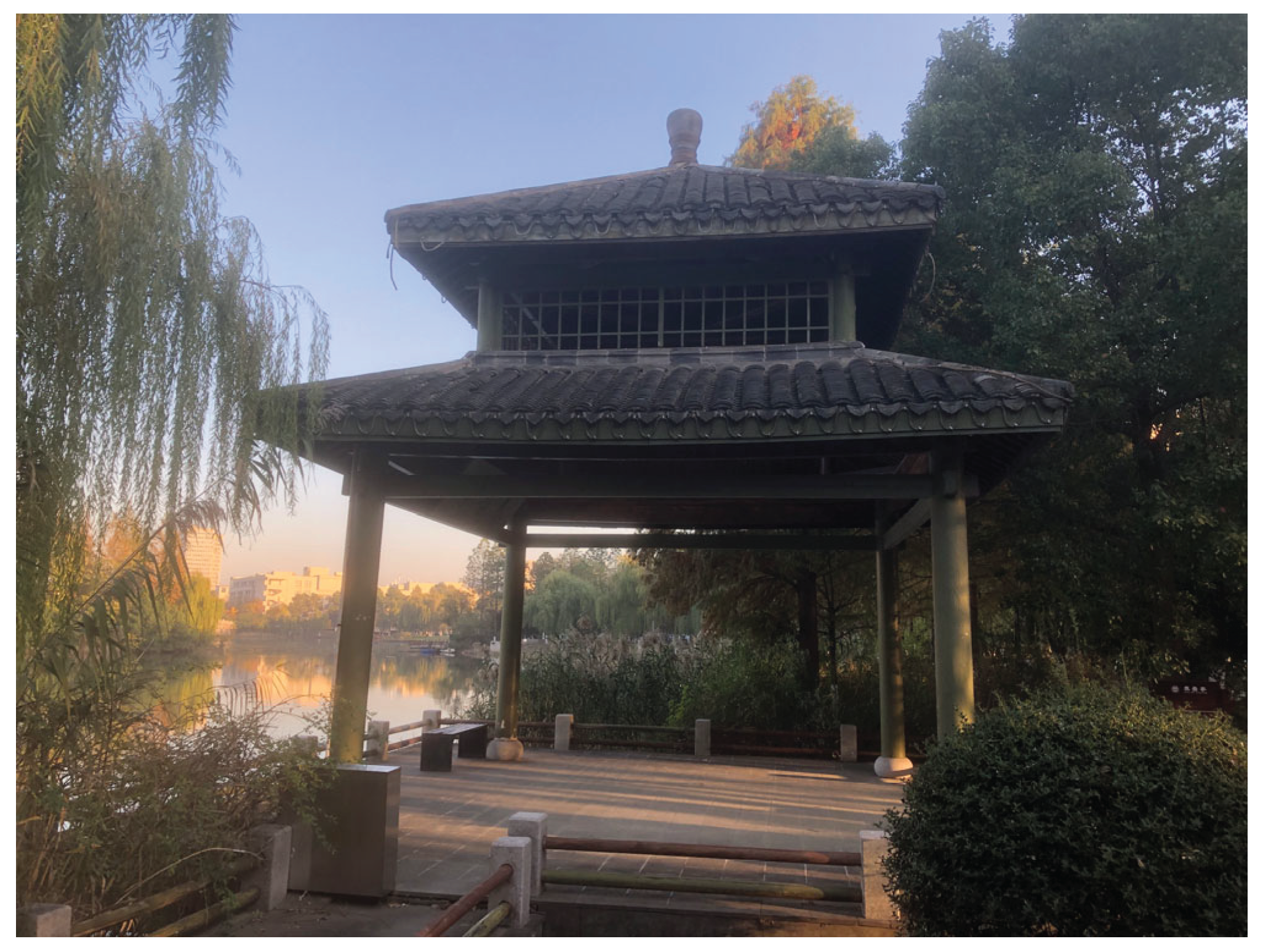
Figure 8.
Jingsi Pavilion (shot in 2025).
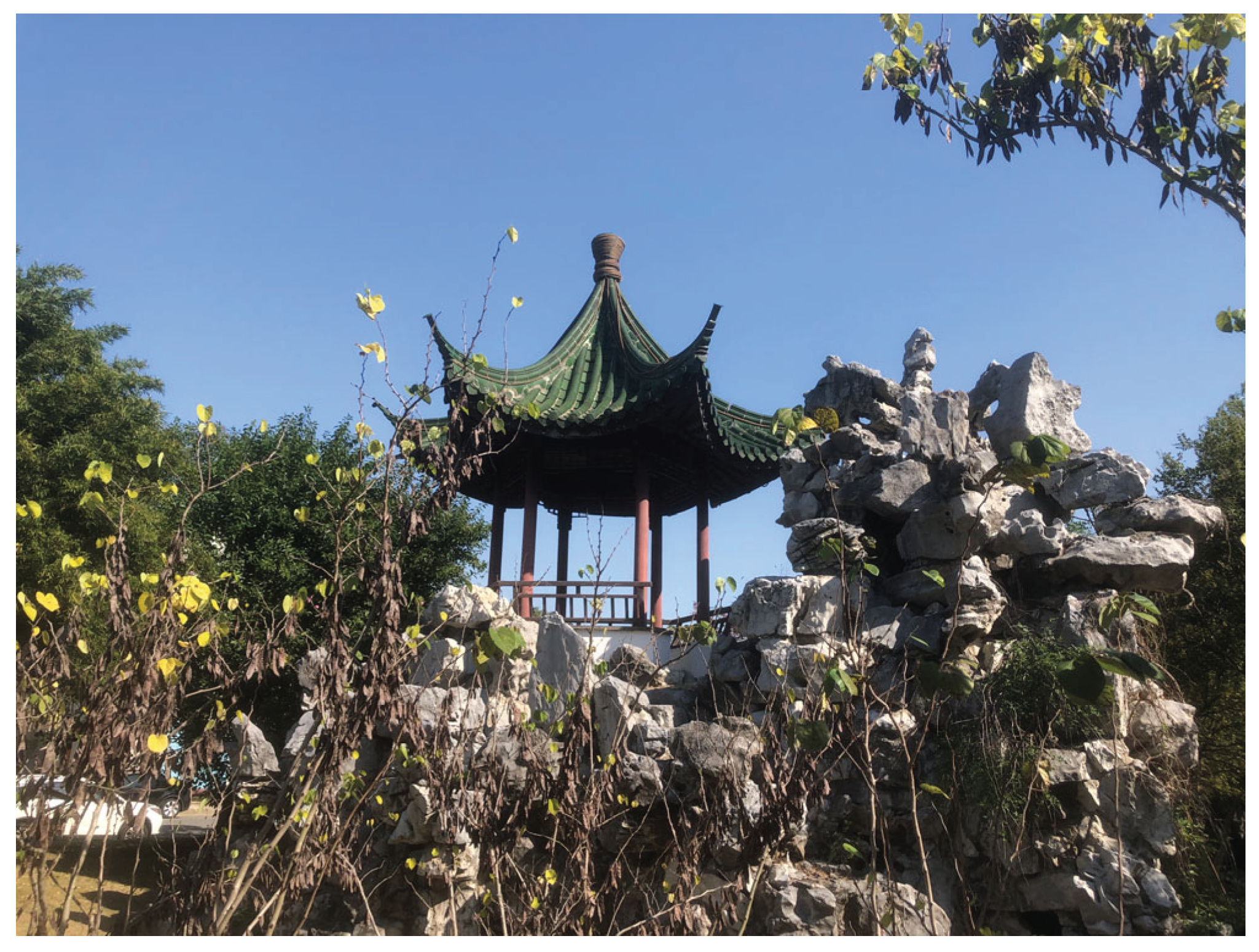
Figure 9.
Shiji Pavilion (shot in 2025).
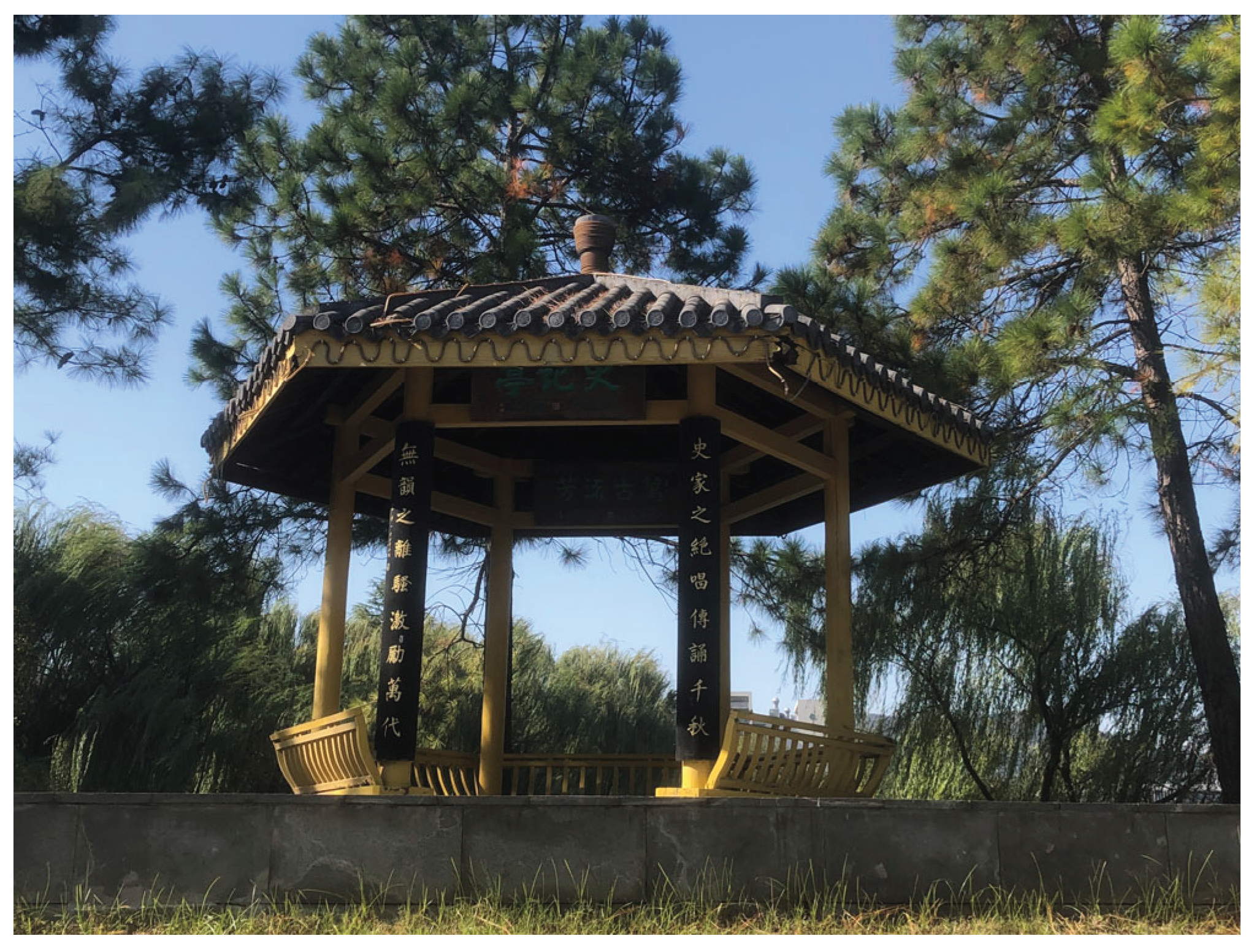
Figure 10.
Aixiao Pavilion (shot in 2025).
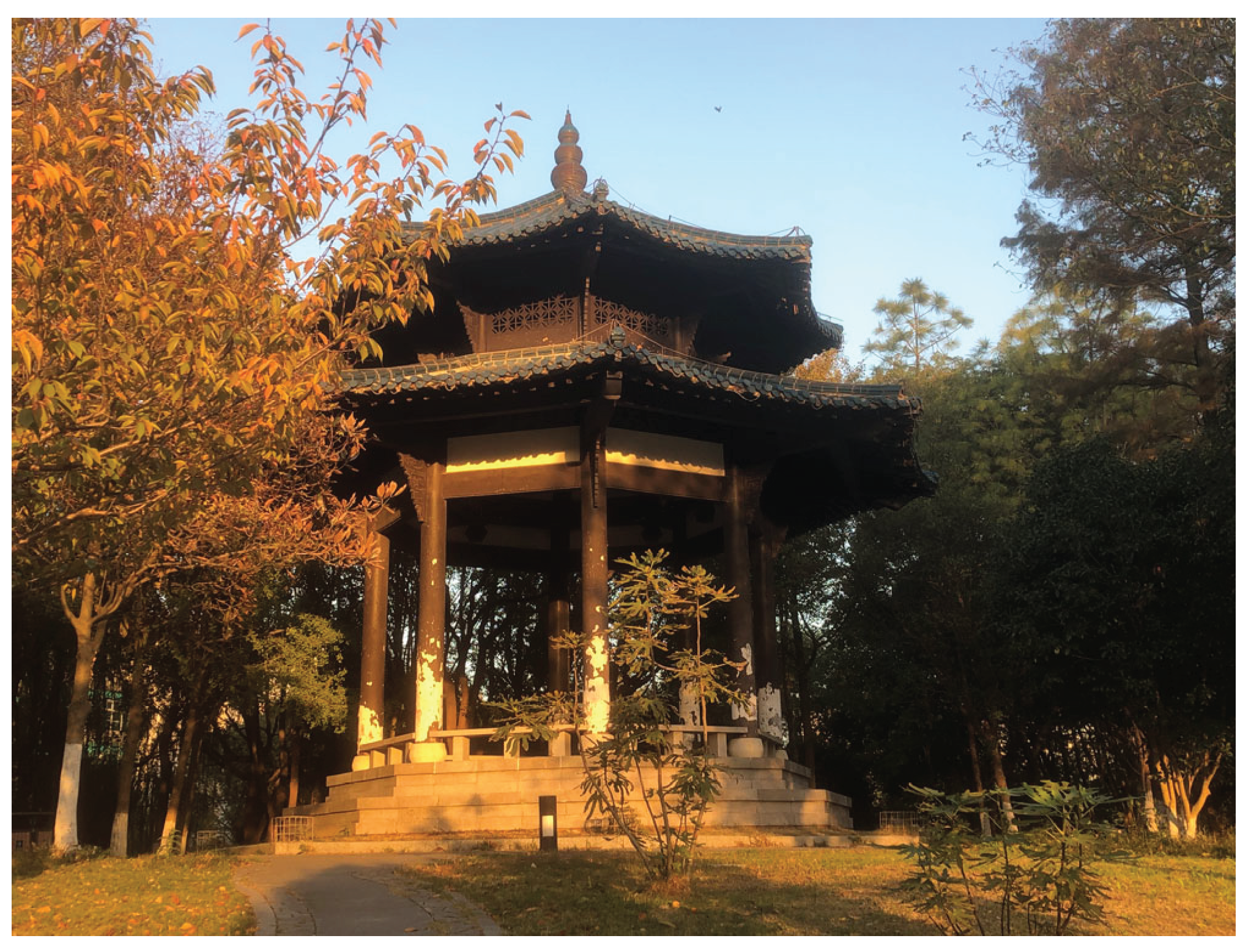
Figure 11.
Name plaque of Qingquan Pavilion (shot in 2025).
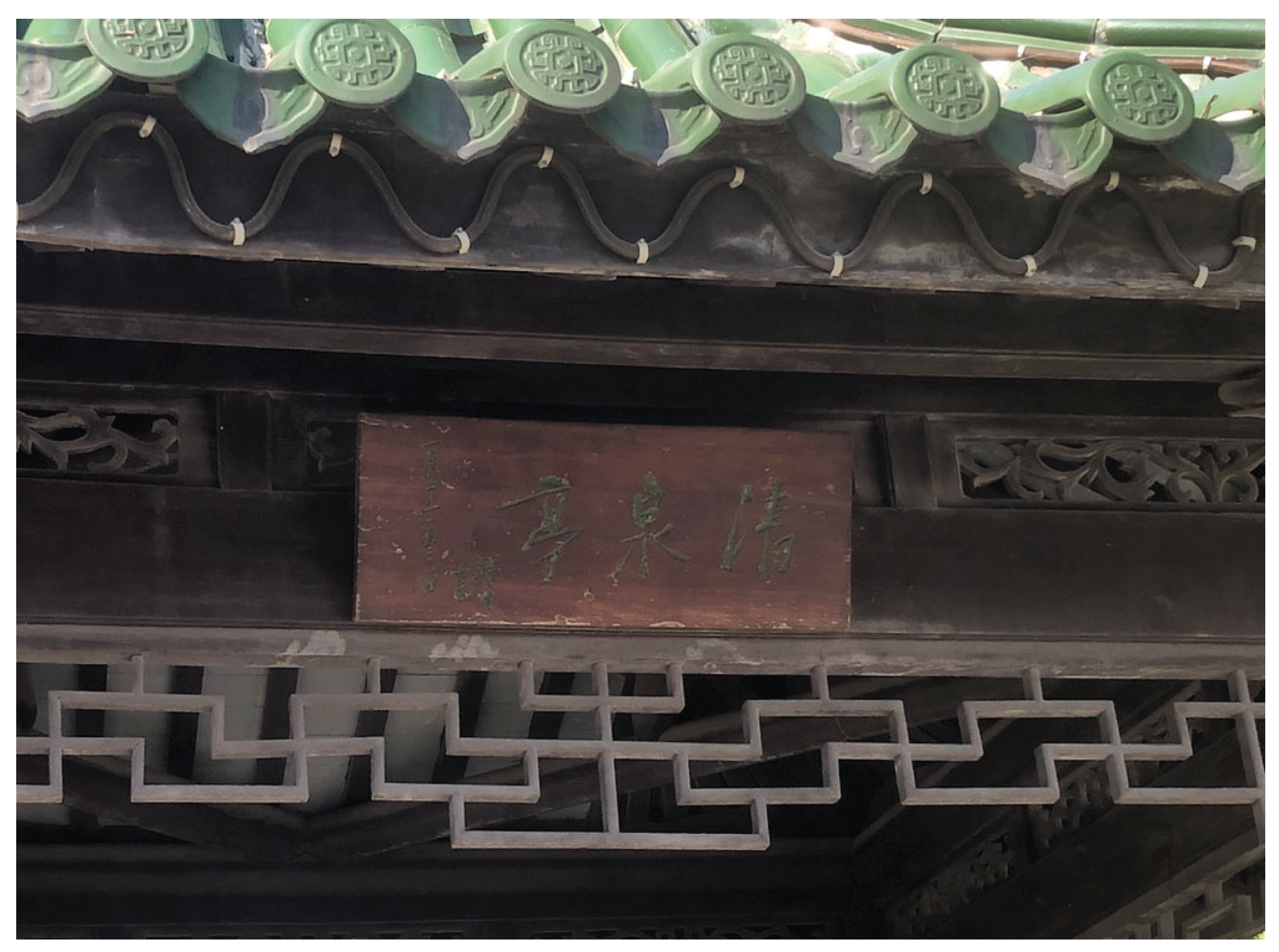
Figure 12.
Scenery around Qingquan Pavilion (shot in 2025).
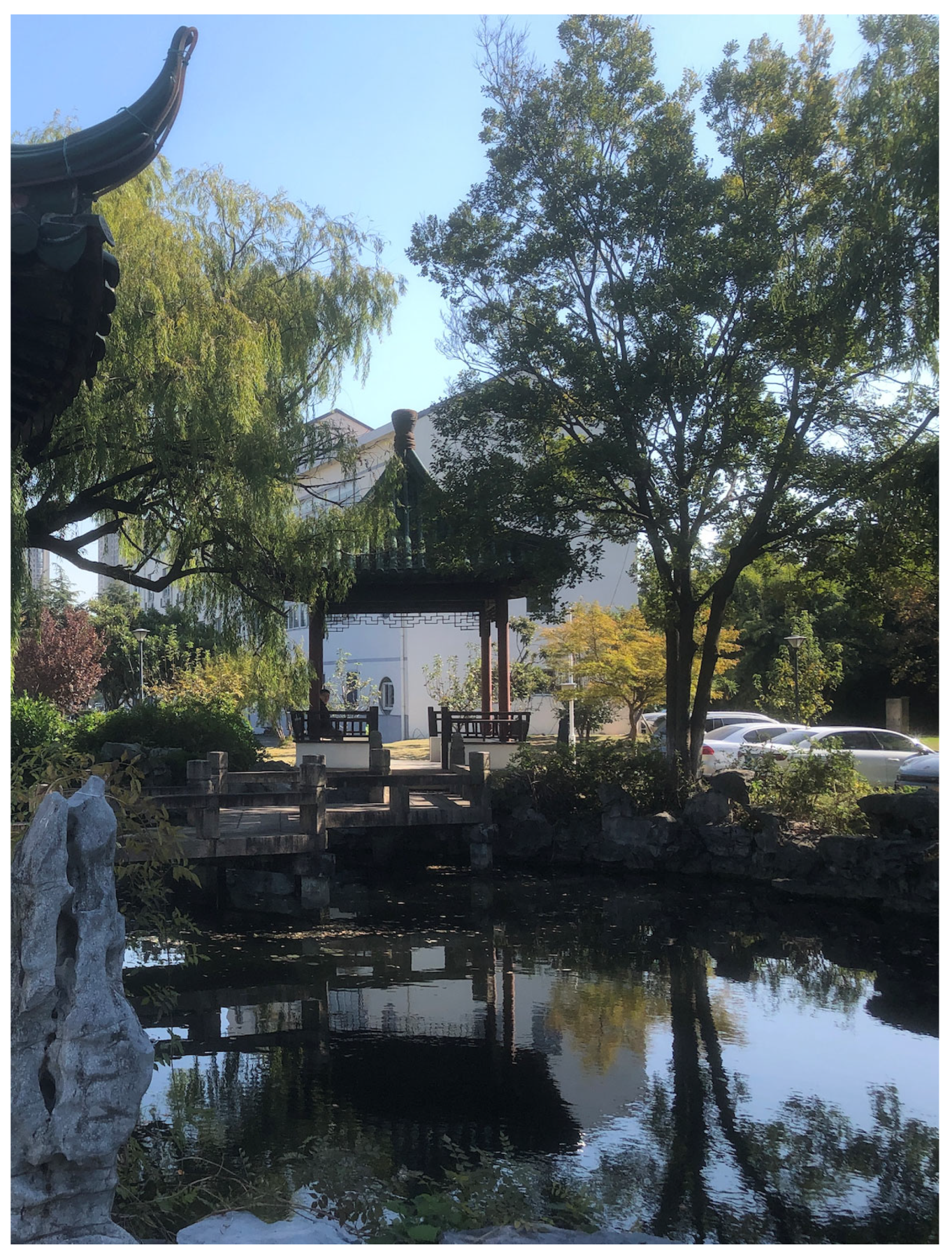
Figure 13.
Name plaque of Aixiao Pavilion (shot in 2025).
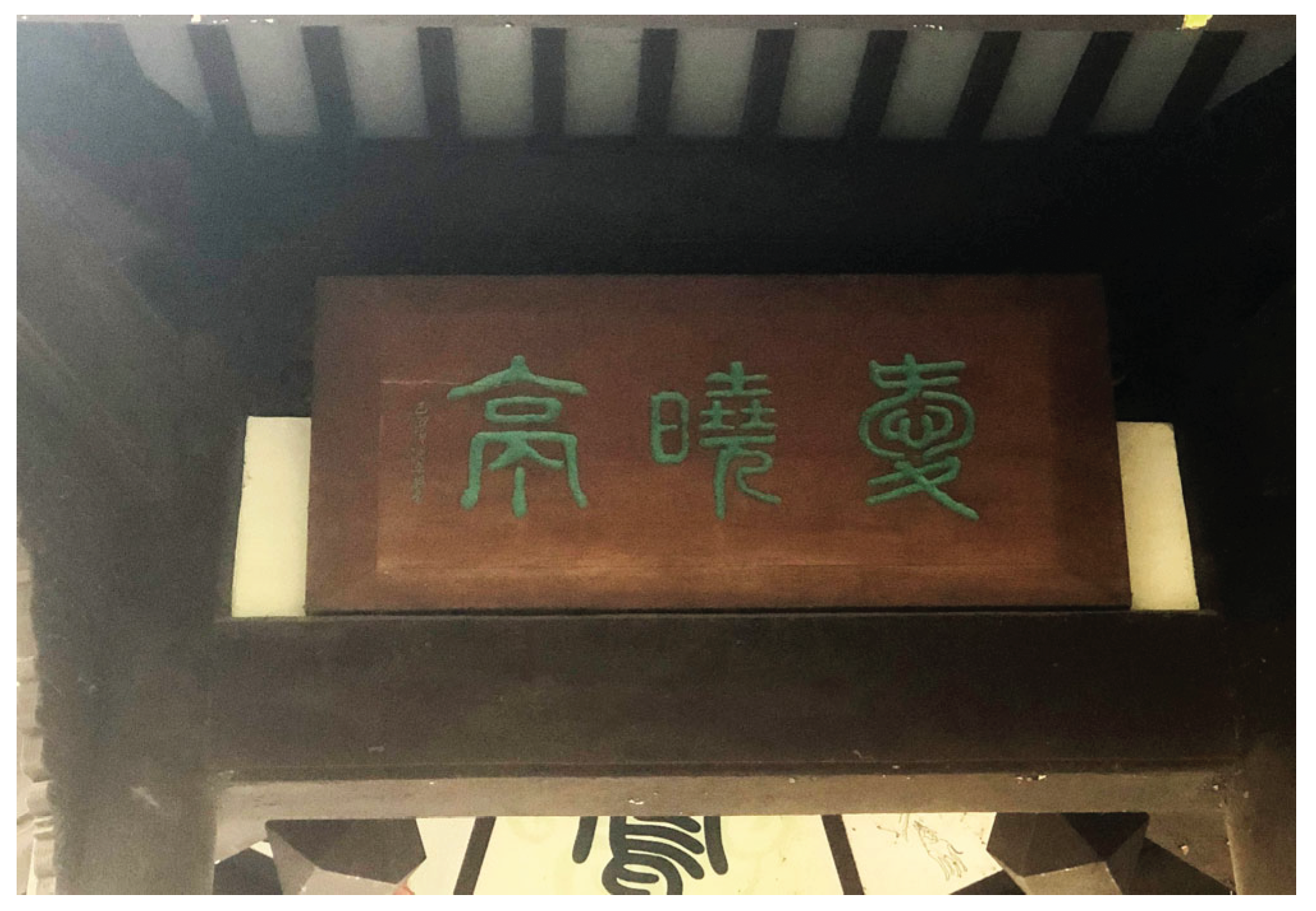
Figure 14.
The scenery of Aixiao Pavilion in the early morning (shot in 2025).
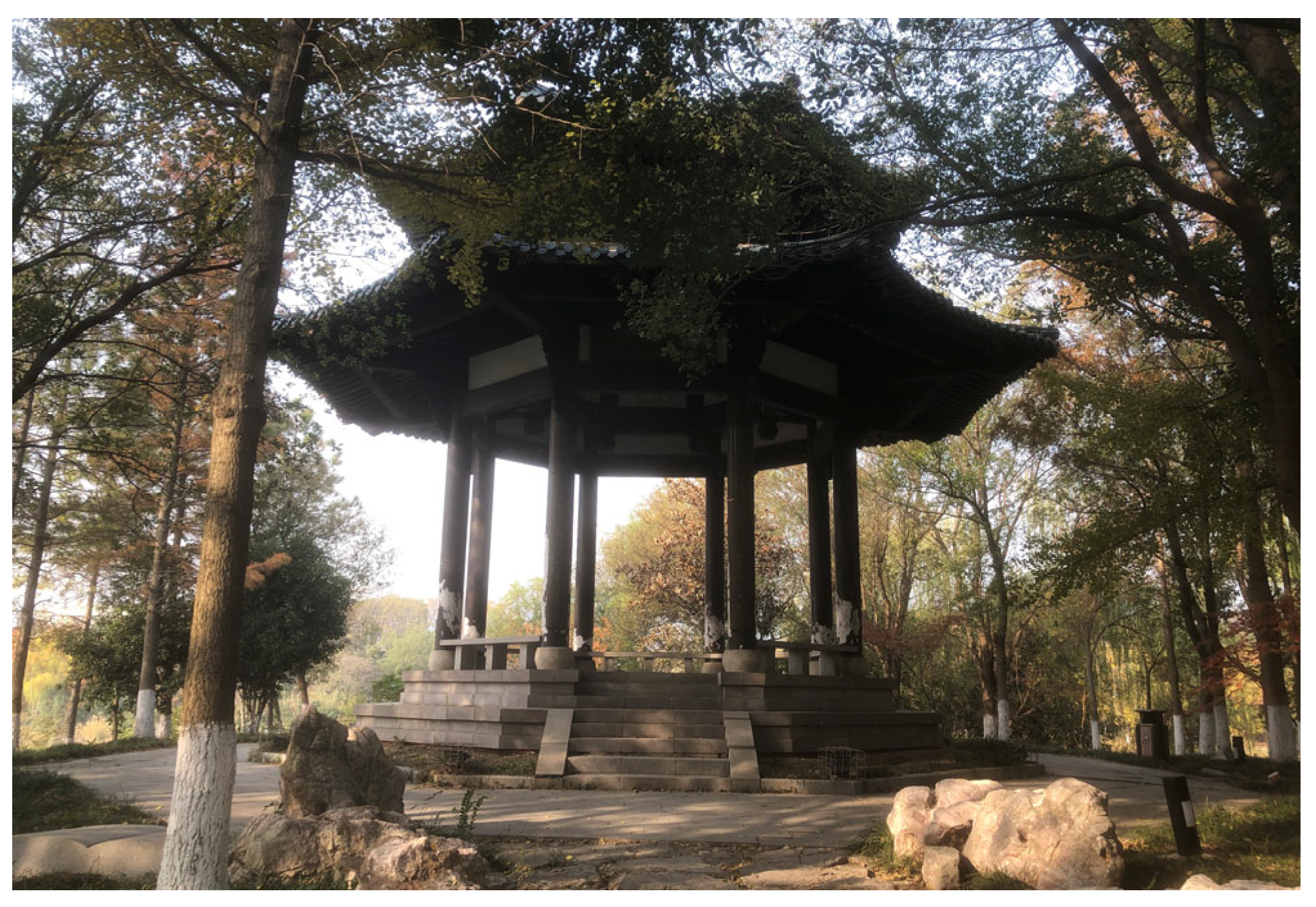
Figure 15.
Couplets of Aixiao Pavilion (shot in 2025).
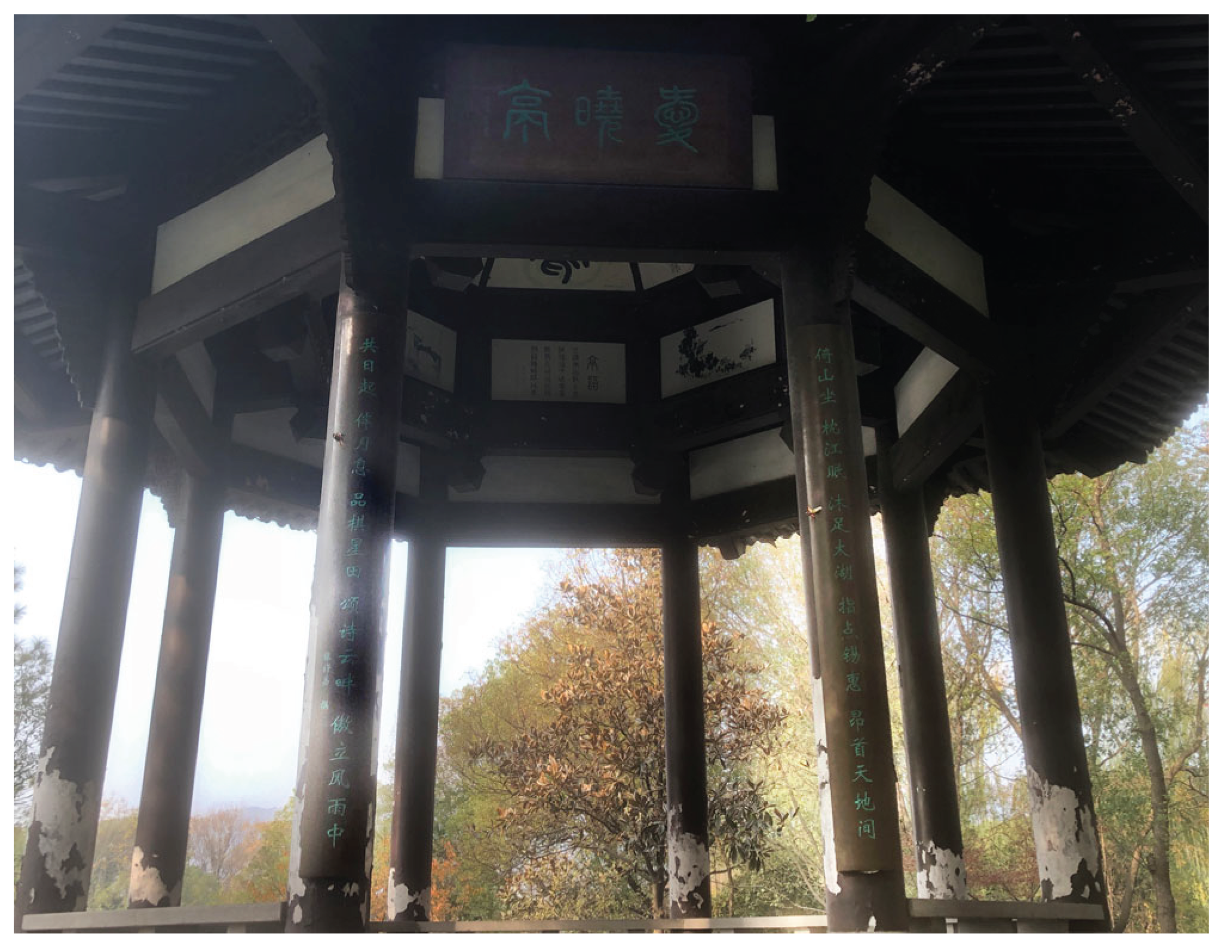
Figure 16.
Name plaque of Jingsi Pavilion (shot in 2025).
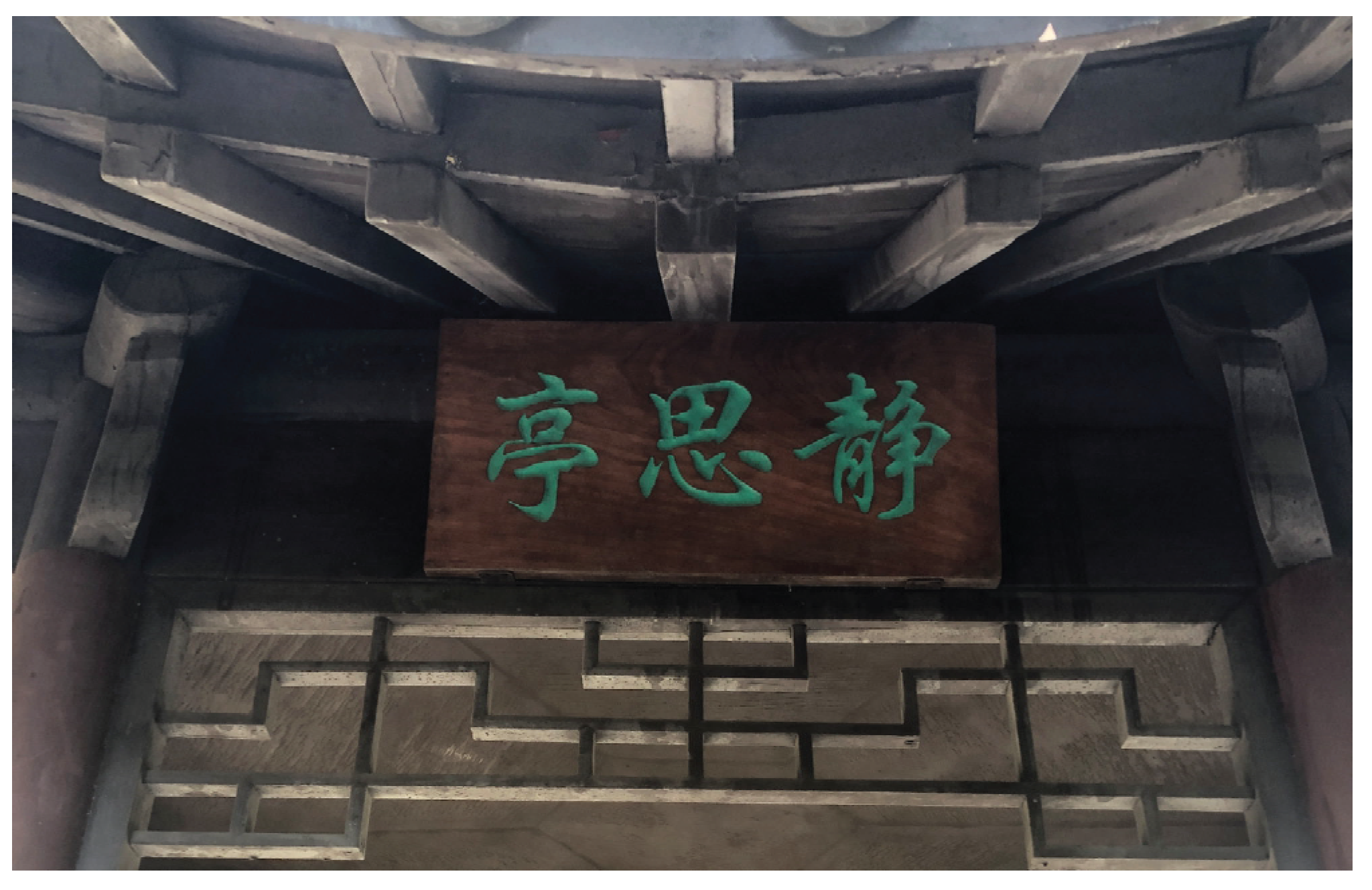
Figure 17.
Wooden plaque next to Yangwu Pavilion (shot in 2025).
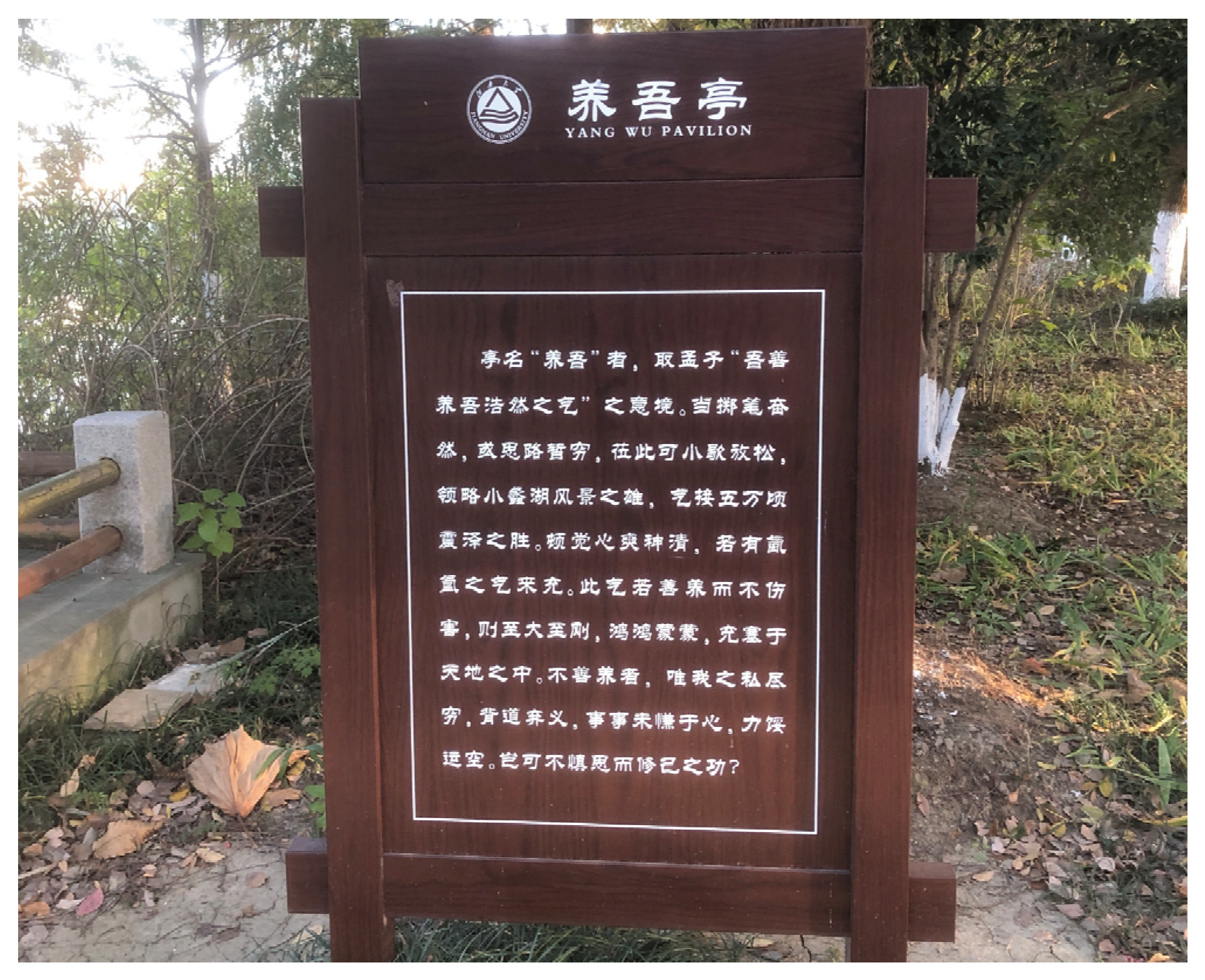
Figure 18.
Name plaque and couplet of Haoshang Pavilion (shot in 2025).
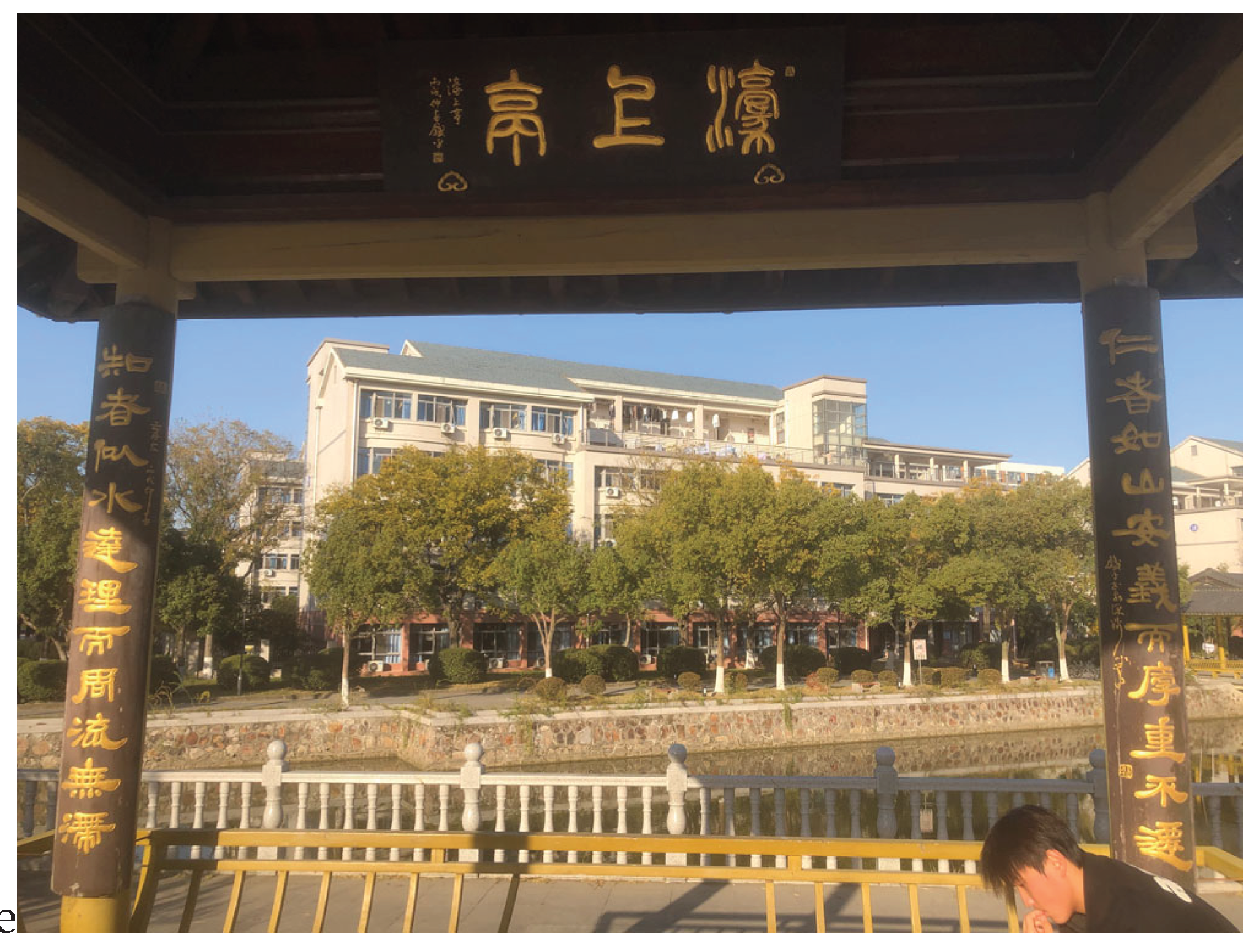
Figure 19.
Name plaques and couplets of Nanyang Pavilion (shot in 2025).
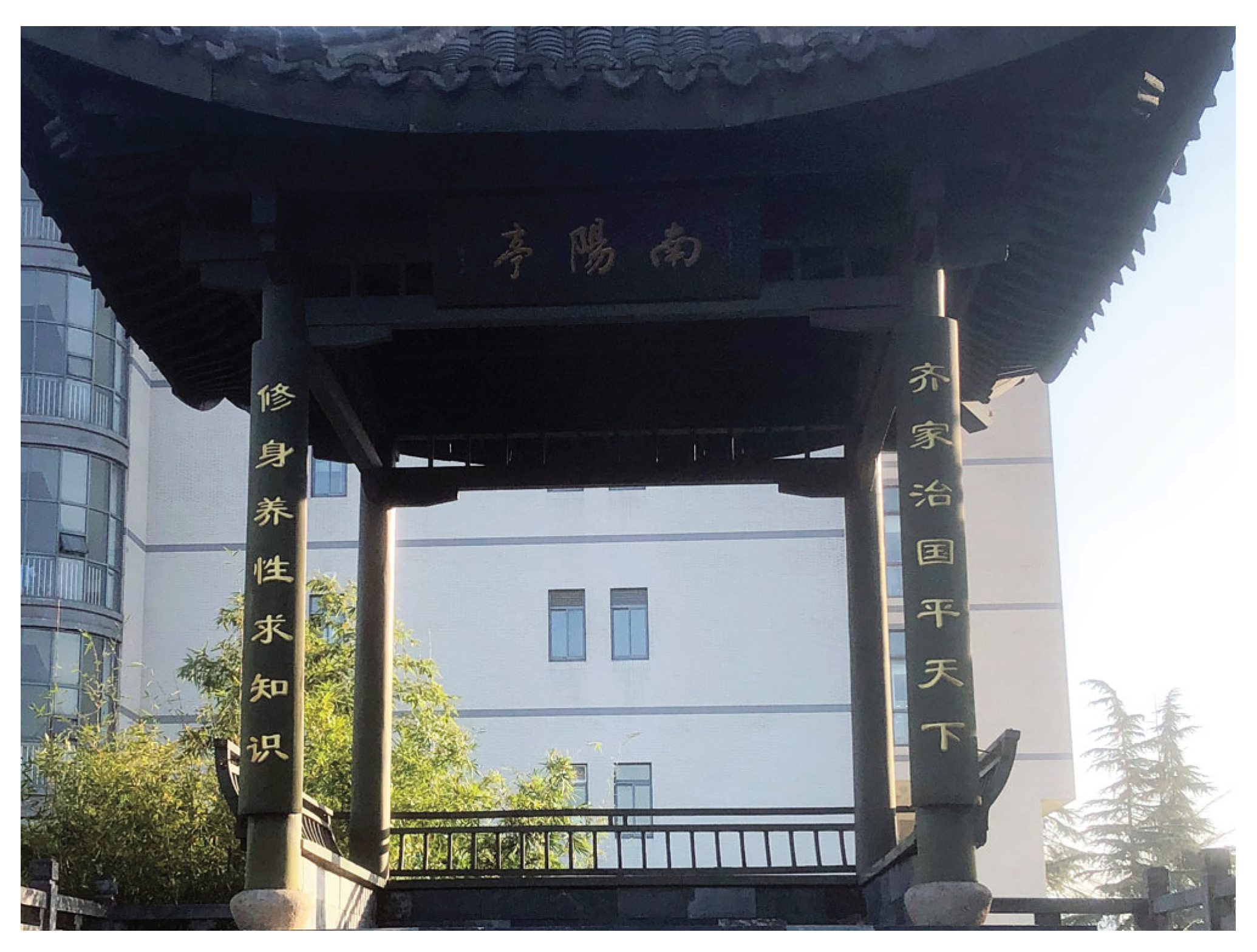
Figure 20.
Two plaques and a pair of couplets in the Shiji Pavilion (shot in 2025).
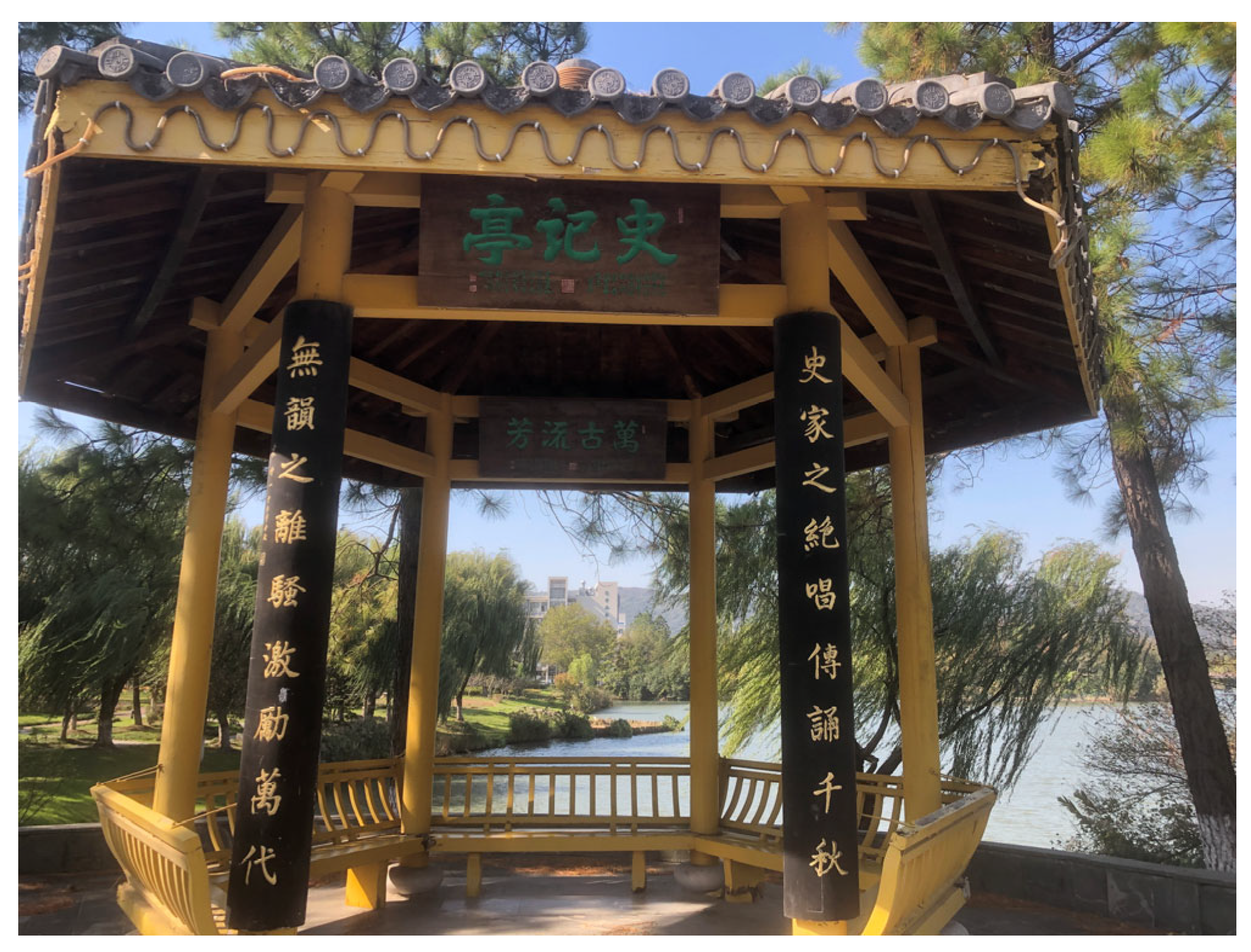
Figure 21.
Decorative painting of the ceiling of Aixiao Pavilion (shot in 2025).
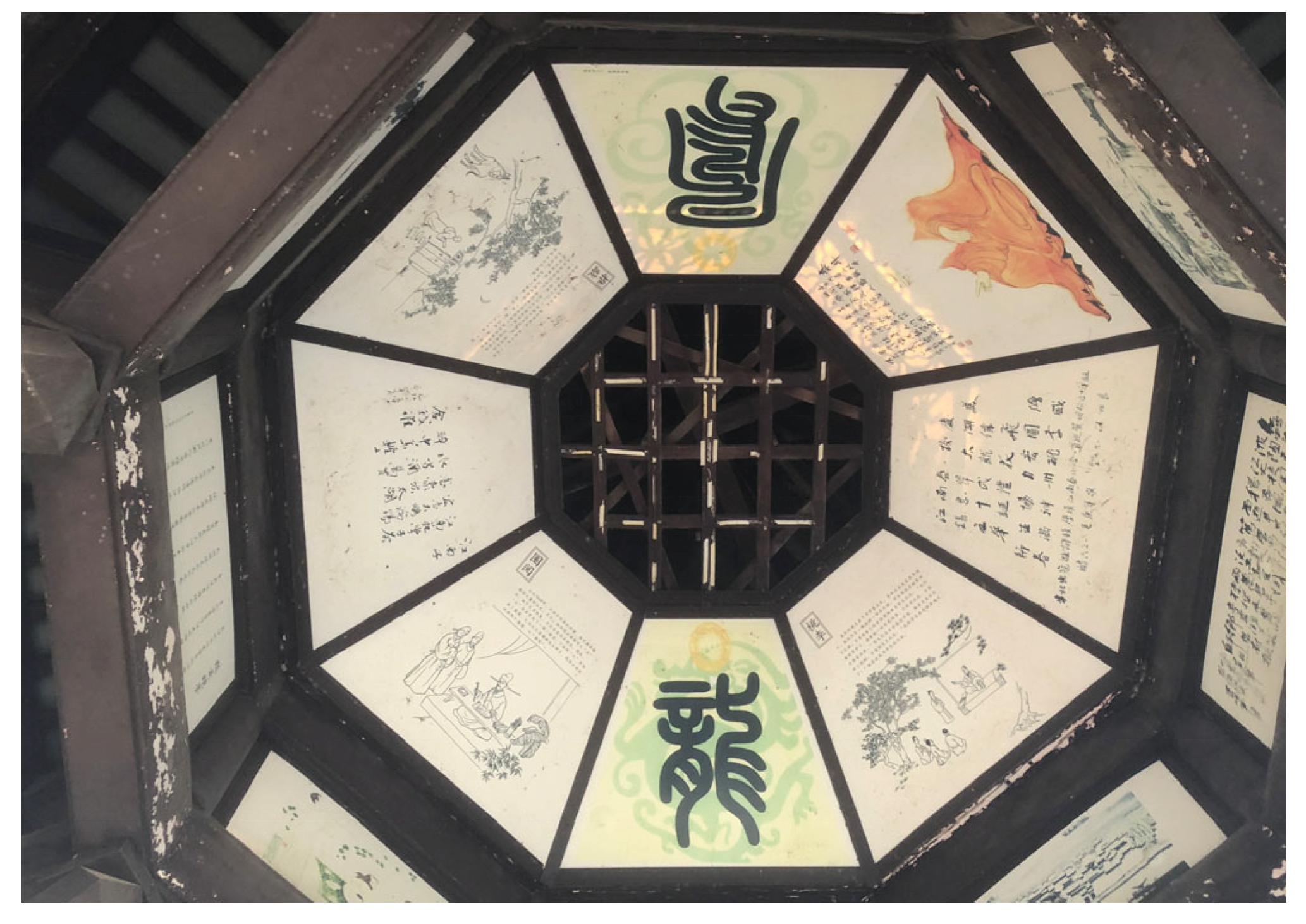
Figure 22.
Comparison between Heidegger's Phenomenology of Architecture's " Fourfold " and the " Fourfold " of Chinese Architectural Culture.
Figure 22.
Comparison between Heidegger's Phenomenology of Architecture's " Fourfold " and the " Fourfold " of Chinese Architectural Culture.
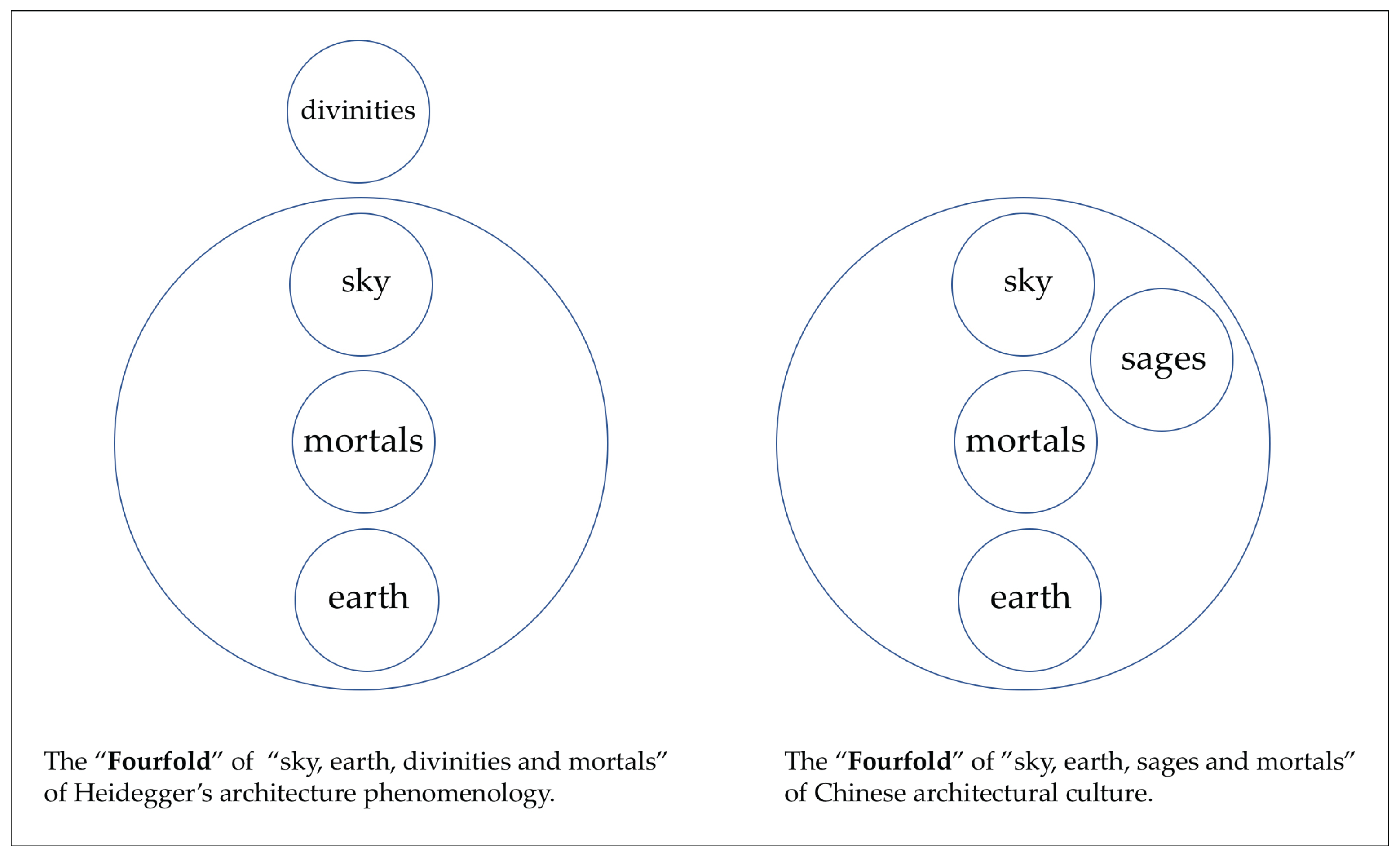

Table 1.
Data of the Seven pavilions at Jiangnan University.
| Name | Shape | Side length | Height |
|---|---|---|---|
| Qingquan Pavilion | Square | 3.77 m | 3.62 m |
| Nanyang Pavilion | Square | 4.00 m | 4.15 m |
| Haoshang Pavilion | Square | 4.37 m | 4.22 m |
| Yangwu Pavilion | Square | 8.81 m | 6.13 m |
| Jingsi Pavilion | Hexagonal | 1.80 m | 2.83 m |
| Shiji Pavilion | Hexagonal | 2.65 m | 4.31 m |
| Aixiao Pavilion | Octagonal | 4.00 m | 7.12 m |
Disclaimer/Publisher’s Note: The statements, opinions and data contained in all publications are solely those of the individual author(s) and contributor(s) and not of MDPI and/or the editor(s). MDPI and/or the editor(s) disclaim responsibility for any injury to people or property resulting from any ideas, methods, instructions or products referred to in the content. |
© 2025 by the authors. Licensee MDPI, Basel, Switzerland. This article is an open access article distributed under the terms and conditions of the Creative Commons Attribution (CC BY) license (http://creativecommons.org/licenses/by/4.0/).
Copyright: This open access article is published under a Creative Commons CC BY 4.0 license, which permit the free download, distribution, and reuse, provided that the author and preprint are cited in any reuse.


