

Submitted:
04 December 2025
Posted:
09 December 2025
You are already at the latest version
Abstract
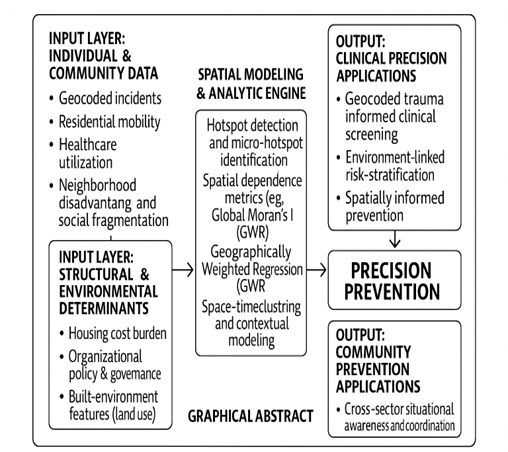
Background/Objectives: Geographic Information Systems (GIS) offer essential capabilities for identifying spatial concentrations of vulnerability and strengthening context-aware prevention efforts across healthcare and community systems. Interpersonal Violence (IPV) remains a critical public health challenge shaped by structural, ecological, and situational factors, but it represents only one of several preventable harms that benefit 24 from this spatially informed analysis. This manuscript presents a geospatial public health architecture designed to generate anticipatory, place-based risk forecasting applicable across diverse community and institutional environments. Methods: The framework integrates de-identified surveillance data, ecological indicators, environmental exposures, and temporal dynamics into a unified spatial epidemiology model. Multilevel data layers are geocoded, spatially matched, and analyzed using clustering, spatial dependence metrics, and contextual modeling to identify micro-environments of elevated vulnerability. Results: The model identifies spatial clustering, mobility-linked risk patterns, and emerging escalation zones using neighborhood disadvantage, built-environment factors, and situational markers. Spatial outputs support clinical applications such as geocoded trauma screening, risk-stratified decision support, and context-aware discharge planning. Community applications include targeted environmental interventions, cross-sector resource coordination, and equity-focused prevention planning. Conclusions: By merging behavioral theory, spatial epidemiology, and prevention science, this methodological model enhances anticipatory detection, strengthens trauma-informed practice, and supports coordinated public health response. It establishes a con- 41 ceptual foundation for future empirical research using high-resolution restricted datasets and advances spatially informed prevention across diverse settings, consequently promoting the continued development of dynamic, integrated equity-focused prevention systems.
Keywords:
geospatial epidemiology
; interpersonal violence
; environmental risk
; spatial analytics
; prevention informatics
; spatial equity
Copyright: This open access article is published under a Creative Commons CC BY 4.0 license, which permit the free download, distribution, and reuse, provided that the author and preprint are cited in any reuse.


