

Submitted:
04 December 2025
Posted:
05 December 2025
You are already at the latest version
Abstract
The most important step for the installation of a wind farm is to know the wind regime in the region, since an error in estimating this wind speed causes an error proportional to the cube of power, resulting in financial losses for investors. Therefore, knowing the methods used for predicting wind energy becomes important and the knowledge of how research and studies in this area are going help map the subject and outline strategies for developing research in strategic areas. For this purpose, a *** using the Scopus database considering some keywords, such as ("forecast" OR "prevision") AND "wind" AND ("turbine" OR "power" OR "energy" or "velocity" or "speed"), considering the period since 2020, and analyzing the data of the documents found using the Bibliometrix package. With the results found, it was possible to map researchers, and institutions that are developing work in this area, in addition to the most cited articles, as an indication parameter. Future works could include CFD simulation models most applied in different wind speed analysis reviews.
Keywords:
forecasting
; prevision
; wind speed
; wind power
; renewable energy
; Scopus base
; Bibliometrix
1. Introduction
Greenhouse gases are contributing to global warming resulting in the amplification of several problems, including environmental problems[1]. One of the ways to control the concentration of these gases is, e.g., by the reduction of fossil fuels in energy sectors[2].
Therefore, wind energy is an important ally in this process[2]. Thus, energy forecasting and planning are important for different stakeholders’ decision-making in global energy development. Forecasting studies related to wind energy are essential to know the potential of a given location [3] and for the installation of wind farms [4], once a forecast study with high uncertainty will generate a cubed error on the predicted power value, which can result in huge losses for investors. Therefore, knowing research trends in this area can guide researchers and investors in decision-making, avoiding future losses. In the context presented here, forecasting is the means of obtaining predicted ranges based on future demand from present and past data, generally investigating future trends [5].
Some authors [6,7,8] talk about the importance of carrying out a review work to understand the evolution of the researched subject and contribute to the advancement of scientific knowledge, guiding researchers, and observing gaps in specific themes that may be explored [9]
Among some important articles that portray the importance of the subject presented and discussed here, we can cite [10,11,12]. The authors [10] used AI for a statistics study of the wind speed in parts of India. Same statistical analyses were done, but this time in PyeongChang [11]. Here are several forecasting models, their applications are quite comprehensive. Therefore, this review article highlights the cutting-edge works on wind energy forecasting models, considering a period of the last five years, since 2020, whose objective is to conduct a bibliometric analysis of the scientific production applied to the study of wind energy forecasts, using the Scopus database and the Bibliometrix tool. The bibliometric analysis allows identifying trends, patterns, and gaps in scientific production on the subject, in addition to providing relevant information for the formulation of public policies and investments in research and development within this field. Via data analysis, it is possible to better understand the evolution and geographic distribution of scientific production, identify the main thematic areas of research, the main institutions and authors involved, among other relevant information [13,14,15,16,17]. The studies in [13] applied VOSviewer and Pajek software to cover forecasting models; while [14] used AI (artificial intelligence) to predict energy wind power; the tool used prediction of wind and solar power in [15]was deep learning. The authors in [16] reviewed gaps on the literature over the output of wind and solar energy and in [17] an open source code was chosen for wind prediction in short term.
Based on these results, it is anticipated that this work may contribute to the advancement of scientific knowledge on the subject, identifying trends and research gaps that can provide valuable directions to the scientific community.
2. Materials and Methods
Containing many articles from reputable sources, Scopus is a widely accepted and often used tool for both scientific research and data extraction[18]. Using this powerful tool, this study proposes mapping trends in the field of wind energy forecasting, to optimize future projects applied in different regions of the globe. The literature was searched considering the most recent years, since 2020, using the advanced search options of “title, abstract and keywords”. Bibliometrics helped to understand research practices, employing citations, refinements and mapping clusters, indicating research networks. To compile the data and perform an analysis of the information, the Bibliometrix tool [19] (https://www.bibliometrix.org/) was used, a free software written in the R language [20].
The search was performed by applying “advanced search”, and when looking for the terms ("forecast" OR "prevision") AND "wind" AND ("turbine" OR "power" OR "energy" or "velocity" or "speed "), applying filters, according to Table 1, for "article and review", English language, final publication stage, type of source, there were 1,640 documents left, which were divided into the sub-areas described in Figure 1.
The final set comprises a total of 1,640 documents, consisting of 1,600 articles and 40 review papers, distributed across 318 distinct sources (i.e., 318 different journals), and featuring the participation of 5,918 authors. Thus, a thorough analysis was carried out to evaluate the participation of the newest developments and future research perspectives using this dataset.
Aiming to obtain accurate and reliable data based on the selected words, this search query was then implemented, including title, abstract, and author keywords. The “Bibliometrix” package (R language) was used to obtain graphs, tables, and diagrams. Scopus (https://www.scopus.com/) is the world's largest database of peer-reviewed interdisciplinary articles, and it is continually expanding [5,22]. It is an important provider of global research output across a multidisciplinary spectrum [23], which is the reason it is a great choice for bibliometric studies.
The main objective here is to present a clear view of technical progress and innovation within the wind energy forecasting field, and why it is so important to understand this phenomenon of nature, which directly impacts the production of wind energy. Such a study can foresee the innovations which will be applied in the wind energy field, to maximize efficiency and to improve the relation cost benefit. The methodology of this study was set by assessing the published works found in the Scopus database, for different “subject areas”, as shown in Figure 1. From Figure 1, the studies were divided by areas, such as energy, engineering, environmental science and computer science. This methodology helps to understand the focus of each work and how they may influence the present analysis.
This set of publications was worked on using Bibliometrix, allowing the construction of maps of journals, countries, institutions, and authors to understand the organization of the clusters. Standard spreadsheets were also used for the analysis.
Figure 2 shows the chosen variables used to analyze information from articles of the Scopus database: (a) list of most cited articles; (b) authors' names, as well as the year of publication of the articles; (c) keywords; (d) number of citations of the documents; (e) journal sources; (f) most prestigious journals and their impact factor (IF); (i) countries and (j) research gaps. It is important to emphasize the importance of considering the impact factor (IF) of the journal and the h-index of an author. The IF can be obtained from the Scopus website and is always up-to-date. The h-index works as an indicator to quantify the research results of an academic. It is a unique value where h of total publications (TP) hold a minimum of h citations each and (TP-h) articles have h citations each [24]. It can give statistical tools that reflect the reality of the influence of a paper, or its author, including longer periods of time; however it can be limited in areas such as health science [25].
Even though some authors affirm that the h factor is no longer an effective index [26], that it has deficiencies [27] and that it can be misinterpreted [28], many review works still use it in their analyses, such as [29,30] e [31]. The work [29] analyzed renewable energy tendencies in Africa using software such as VOSviewer and ITgInsight; [30] did a bibliometric review on papers published between 2011 and 2022 about the risk assessment of autonomous ships; and [31] used Web of Science and Scopus to determine the influence of gender on renewable energy research.
Study limitations, such as period of publication, were added to promote insights and future developments in the research for wind energy forecasting. Finally, an analysis of the most cited works was carried out to contribute to an overview of the subject. The review’s results elucidate the outcomes of the bibliographic analysis and make recommendations for further research.
3. Results
Bibliometric analyses are scientific specialties, posing as a major aspect of research evaluation, especially in both the scientific and the applied sectors [32]. It is an important tool used to evaluate the overall tendencies of articles from all over the globe, from different institutions of research and teaching. All the papers included in this study were sourced from journal articles and were published exclusively in English.
Figure 3 shows the search criteria and refinement conditions used. The criteria used were keywords, time of publication, language, authors and type of document (reviews). Combining all of it, the refined number was 1,640 documents total.
The bibliometric study's findings on wind energy prediction are detailed in the sections that follow, highlighting the most important research areas, keywords, affiliations, journals, authors, and countries. Each aspect of the results is discussed to provide insight into the progress of the wind energy forecasting field, including trends, updates, and key areas of focus.
The number of citations in a field is a crucial metric for categorizing and comprehending current research trends. It also serves as a clear indicator of the impact of a particular journal or publication, providing transparent data on the most significant areas of research, as well as current trends in wind energy prediction studies.
According to the observed data, the publication trend has been growing in recent years, with 234 articles published in 2020, 254 in 2021, 332 articles in 2022, 262 in 2023 and 341 documents in 2024. As of 2025, the year of this work's completion, there are 215 publications in this research area, with an additional 2 papers published in 2026. Of course, an increase in the number of articles leads to an increase of researchers with similar interests.
Among the current papers, one can cite [33] which offered a forecasting tool based on a set of time series data to estimate wind energy. As well, [34] evaluated wind speed prediction and power generation using statistical metrics. In [35] it is said that the accuracy of energy prediction results can be impaired by insufficient modeling capacity. And [36] proposes a unified model for predicting wind velocity. All tried using different models, such as RF, XGBoost and LSTM to predict the wind energy production in spatial and time limitations, observing that some models are more accurate for short periods of time or can be used even with different meteorological data input.
Among the papers published in 2025, there is the document by [37] entitled “Wind and solar power forecasting based on hybrid CNN-ABiLSTM, CNN-transformer-MLP models”, published in the journal “Renewable Energy”, and having 28 citations. The article [38] with the title “Demand response of grid-connected microgrid based on metaheuristic optimization algorithm”, published in the journal “Energy Sources Part A Recovery Utilization and Environmental Effects” with 10 citations, and the article by [39] “Informer learning framework based on secondary decomposition for multi-step forecast of ultra-short term wind speed”, published in the journal “Engineering Applications of Artificial Intelligence”, with 8 citations. In the year 2025, the articles that have already received 6 citations were the works of [40] “Multi-step wind energy forecasting in the Mexican Isthmus using machine and deep learning”, “A MPC-based load frequency control considering wind power intelligent forecasting”, [41] “Ultra-short-term wind power forecasting jointly driven by anomaly detection, clustering and graph convolutional recurrent neural networks”, (Wang et al., 2025) “Experimental-based Gaidai multidimensional reliability assessment approach for wind energy harvesters”, [42] “Holistic opportunistic maintenance scheduling and routing for offshore wind farms” The tools such as AI and deep learning used to forecast wind energy production are some of the pattern observed from more recent articles.
In 2026, the paper that appears is by [43], published in the journal “Pattern Recognition”, with the title “Twin proximal support vector regression with Gauss–Laplace mixed noise”, which addresses the regression model and the paper [44] “Probabilistic digital twin for reliability-based maintenance optimization of offshore wind turbines”, published in the journal “Renewable Energy”. The authors observed that the digital framework is robust even in different meteorological conditions and be applied to assess the lifecycle within renewable energy sources.
3.1. Most Relevant Sources
Table 2 presents a list of the top 15 journals that have published research on wind energy forecasting, specifically the most prominent scientific journals, based on the number of publications in this research area. CiteScore or Impact Factor, h-index, and Total Publications are metrics that aid in measuring citation relevance and journal growth [24,45,46].
A quantitative analysis of the publications of these 15 journals reveals that they aggregate for almost 48% of the publications identified. This helps when data extraction and selection must be done by researchers when performing a bibliometric analysis.
A total of 125 documents, which corresponds to 7.6% of the total articles published considering this data set, were published in ATMOSPHERE (https://www.mdpi.com/journal/atmosphere), which is an open access, peer-reviewed journal published biweekly online by MDPI. Despite the number of published works, that is, having the highest publication frequency, the journal currently has one of the lowest impact factors in the list of the top 15 journals, 3.11, where the impact factor of a given year relies on, for example, the number of citations in recent years. Subsequently, the RENEWABLE ENERGY journal (https://www.sciencedirect.com/journal/renewable-energy) appears in second place in terms of publication frequency, with 113 documents (6.89%), followed by APPLIED ENERGY journal (https://www.sciencedirect.com/journal/applied-energy), with 92 publications (5.61%), which obtained the highest number of citations.
From the RENEWABLE ENERGY, it can be mentioned works that focus on the prediction of solar and renewable energy production, using neural additives models [47]. In APPLIED ENERGY, the authors performed a review of the statistical mechanisms to forecast wind speed and wind power [48].
Among the list of high-impact factor journals, RENEWABLE AND SUSTAINABLE ENERGY REVIEWS (https://www.sciencedirect.com/journal/renewable-and-sustainable-energy-reviews) obtained the highest ranking, having an impact factor of 16,799, even though the journal occupies a lower position, 11th, in terms of publication of articles on the proposed topic, covering only 1.89% of published documents. This probably occurs because it is a journal that addresses several topics, so this wind energy prediction topic is just one of them. The number, even representing 1.89% of total papers, indicates that the ones focusing on wind energy have high impact due to its quality.
3.2. Most Cited Articles
The growing demand for energy imposes the search for renewable energy sources and modern energy systems to meet recent and future energy needs [49]. Among the most used and studied renewable sources today is wind energy, whose production depends directly on the wind potential of the region where a given farm can be installed. An error in estimating the wind parameter can generate a cubed error in the power to be generated. Therefore, studying methods for predicting this wind energy is extremely important to try to work with data as close to reality as possible.
In this sense, Table 3 lists the 15 most cited articles, considering the general set of researched documents. The following information was extracted from them: i) Name of the first author of the article; ii) Title of the article; iii) Total citations per article; iv) Journal that published the 15 most cited articles; v) year the article was published and vi) the country of the first author.
The chosen articles add up to a total of 4,754 citations. The journal that received the most publications in the area was “Applied Energy (https://www.sciencedirect.com/journal/applied-energy)”, receiving 4 of the 15 most cited documents in this data set.

Table 4.
The 15 most cited articles considering the set of documents studied, with the author and country listed in this table corresponding to the first author of each article.
Table 4.
The 15 most cited articles considering the set of documents studied, with the author and country listed in this table corresponding to the first author of each article.
| RANK | CITATION | TITLE | TOTAL CITATIONS | JOURNAL | YEAR | COUNTRY |
|---|---|---|---|---|---|---|
| 1 | [50] | A critical review of comparative global historical energy consumption and future demand: The story told so far | 806 | Energy Reports | 2020 | China |
| 2 | [51] | A review of wind speed and wind power forecasting with deep neural networks | 611 | Applied Energy | 2021 | China |
| 3 | [52] | Review of the current status, technology and future trends of offshore wind farms | 502 | Ocean Engineering | 2020 | Portugal |
| 4 | [53] | Extensive comparison of physical models for photovoltaic power forecasting | 295 | Applied Energy | 2021 | Hungary |
| 5 | [54] | Electric load forecasting based on deep learning and optimized by heuristic algorithm in smart grid | 291 | Applied Energy | 2020 | Pakistan |
| 6 | [55] | Short-term wind speed prediction model based on GA-ANN improved by VMD | 272 | Renewable Energy | 2020 | China |
| 7 | [56] | A combined forecasting model for time series: Application to short-term wind speed forecasting | 265 | Applied Energy | 2020 | China |
| 8 | [57] | Empirically grounded technology forecasts and the energy transition | 260 | JOULE | 2022 | UK |
| 9 | [58] | A novel model to predict significant wave height based on long short-term memory network | 234 | Ocean Engineering | 2020 | China |
| 10 | [59] | Study on deep reinforcement learning techniques for building energy consumption forecasting | 224 | Energy and Buildings | 2020 | China |
| 11 | [60] | A deep learning-based forecasting model for renewable energy scenarios to guide sustainable energy policy: A case study of Korea | 212 | Renewable and Sustainable Energy Reviews | 2020 | South Korea |
| 12 | [61] | The future of forecasting for renewable energy | 198 | WIREs Energy and Environment | 2020 | Ireland |
| 13 | [62] | An improved residual-based convolutional neural network for very short-term wind power forecasting | 198 | Energy Conversion and Management | 2021 | Turkey |
| 14 | [17] | A review of very short-term wind and solar power forecasting | 195 | Renewable and Sustainable Energy Reviews | 2022 | UK |
| 15 | [63] | Optimal power peak shaving using hydropower to complement wind and solar power uncertainty | 191 | Energy Conversion and Management | 2020 | China |
The article by [50] presents a critical analysis of mixed energy demand in developed/developing countries, summarizing time series and concluding that there is a large future global demand for energy until 2040 under several scenarios. It included a detailed analysis of CO2 emissions, with the use of gas, oleo, electricity and the production of energy from wind, nuclear and solar, combining with different sectors such as agricultural, transport and buildings. One of its main conclusions is that CO2 emissions will be reduced by an increase in energy efficiency.
The authors of [52] provide a comprehensive overview of the present state and future trends of offshore wind farms worldwide. They discuss the technological difficulties associated with wind farm layout and key components, such as the number of turbines, installed capacity, distance from shore, and water depth. The tendency is an increase in the wind farm dimensions in line with other sources of energy.
To overcome some challenges and further enhance the performance and stability of wind energy forecasting, the authors of [56] developed a forecasting system based on a data pre-treatment strategy, a modified multi-objective optimization algorithm, and various forecasting models.
According to [51], due to the improvement of artificial intelligence technologies, especially deep learning, an increasing number of models based on deep learning are being implemented for wind speed and wind power (WS/WP) prediction because of their superior ability to deal with complex nonlinear problems. Therefore, the authors comprehensively analyzed a plethora of deep learning methodologies used in WS/WP prediction. The tendency is to use deep learning for data processing, feature extraction and relationship learning, and to compare with real data.
It is important to emphasize that among these 15 research works, different techniques and methods were used to analyze which is the best to predict wind energy. The different techniques are constrained sometimes by meteorological and weather conditions, or by short or longer periods of time, where a deep analysis must be performed to decide over which methodology is more appropriate for each situation.
3.4. Most Relevant Affiliations
With regard to the performance of the institutions, the 20 most productive ones, that is, those that most developed articles in the area considered, are listed in Table 5. The number of articles linked to them, the country or region where they are located, and the percentage that each one represents in view of the global number of publications are also presented. The institutions with higher percentages are in Asia and Europe, with NREL being the only representative from the United States amongst the first 10 institutions, which reflects the actual scenario where China is the main player into renewables and its devices such as batteries.
From Table 5, universities located in China, lead with a total of 855 documents, corresponding to 52.13% of the total documents analyzed.
Figure 4 shows the growth in publications from the five main institutions over the time considered.
There is a growth in the number of published works related to this subject in all five institutions considered. However, it is possible to notice that NORTH CHINA ELECTRIC POWER UNIVERSITY has been presenting a greater growth in relation to the number of publications over the years and standing out in the area in question. It is in Beijing with 3,000 faculty staff, 20,000 undergraduates and 7,000 postgraduates. The school of energy, power and mechanical engineering include research such as “Basic Research on Process Energy Saving of Large-scale Coal-fired Generating Units”; “Basic Research on Deep Utilization of Waste Heat of Boiler Flue Gas” and “Basic Research on Energy Efficient and Clean Utilization of Coal-fired Power Generation System”.
Among the articles published by authors of these institutions, we can mention the paper of [55] from the North China Electric Power University, which already had 272 citations, and the document [64] with 171 citations. From Technical University of Denmark, one can cite the article by [60], which already had 212 citations, the paper [61] with 198 citations, and the document of [65] with 77 citations. Concerning the paper developed by researchers from Southeast University, one can cite the document [66] with 113 citations, the paper of [67] with 86 citations, and the article [68] with 82 citations. These articles focus on the prediction of wind energy forecasting as an strategic tool for future projects and how it can be done more efficiently through tools such as deep learning and neural networks.
It highlights the growth of institutions in relation to the amount of research carried out on the researched subject over time.
3.4. Number of Articles by the Country of the Authors' Affiliations
The network mapping of countries and territories, together with their publications and citation analyses, is displayed in Table 6. It shows the number of documents by country, taking into account not only the corresponding authors but any author that is in the publication.
The Bibliometrix tool analyzes the number of publications considering only the corresponding author and observing whether the publications had contributions of authors from other countries. This information can be analyzed in Table 6, where the highest number of publications from a single country (SCP) and from several countries (MCP) showed that researchers in China have been working with other countries, 117, as shown in the Table.
This result shows the considerable participation of Chinese researchers in the various papers. The 15 most productive countries are the home of 72.9% of total publications. One can understand that the interest of these two countries in wind energy forecasting is due to the pursuit of clean solutions and renewable energy sources and the commitment to the decarbonization of transport [69].
For the present study on wind energy forecasting, the results elucidate that the maximum number of articles is from Chinese authors (578 articles), corresponding to more than 35% of the papers published in the area, considering that the total number of retrieved documents is 1640. The second highest number of published articles is from India (120 articles), followed by the USA (117 articles), Iran (45 articles), and the United Kingdom (41 articles).
The participation of Chinese researchers exceeds that of researchers from other countries, both in terms of the number of articles and the number of citations received.
A possible explanation for the surge in the number of publications and citations in the case of the USA and China may be attributed to the fact that the developed countries started the renewable energy usage discussion years before the developing countries, allowing them to set a relatively effective management system for future advances [70]. In addition, due to environmental concerns in the USA and the high consumption of fossil fuels in both countries, concerns have arisen around the theme, contributing to the development of studies and research. It is interesting to mention that these nations have some of the largest populations in the world and are the world's largest emitters of CO2 [71].
Among the most cited works with Chinese authors, we can mention the article [50] with 806 citations, the paper of [51] with 611 citations, the document [55] with 272 citations, and the article [56] with 265 citations. All these documents have the participation of Chinese authors and are fully linked to the theme of this present study. The focus of these works is wind energy production or forecasting in line with this bibliometric work.
These data show that globalization in wind energy forecasting expanded substantially across Asia, Australia, America, and Europe.
For the data in Table 6, the information provided by the corresponding author regarding the country and institution of origin of the paper was taken into consideration.
It can also be drawn from Table 6 that some countries, especially the developing ones, do not appear substantially, showing that these countries still need to invest more in research in this area to have their work published. This opens an interesting question, that is if many aspects are inherent to a given region, failure to invest in research for that region can leave a given country behind in terms of its economic development.
It is important to highlight that countries in Europe, like Germany, Denmark and Spain, were pioneers in wind energy projects, with several papers related to the subject, such as [72,73], which had German authors as the main authors. Articles [74,75,76,77] were written by researchers from Spain.
The papers [78,79] involved researchers from Denmark. However, during this period, the countries with the most publications related to the topic considered were China, India, and the United States. Perhaps, if we had considered other sets of keywords, these European countries could have appeared in a higher position.
3.5. TreeMap - Word Cloud
TreeMaps present, in plot form, the most used keyword terms in each topic and their frequency of citation. For this set of data, Figure 5 was obtained, which portrays the author's keywords that were considered most significant in the set of analyzed documents.
This research centers on analyzing the 20 most utilized keywords that play a significant role in the highest-ranked articles, aiming to uncover the primary areas of active research within the wind energy forecasting field. Figure 4 indicates the 20 most used keywords in the keyword field, ranging in frequency from 116 to 818. The different sizes and colors of the fields indicate keyword frequency and its rank. According to this figure, the term wind power is the most used keyword, with a frequency of 818, which corresponds to 16%. It is followed by the term weather forecasting, forecasting, wind speed, and wind, with relative frequencies of 669, 426, 415 e 358.
Notably, keywords, such as machine learning, long short-term memory, stochastic systems, electric power transmission networks, deep learning, wind turbines, learning systems, and uncertainty analysis, hold significance because they play a special role in facilitating the researcher in locating and identifying specific information pertinent to the work on forecasting wind energy. Keywords can also indicate an attempt to identify what has been elaborated in the publications, along with the knowledge structure of the topic and the interrelationships between distinct fields of wind energy forecasting.
It can be noticed that the theme focus of this work does not appear as frequently as expected, which indicates that it is a theme that still has room to be explored and that there are still few works addressing the theme as a priority in recent years.
Among the papers that present these keywords, it can be mentioned, from the year 2020, the paper [56], with 265 citations. The authors in [56] developed an algorithm that can eliminate the noise in wind speed forecasting with a pretreatment strategy. From the year 2021, the article [51] with 611 citations, discuss the papers that applied deep learning as a tool to predict wind speed and wing power, including data processing, feature extraction and relationship learning. As of 2022, one can reference the paper of [17] with 195 citations, which focus on the forecasting of solar and wind energy production within minutes to hours ahead.
Regarding the terms that appear in less occurrence, it is possible to indicate a direction of which themes need to be further explored and researched, where additional work is needed, but it is important to carry out a preliminary evaluation of these terms. Such themes include long-short-term memory and electric utilities. Therefore, it can be based on some terms that have a low occurrence and may be used as a guide for future research, showing new fields to be explored and researched.
3.6. Grouping by Coupling (Bibliographic Link)
Two articles are said to be bibliographically linked if at least one cited source appears in the bibliographies or reference lists of both articles. Clusters of terms most used to refer to a particular topic and their relationship with other terms can be graphically presented, in the form of a map and/or network. This data can be visualized by the analysis units, author, document, or source, and coupled with abstracts, references, titles, and keywords.
It graphically presents the formation of networks of the most representative words of a given theme, according to the network of authors, and its connection with other networks of words. These words may be derived from keywords, abstract, title, or words most used in the text. In the case of this work, the network was built using the keywords.
In Figure 6, one can see the clusters that group the subjects, delimiting the communities that are working on them with similar efforts.
The connectivity of the keywords that have the strongest binding strengths is depicted, containing several clusters that include wind, wind power, forecasting, and weather forecasting, all focused on wind energy forecasting. Within this network diagram, different colors represent different groups, and the conformation of the groups was set on the connections between elements (instances of keyword occurrences across documents), leading to groups of closely related elements. The map depicts the different groups, and the size of the circles directly reflects the overall strength of links associated with each keyword. Furthermore, the distance between the terms suggests whether they were related to each other or not.
Here, we can refer to some review works among these groups, such as the paper [17] of 2022 with 195 citations, developed in the United Kingdom, and the article [65] of 2022,Work in[17] is included in the wind and solar forecast group, by indications such as keywords, and [65] in the wind power group. with 77 citations, developed by researchers from China, Denmark, and Germany.
3.7. Future Trends and Limitations of Previous Studies
In this section, only the review papers found in our data set were used, to check for limitations of the results of previous research, as well as the trends that may guide future research, found by the respective authors.
Some papers can be cited, such as the work of [80], published in 2022, which addresses the forecast of wind energy, and states that only 6 of the 116 articles analysed by the authors addressed forecasts of energy generation in offshore farms, showing that this investigation is expected to intensify in the future. Although this is partly due to a significantly smaller number of such systems than the land-based farms, it shows a gap that still exists concerning studies related to forecasting offshore wind energy.
The work of [81] cited 262 papers, which were articles found between 2020 and 2022 related to machine learning (ML) to predict electricity production from renewable energy sources, and listed the weaknesses and threats related to the use of ML.
Other authors [82] focus on the generation scheduling problem of hybrid hydro-wind-solar systems. Some aspects are analyzed, such as the prediction and description of the energy generation laws of wind and photovoltaic plants, risk management of hybrid hydro-wind-solar, and present the challenges and opportunities in future research.
In [13] it was commented that studies that aim to predict the behavior of wind microturbines installed in residential and urban areas are scarce. Regarding the forecast horizon, the authors observed that most of the articles analyzed focused on the study of forecast models with a time horizon of less than 4 hours ahead. Finally, they conclude by saying that wind energy and power forecasts continue to be a research in progress.
The work [65] addresses that the question is no longer whether there are uncertainties to deal with, but rather how to deal with and quantify uncertainties in forecasting processes in a way that can meet users' needs, as there is a series of gaps in the use of uncertainty. They say that a trend is the horizon from short-term forecasts to medium-term forecasts, up to minutes and seconds ahead. The authors of [83] say that there is still a lack of studies in most regions related to wind energy. There is a gap in relation to the impacts of climate change, and there is a need to increase the resolution of climate simulations once a few studies address the combined impact of climate change over renewable energy sources.
In [14] the authors presented a review of wind energy monitoring equipment for forecasting wind power. They comment that there is a need for more rigorous research when examining working circumstances, as well as evaluating the impact of numerous factors on operational characteristics in a busy area, during peak times, weekends, and holidays. In [84] the authors present the current state of urban wind energy, as well as the approaches used to evaluate it, including the challenges, and posit that conventional methods are not adequate to correctly predict wind data. It is affirmed that machine learning- or deep learning-based wind mapping can be considered a viable option for assessing urban wind energy.
In (Lei et al., 2022) researchers carried out a study on various types of Deep Learning (DL) and Machine Learning (ML) algorithms used in solar and wind energy, and pointed out that variations in efficiency, robustness, precision values, and generalization capacity are the difficulties more apparent for the use of learning techniques based on Artificial Intelligence. Other energy-related issues may be investigated in future works using new and improved methods of machine learning, deep learning, optimization algorithms, and others.
The paper of [85] addresses a review of the status of research and scientific problems of floating offshore wind turbines, which, although operating in some coastal countries, still present a series of problems, such as cost, control, operation, and maintenance. The authors say that most of the articles are based on existing theories and experiments. In this sense, for future work, the combination of experiment and theory should be strengthened to provide design criteria and technical support for the future development of floating offshore wind energy technology.
In [16], the authors present several methods to predict wind speed / solar energy, and indicate, among other discussions, the heterogeneity of solar and wind production and the value of the predictions, in addition to methods that combine forecasts with different approaches. In [86], the main focus of the work was to evaluate new probabilistic wind energy forecasts related to short-term forecast models, aiming to review methodologies that aim to focus on forecasts under this horizon, providing an assessment of the state-of-the-art, short-term forecasting models, classification of research works according to various evaluation metrics. The authors pointed out that future research directions include focusing on decision-making, improving the accuracy of existing models, advancing spatiotemporal prediction models, efficiently utilizing deep learning models, improving the research of ramp events, and investigating the selection and analysis of input data.
The work in [17] comments on the importance of the proposed methods, which risk of being undermined when case studies are evaluated on small private data sets (hours to days rather than months to years), only being compared with variations of the same approach. Often, methods are evaluated for wind speed forecasting, and their suitability for application in wind power forecasting is not discussed or verified. Furthermore, they comment that a competition focused on very short-term forecasts would be more difficult to carry out (for example, holding it live or requiring participants to submit software), but could make a valuable contribution to the field.
The authors of [87] propose future research to improve the accuracy of existing deterministic forecasting models, as well as to develop more advanced probabilistic forecasting models to successfully implement them in energy systems and in the management of energy markets. Probabilistic forecasting models are still at an early stage of research, and the use of deterministic and probabilistic methods in energy systems, as well as in electricity markets, could be a possibility in the future, as they could offer a more complete, stable, and reliable energy system.
Among the documents from 2024, we can also mention [88], with the title “A survey of artificial intelligence methods for renewable energy forecasting: Methodologies and insights”, holding 34 citations, the document [89], with the title “Principal component analysis of day-ahead electricity price forecasting in CAISO and its implications for highly integrated renewable energy markets”, with 15 citations, and finally the paper [90] “Recent advances and applications of machine learning in the variable renewable energy sector”, with 9 citations.
Among the documents from 2025, it is worth mentioning [91], with the title “Numerical modelling of offshore wind-farm cluster wakes”, holding to this date 2 citations, and the paper [92] with the title “A Review on Energy Forecasting Algorithms Crucial for Energy Industry Development and Policy Design”, with 4 citations.
5. Conclusions
This study has presented the scarcity of a significant number of documents highlighting wind energy forecasting, and future research can fill such gaps in this theme.
In this sense, the present work has as its objective to perform the bibliometric analysis on the subject of wind energy forecasting, where a search was used considering the terms ("forecast" OR "prevision" ) AND "wind" AND ( "turbine" OR "power" OR "energy" or "velocity" or "speed "), to encompass in the best possible way the works related to wind speed forecasting, and assess the research trends in this area, to carry out this analysis in the spectrum of publications facing the world context.
For this purpose, the Scopus database was used and, later, an analysis of the data was carried out by Bibliometrix, allowing the identification of trends, patterns, and gaps in the scientific production on the subject, in addition to providing relevant information for the formulation of policies and investments in research and development in this area. In this study, a total of 1,640 documents were analyzed, with 1,600 articles and 40 review papers, distributed from 318 sources and with the participation of 5,918 authors.
It is conclusive that, over the years, analyses on the subject have been more widespread and stimulated due to decarbonization pacts that made countries look for ways to reduce CO2 production and invest more in renewable sources, including wind power, and for that, the study of wind energy forecasts is essential for any project.
As a result, we can observe an increase in research mainly between China and the USA, countries where renewable energy, including wind energy, has become a fundamental and viable alternative. However, much still needs to be researched in this area.
Author Contributions
Conceptualization, P.A.C.R., and C.F.d.A.; methodology, P.A.C.R., and C.F.d.A.; software, C.F.d.A.; validation, C.F.d.A.; formal analysis, P.A.C.R., and C.F.d.A.; investigation, P.A.C.R., and C.F.d.A.; resources, C.F.d.A.; data curation, P.A.C.R., C.F.d.A. and V.F.N.; writing—original draft preparation, P.A.C.R., C.F.d.A., F.O.M.C., V.F.N., and M.L.M.d.O; writing—review and editing, C.F.d.A., P.A.C.R., F.O.M.C., M.L.M.d.O, J.V.G.T., and B.G.; visualization, P.A.C.R., and C.F.d.A.; supervision, J.V.G.T, and B.G.; project administration, B.G.; funding acquisition, P.A.C.R., C.F.d.A., J.V.G.T., and B.G. All authors have read and agreed to the published version of the manuscript.
Funding
This research was funded by the Conselho Nacional de Desenvolvimento Científico e Tecnológico—Brasil (CNPq), grant No. 408431/2023-7), grant No. 307096/2021-1, and grant No. 303585/2022-6, Research and Innovation Network on Renewable Energy, Rede VERDES, grant No. 07548003/2023) and the Natural Sciences and Engineering Research Council of Canada (NSERC) Alliance, grant No. 401643, in association with Lakes Environmental Software Inc.
Conflicts of Interest
The authors declare no conflict of interest.
References
- M. N. Shahid, M. U. Shahid, and M. Irfan, “Advances in Building Energy Management: A Comprehensive Review,” Buildings, vol. 15, no. 23, p. 4237, Nov. 2025. [CrossRef]
- Q. Pu, X. Chen, B. Shen, and L. Fu, “Low-Carbon Economic Dispatch of Agricultural Park Integrated Energy Systems Based on Improved Multi-Objective Grey Wolf Optimizer,” Energies (Basel), vol. 18, no. 23, p. 6138, Nov. 2025. [CrossRef]
- H. Shu, B. Wang, J. Dong, and Y. Tang, “Fault location in the observation matrix of collection lines for grid-connected wind power supported by grid-forming energy storage,” International Journal of Electrical Power & Energy Systems, vol. 172, p. 111226, Nov. 2025. [CrossRef]
- Y. Deng, H. Shu, P. Cao, and M. Zhu, “Time-domain fault location method for wind farm double-circuit lines based on circumfluence component,” International Journal of Electrical Power & Energy Systems, vol. 172, p. 111340, Nov. 2025. [CrossRef]
- M. Santhosh, C. Venkaiah, and D. M. Vinod Kumar, “Current advances and approaches in wind speed and wind power forecasting for improved renewable energy integration: A review,” Engineering Reports, vol. 2, no. 6, Jun. 2020. [CrossRef]
- C. Ying, W. Wang, J. Yu, Q. Li, D. Yu, and J. Liu, “Deep learning for renewable energy forecasting: A taxonomy, and systematic literature review,” J Clean Prod, vol. 384, p. 135414, Jan. 2023. [CrossRef]
- W. Zhang, B. Li, R. Xue, C. Wang, and W. Cao, “A systematic bibliometric review of clean energy transition: Implications for low-carbon development,” PLoS One, vol. 16, no. 12, p. e0261091, Dec. 2021. [CrossRef]
- K. Piwowar-Sulej, M. Sołtysik, S. Jarosz, and R. Pukała, “The Linkage between Renewable Energy and Project Management: What Do We Already Know, and What Are the Future Directions of Research?,” Energies (Basel), vol. 16, no. 12, p. 4609, Jun. 2023. [CrossRef]
- İ. M. Eligüzel and E. Özceylan, “A bibliometric, social network and clustering analysis for a comprehensive review on end-of-life wind turbines,” J Clean Prod, vol. 380, p. 135004, Dec. 2022. [CrossRef]
- A. Marndi, G. K. Patra, and K. C. Gouda, “Short-term forecasting of wind speed using time division ensemble of hierarchical deep neural networks,” Bulletin of Atmospheric Science and Technology, vol. 1, no. 1, pp. 91–108, Apr. 2020. 2020. [CrossRef]
- K. Han, J. Choi, and C. Kim, “Comparison of Statistical Post-Processing Methods for Probabilistic Wind Speed Forecasting,” Asia Pac J Atmos Sci, vol. 54, no. 1, pp. 91–101, Feb. 2018. [CrossRef]
- L. K. Berg et al., “Sensitivity of Turbine-Height Wind Speeds to Parameters in the Planetary Boundary-Layer Parametrization Used in the Weather Research and Forecasting Model: Extension to Wintertime Conditions,” Boundary Layer Meteorol, vol. 170, no. 3, pp. 507–518, Mar. 2019. [CrossRef]
- A. Lagos et al., “State-of-the-Art Using Bibliometric Analysis of Wind-Speed and -Power Forecasting Methods Applied in Power Systems,” Energies (Basel), vol. 15, no. 18, p. 6545, Sep. 2022. [CrossRef]
- L. Zhao, M. S. Nazir, H. M. J. Nazir, and A. N. Abdalla, “A review on proliferation of artificial intelligence in wind energy forecasting and instrumentation management,” Environmental Science and Pollution Research, vol. 29, no. 29, pp. 43690–43709, Jun. 2022. [CrossRef]
- L. Abualigah et al., “Wind, Solar, and Photovoltaic Renewable Energy Systems with and without Energy Storage Optimization: A Survey of Advanced Machine Learning and Deep Learning Techniques,” Energies (Basel), vol. 15, no. 2, p. 578, Jan. 2022. [CrossRef]
- J. Boland, S. Farah, and L. Bai, “Forecasting of Wind and Solar Farm Output in the Australian National Electricity Market: A Review,” Energies (Basel), vol. 15, no. 1, p. 370, Jan. 2022. [CrossRef]
- R. Tawn and J. Browell, “A review of very short-term wind and solar power forecasting,” Renewable and Sustainable Energy Reviews, vol. 153, p. 111758, Jan. 2022. [CrossRef]
- A. R. Hashem E, N. Z. Md Salleh, M. Abdullah, A. Ali, F. Faisal, and R. M. Nor, “Research trends, developments, and future perspectives in brand attitude: A bibliometric analysis utilizing the Scopus database (1944–2021),” Heliyon, vol. 9, no. 1, p. e12765, Jan. 2023. [CrossRef]
- D. Gao, J. Cai, and K. Wu, “The smart green tide: A bibliometric analysis of AI and renewable energy transition,” Energy Reports, vol. 13, pp. 5290–5304, Jun. 2025. [CrossRef]
- M. Aria and C. Cuccurullo, “bibliometrix : An R-tool for comprehensive science mapping analysis,” J Informetr, vol. 11, no. 4, pp. 959–975, Nov. 2017. [CrossRef]
- N. Donthu, S. Kumar, D. Mukherjee, N. Pandey, and W. M. Lim, “How to conduct a bibliometric analysis: An overview and guidelines,” J Bus Res, vol. 133, pp. 285–296, Sep. 2021. [CrossRef]
- A. Kumar, S. Mallick, and P. Swarnakar, “Mapping Scientific Collaboration: A Bibliometric Study of Rice Crop Research in India,” Journal of Scientometric Research, vol. 9, no. 1, pp. 29–39, May 2020. [CrossRef]
- N. Safura Zabidin, S. Belayutham, and C. K. I. Che Ibrahim, “A bibliometric and scientometric mapping of Industry 4.0 in construction,” Journal of Information Technology in Construction, vol. 25, pp. 287–307, Jun. 2020. [CrossRef]
- L. Bornmann and H.-D. Daniel, “What do we know about theh index?,” Journal of the American Society for Information Science and Technology, vol. 58, no. 9, pp. 1381–1385, Jul. 2007. [CrossRef]
- J. E. Hirsch and G. Buela-Casal, “The meaning of the h-index,” International Journal of Clinical and Health Psychology, vol. 14, no. 2, pp. 161–164, May 2014. [CrossRef]
- V. Koltun and D. Hafner, “The h-index is no longer an effective correlate of scientific reputation,” PLoS One, vol. 16, no. 6, p. e0253397, Jun. 2021. [CrossRef]
- U. Senanayake, M. Piraveenan, and A. Zomaya, “The Pagerank-Index: Going beyond Citation Counts in Quantifying Scientific Impact of Researchers,” PLoS One, vol. 10, no. 8, p. e0134794, Aug. 2015. [CrossRef]
- J. Bohannon, “Hate journal impact factors? New study gives you one more reason,” Science (1979), Jul. 2016. [CrossRef]
- S. Afrane, J. D. Ampah, and E. M. Aboagye, “Investigating evolutionary trends and characteristics of renewable energy research in Africa: a bibliometric analysis from 1999 to 2021,” Environmental Science and Pollution Research, vol. 29, no. 39, pp. 59328–59362, Aug. 2022. [CrossRef]
- M. Chaal et al., “Research on risk, safety, and reliability of autonomous ships: A bibliometric review,” Saf Sci, vol. 167, p. 106256, Nov. 2023. [CrossRef]
- T. Bagdi, S. Ghosh, A. Sarkar, A. K. Hazra, S. Balachandran, and S. Chaudhury, “Evaluation of research progress and trends on gender and renewable energy: A bibliometric analysis,” J Clean Prod, vol. 423, p. 138654, Oct. 2023. [CrossRef]
- S. Laengle et al., “Forty years of the European Journal of Operational Research: A bibliometric overview,” Eur J Oper Res, vol. 262, no. 3, pp. 803–816, Nov. 2017. [CrossRef]
- U. Singh and M. Rizwan, “SCADA system dataset exploration and machine learning based forecast for wind turbines,” Results in Engineering, vol. 16, p. 100640, Dec. 2022. [CrossRef]
- E. G. S. Nascimento, T. A. C. de Melo, and D. M. Moreira, “A transformer-based deep neural network with wavelet transform for forecasting wind speed and wind energy,” Energy, vol. 278, p. 127678, Sep. 2023. [CrossRef]
- S. Sun, Y. Liu, Q. Li, T. Wang, and F. Chu, “Short-term multi-step wind power forecasting based on spatio-temporal correlations and transformer neural networks,” Energy Convers Manag, vol. 283, p. 116916, May 2023. [CrossRef]
- X. Liu, L. Zhang, J. Wang, Y. Zhou, and W. Gan, “A unified multi-step wind speed forecasting framework based on numerical weather prediction grids and wind farm monitoring data,” Renew Energy, vol. 211, pp. 948–963, Jul. 2023. [CrossRef]
- T. Bashir, H. Wang, M. Tahir, and Y. Zhang, “Wind and solar power forecasting based on hybrid CNN-ABiLSTM, CNN-transformer-MLP models,” Renew Energy, vol. 239, p. 122055, Feb. 2025. [CrossRef]
- A. R. Singh, L. Ding, D. K. Raju, R. S. Kumar, and L. P. Raghav, “Demand response of grid-connected microgrid based on metaheuristic optimization algorithm,” Energy Sources, Part A: Recovery, Utilization, and Environmental Effects, vol. 47, no. 1, pp. 11765–11786, Jun. 2025. [CrossRef]
- Z. Jin, X. Fu, L. Xiang, G. Zhu, and A. Hu, “Informer learning framework based on secondary decomposition for multi-step forecast of ultra-short term wind speed,” Eng Appl Artif Intell, vol. 139, p. 109702, Jan. 2025. [CrossRef]
- P. Wang, J. Guo, F. Cheng, Y. Gu, F. Yuan, and F. Zhang, “A MPC-based load frequency control considering wind power intelligent forecasting,” Renew Energy, vol. 244, p. 122636, May 2025. [CrossRef]
- J. Wang, M. Kou, R. Li, Y. Qian, and Z. Li, “Ultra-short-term wind power forecasting jointly driven by anomaly detection, clustering and graph convolutional recurrent neural networks,” Advanced Engineering Informatics, vol. 65, p. 103137, May 2025. [CrossRef]
- O. Gaidai et al., “Experimental-based Gaidai multidimensional reliability assessment approach for wind energy harvesters,” Applications in Engineering Science, vol. 21, p. 100209, Mar. 2025. [CrossRef]
- A. Liu and Q. Qian, “Twin proximal support vector regression with Gauss–Laplace mixed noise,” Pattern Recognit, vol. 169, p. 111860, Jan. 2026. [CrossRef]
- X. Zhang, J. Tao, and A. Noshadravan, “Probabilistic digital twin for reliability-based maintenance optimization of offshore wind turbines,” Renew Energy, vol. 256, p. 123777, Jan. 2026. [CrossRef]
- S. K. Kar, S. Harichandan, and B. Roy, “Bibliometric analysis of the research on hydrogen economy: An analysis of current findings and roadmap ahead,” Int J Hydrogen Energy, vol. 47, no. 20, pp. 10803–10824, Mar. 2022. [CrossRef]
- S. Ghazinoory, F. Ameri, and S. Farnoodi, “An application of the text mining approach to select technology centers of excellence,” Technol Forecast Soc Change, vol. 80, no. 5, pp. 918–931, Jun. 2013. [CrossRef]
- L. O. Seman, S. F. Stefenon, K.-C. Yow, L. dos S. Coelho, and V. C. Mariani, “Multi-step short-term solar energy forecasting using Fourier-enhanced BiLSTM and neural additive models,” Renew Energy, vol. 257, p. 124738, Feb. 2026. [CrossRef]
- Y. Wang et al., “A review of predictive uncertainty modeling techniques and evaluation metrics in probabilistic wind speed and wind power forecasting,” Appl Energy, vol. 396, p. 126234, Oct. 2025. [CrossRef]
- Z. Abdin, A. Zafaranloo, A. Rafiee, W. Mérida, W. Lipiński, and K. R. Khalilpour, “Hydrogen as an energy vector,” Renewable and Sustainable Energy Reviews, vol. 120, p. 109620, Mar. 2020. [CrossRef]
- T. Ahmad and D. Zhang, “A critical review of comparative global historical energy consumption and future demand: The story told so far,” Energy Reports, vol. 6, pp. 1973–1991, Nov. 2020. [CrossRef]
- Y. Wang, R. Zou, F. Liu, L. Zhang, and Q. Liu, “A review of wind speed and wind power forecasting with deep neural networks,” Appl Energy, vol. 304, p. 117766, Dec. 2021. [CrossRef]
- H. Díaz and C. Guedes Soares, “Review of the current status, technology and future trends of offshore wind farms,” Ocean Engineering, vol. 209, p. 107381, Aug. 2020. [CrossRef]
- M. J. Mayer and G. Gróf, “Extensive comparison of physical models for photovoltaic power forecasting,” Appl Energy, vol. 283, p. 116239, Feb. 2021. [CrossRef]
- G. Hafeez, K. S. Alimgeer, and I. Khan, “Electric load forecasting based on deep learning and optimized by heuristic algorithm in smart grid,” Appl Energy, vol. 269, p. 114915, Jul. 2020. [CrossRef]
- Y. Zhang, G. Pan, B. Chen, J. Han, Y. Zhao, and C. Zhang, “Short-term wind speed prediction model based on GA-ANN improved by VMD,” Renew Energy, vol. 156, pp. 1373–1388, Aug. 2020. [CrossRef]
- Z. Liu, P. Jiang, L. Zhang, and X. Niu, “A combined forecasting model for time series: Application to short-term wind speed forecasting,” Appl Energy, vol. 259, p. 114137, Feb. 2020. [CrossRef]
- R. Way, M. C. Ives, P. Mealy, and J. D. Farmer, “Empirically grounded technology forecasts and the energy transition,” Joule, vol. 6, no. 9, pp. 2057–2082, Sep. 2022. [CrossRef]
- S. Fan, N. Xiao, and S. Dong, “A novel model to predict significant wave height based on long short-term memory network,” Ocean Engineering, vol. 205, p. 107298, Jun. 2020. [CrossRef]
- T. Liu, Z. Tan, C. Xu, H. Chen, and Z. Li, “Study on deep reinforcement learning techniques for building energy consumption forecasting,” Energy Build, vol. 208, p. 109675, Feb. 2020. [CrossRef]
- K. Nam, S. Hwangbo, and C. Yoo, “A deep learning-based forecasting model for renewable energy scenarios to guide sustainable energy policy: A case study of Korea,” Renewable and Sustainable Energy Reviews, vol. 122, p. 109725, Apr. 2020. [CrossRef]
- C. Sweeney, R. J. Bessa, J. Browell, and P. Pinson, “The future of forecasting for renewable energy,” WIREs Energy and Environment, vol. 9, no. 2, Mar. 2020. [CrossRef]
- C. Yildiz, H. Acikgoz, D. Korkmaz, and U. Budak, “An improved residual-based convolutional neural network for very short-term wind power forecasting,” Energy Convers Manag, vol. 228, p. 113731, Jan. 2021. [CrossRef]
- B. Liu, J. R. Lund, S. Liao, X. Jin, L. Liu, and C. Cheng, “Optimal power peak shaving using hydropower to complement wind and solar power uncertainty,” Energy Convers Manag, vol. 209, p. 112628, Apr. 2020. [CrossRef]
- Q. Wu, F. Guan, C. Lv, and Y. Huang, “Ultra-short-term multi-step wind power forecasting based on CNN-LSTM,” IET Renewable Power Generation, vol. 15, no. 5, pp. 1019–1029, Apr. 2021. [CrossRef]
- J. Yan, C. Möhrlen, T. Göçmen, M. Kelly, A. Wessel, and G. Giebel, “Uncovering wind power forecasting uncertainty sources and their propagation through the whole modelling chain,” Renewable and Sustainable Energy Reviews, vol. 165, p. 112519, Sep. 2022. [CrossRef]
- X. Yan, Y. Liu, Y. Xu, and M. Jia, “Multistep forecasting for diurnal wind speed based on hybrid deep learning model with improved singular spectrum decomposition,” Energy Convers Manag, vol. 225, p. 113456, Dec. 2020. [CrossRef]
- M. Cao, Q. Xu, X. Qin, and J. Cai, “Battery energy storage sizing based on a model predictive control strategy with operational constraints to smooth the wind power,” International Journal of Electrical Power & Energy Systems, vol. 115, p. 105471, Feb. 2020. [CrossRef]
- H. Wang, Y.-M. Zhang, J.-X. Mao, and H.-P. Wan, “A probabilistic approach for short-term prediction of wind gust speed using ensemble learning,” Journal of Wind Engineering and Industrial Aerodynamics, vol. 202, p. 104198, Jul. 2020. [CrossRef]
- B. D. Catumba et al., “Sustainability and challenges in hydrogen production: An advanced bibliometric analysis,” Int J Hydrogen Energy, vol. 48, no. 22, pp. 7975–7992, Mar. 2023. [CrossRef]
- A. Sridhar, M. Ponnuchamy, P. Senthil Kumar, A. Kapoor, and L. Xiao, “Progress in the production of hydrogen energy from food waste: A bibliometric analysis,” Int J Hydrogen Energy, vol. 47, no. 62, pp. 26326–26354, Jul. 2022. [CrossRef]
- L. Sillero, W. G. Sganzerla, T. Forster-Carneiro, R. Solera, and M. Perez, “A bibliometric analysis of the hydrogen production from dark fermentation,” Int J Hydrogen Energy, vol. 47, no. 64, pp. 27397–27420, Jul. 2022. [CrossRef]
- M. Lehna, F. Scheller, and H. Herwartz, “Forecasting day-ahead electricity prices: A comparison of time series and neural network models taking external regressors into account,” Energy Econ, vol. 106, p. 105742, Feb. 2022. [CrossRef]
- D. Nikodinoska, M. Käso, and F. Müsgens, “Solar and wind power generation forecasts using elastic net in time-varying forecast combinations,” Appl Energy, vol. 306, p. 117983, Jan. 2022. [CrossRef]
- C. Peláez-Rodríguez, J. Pérez-Aracil, D. Fister, L. Prieto-Godino, R. C. Deo, and S. Salcedo-Sanz, “A hierarchical classification/regression algorithm for improving extreme wind speed events prediction,” Renew Energy, vol. 201, pp. 157–178, Dec. 2022. [CrossRef]
- T. Song, R. Han, F. Meng, J. Wang, W. Wei, and S. Peng, “A significant wave height prediction method based on deep learning combining the correlation between wind and wind waves,” Front Mar Sci, vol. 9, Oct. 2022. [CrossRef]
- T. C. Carneiro, P. A. C. Rocha, P. C. M. Carvalho, and L. M. Fernández-Ramírez, “Ridge regression ensemble of machine learning models applied to solar and wind forecasting in Brazil and Spain,” Appl Energy, vol. 314, p. 118936, May 2022. [CrossRef]
- J. Manterola, I. Leciñana, J. Zurbitu, H. Zabala, I. Urresti, and M. Olave, “Lifetime prediction of bonded structural patch repairs for wind turbine pitch bearing strengthening,” J Adhes, vol. 98, no. 6, pp. 739–757, Apr. 2022. [CrossRef]
- M. Gross, V. Magar, and A. Peña, “Evaluation of orography and roughness model inputs and deep neural network regression for wind speed predictions,” Wind Energy, vol. 25, no. 12, pp. 2036–2051, Dec. 2022. [CrossRef]
- C. Gilbert et al., “Statistical post-processing of turbulence-resolving weather forecasts for offshore wind power forecasting,” Wind Energy, vol. 23, no. 4, pp. 884–897, Apr. 2020. [CrossRef]
- P. Piotrowski, I. Rutyna, D. Baczyński, and M. Kopyt, “Evaluation Metrics for Wind Power Forecasts: A Comprehensive Review and Statistical Analysis of Errors,” Energies (Basel), vol. 15, no. 24, p. 9657, Dec. 2022. [CrossRef]
- A. Krechowicz, M. Krechowicz, and K. Poczeta, “Machine Learning Approaches to Predict Electricity Production from Renewable Energy Sources,” Energies (Basel), vol. 15, no. 23, p. 9146, Dec. 2022. [CrossRef]
- C. Chen, H. Liu, Y. Xiao, F. Zhu, L. Ding, and F. Yang, “Power Generation Scheduling for a Hydro-Wind-Solar Hybrid System: A Systematic Survey and Prospect,” Energies (Basel), vol. 15, no. 22, p. 8747, Nov. 2022. [CrossRef]
- M. A. Russo, D. Carvalho, N. Martins, and A. Monteiro, “Forecasting the inevitable: A review on the impacts of climate change on renewable energy resources,” Sustainable Energy Technologies and Assessments, vol. 52, p. 102283, Aug. 2022. [CrossRef]
- R. K. Reja et al., “A review of the evaluation of urban wind resources: challenges and perspectives,” Energy Build, vol. 257, p. 111781, Feb. 2022. [CrossRef]
- Z. Lei, X. Wang, S. Zhou, Z. Wang, T. Wang, and Y. Yang, “A Review of Research Status and Scientific Problems of Floating Offshore Wind Turbines,” Energy Engineering, vol. 119, no. 1, pp. 123–143, 2022. [CrossRef]
- K. Bazionis, P. A. Karafotis, and P. S. Georgilakis, “A review of short-term wind power probabilistic forecasting and a taxonomy focused on input data,” IET Renewable Power Generation, vol. 16, no. 1, pp. 77–91, Jan. 2022. [CrossRef]
- K. Bazionis and P. S. Georgilakis, “Review of Deterministic and Probabilistic Wind Power Forecasting: Models, Methods, and Future Research,” Electricity, vol. 2, no. 1, pp. 13–47, Jan. 2021. [CrossRef]
- B. O. Abisoye, Y. Sun, and W. Zenghui, “A survey of artificial intelligence methods for renewable energy forecasting: Methodologies and insights,” Renewable Energy Focus, vol. 48, p. 100529, Mar. 2024. [CrossRef]
- Akintunde, “Principal component analysis of day-ahead electricity price forecasting in CAISO and its implications for highly integrated renewable energy markets,” WIREs Energy and Environment, vol. 13, no. 1, Jan. 2024. [CrossRef]
- S. Chatterjee, P. W. Khan, and Y.-C. Byun, “Recent advances and applications of machine learning in the variable renewable energy sector,” Energy Reports, vol. 12, pp. 5044–5065, Dec. 2024. [CrossRef]
- P. Ouro, M. Ghobrial, K. Ali, and T. Stallard, “Numerical modelling of offshore wind-farm cluster wakes,” Renewable and Sustainable Energy Reviews, vol. 215, p. 115526, Jun. 2025. [CrossRef]
- M. Babu and P. Ray, “A Review on Energy Forecasting Algorithms Crucial for Energy Industry Development and Policy Design,” Energy Sources, Part A: Recovery, Utilization, and Environmental Effects, vol. 47, no. 2, Dec. 2025. [CrossRef]
Figure 1.
Percentage of documents by sub-area.
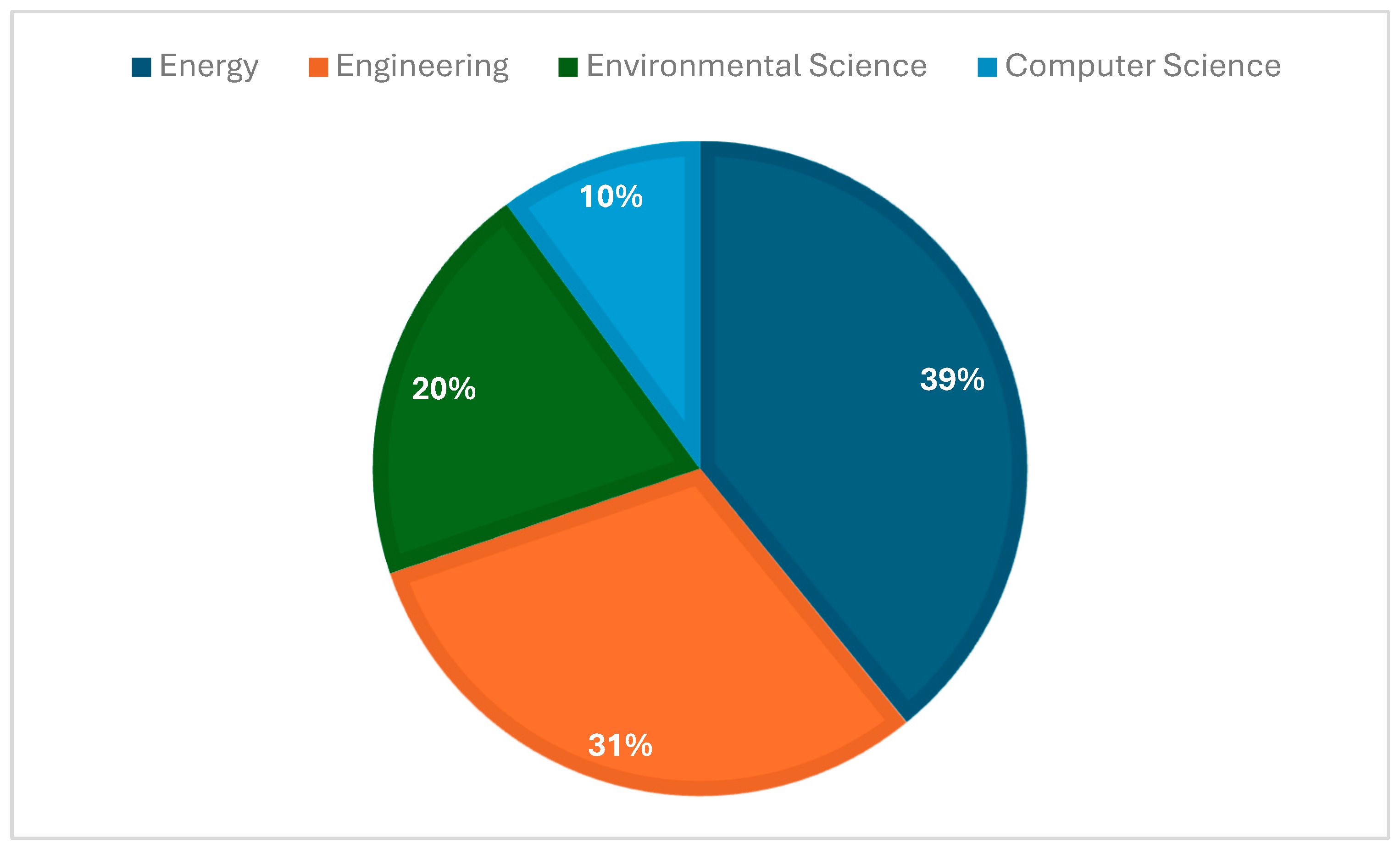
Figure 2.
Structure and search criteria carried out in the Scopus base and the number of documents found.
Figure 2.
Structure and search criteria carried out in the Scopus base and the number of documents found.
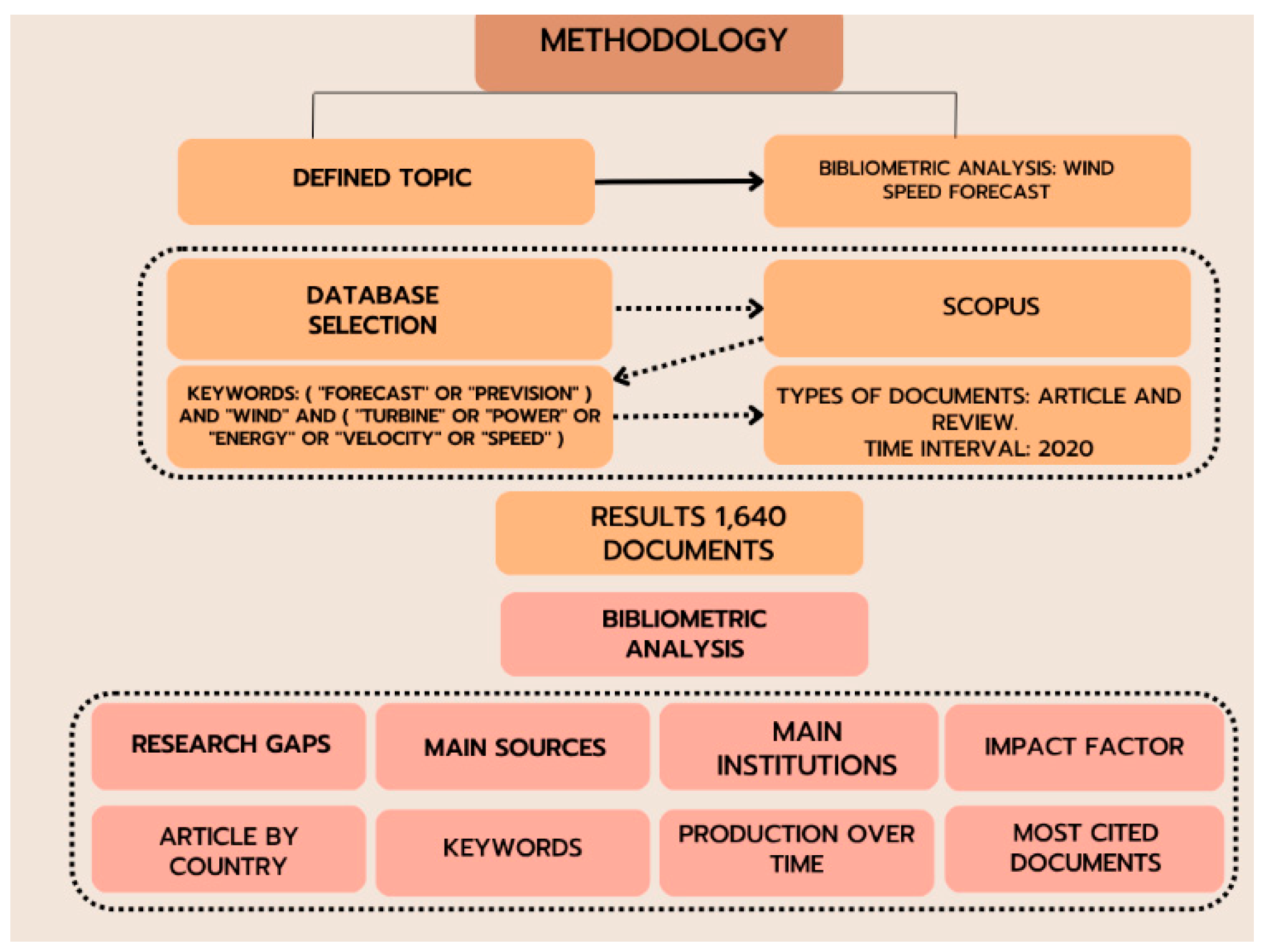
Figure 3.
Search criteria and refinement conditions.
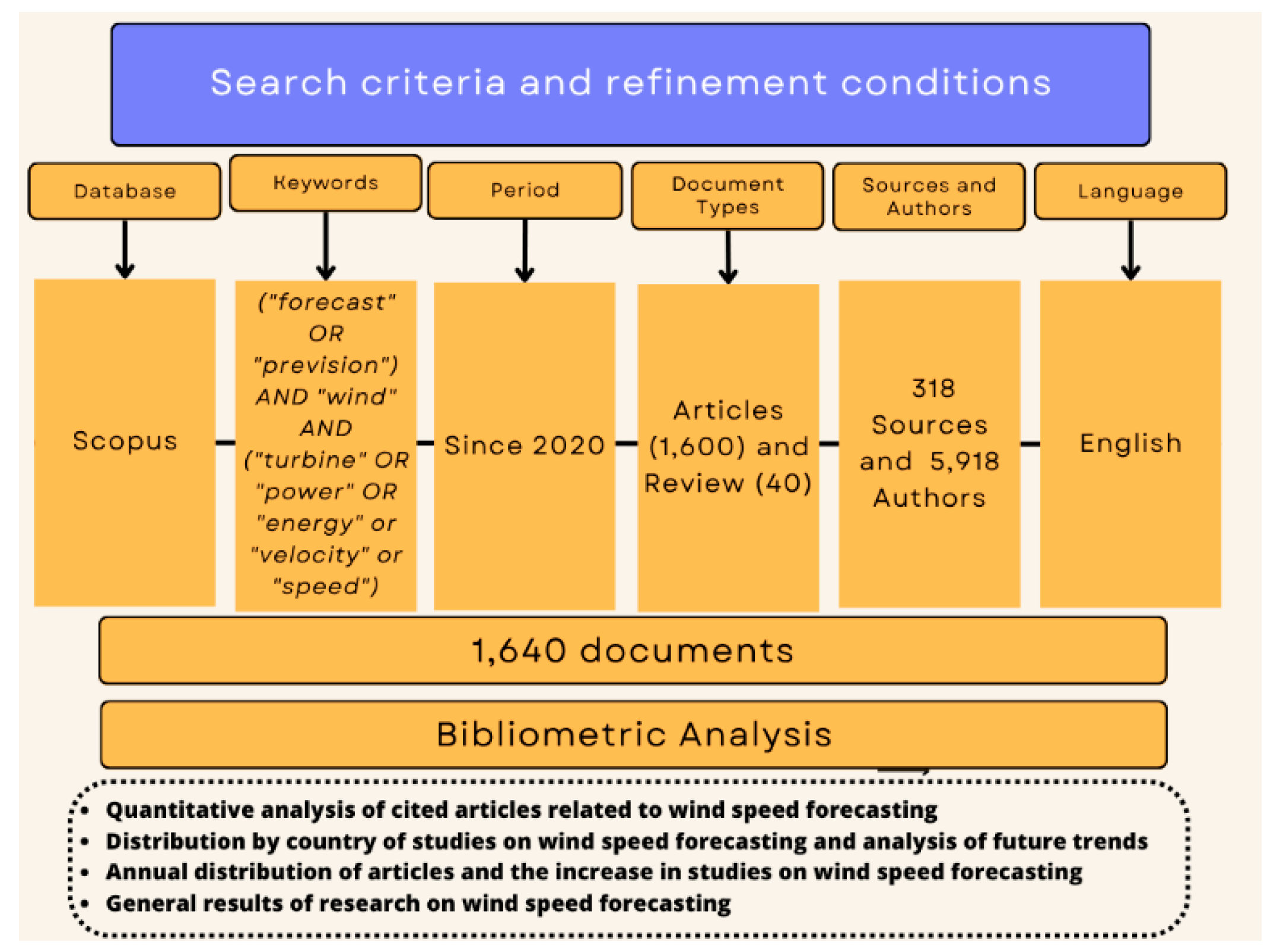
Figure 4.
Growth over time of publications from the 5 institutions with the highest number of publications in the area.
Figure 4.
Growth over time of publications from the 5 institutions with the highest number of publications in the area.
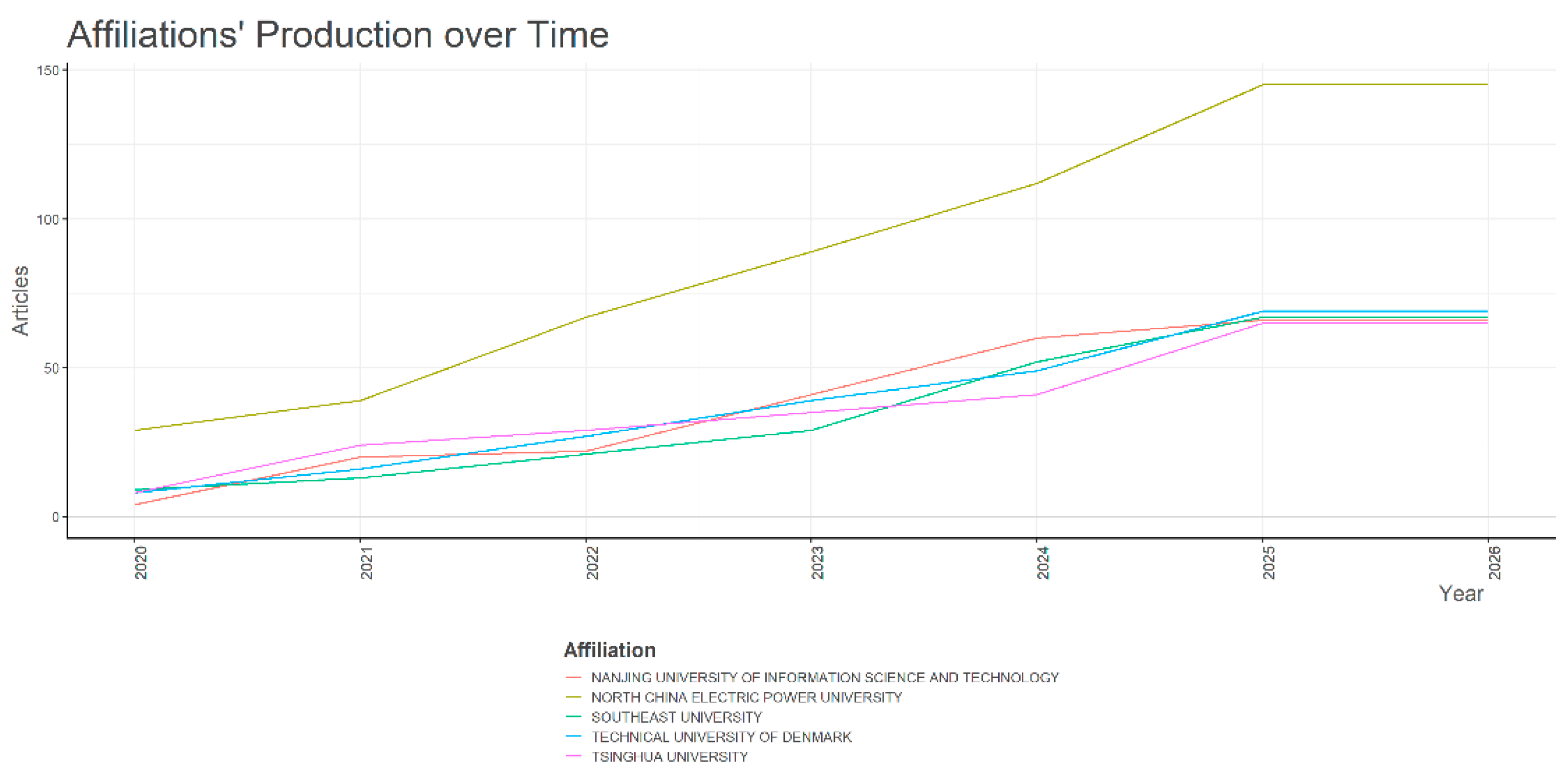
Figure 5.
Number of each of the keywords most cited by the authors.
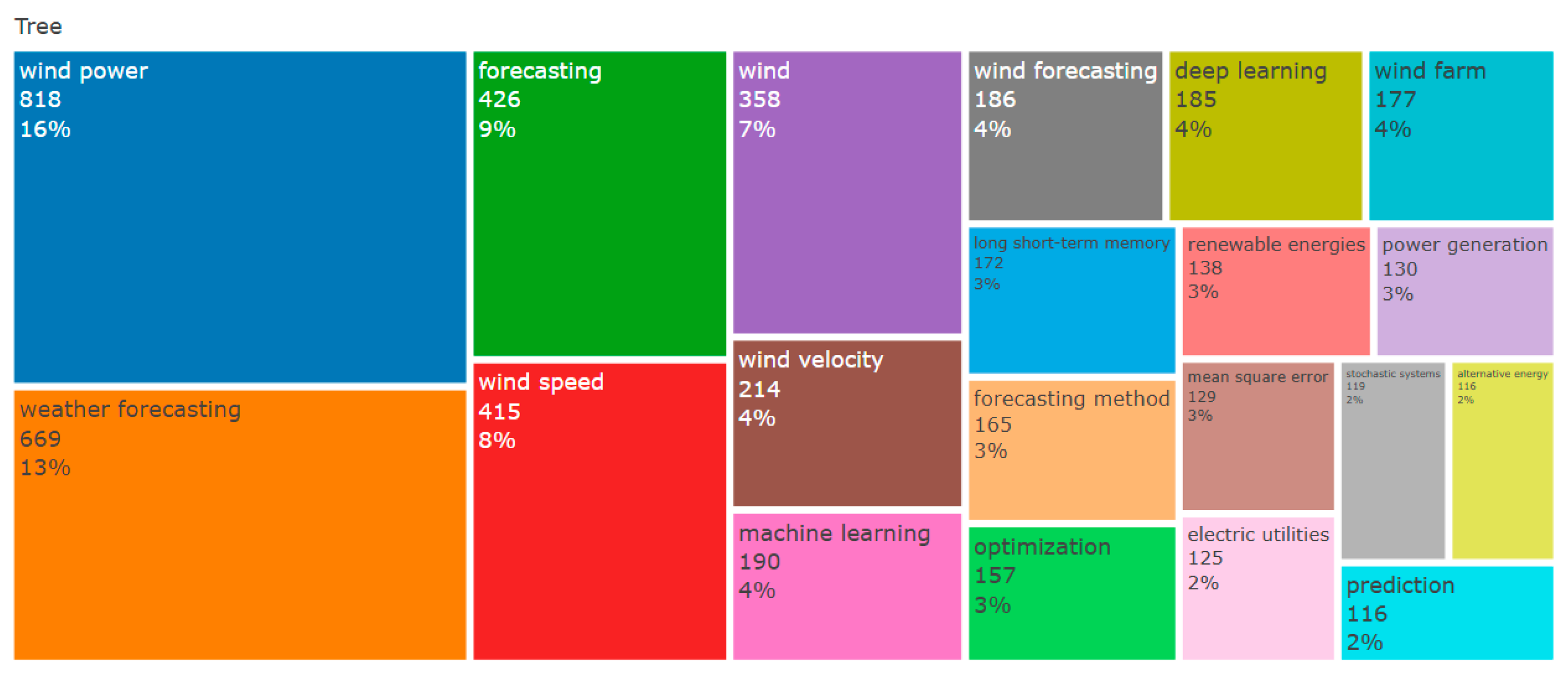
Figure 6.
Network of the most representative words within the set of keywords.
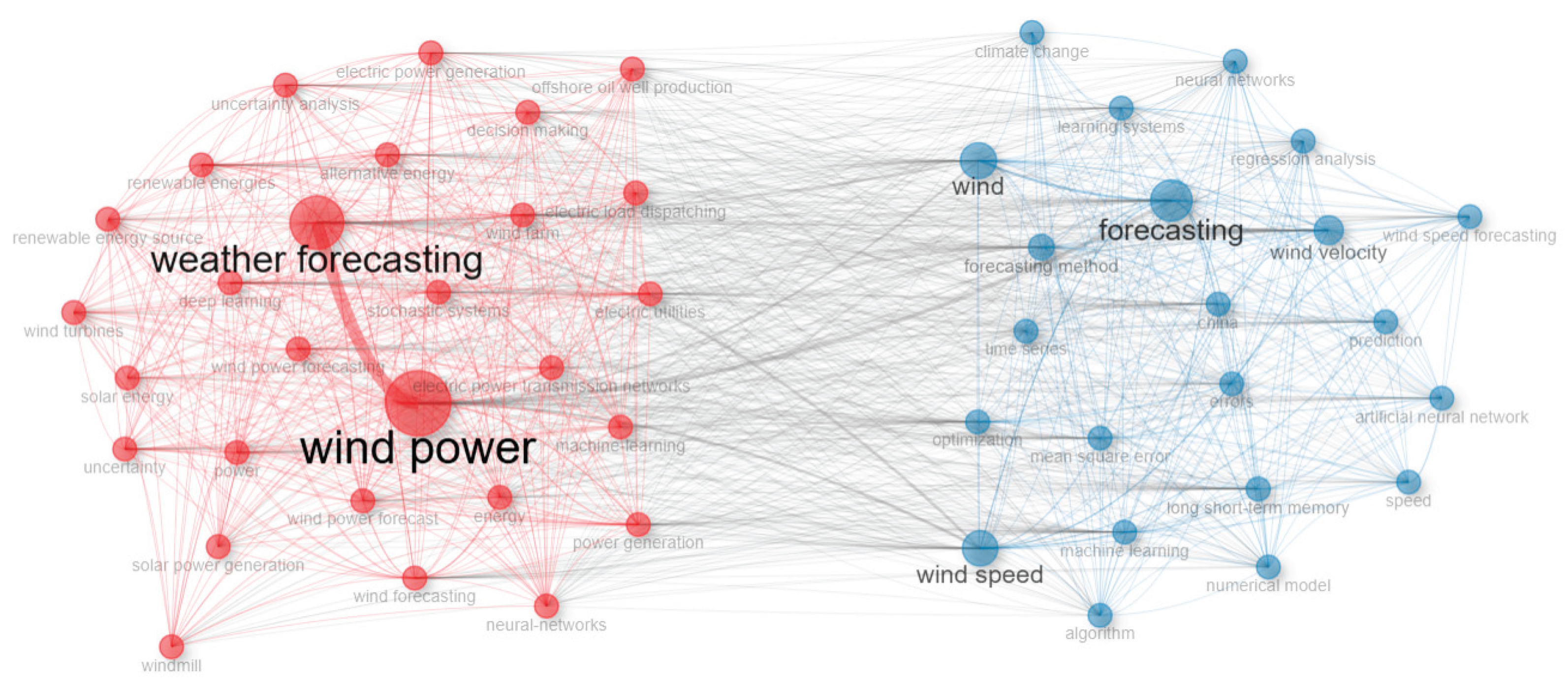
Table 1.
Scope, database, terms, and filters referring to the bibliometric analysis performed with the Bibliometrix tool [21].
Table 1.
Scope, database, terms, and filters referring to the bibliometric analysis performed with the Bibliometrix tool [21].
| Database | Researched Terms | Number of documents | Inserted filters |
|---|---|---|---|
| Scopus | ("forecast" OR "prevision") AND "wind" AND ("turbine" OR "power" OR "energy" or "velocity" or "speed"),” | 1,640 | Documents: Scientific Articles and Review Publication stage: Final Source Type: Journal English language |
Source: Scopus Base, Jul.2025.
Table 2.
Sources with the most publications in the analyzed dataset.
| Sources | TP | h_index | TC | CiteScore or Impact Factor (IF) | Pr (%) | AC |
|---|---|---|---|---|---|---|
| ATMOSPHERE | 125 | 13 | 768 | 3.11 | 7.62 | 6.14 |
| RENEWABLE ENERGY | 113 | 34 | 3649 | 8.634 | 6.89 | 32.29 |
| APPLIED ENERGY | 92 | 41 | 4811 | 11.446 | 5.61 | 52.29 |
| ENERGY REPORTS | 61 | 19 | 1822 | 4.937 | 3.72 | 29.87 |
| ENERGY CONVERSION AND MANAGEMENT | 56 | 28 | 2547 | 11.533 | 3.41 | 45.48 |
| OCEAN ENGINEERING | 47 | 14 | 1321 | 8.4 | 2.87 | 28.11 |
| IEEE TRANSACTIONS ON SUSTAINABLE ENERGY | 40 | 22 | 1495 | 8.31 | 2.44 | 37.38 |
| INTERNATIONAL JOURNAL OF ELECTRICAL POWER AND ENERGY SYSTEMS | 40 | 18 | 1034 | 5.659 | 2.44 | 25.85 |
| IEEE TRANSACTIONS ON POWER SYSTEMS | 37 | 15 | 969 | 7.326 | 2.26 | 26.19 |
| IET RENEWABLE POWER GENERATION | 35 | 11 | 496 | 3.03 | 2.13 | 14.17 |
| RENEWABLE AND SUSTAINABLE ENERGY REVIEWS | 31 | 15 | 1219 | 16.799 | 1.89 | 39.32 |
| ELECTRIC POWER SYSTEMS RESEARCH | 30 | 13 | 716 | 3.818 | 1.83 | 23.87 |
| JOURNAL OF MARINE SCIENCE AND ENGINEERING | 30 | 10 | 324 | 5.0 | 1.83 | 10.80 |
| WIND ENERGY | 26 | 12 | 375 | 3.71 | 1.59 | 14.42 |
| SUSTAINABLE ENERGY TECHNOLOGIES AND ASSESSMENTS | 24 | 15 | 680 | 17.3 | 1.46 | 28.33 |
Note: TPs = Total Publications; Pr(%) = Proportion; TC = Total Citations; IF = Impact Factor in 2025; AC = Average Citation = CT/TPs.
Table 5.
The 20 institutions with the highest number of articles and their location.
| Rank | Institution/Affiliation | Articles | Country | Percentage (%) |
|---|---|---|---|---|
| 1 | NORTH CHINA ELECTRIC POWER UNIVERSITY | 145 | China | 8,84% |
| 2 | TECHNICAL UNIVERSITY OF DENMARK | 69 | Denmark | 4,21% |
| 3 | SOUTHEAST UNIVERSITY | 67 | Bangladesh | 4,09% |
| 4 | NANJING UNIVERSITY OF INFORMATION SCIENCE AND TECHNOLOGY | 66 | China | 4,02% |
| 5 | TSINGHUA UNIVERSITY | 65 | China | 3,96% |
| 6 | HOHAI UNIVERSITY | 59 | China | 3,60% |
| 7 | SHANDONG UNIVERSITY | 57 | China | 3,48% |
| 8 | ZHEJIANG UNIVERSITY | 57 | China | 3,48% |
| 9 | WUHAN UNIVERSITY | 56 | China | 3,41% |
| 10 | NATIONAL RENEWABLE ENERGY LABORATORY | 49 | United States | 2,99% |
| 11 | CENTRAL SOUTH UNIVERSITY | 48 | China | 2,93% |
| 12 | HUAZHONG UNIVERSITY OF SCIENCE AND TECHNOLOGY | 48 | China | 2,93% |
| 13 | XI'AN JIAOTONG UNIVERSITY | 48 | China | 2,93% |
| 14 | SHANGHAI JIAO TONG UNIVERSITY | 46 | China | 2,80% |
| 15 | PACIFIC NORTHWEST NATIONAL LABORATORY | 42 | United States | 2,56% |
| 16 | CHINA AGRICULTURAL UNIVERSITY | 36 | China | 2,20% |
| 17 | DONGBEI UNIVERSITY OF FINANCE AND ECONOMICS | 35 | China | 2,13% |
| 18 | SOUTH CHINA UNIVERSITY OF TECHNOLOGY | 34 | China | 2,07% |
| 19 | MACAU UNIVERSITY OF SCIENCE AND TECHNOLOGY | 28 | China | 1,71% |
| 20 | SOUTHWEST JIAOTONG UNIVERSITY | 27 | China | 1,65% |
Table 6.
Number of collaborations between different countries, per article.
| Country | Articles | Articles % | SCP | MCP | MCP % | TC | |
|---|---|---|---|---|---|---|---|
| 1 | CHINA | 578 | 35,2 | 461 | 117 | 20,2 | 14754 |
| 2 | INDIA | 120 | 7,3 | 105 | 15 | 12,5 | 1383 |
| 3 | USA | 117 | 7,1 | 99 | 18 | 15,4 | 1998 |
| 4 | IRAN | 45 | 2,7 | 29 | 16 | 35,6 | 917 |
| 5 | UNITED KINGDOM | 41 | 2,5 | 24 | 17 | 41,5 | 1230 |
| 6 | GERMANY | 35 | 2,1 | 31 | 4 | 11,4 | 454 |
| 7 | ITALY | 35 | 2,1 | 22 | 13 | 37,1 | 763 |
| 8 | AUSTRALIA | 34 | 2,1 | 16 | 18 | 52,9 | 990 |
| 9 | BRAZIL | 34 | 2,1 | 20 | 14 | 41,2 | 536 |
| 10 | SPAIN | 34 | 2,1 | 28 | 6 | 17,6 | 746 |
| 11 | KOREA | 31 | 1,9 | 24 | 7 | 22,6 | 575 |
| 12 | DENMARK | 24 | 1,5 | 14 | 10 | 41,7 | 441 |
| 13 | TURKEY | 24 | 1,5 | 23 | 1 | 4,2 | 479 |
| 14 | PORTUGAL | 23 | 1,4 | 16 | 7 | 30,4 | 822 |
| 15 | FRANCE | 22 | 1,3 | 13 | 9 | 40,9 | 296 |
Disclaimer/Publisher’s Note: The statements, opinions and data contained in all publications are solely those of the individual author(s) and contributor(s) and not of MDPI and/or the editor(s). MDPI and/or the editor(s) disclaim responsibility for any injury to people or property resulting from any ideas, methods, instructions or products referred to in the content. |
© 2025 by the authors. Licensee MDPI, Basel, Switzerland. This article is an open access article distributed under the terms and conditions of the Creative Commons Attribution (CC BY) license (http://creativecommons.org/licenses/by/4.0/).
Copyright: This open access article is published under a Creative Commons CC BY 4.0 license, which permit the free download, distribution, and reuse, provided that the author and preprint are cited in any reuse.


