

Submitted:
03 December 2025
Posted:
03 December 2025
You are already at the latest version
Abstract
Residential retrofitting is a cornerstone of national strategies for achieving net-zero emissions by 2050. Yet, despite decades of policy incentives, adoption remains limited, delivery performance is uneven, and realised carbon reductions often fall short of predictions. This paper conceptualises housing retrofit projects as complex micro-projects—small in scale but marked by technical, organisational, and social inter-dependencies that challenge conventional project delivery. Drawing on an integrative review of 56 studies, we synthesise evidence across the Owner, Supplier, and Delivery domains to identify the managerial, coordination, and communication barriers that shape whole-life CO₂ outcomes. By framing these challenges through concepts of static and dynamic complexity, the study demonstrates that performance shortfalls stem less from technological gaps than from fragmented project organisation and weak cross-domain coordination. The review contributes an evidence-based understanding of how complexity affects retrofit delivery, outlines implications for policy and practice, and proposes a research agenda for improving assurance, learning, and verification in housing retrofit management.
Keywords:
housing retrofit
; complex micro-projects
; project delivery
; whole-life carbon
; construction management
; sustainability transitions
1. Introduction
Global efforts to limit climate change under the Paris Agreement have intensified the urgency to decarbonise the built environment. The construction industry contributes over one-third of global CO2 emissions [1], and existing buildings—particularly the residential stock—represent a major share of operational and embodied carbon. In countries such as the United Kingdom, around 28.5 million houses account for approximately 30 % of national energy use, with heating and hot water responsible for most of this consumption [2]. Because the majority of homes that will exist in 2050 already stand today, achieving net-zero housing depends primarily on upgrading existing dwellings rather than constructing new ones.
National policies have responded with various incentive programmes promoting improvements to building fabric, heating systems, and renewable technologies [3]. Nevertheless, progress remains slow. Despite decades of interventions—including grants, tax relief, and regulatory reforms—retrofit activity levels are far below what is required for 2050 targets. Previous research attributes this to barriers such as financial risk, disruption, information gaps, and lack of supply-side capacity [4,5]. Yet these explanations tend to treat retrofits as technical or economic problems rather than as a management challenge of organising complex micro-projects.
We argue that housing retrofit projects, though typically modest in size, are complex micro-projects. They exhibit the same characteristics of complexity found in major projects—uncertainty, interdependence, and emergent behaviour—but within the constraints of domestic settings, fragmented supply chains, and lay decision-makers. Treating retrofits as complex micro-projects reframes the challenge: rather than merely improving technology or subsidies, progress depends on how owners, suppliers, and delivery teams coordinate to manage uncertainty and integrate socio-technical systems effectively.
This paper pursues two main aims.
First, it provides an integrative review of housing retrofit research organised around the three domains of project organising [6,7]: the Owner Domain (homeowners, social landlords, private landlords), the Supplier Domain (manufacturers, merchants, installers), and the Delivery Domain (project execution and on-site integration).
Second, it examines how project complexity—both static and dynamic—affects the management and delivery of retrofit projects and, in turn, their contribution to whole-life CO2 outcomes. By bridging project-management theory with housing retrofit practice, the review identifies how coordination, communication, and trust across domains influence project performance.
The remainder of the paper is structured as follows. Section 2 introduces the conceptual background and outlines the research gap. Section 3 explains the integrative review methodology. Section 4 synthesises the literature across the three domains and summarises common challenges. Section 5 discusses the interaction between project complexity and carbon outcomes. Section 6 presents the implications and future research agenda, followed by conclusions.
2. Conceptual Background: Housing Retrofits as Complex Micro-Projects
2.1. The Concept of Complexity
Complexity has become a defining feature of modern projects and organisations. Researchers across disciplines conceptualise it as the property of systems composed of numerous interrelated components whose behaviour cannot be fully predicted [8,9,10]. Complex systems were similarly viewed as hierarchies of interacting subsystems whose collective behaviour exhibits emergent properties not reducible to individual parts [11]. The Cynefin Framework [12] distinguishes complex situations—characterised by “unknown unknowns” and emergent patterns—from complicated ones, where cause-and-effect relationships are knowable through analysis. The terms are often conflated: complicatedness involves intricacy yet predictability, whereas complexity involves uncertainty and adaptation [7].
In project management, complexity has been defined as “consisting of many different interrelated components that can be viewed from a differentiated and interdependent perspective” [7] (p. 202). Building on this foundation, researchers identify recurring features of complex projects:
- Unpredictability – outputs cannot be linearly derived from inputs.
- Non-linearity – small changes can produce disproportionate effects.
- Emergence – challenges and requirements shift over time [13].
Complicatedness, by contrast, concerns projects with many elements but stable relationships among them [7,12]. It was described as intricacy rather than indeterminacy [14]. Such projects are difficult yet ultimately analysable through detailed planning, modelling, and expert knowledge. In the housing context, constructing a new dwelling is complicated—it demands coordination of many trades but follows well-established methods. A community-wide retrofit programme, however, is complex—it involves evolving technologies, occupant behaviours, and policy conditions that interact unpredictably.
2.2. Static and Dynamic Complexity
Static and dynamic complexity were distinguished from each other [10,15]. Static (or structural) complexity refers to the number of elements and interfaces within a project—its visible architecture [10]—which we here align with the concept of “complicated” [12]. Dynamic complexity concerns the unpredictable interactions and feedback loops among those elements over time [16,17], thereby linking dynamic complexity to emergent change and learning within systems, which we here align with the concept of “complexity” [12]. Table 1 (below) summarises their distinctions.
Understanding this distinction is vital for housing retrofit. Complicatedness arises from numerous components—walls, roofs, heating systems, insulation layers—each requiring technical coordination. Complexity emerges from how these elements interact with human, social, and regulatory systems: owners’ decisions, tenant behaviours, funding schemes, and supply-chain dependencies.
2.3. Complexity in Housing Retrofit Projects
Retrofit projects appear deceptively small yet embody substantial complexity. Even modest dwellings can involve unpredictable structural conditions, bespoke designs, and evolving regulations. Heterogeneity of the existing stock, emerging energy technologies, and multi-actor arrangements were identified as key sources of complexity [18]. Recognising complexity aids managers by clarifying coordination needs, guiding organisational form, and shaping success criteria [19].
Technological complexity stems from the integration of new systems into old structures. Retrofitting may require specialised construction methods to preserve integrity, avoid thermal bridging, and meet airtightness or ventilation standards. Older homes conceal unknowns—degraded materials, outdated wiring, hidden dampness—that are only discovered during project execution [20]. Introducing modern heating and control systems into such contexts often triggers unforeseen compatibility problems [21].
Organisational complexity arises from fragmented governance and multiple small stakeholders. Retrofit projects involve diverse actors—homeowners, tenants, installers, architects, merchants, and regulators—whose objectives may conflict [22,23]. Managing these interdependencies requires continual negotiation, learning, and trust-building.
Social complexity reflects occupants’ daily lives and emotional attachments to their homes. Unlike new construction, retrofits often occur in inhabited spaces where disruption and aesthetics strongly influence acceptance [24,25]. Owners’ risk perceptions, trust in suppliers, and cultural meanings of “home” all shape project outcomes.
Technological, organisational, and social complexities interact to produce dynamic uncertainty: small changes in design or occupant preference can cascade into cost overruns, performance gaps, or dissatisfaction. These micro-level challenges mirror those of large-scale infrastructure projects but unfold within the personal domain of households. As a result, project success in retrofit depends less on rigid planning and more on adaptive management—iterative coordination, flexible learning, and transparent communication among participants.
2.4. Complexity, Delivery, and CO2 Outcomes
Complexity also affects environmental performance. Variability in workmanship, sequencing, and user behaviour contributes to the well-documented energy performance gap—the discrepancy between modelled and realised savings [26]. Dynamic complexity means that even well-specified technologies can underperform when installed under real-world constraints or used differently than anticipated. Addressing this requires not only better technical standards but also improved project delivery processes that integrate feedback, monitoring, and verification.
Recognising housing retrofit as a complex micro-project, therefore reframes its contribution to sustainability transitions. It underscores that achieving reliable CO2 reductions is not simply a matter of scaling technologies, but of managing socio-technical complexity effectively. The following sections operationalise this insight by reviewing how the Owner, Supplier, and Delivery domains interact to influence project outcomes.
2.5. Research Gap and Contribution
While several reviews have addressed housing retrofit from policy or technical perspectives, most concentrate on incentive schemes, governance, or engineering solutions rather than on the management and delivery of retrofit projects.
- An interdisciplinary lens was adopted to link engineering and social theory to assess sustainable thermal retrofit policy [27]. They highlight neglected issues such as health, affordability, and heritage.
- A systematic review of “green retrofitting” was conducted to identify critical success factors (CSFs) and barriers, including unreliable technologies and material shortages [28].
- Chinese policies promoting building green retrofit were examined, and they identified barriers related to finance, awareness, and technical capacity [29].
Policy frameworks and technologies vary widely by country and context, limiting the generalisability of these studies and leaving the practical problem of project organisation largely unexplored. Yet housing retrofits are, at their core, projects whose outcomes depend on how owners, suppliers, and delivery actors coordinate resources and manage complexity. This paper, therefore, contributes an integrative review that consolidates fragmented knowledge on retrofit management across these domains, identifies recurring barriers, and highlights gaps where project-management research can strengthen future retrofit practice.
3. Methods: Integrative Review with PRISMA-Style Transparency
3.1. Rationale for the Integrative Review
We conducted an integrative literature review methodology because research on housing retrofit management is fragmented across disciplines, sectors, and geographical contexts. Unlike a systematic review, which requires a large volume of empirical studies for meta-analysis, an integrative review allows for the inclusion of diverse forms of evidence—including conceptual, qualitative, quantitative, and grey literature—while maintaining transparency and rigour [30,31]. This approach is particularly suitable for synthesising an emerging field that bridges technology, policy, and project management [32].
Integrative reviews go beyond descriptive stock-taking: they aim to generate conceptual insights by critiquing and recombining existing knowledge [33]. In this study, we used the integrative approach to identify how different strands of research conceptualise and address the challenges of managing housing retrofit projects, focusing on the interrelationships between owners, suppliers, and delivery processes.
3.2. Review Protocol
Following established guidance for integrative reviews in management research [30,34,35], we structured our review around three phases: scoping, searching/screening, and synthesis. This approach is widely adopted in management and organisation studies and ensures transparency while accommodating diverse forms of evidence.
We operationalised this structure into a transparent, reproducible protocol aligned with PRISMA-style reporting principles. The review question guiding our search was:
How have housing retrofit projects been studied and managed across owner, supplier, and delivery domains, and what factors influence their success in achieving sustainability and CO2 reduction?
3.3. Search Strategy
To ensure comprehensive coverage, we searched four major academic databases—Google Scholar, Web of Science, ScienceDirect, and Scopus—along with selected government and professional reports. We used Boolean combinations of keywords related to housing retrofit and project management (Table 2).
The starting year (2005) corresponds to the entry into force of the Kyoto Protocol, marking the beginning of coordinated global greenhouse gas reduction commitments. Although the Paris Agreement (2015) represents a later milestone, including the earlier period captures important foundational research in retrofit practice and policy.
A snowballing process (Ghafoor et al., 2023) was also applied, using citation tracking and reference lists from key papers to identify additional studies. After duplicates and non-relevant records were removed, 56 articles met the inclusion criteria. The flow of selection is summarised in Figure 1.
3.4. Inclusion and Exclusion Criteria
We included studies that:
- addressed housing retrofit projects with explicit discussion of management, organisation, or delivery.
- provided empirical or conceptual insights relevant to the Owner, Supplier, or Delivery domains.
- were published in peer-reviewed journals or as authoritative reports between 2005 and 2022.
- were written in English and focused on housing (not commercial or industrial buildings).
- We excluded studies that:
- focused solely on technical or engineering aspects without organisational or management analysis.
- addressed new-build projects rather than retrofit.
- were purely policy commentaries without methodological transparency.
Because few empirical studies report quantified CO2 outcomes, we broadened inclusion to encompass research on energy efficiency, retrofit quality, and performance gaps, as these factors are directly related to CO2 outcomes.
3.5. Data Extraction and Synthesis
For each paper, we recorded:
- bibliographic information (title, author, year, journal, DOI).
- research focus and methods.
- housing type and country context.
- key findings on barriers, drivers, and delivery processes.
- Owner Domain – including owner-occupiers, social landlords, and private landlords.
- Supplier Domain – covering manufacturers, merchants, contractors, and installers.
- Delivery Domain – focusing on project execution and integration.
We used this conceptual framing because it provides a holistic perspective on project organising, encompassing both the temporary and permanent organisations involved, and the interfaces between them. This is in contrast to much of the project management literature (Lundin & Söderholm, 1995), which focuses merely on the temporary project organisation in the delivery domain.
3.6. Iterative Thematic Synthesis
Data analysis followed an iterative thematic synthesis approach [37]. Each article was read multiple times to identify recurring themes—for example, trust, financing, split incentives, training, communication, and performance gaps. Themes were compared, grouped, and refined through successive coding cycles until stable clusters emerged both within and across the three domains. This iterative process enabled us to trace interdependencies—for instance, how supplier capability influences owner confidence and delivery quality—and to interpret their broader implications for sustainability.
3.7. Synthesis and Interpretation
Finally, we synthesised the coded material thematically to highlight three dimensions:
- recurring barriers and drivers across domains.
- cross-domain interdependencies shaping project outcomes.
- implications for energy and potential CO2 performance.
While the majority of reviewed studies assessed energy efficiency or organisational performance rather than direct carbon metrics, we interpret these findings as proxies for whole-life CO2 performance. We also note the absence of consistent carbon reporting as an important evidence gap for future research.
The following section presents the results of this synthesis, organised around the Owner, Supplier, and Delivery domains.
4. Results: Evidence Across the Three Domains
4.1. Overview of the Evidence Base
Of the 56 reviewed papers, 25 focused on owner-occupiers, eight on social landlords, and seven on private landlords. Thirteen studies centred on suppliers, while nine analysed project delivery (Table 3). The evidence was geographically concentrated in north-western Europe—particularly the UK, the Netherlands, Germany, and the Nordic countries—reflecting shared reliance on gas heating, similar tenure mixes, and mature housing stocks.
4.2. Owner Domain
4.2.1. Owner-Occupiers
Owner-occupiers remain central to national retrofit targets because they represent the majority of the housing stock. However, evidence shows that their decisions are rarely motivated purely by energy efficiency. Rather, homeowners prioritise aesthetic and comfort improvements—visible changes such as kitchens and bathrooms—over invisible thermal upgrades [24,25,58]. The distinction between house and home is crucial: energy-related investments compete with personal and emotional attachments to domestic spaces [48].
Participation is strongly shaped by life-cycle factors: new homeowners, often younger and more educated, are more willing to undertake disruptive retrofits [49]. In contrast, long-term residents tend to avoid interventions that disturb familiar routines. These behavioural patterns align with studies showing that homeowners with higher environmental awareness and social capital networks are more likely to act [51,57].
Knowledge gaps are another persistent barrier. Limited publicity and inconsistent advice from consultants leave homeowners dependent on peer networks for information. Trust, both interpersonal and professional, plays a decisive role [88]. Finally, financial considerations constrain adoption: retrofit costs are high, returns take a long time, and predicted energy savings are often not realised due to rebound and prebound effects [26,39].
Overall, homeowners’ engagement in retrofitting remains low because they face a combination of technical uncertainty, emotional reluctance, and limited confidence in the supply side.
4.2.2. Social Landlords
Social landlords—public or non-profit entities providing affordable housing—are better positioned to manage retrofits because they operate at scale and employ professional asset managers. Their social purpose aligns with reducing fuel poverty and carbon emissions [44,59]. Uniform building typologies allow economies of scale and replication of solutions [61].
However, even here, complexity arises. Upgrades must accommodate tenants’ needs and prevent political backlash when rent increases exceed energy savings [63]. Social landlords must balance technical and social objectives, manage expectations and coordinate multiple stakeholders. Effective communication with tenants is essential for adoption and sustained performance [61].
4.2.3. Private Landlords
Private landlords, especially small private landlords (SPLs), are typically risk-averse and poorly informed about retrofit opportunities [67,68]. Being older and less financially leveraged, SPLs prioritise property maintenance and stable rent income over energy performance. The classic split-incentive problem—where landlords pay for retrofits, but tenants benefit from lower bills—undermines investment motivation [65]. Bureaucratic funding schemes further discourage participation [67]. Even when policies permit rent increases to recoup investments, as in Germany, tenants often pay more in rent increases than they save in energy costs [63].
Overall, across owner types, the evidence highlights limited demand for retrofit, low trust in supply chains, and insufficient integration between financial, technical, and behavioural interventions.
4.3. Supplier Domain
Suppliers—manufacturers, merchants, and installers—form the intermediary infrastructure of retrofit delivery. The literature consistently portrays this sector as fragmented, under-capacitated, and dominated by micro-enterprises employing fewer than ten people [5,79].
4.3.1. Intermediary Role and Market Maturity
Suppliers act as intermediaries linking homeowners’ needs to technologies. Yet they are primarily demand-led: since most renovation work targets aesthetics, retrofit products are marginal to their business [78]. Manufacturers provide limited training, often more promotional than educational [5]. Merchants play an under-recognised role by shaping what materials and technologies are available locally [89].
4.3.2. Knowledge and Capability Gaps
Micro-enterprises lack resources for innovation and rely on “learning by doing.” Training systems remain technology-specific rather than system-based [72]. As domestic energy systems become smarter, the installers’ advisory role grows, yet professional jurisdictions remain fragmented [74]. These structural weaknesses contribute to inconsistent quality and reinforce homeowners’ mistrust.
4.3.3. Conservatism and Resistance
The retrofit supply chain exhibits conservatism akin to “hard-wired inertia” [5]. Installers prefer familiar products, merchants stock proven items, and manufacturers depend on established distribution relationships. The result is limited uptake of innovative technologies and slow diffusion of best practices.
4.3.4. Supplier–Owner Relationship
Poor communication between suppliers and clients amplifies risk. Owners unfamiliar with technical language misinterpret advice, leading to mismatched expectations. Negative experiences propagate through social networks, deterring others [80]. Effective communication—clear, jargon-free, and trust-based—is therefore central to improving retrofit outcomes.
4.4. Delivery Domain
Retrofit delivery involves executing works within occupied buildings under uncertainty. Compared to new-build projects, retrofits exhibit discovery during execution—hidden defects, unforeseen materials, or occupant interventions [20,90]—all contribute to dynamic complexity and therefore emergence during project execution.
4.4.1. Uncertainty and Risk
Execution uncertainty complicates scheduling and budgeting [91]. Each dwelling presents unique physical conditions requiring bespoke solutions. For example, the Kerkrade West project in the Netherlands achieved remarkable energy performance through standardised prefabrication (“renovation trains”), but only after extensive trial-and-error learning and at high cost [82]. Conversely, the UK FLASH project revealed severe incompatibilities among retrofit systems, showing how technical interdependence and site variability can undermine performance [84]. Even properties that were built to a standardised template many years or decades previously will have become differentiated as they “learn” in response to occupants’ diverse requirements [92].
4.4.2. Occupant Interactions
Delivery complexity also stems from ongoing interaction with occupants. In owner-occupied housing, families usually remain in situ during renovations, making disruption management a key success factor. Schedules must accommodate daily routines and negotiate aesthetic choices [82]. In social housing, landlords often act as mediators between tenants and contractors, improving coordination [84].
4.4.3. Performance Verification
Unlike new-build projects, retrofit success cannot be judged at handover; performance unfolds over time. Continuous monitoring and post-occupancy evaluation are rarely implemented, leaving limited feedback to improve future projects. The energy performance gap—the divergence between predicted and actual savings—illustrates how inadequate commissioning and verification erode long-term CO2 benefits [39].
4.4.4. Managerial Capabilities
Retrofit project managers must integrate technical, social, and organisational complexity. The need for a new professional role is highlighted [93]—the retrofit coordinator—who bridges design, installation, and quality assurance. Adaptive management, strong communication, and iterative learning are critical competencies.
4.5. Key insights Across Domains
Owner Domain
Across contexts, owners’ decisions have significant carbon implications. Projects initiated for aesthetic reasons often ignore optimal insulation or heating upgrades, resulting in minimal CO2 benefits. Conversely, projects with high environmental awareness achieve deeper energy savings but face financial constraints. Policies focusing solely on subsidies fail to address these behavioural and social determinants.
Supplier Domain
Supplier capability directly affects performance outcomes. Poor installation quality, lack of system integration, and inadequate commissioning are major sources of the performance gap. CO2 savings depend not only on materials but also on workmanship and sequencing—factors seldom captured in policy modelling.
Delivery Domain
Delivery determines whether technical potential becomes actual CO2 reduction. Poor coordination among trades, insufficient monitoring, and user mismanagement reduce effectiveness. Few studies report post-retrofit evaluation, and those that do [94] find lower-than-expected savings due to behavioural rebound—a phenomenon where occupants, after improving energy efficiency, increase their energy use (for example, by heating rooms to higher temperatures or using appliances more often), thereby offsetting some of the expected savings. In addition, incomplete commissioning processes and inadequate post-occupancy support further limit the actual achievement of carbon emission reductions.
4.6. Summary of Common Challenges
Across domains, four overarching themes emerge:
- Fragmented project management – retrofits lack integrated delivery models linking design, installation, and verification.
- Trust and communication deficits – low confidence between owners and suppliers undermines uptake and satisfaction.
- Performance uncertainty – the energy performance gap remains pervasive due to dynamic complexity.
- Socio-technical misalignment – technical measures often conflict with occupant preferences or use patterns.
4.7. Implications for Carbon Outcomes and Delivery Practice
The review confirms that management processes are as critical to CO2 outcomes as technological specifications. Delivery failures, rather than technology limitations, explain much of the deviation between modelled and realised CO2 reductions. Addressing this requires a process-anchored approach linking complexity management with measurement and verification.
5. Framework and Discussion: Mapping Complexity, Delivery, and Whole-Life CO2
5.1. Linking Project Complexity to CO2 Performance
The preceding review revealed that retrofit outcomes depend less on technological innovation and more on how complexity is managed during delivery. Technical potential alone cannot guarantee CO2 outcomes; rather, project organisation—coordination, sequencing, and quality assurance—determines whether predicted energy savings are realised.
Drawing on the concepts of static and dynamic complexity [15,95] and our three-domain analysis, we propose a conceptual framework that maps project-management complexity to whole-life CO2 outcomes as Figure 2.
Figure 2 conceptualises how the management of project complexity shapes CO2 outcomes in housing retrofit projects. Static complexity arises from the technical configuration of multiple systems and trades, while dynamic complexity stems from social, organisational, and regulatory uncertainty. Effective management responses—such as coordination across the Owner, Supplier, and Delivery domains, transparent communication, adaptive planning, and rigorous quality assurance—translate these complexities into controlled delivery processes. High-quality installation, commissioning, and user engagement then determine whether the technical potential of retrofit measures is realised as verifiable reductions in operational and embodied CO2. Where complexity is out of control, fragmented decision-making and poor workmanship generate performance gaps. The feedback loop indicates that learning from measured carbon outcomes should continuously inform policy, standards, and professional practice, closing the gap between predicted and achieved sustainability benefits.
Static complexity corresponds to the number of physical components, trades, and interfaces involved in a retrofit (e.g., insulation systems, glazing, HVAC upgrades). Managing static complexity requires detailed planning, sequencing, and technical coordination—activities typically handled by contractors and site managers.
Dynamic complexity arises from unpredictable interactions between social, organisational, and technical subsystems—homeowners’ decisions, installer behaviour, policy changes, or tenant adaptation. Managing dynamic complexity demands adaptive coordination, learning, and trust building across project boundaries.
When static and dynamic complexities are both high—as in most housing retrofits—the risk of performance gaps and rework increases. Mismanaged complexity translates directly into CO2 inefficiency: poor sequencing causes thermal bridging; communication failures lead to incorrect operation of heating systems; fragmented responsibility delays fault detection.
5.2. The three-Domain Interaction Model
The integrative synthesis shows that the Owner, Supplier, and Delivery domains interact through feedback loops that influence both energy and carbon outcomes (Table 4).
Although few studies provide quantitative data on firm size distribution, the literature consistently characterises the retrofit supply chain as dominated by small and micro-enterprises, with limited capacity for coordination and innovation [5,79].
These three domains are mutually interdependent. For instance, supplier professionalism affects owner confidence, which in turn determines retrofit ambition and budget. Delivery performance then feeds back into public trust and future policy uptake. The framework, therefore, emphasises that achieving whole-life CO2 reduction requires systemic coordination across all three domains rather than isolated technological optimisation.
The synthesis above shows that effective coordination among owners, suppliers, and delivery actors is central to improving whole-life carbon performance. The following section discusses the practical, theoretical, and research implications arising from these findings.
6. Implications and Future Research
6.1. Managerial and Policy Implications
- Adopt complexity-aware management practices.
Policymakers and industry bodies should recognise retrofit projects as complex micro-projects and train coordinators accordingly. The emerging retrofit-coordinator role exemplifies this shift from technical to integrative capability [93].
- 2.
- Strengthen quality assurance and verification.
National programmes should require commissioning and post-occupancy monitoring to ensure predicted CO2 reductions are achieved.
- 3.
- Professionalise the micro-enterprise supply chain.
Developing shared training standards and collaborative networks can mitigate capability fragmentation and ensure consistent workmanship.
- 4.
- Encourage owner engagement and trust.
Transparent communication, user-centred design, and clear demonstration of comfort and financial benefits increase willingness to invest.
- 5.
- Integrate retrofit policy with carbon accounting.
Linking grants and tax incentives to verified CO2 outcomes, rather than merely energy-efficiency ratings, would improve accountability.
6.2. Theoretical Implications
This review extends project management theory by demonstrating that complexity dynamics observed in major projects also apply at the micro-project scale of housing retrofits. It also advances sustainability-transition research by linking managerial practices to environmental outcomes, bridging socio-technical and project-organising perspectives. Finally, it shows how integrative review methods can synthesise interdisciplinary evidence to generate conceptual clarity in emerging research areas.
6.3. Research Agenda
- Quantification of management-carbon linkages.
There remains limited empirical evidence linking delivery practices directly to carbon outcomes. Mixed-method studies combining monitoring data with qualitative process evaluation would address this gap.
- 2.
- Comparative analysis across regions.
Most existing research focuses on north-western Europe. Expanding analysis to other climatic and regulatory contexts would test the framework’s generalisability.
- 3.
- Integration with digital technologies.
Building Information Modelling (BIM), digital twins, and data analytics offer tools for managing complexity and verifying CO2 outcomes in real time.
7. Conclusions
This study conceptualises housing retrofit projects as complex micro-projects whose success depends on managing technological, organisational, and social interdependencies. Through an integrative review of 56 studies, we mapped challenges across the Owner, Supplier, and Delivery domains and developed a framework linking project complexity to whole-life CO2 performance.
Our findings reveal that the barriers to decarbonising the existing housing stock are primarily managerial rather than purely technical. Fragmented supply chains, limited owner engagement, and inadequate verification processes undermine the potential of retrofit technologies. Recognising and managing these forms of complexity can transform retrofit delivery from a series of isolated interventions into a coordinated, learning-based system capable of delivering verified carbon reductions.
By reframing retrofits through the lens of complexity-informed project management, this paper contributes to both theory and practice. It invites researchers and practitioners to view small housing projects not as routine construction tasks but as dynamic socio-technical systems whose management determines their true climate impact.
Author Contributions
Conceptualization, Fengwen Yan and Graham Miles Winch; Methodology, Fengwen Yan; Formal analysis, Fengwen Yan; Investigation, Fengwen Yan; Writing – original draft, Fengwen Yan; Writing – review & editing, Fengwen Yan, Graham Miles Winch and Katherine Barker; Supervision, Graham Miles Winch and Katherine Barker.
Funding
This research received no external funding.
Institutional Review Board Statement
Not applicable.
Informed Consent Statement
Not applicable.
Data Availability Statement
Not applicable.
Conflicts of Interest
The authors declare no conflict of interest.
References
- Ritchie, H.; Rosado, P.; Roser, M. CO2 and greenhouse gas emissions. Our World in Data. 2020. Available online: https://ourworldindata.org/co2-and-greenhouse-gas-emissions (accessed on 24 April 2025).
- CPC. Homes Fit for the Future: Project Position Report. Connected Places Catapult: London. 2019. Available online: https://cp-catapult.s3.amazonaws.com/uploads/2022/05/Homes-for-the-future-Project-position-paper.pdf (accessed on 24 April 2025).
- HMG. The energy white paper: Powering our net zero future. Department for Business, Energy and Industrial Strategy: London. 2020. Available online: https://assets.publishing.service.gov.uk/media/5fdc61e2d3bf7f3a3bdc8cbf/201216_BEIS_EWP_Command_Paper_Accessible.pdf (accessed on 24 April 2025).
- CCC. UK housing: Fit for the future? Committee for Climate Change: London. 2019. Available online: https://www.theccc.org.uk/wp-content/uploads/2019/02/UK-housing-Fit-for-the-future-CCC-2019.pdf (accessed on 26 April 2025).
- Killip, G.; Owen, A.; Topouzi, M. Exploring the practices and roles of UK construction manufacturers and merchants in relation to Housing Energy Retrofit. Journal of Cleaner Production 2020, 251, 119205. [Google Scholar] [CrossRef]
- Winch, G.M. Three domains of Project Organising. International Journal of Project Management 2014, 32, 721–731. [Google Scholar] [CrossRef]
- Winch, G.M.; Maytorena, E.; Sergeeva, N. Strategic project organizing; Oxford University Press: Oxford, 2022. [Google Scholar]
- Baccarini, D. The concept of Project Complexity—a review. International Journal of Project Management 1996, 14, 201–204. [Google Scholar] [CrossRef]
- Sheard, S.A.; Mostashari, A. 5.2.2 complexity measures to predict system development project outcomes. INCOSE International Symposium 2013, 23, 170–183. [Google Scholar] [CrossRef]
- Browning, T.R. Complexity. Research Handbook on Complex Project Organizing 2023, 26–35. [CrossRef]
- Simon, H.A. The sciences of the artificial; The MIT Press: Cambridge, 1969. [Google Scholar]
- Snowden, D.J.; Boone, M.E. A Leader’s Framework for Decision Making. Harvard Business Review 2007, 1, 8–13. Available online: https://hbr.org/2007/11/a-leaders-framework-for-decision-making (accessed on 02 May 2025).
- Bakhshi, J.; Ireland, V.; Gorod, A. Clarifying the project complexity construct: Past, present and future. International Journal of Project Management 2016, 34, 1199–1213. [Google Scholar] [CrossRef]
- Geraldi, J.; Maylor, H.; Williams, T. Now, let’s make it really complex (complicated). International Journal of Operations & Production Management 2011, 31, 966–990. [Google Scholar] [CrossRef]
- Brady, T.; Davies, A. Managing structural and dynamic complexity: A tale of two projects. Project Management Journal 2014, 45, 21–38. [Google Scholar] [CrossRef]
- Daniel, P.A.; Daniel, C. Complexity, uncertainty and mental models: From a paradigm of regulation to a paradigm of emergence in project management. International Journal of Project Management 2018, 36, 184–197. [Google Scholar] [CrossRef]
- Daniel, P.A.; Daniel, E. Multi-level project organizing: A Complex Adaptive Systems Perspective. Research Handbook on Complex Project Organizing 2023, 138–147. [CrossRef]
- de Boeck, L.; Verbeke, S.; Audenaert, A.; De Mesmaeker, L. Improving the energy performance of residential buildings: A literature review. Renewable and Sustainable Energy Reviews 2015, 52, 960–975. [Google Scholar] [CrossRef]
- Cristóbal, J.R.S. Complexity in project management. Procedia Computer Science 2017, 121, 762–766. [Google Scholar] [CrossRef]
- Killip, G. Products, practices and processes: Exploring the innovation potential for low-carbon housing refurbishment among small and medium-sized enterprises (smes) in the UK construction industry. Energy Policy 2013, 62, 522–530. [Google Scholar] [CrossRef]
- Owen, A.; Mitchell, G.; Gouldson, A. Unseen influence—the role of Low Carbon Retrofit Advisers and installers in the adoption and use of Domestic Energy Technology. Energy Policy 2014, 73, 169–179. [Google Scholar] [CrossRef]
- Pettifor, H.; Wilson, C.; Chryssochoidis, G. The appeal of the green deal: Empirical evidence for the influence of energy efficiency policy on renovating homeowners. Energy Policy 2015, 79, 161–176. [Google Scholar] [CrossRef]
- Murto, P.; Jalas, M.; Juntunen, J.; Hyysalo, S. Devices and strategies: An analysis of managing complexity in Energy Retrofit Projects. Renewable and Sustainable Energy Reviews 2019, 114, 109294. [Google Scholar] [CrossRef]
- Tjørring, L.; Gausset, Q. Drivers for retrofit: A sociocultural approach to houses and inhabitants. Building Research & Information 2019, 47, 394–403. [Google Scholar] [CrossRef]
- Ambrose, A.; McCarthy, L. Taming the “masculine pioneers”? changing attitudes towards energy efficiency amongst private landlords and tenants in New Zealand: A case study of dunedin. Energy Policy 2019, 126, 165–176. [Google Scholar] [CrossRef]
- Sunikka-Blank, M.; Galvin, R. Introducing the prebound effect: The gap between performance and actual energy consumption. Building Research & Information 2012, 40, 260–273. [Google Scholar] [CrossRef]
- Galvin, R.; Sunikka-Blank, M. Ten questions concerning sustainable domestic thermal retrofit policy research. Building and Environment 2017, 118, 377–388. [Google Scholar] [CrossRef]
- Jagarajan, R.; Abdullah Mohd Asmoni, M.N.; Mohammed, A.H.; Jaafar, M.N.; Lee Yim Mei, J.; Baba, M. Green retrofitting – a review of current status, implementations and challenges. Renewable and Sustainable Energy Reviews 2017, 67, 1360–1368. [Google Scholar] [CrossRef]
- Liu, G.; Li, X.; Tan, Y.; Zhang, G. Building Green Retrofit in China: Policies, barriers and recommendations. Energy Policy 2020, 139, 111356. [Google Scholar] [CrossRef]
- Tranfield, D.; Denyer, D.; Smart, P. Towards a methodology for developing evidence-informed management knowledge by means of systematic review. British Journal of Management 2003, 14, 207–222. [Google Scholar] [CrossRef]
- Fan, D.; Breslin, D.; Callahan, J.L.; Iszatt-White, M. Advancing literature review methodology through rigour, generativity, scope and transparency. International Journal of Management Reviews 2022, 24, 171–180. [Google Scholar] [CrossRef]
- Elsbach, K.D.; van Knippenberg, D. Creating high-impact literature reviews: An argument for ‘integrative reviews. Journal of Management Studies 2020, 57, 1277–1289. [Google Scholar] [CrossRef]
- Rousseau, D.M.; Manning, J.; Denyer, D. 11 evidence in management and organizational science: Assembling the field’s full weight of scientific knowledge through syntheses. Academy of Management Annals 2008, 2, 475–515. [Google Scholar] [CrossRef]
- Breslin, G.; Shannon, S.; Cummings, M.; Leavey, G. An updated systematic review of interventions to increase awareness of mental health and well-being in athletes, coaches, officials and parents. Systematic Reviews 2022, 11. [Google Scholar] [CrossRef]
- Snyder, H. Literature review as a research methodology: An overview and guidelines. Journal of Business Research 2019, 104, 333–339. [Google Scholar] [CrossRef]
- Ghafoor, S.; Hosseini, M.R.; Kocaturk, T.; Weiss, M.; Barnett, M. The product-service system approach for housing in a circular economy: An integrative literature review. Journal of Cleaner Production 2023, 403, 136845. [Google Scholar] [CrossRef]
- Lundin, R.A.; Söderholm, A. A theory of the temporary organization. Scandinavian Journal of Management 1995, 11, 437–455. [Google Scholar] [CrossRef]
- Risholt, B.; Berker, T. Success for energy efficient renovation of dwellings—learning from private homeowners. Energy Policy 2013, 61, 1022–1030. [Google Scholar] [CrossRef]
- Galvin, R. Making the ‘rebound effect’ more useful for performance evaluation of thermal retrofits of existing homes: Defining the ‘energy savings deficit’ and the ‘energy performance gap. Energy and Buildings 2014, 69, 515–524. [Google Scholar] [CrossRef]
- Kuusk, K.; Kalamees, T. Retrofit cost-effectiveness: Estonian apartment buildings. Building Research & Information 2015, 44, 920–934. [Google Scholar] [CrossRef]
- Wilkinson, S.; Lamond, J.; Proverbs, D.G.; Sharman, L.; Heller, A.; Manion, J. Technical considerations in green roof retrofit for stormwater attenuation in the central business district. Structural Survey 2015, 33, 36–51. [Google Scholar] [CrossRef]
- Buser, M.; Carlsson, V. What you see is not what you get: Single-family house renovation and energy retrofit seen through the lens of sociomateriality. Construction Management and Economics 2016, 35, 276–287. [Google Scholar] [CrossRef]
- Collins, M.; Curtis, J. An examination of the abandonment of applications for energy efficiency retrofit grants in Ireland. Energy Policy 2017, 100, 260–270. [Google Scholar] [CrossRef]
- Cauvain, J.; Karvonen, A. Social housing providers as unlikely low-carbon innovators. Energy and Buildings 2018, 177, 394–401. [Google Scholar] [CrossRef]
- Hope, A.; Roberts, T.; Walker, I. Consumer engagement in low-carbon home energy in the United Kingdom: Implications for future energy system decentralization. Energy Research & Social Science 2018, 44, 362–370. [Google Scholar] [CrossRef]
- Matosović, M.; Tomšić, Ž. Evaluating homeowners’ retrofit choices – croatian case study. Energy and Buildings 2018, 171, 40–49. [Google Scholar] [CrossRef]
- Trotta, G. The determinants of energy efficient retrofit investments in the English residential sector. Energy Policy 2018, 120, 175–182. [Google Scholar] [CrossRef]
- Wilson, C.; Pettifor, H.; Chryssochoidis, G. Quantitative modelling of why and how homeowners decide to renovate energy efficiently. Applied Energy 2018, 212, 1333–1344. [Google Scholar] [CrossRef]
- Bravo, G.; Pardalis, G.; Mahapatra, K.; Mainali, B. Physical vs. aesthetic renovations: Learning from Swedish House owners. Buildings 2019, 9, 12. [Google Scholar] [CrossRef]
- Liang, X.; Yu, T.; Hong, J.; Shen, G.Q. Making incentive policies more effective: An agent-based model for energy-efficiency retrofit in China. Energy Policy 2019, 126, 177–189. [Google Scholar] [CrossRef]
- Broers, W.M.H.; Vasseur, V.; Kemp, R.; Abujidi, N.; Vroon, Z.A.E.P. Decided or divided? an empirical analysis of the decision-making process of Dutch homeowners for energy renovation measures. Energy Research & Social Science 2019, 58, 101284. [Google Scholar] [CrossRef]
- Zheng, D.; Yu, L.; Wang, L.; Tao, J. Integrating willingness analysis into investment prediction model for large scale building energy saving retrofit: Using fuzzy multiple attribute decision making method with Monte Carlo Simulation. Sustainable Cities and Society 2019, 44, 291–309. [Google Scholar] [CrossRef]
- Butt, B.; Jones, R.V.; Fuertes, A. Opportunities and barriers to business engagement in the UK domestic retrofit sector: An industry perspective. Building Services Engineering Research and Technology 2020, 42, 293–305. [Google Scholar] [CrossRef]
- Jia, L.; Qian, Q.K.; Meijer, F.; Visscher, H. Exploring key risks of energy retrofit of residential buildings in China with transaction cost considerations. Journal of Cleaner Production 2021, 293, 126099. [Google Scholar] [CrossRef]
- Azcarate-Aguerre, J.F.; Conci, M.; Zils, M.; Hopkinson, P.; Klein, T. Building Energy Retrofit-as-a-service: A total value of ownership assessment methodology to support whole life-cycle building circularity and decarbonisation. Construction Management and Economics 2022, 40, 676–689. [Google Scholar] [CrossRef]
- D’Angelo, L.; Hajdukiewicz, M.; Seri, F.; Keane, M.M. A novel BIM-based process workflow for building retrofit. Journal of Building Engineering 2022, 50, 104163. [Google Scholar] [CrossRef]
- Jowkar, M.; Temeljotov-Salaj, A.; Lindkvist, C.M.; Støre-Valen, M. Sustainable building renovation in residential buildings: Barriers and potential motivations in Norwegian culture. Construction Management and Economics 2022, 40, 161–172. [Google Scholar] [CrossRef]
- de Wilde, M. The Sustainable Housing Question: On the role of interpersonal, impersonal and professional trust in low-carbon retrofit decisions by homeowners. Energy Research & Social Science 2019, 51, 138–147. [Google Scholar] [CrossRef]
- Swan, W.; Ruddock, L.; Smith, L. Low carbon retrofit: Attitudes and readiness within the social housing sector. Engineering, Construction and Architectural Management 2013, 20, 522–535. [Google Scholar] [CrossRef]
- Meehan, J.; Bryde, D.J. A field-level examination of the adoption of sustainable procurement in the social housing sector. International Journal of Operations & Production Management 2015, 35, 982–1004. [Google Scholar] [CrossRef]
- Grandclément, C.; Karvonen, A.; Guy, S. Negotiating comfort in low energy housing: The Politics of Intermediation. Energy Policy 2015, 84, 213–222. [Google Scholar] [CrossRef]
- Monteiro, C.S.; Causone, F.; Cunha, S.; Pina, A.; Erba, S. Addressing the challenges of public housing retrofits. Energy Procedia 2017, 134, 442–451. [Google Scholar] [CrossRef]
- Weber, I.; Wolff, A. Energy efficiency retrofits in the residential sector – analysing tenants’ cost burden in a German field study. Energy Policy 2018, 122, 680–688. [Google Scholar] [CrossRef]
- Lambrechts, W.; Mitchell, A.; Lemon, M.; Mazhar, M.U.; Ooms, W.; van Heerde, R. The transition of Dutch social housing corporations to sustainable business models for new buildings and retrofits. Energies 2021, 14, 631. [Google Scholar] [CrossRef]
- Ástmarsson, B.; Jensen, P.A.; Maslesa, E. Sustainable renovation of residential buildings and the landlord/tenant dilemma. Energy Policy 2013, 63, 355–362. [Google Scholar] [CrossRef]
- Lee, H.W.; Tommelein, I.D.; Ballard, G. Target-setting practice for loans for commercial energy-retrofit projects. Journal of Management in Engineering 2015, 31. [Google Scholar] [CrossRef]
- März, S. Beyond economics—understanding the decision-making of German small private landlords in terms of energy efficiency investment. Energy Efficiency 2018, 11, 1721–1743. [Google Scholar] [CrossRef]
- Miu, L.; Hawkes, A.D. Private landlords and energy efficiency: Evidence for policymakers from a large-scale study in the United Kingdom. Energy Policy 2020, 142, 111446. [Google Scholar] [CrossRef]
- Malinowski, P.A.; Schwarz, P.M.; Wu, J.S. Fee credits as an economic incentive for green infrastructure retrofits in stormwater-impaired urban watersheds. Journal of Sustainable Water in the Built Environment 2020, 6. [Google Scholar] [CrossRef]
- Berghorn, G.H.; Syal, M.G.M. Risk framework for energy performance contracting building retrofits. Journal of Green Building 2016, 11, 93–115. [Google Scholar] [CrossRef]
- Wade, F.; Hitchings, R.; Shipworth, M. Understanding the missing middlemen of domestic heating: Installers as a community of professional practice in the United Kingdom. Energy Research & Social Science 2016, 19, 39–47. [Google Scholar] [CrossRef]
- Clarke, L.; Gleeson, C.; Winch, C. What kind of expertise is needed for low energy construction? Construction Management and Economics 2016, 35, 78–89. [Google Scholar] [CrossRef]
- Hrovatin, N.; Zorić, J. Determinants of energy-efficient home retrofits in Slovenia: The role of information sources. Energy and Buildings 2018, 180, 42–50. [Google Scholar] [CrossRef]
- Wade, F.; Murtagh, N.; Hitchings, R. Managing professional jurisdiction and domestic energy use. Building Research & Information 2018, 46, 42–53. [Google Scholar] [CrossRef]
- Pallesen, T.; Jacobsen, P.H. Articulation work from the middle—a study of how technicians mediate users and Technology. New Technology, Work and Employment 2018, 33, 171–186. [Google Scholar] [CrossRef]
- Murto, P.; Jalas, M.; Juntunen, J.; Hyysalo, S. The difficult process of adopting a comprehensive energy retrofit in housing companies: Barriers posed by nascent markets and complicated calculability. Energy Policy 2019, 132, 955–964. [Google Scholar] [CrossRef]
- Simpson, K.; Janda, K.B.; Owen, A. Preparing ‘middle actors’ to deliver zero-carbon building transitions. Buildings and Cities 2020, 1, 610. [Google Scholar] [CrossRef]
- Murtagh, N.; Owen, A.M.; Simpson, K. What motivates building repair-maintenance practitioners to include or avoid energy efficiency measures? evidence from three studies in the United Kingdom. Energy Research & Social Science 2021, 73, 101943. [Google Scholar] [CrossRef]
- Simpson, K.; Murtagh, N.; Owen, A. Domestic retrofit: Understanding capabilities of micro-enterprise building practitioners. Buildings and Cities 2021, 2, 449–466. [Google Scholar] [CrossRef]
- Zaunbrecher, B.S.; Arning, K.; Halbey, J.; Ziefle, M. Intermediaries as gatekeepers and their role in retrofit decisions of house owners. Energy Research & Social Science 2021, 74, 101939. [Google Scholar] [CrossRef]
- Bryde, D.J.; Schulmeister, R. Applying lean principles to a building refurbishment project: Experiences of key stakeholders. Construction Management and Economics 2012, 30, 777–794. [Google Scholar] [CrossRef]
- Rovers, R. New Energy Retrofit Concept: ‘renovation trains’ for mass housing. Building Research & Information 2014, 42, 757–767. [Google Scholar] [CrossRef]
- Alam, M.; Zou, P.X.W.; Stewart, R.A.; Bertone, E.; Sahin, O.; Buntine, C.; Marshall, C. Government championed strategies to overcome the barriers to public building energy efficiency retrofit projects. Sustainable Cities and Society 2019, 44, 56–69. [Google Scholar] [CrossRef]
- Lowe, R.; Chiu, L.F. Innovation in deep housing retrofit in the United Kingdom: The role of situated creativity in transforming practice. Energy Research & Social Science 2020, 63, 101391. [Google Scholar] [CrossRef]
- Brocklehurst, F.; Morgan, E.; Greer, K.; Wade, J.; Killip, G. Domestic Retrofit Supply Chain Initiatives and Business Innovations: An international review. Buildings and Cities 2021, 2, 533. [Google Scholar] [CrossRef]
- Sandberg, R.; Löwstedt, M.; Räisänen, C. Working in a loosely coupled system: Exploring practices and implications of coupling work on construction sites. Construction Management and Economics 2020, 39, 212–226. [Google Scholar] [CrossRef]
- Dauda, J.A.; Ajayi, S.O. Understanding the impediments to sustainable structural retrofit of existing buildings in the UK. Journal of Building Engineering 2022, 60, 105168. [Google Scholar] [CrossRef]
- de Wilde, M.; Spaargaren, G. Designing trust: How strategic intermediaries choreograph homeowners’ low-carbon retrofit experience. Building Research & Information 2018, 47, 362–374. [Google Scholar] [CrossRef]
- Agapiou, A.; Flanagan, R.; Norman, G.; Notman, D. The changing role of builders merchants in the construction supply chain. Construction Management and Economics 1998, 16, 351–361. [Google Scholar] [CrossRef]
- Egbu, C.O. Perceived degree of difficulty of management tasks in construction refurbishment work. Building Research & Information 1995, 23, 340–344. [Google Scholar] [CrossRef]
- Egbu, C.O. Skills, knowledge and competencies for managing construction refurbishment works. Construction Management and Economics 1999, 17, 29–43. [Google Scholar] [CrossRef]
- Brand, S. How buildings learn: What happens after they’re built; Viking: New York, 1994. [Google Scholar]
- Eunomia. Building Skills for Net Zero. Construction Industry Training Board: Peterborough, 2021. Available online: https://eunomia.eco/reports/building-skills-for-net-zero/ (accessed on 19 June 2025).
- Jones, P.; Lannon, S.; Patterson, J. Retrofitting existing housing: How far, how much? Building Research & Information 2013, 41, 532–550. [Google Scholar] [CrossRef]
- Winch, G.M.; Brunet, M.; Cao, D. Research Handbook on Complex Project Organizing: Edited by Graham Winch, Maude Brunet and Dongping Cao; Edward Elgar Publishing: Cheltenham, UK; Northampton, MA, 2023.
Figure 1.
PRISMA-style flow diagram of literature identification, screening, and inclusion.
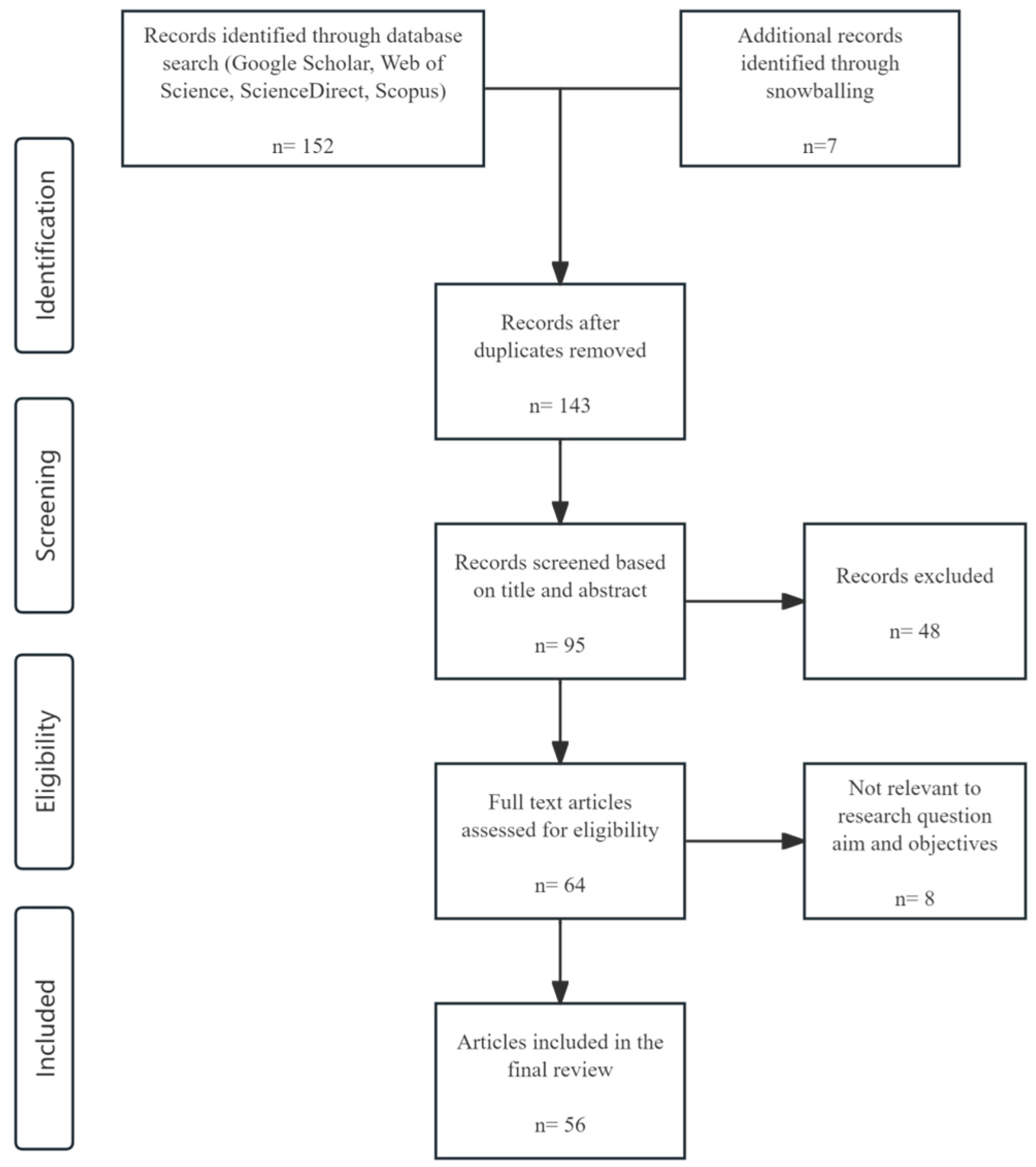
Figure 2.
Framework linking project complexity and CO2 outcomes in housing retrofit projects.
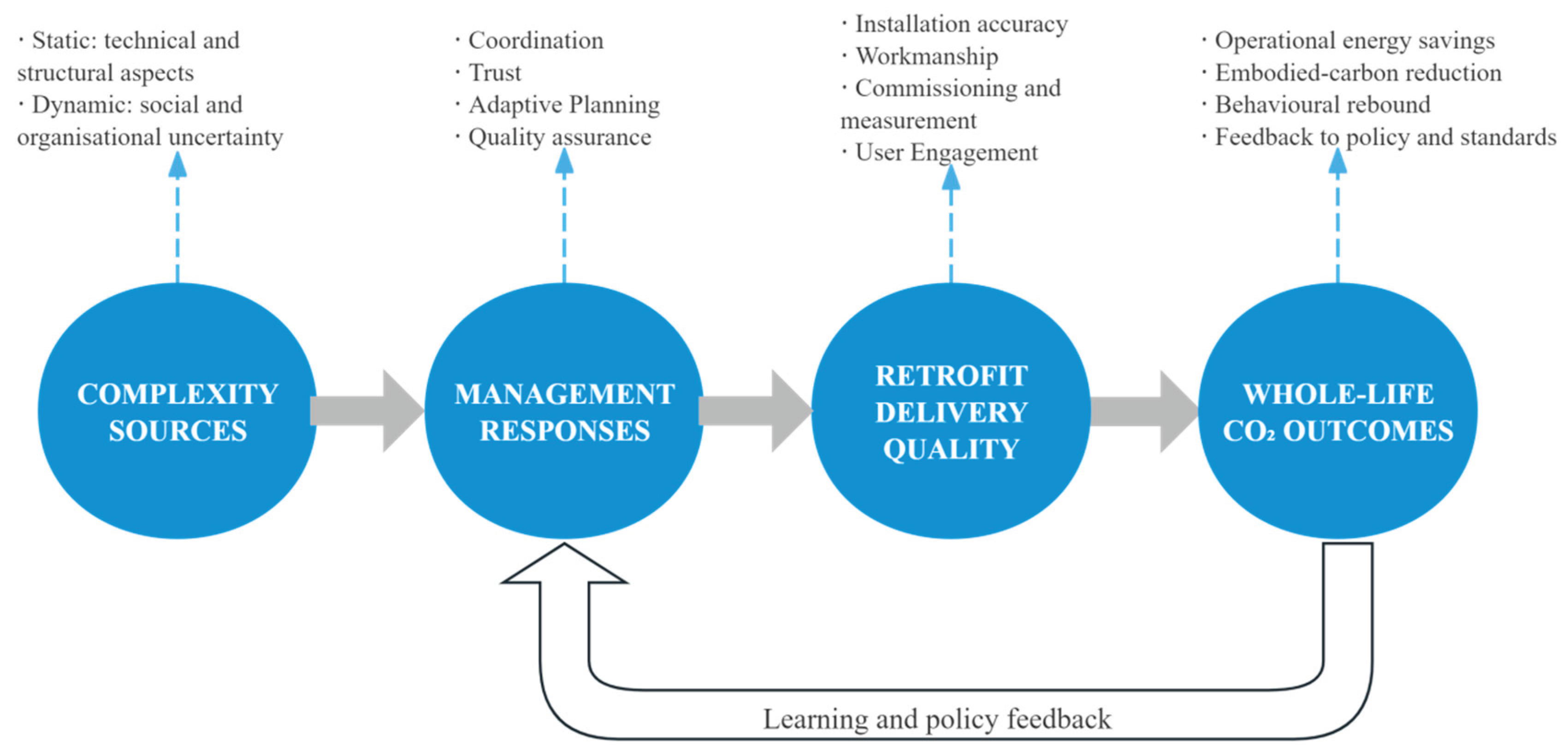

Table 1.
Features of complicatedness (static complexity) and complexity (dynamic complexity).
| Complicatedness (Static Complexity) | Complexity (Dynamic Complexity) |
|---|---|
| Tangible, countable, predictable elements of a project | Unpredictable, nonlinear, interdependent relationships |
| Challenges known; outcomes generally predictable with expertise | Uncertain interactions lead to unforeseen outcomes |
| Managed by detailed planning and control | Managed by adaptability, learning, and communication |
| Example: constructing a standard house | Example: retrofitting occupied dwellings with variable needs |
Table 2.
Search parameters.
| Database | Fields searched | Core Keywords and Boolean Strings | Time Horizon | Language |
|---|---|---|---|---|
| Google Scholar, Web of Science, ScienceDirect, Scopus | Title and Abstract | “housing retrofit” OR “energy renovation” OR “building refurbishment” OR “residential retrofit”) AND (“project management” OR “construction management” OR “delivery” OR “supply chain” OR “stakeholder”) | 2005–2022 | English |
Table 3.
Categorisation of reviewed literature by domain and ownership type.
| Domains | Reference | Number of Articles | |
|---|---|---|---|
| Owner Domain | Owner-occupier | Tjørring and Gausset(2019) [24]; Ambrose & McCarthy(2019) [25]; Sunikka-Blank & Galvin(2012) [26]; Liu et al. (2020) [29]; Risholt and Berker(2013) [38]; Galvin(2014) [39]; Kuusk & Kalamees (2015) [40]; Wilkinson et al.(2015) [41]; Buser & Carlsson(2017) [42]; Collins & Curtis (2017) [43]; Cauvain & Karvonen(2018) [44]; Hope et al.(2018) [45]; Matosović & Tomšić (2018) [46]; Trotta (2018) [47]; Wilson et al.(2018) [48]; Bravo et al.(2019) [49]; Liang et al.(2019) [50]; Broers et al.(2019) [51]; Zheng et al.(2019) [52]; Butt et al.(2020) [53]; Jia et al.(2021) [54]; Azcarate-Aguerre et al.(2022) [55]; D'Angelo et al.(2022) [56]; Jowkar et al.(2022) [57]; de Wilde(2019) [58]; | 25 |
| Social landlord | Cauvain & Karvonen (2018) [44]; Trotta (2018) [47]; Swan et al. (2013) [59]; Meehan & Bryde (2015) [60]; Grandclément et al. (2015) [61]; Monteiro et al. (2017) [62]; Weber & Wolff (2018) [63]; Lambrechts et al. (2021) [64]. | 8 | |
| Private landlord | Trotta (2018) [47]; Weber & Wolff (2018) [63]; Ástmarsson et al. (2013) [65]; Lee et al. (2015) [66]; März (2018) [67]; Miu & Hawkes (2020) [68]; Malinowski et al. (2020) [69]. | 7 | |
| Supplier Domain | Killip et al. (2020) [5]; Owen et al. (2014) [21]; Berghorn & Syal (2016) [70]; Wade et al. (2016) [71]; Clarke et al. (2017) [72]; Hrovatin & Zorić (2018) [73]; Wade et al. (2018) [74]; Pallesen and Jacobsen (2018) [75]; Murto et al. (2019) [76]; Simpson et al. (2020) [77]; Murtagh et al. (2021) [78]; Simpson et al. (2021) [79]; Zaunbrecher et al. (2021) [80]. | 13 | |
| Delivery Domain | Killip (2013) [20]; Owen et al. (2014) [21]; Bryde and Schulmeister (2012) [81]; Rovers (2014) [82]; Alam et al. (2019) [83]; Lowe and Chiu (2020) [84]; Brocklehurst et al. (2021) [85]; Sandberg et al. (2021) [86]; Dauda & Ajayi (2022) [87]. | 9 | |
Table 4.
Interactions between Owner, Supplier, and Delivery domains and their influence on CO2 performance.
Table 4.
Interactions between Owner, Supplier, and Delivery domains and their influence on CO2 performance.
| Domain | Core Complexity Drivers | Mechanisms Affecting CO2 Performance |
|---|---|---|
| Owner | Decision uncertainty; aesthetic vs. energy priorities; limited knowledge; trust deficits | Determines project scope and retrofit depth; behavioural rebound reduces realised savings |
| Supplier | Predominantly small and micro-enterprises with limited integration across the supply chain; weak training systems; conservative, risk-averse practices | Affects installation quality, commissioning accuracy, and the durability of CO2 benefits |
| Delivery | On-site uncertainty, occupant interaction, and poor project management practices | Shapes actual energy savings through workmanship, sequencing, and verification |
Disclaimer/Publisher’s Note: The statements, opinions and data contained in all publications are solely those of the individual author(s) and contributor(s) and not of MDPI and/or the editor(s). MDPI and/or the editor(s) disclaim responsibility for any injury to people or property resulting from any ideas, methods, instructions or products referred to in the content. |
© 2025 by the authors. Licensee MDPI, Basel, Switzerland. This article is an open access article distributed under the terms and conditions of the Creative Commons Attribution (CC BY) license (http://creativecommons.org/licenses/by/4.0/).
Copyright: This open access article is published under a Creative Commons CC BY 4.0 license, which permit the free download, distribution, and reuse, provided that the author and preprint are cited in any reuse.


