

Submitted:
08 December 2025
Posted:
09 December 2025
You are already at the latest version
Abstract
The origin and evolution of the universe are central questions in modern natural science. The current mainstream theoretical frameworks in related fields are the Standard Model of Particle Physics and the Big Bang theory of cosmology, both of which exhibit significant limitations. The Standard Model fails to incorporate gravitational interactions and includes an extensive array of elementary particle types. The Big Bang theory’s "singularity" hypothesis struggles to explain the initial conditions of the universe, dark matter, dark energy, and the accelerated expansion of the cosmos. This paper proposes a unified theoretical framework — the Great Tao Model, which consists of the Yin-Yang Model of elementary particles and the Theory of Existence Field. The Yin-Yang Model classifies elementary particles into three categories based on charge properties: electron, positron, and subston, and deduces five composite particles (proton, antiproton, neutron, antineutron, neutrino). The Theory of Existence Field posits that charge and mass, as fundamental physical quantities, inherently and continuously diffuse their physical information into surrounding space, forming an "existence field". Elementary particles transmit physical information and interact through their existence fields. Based on the Great Tao Model, this paper systematically elucidates the complete physical picture from the combination of elementary particles to the formation of cosmic structures and provides unified explanations for puzzles such as dark matter, neutrinos, the nature of nuclear forces, the precession of Mercury, and the accelerated expansion of the universe. Philosophically, the model aligns with ancient Chinese Daoist thought, while physically, it embodies theoretical simplicity and unity, making it a potential candidate for a "Theory of Everything".
Keywords:
elementary particles
; standard model
; The Big Bang Theory of the universe
; The Great Tao model
; Yin-Yang model
; the theory of existence field
1. Introduction
The origin of the universe and the ultimate constitution of matter are fundamental questions in basic physics. In modern physics, the Standard Model of Particle Physics (SMPP) [1] and the Standard Model of Cosmology (Λ-CDM model, based on the Big Bang theory) [2] are the two mainstream theories describing microscopic particles and the macroscopic universe, respectively. However, both frameworks exhibit significant shortcomings. The Standard Model describes the strong, weak, and electromagnetic interactions and the elementary particles constituting matter but does not incorporate gravitational interaction, and includes 61 types of elementary particles, resulting in a complex theoretical structure. The core concept of the Big Bang theory, the "singularity", represents a state where physical laws break down, failing to explain the universe's initial conditions, the cause of the Big Bang, and observed phenomena such as dark matter, dark energy, and cosmic accelerated expansion [2]. Furthermore, these two theories lack a unified foundation, unable to describe the complete evolutionary process from microscopic particles to the macroscopic universe through a coherent physical mechanism. Therefore, constructing a "Theory of Everything" that unifies the description of elementary particles and their interactions remains a central goal in physics.
The complexity of a theory does not equate to its correctness or profundity. The ancient Chinese philosopher Laozi proposed in the Tao Te Ching the cosmological view that "The Tao generates one; one generates two; two generates three; three generates all things in the universe" and noted that "The Great Tao is extremely simple, yet evolves into all complexity". This inspires us to consider that the fundamental laws of the universe may possess an exceedingly simple form, with the world's complexity arising from the evolution of simple rules. Inspired by this philosophical thinking, this paper attempts to establish a physical theory based on simple first principles. We propose the Great Tao Model, comprising the Yin-Yang Model of elementary particles and the Theory of Existence Field, aiming to provide a unified and self-consistent description of elementary particles and their interactions, and to systematically explain the formation and evolution of the universe on this basis.
2. The "Yin-Yang Model" of Elementary Particles
Ancient Chinese sage Laozi revealed in the Tao Te Ching that all things in the universe evolve from limited fundamental entities, following the fundamental law of the unity of opposites between Yin and Yang. Modern science shows that matter is composed of microscopic particles such as molecules and atoms, all of which are composite particles. According to the Yin-Yang law, the existence of composite particles necessarily implies the existence of non-composite particles — the indivisible minimal units constituting matter, called elementary particles. Therefore, integrating modern science with ancient Chinese philosophy, we posit that all things in the universe evolve from elementary particles obeying the Yin-Yang law.
2.1. First Principles of Model Construction
The construction of this model is based on two first principles:
Principle of Unity of Opposites (Yin-Yang Law):
All things in the universe universally possess two aspects that are mutually opposed and interdependent. At the level of elementary particles, this is directly manifested as the mutual opposition and interdependence of physical properties.
Principle of Physical Fact Priority (Basic Facts):
The theory must be built upon solid, repeatable experimental facts. This model takes the objective existence of electrons and positrons as its starting point and acknowledges mass as an inherent property of matter.
2.2. Core Definition and Criteria for Elementary Particles
Based on the above first principles, this paper defines "elementary particle" as the ultimate, indivisible entity constituting the material world, which must satisfy the following three core characteristics:
Indivisibility: An elementary particle is the limit of material division and cannot be decomposed into smaller particles with different properties. Here "indivisible" emphasizes the integrity of its physical properties, not that it cannot produce transient, same-property excitations under extremely high energies.
Independent Stability: An elementary particle can stably exist, possessing invariance, rather than appearing instantaneously only as a resonance state or coupled entity.
Inherent Property: The core physical properties (such as charge, mass) of an elementary particle are intrinsic and fixed, not "acquired" through interaction with external fields (e.g., Higgs mechanism).
Based on this definition, we propose the following criteria to distinguish genuine elementary particles from theoretical constructs or composite particles:
Entity Observability: Observable through direct experimental means, or confirmed by clear, stable physical effects it produces.
Property Conservation: Its core properties remain conserved in all physical processes.
Fundamentality of Interaction: The interactions it participates in are direct and fundamental, not reliant on complex intermediate mechanisms.
According to these criteria, the electron and positron are undisputed elementary particles.
2.3. Classification System and Properties of Elementary Particles
Following the "binary" logic of the Yin-Yang law, we establish the following classification system (Figure 1A):
First-Level Division (Yin-Yang Division):
Based on whether they carry charge, elementary particles are divided into:
Charged Particles (Yang Particles): Participate in electromagnetic interaction, with active properties.
Un-Charged Particles (Yin Particles): Do not participate in electromagnetic interaction, with stable properties.
Second-Level Division (Yin-Yang within Yang):
For charged particles, further divided based on charge sign:
Positively Charged Particles (Yang within Yang): Ultimate carrier of positive charge.
Negatively Charged Particles (Yin within Yang): Ultimate carrier of negative charge.
Through this clear and complete classification, we conclude that only three elementary particles exist in the universe:
Electron (e⁻): Carries one unit of negative charge (-e).
Positron (e⁺): Carries one unit of positive charge (+e).
Un-Charged Particle: Carries no charge, only possesses mass.
2.4. Formation Mechanism of Composite Particles
According to Laozi's philosophy, "All things bear Yin and embrace Yang", thus composite particles should be composed of "Yin particles" and "Yang particles", precisely conforming to the laws of electrostatic attraction or gravitational interaction between the charge and mass properties of elementary particles. Based on permutations and combinations and gravitational interaction, first, one Yin particle and one Yang particle form composite particles composed of two elementary particles, with three combination methods in total:
A: Electron + Positron;
B: Electron + Un-Charged Particle;
C: Positron + Un-Charged Particle.
Then, one elementary Yin particle (or Yang particle) and one composite Yang particle (or Yin particle) form composite particles composed of three elementary particles, with two combination methods:
D: Electron + C Particle;
E: Positron + B Particle.
Currently, known particles constituting atomic matter are electron, proton, and neutron; particles constituting antimatter atoms are antielectron (positron), antiproton, and antineutron. Since elementary particles are only electron, positron, and un-charged particle, we reasonably speculate that proton, antiproton, neutron, and antineutron are composite particles formed from these three elementary particles.
Since proton carries positive charge, antiproton carries negative charge, while neutron and antineutron are un-charged, comparing the five composite particles composed of three elementary particles, we can infer: proton is composed of positron and un-charged particle (composite particle C), antiproton is composed of electron and un-charged particle (composite particle B), neutron or antineutron is composite particle D or E. Based on experimental observations that neutron decays into proton and electron, atomic nucleus can convert extranuclear electron and proton into neutron through K-capture process, and neutron externally exhibits negative charge while internally positive charge, we speculate that neutron is a composite particle formed by electron combining with proton (D). Then, antineutron should be the composite particle E formed by positron combining with antiproton. Since composite particle A composed of electron and positron is electrically un-charged, its mass is far less than neutron or antineutron, and its antiparticle is itself (Majorana particle), it is speculated to be the neutrino.
Since the masses of electron and positron are extremely small, the masses of proton, antiproton, neutron, and antineutron mainly come from the "un-charged particle", which we name "subston", with a mass approximately 1835 times that of the electron. Charged elementary particles have small mass, while un-charged elementary particles have large mass, opposite in mass attribute size, also conforming to the Yin-Yang law.
In composite particles: neutrino has electron and positron orbiting each other; proton has positron orbiting subston; antiproton has electron orbiting subston; neutron has electron orbiting proton; antineutron has positron orbiting antiproton (Figure 1B). Therefore, although neutron and antineutron are overall electrically un-charged, neutron's shell carries negative charge, middle layer positive charge, while antineutron's shell carries positive charge, middle layer negative charge.
In summary, we obtain an elementary particle model based on the Yin-Yang law: the origin of the universe is the Tao, whose material carrier is elementary particles. Elementary particles are divided into charged and un-charged categories; charged particles further divided into positive and negative charges, totaling three types: electron, positron, and subston. These three elementary particles combine through Yin-Yang interactions, forming five composite particles—proton, antiproton, neutron, antineutron, and neutrino—and subsequently constituting all things in the universe. The establishment of this model fundamentally relies on the strict adherence of the classification, properties, and combination methods of elementary particles to the fundamental law of unity of opposites between Yin and Yang. Therefore, we name this elementary particle model the "Yin-Yang Model". It also naturally embodies the generative logic of "The Tao generates one; one generates two; two generates three; three generates all things in the universe" and the philosophical concept of "The Great Tao is extremely simple".
3. The Theory of Existence Field for Elementary Particles
3.1. Fundamental Physical Quantities and Definition of Existence Field
3.1.1. Essential Properties of Fundamental Physical Quantities
Within the framework of the Yin-Yang Model, elementary particles are the ultimate existence (minimal material units) constituting the universe, whose essence of existence is two types of inherent fundamental physical quantities: mass and charge. Starting from the first principles of theory construction, the origin of elementary particles requires no further tracing (nor can it be derived through existing physical frameworks), with essential characteristics:
Inherent Invariance: The values of fundamental physical quantities are fixed, not varying with motion state or external environment (e.g., electron charge always -e, mass always m_e).
Information Diffusivity: Fundamental physical quantities diffuse physical information into surrounding space, with diffusion speed being constant c, conforming to the motion law of massless objects [3]. If diffusion speed were infinite, causality would be violated (e.g., particle position change instantly affects infinite distant space), thus it must be finite constant c.
"Physical information" is the core concept introduced in this theory to describe how the inherent properties of fundamental physical quantities (mass, charge) affect space. The essence of this information is the manifestation of the "existence" of fundamental physical quantities themselves; its outward diffusion constitutes the carrier of physical interactions. Macroscopically, the observable physical effect formed by this information diffusion manifests as the "existence field".
3.1.2. Core Definition of Existence Field
Based on the above properties, the existence field is defined as: the inherent property of an elementary particle's fundamental physical quantity (mass/charge) uniformly and continuously diffusing physical information into surrounding space (Figure 2A). Its mathematical expression must satisfy:
Vector Nature: Existence field has direction (from particle to any point in space), is a vector field.
Spherical Symmetry: Existence field of stationary particle is concentric spherical distribution centered on particle, physical information density decreases with increasing distance. The singularity and uniformity of elementary particles determine the spherical symmetry of existence field diffusion.
Constant Propagation Speed: Diffusion speed of physical information relative to absolute stationary reference frame is c, independent of particle motion state.
Same-Type Interaction: Only existence fields of the same fundamental physical quantity can interact (mass field only with mass field, charge field only with charge field); different fields (e.g., mass and charge fields) have no direct interaction.
3.2. Static Existence Field
When an elementary particle is stationary, its existence field exhibits spherical symmetric distribution (Figure 2B). Let a fundamental physical quantity of the elementary particle be Q (mass m or charge e), with spherical surface area S = 4πr² at radius r centered on particle. Define the spatial propagation surface density ρ of physical quantity Q as:
This density decreasing inversely with square of distance is a geometric necessity from uniform distribution of physical information on spherical surface. The existence field intensity is proportional to ρ, with vector expression:
where is the existence field constant, its value depending on type of fundamental physical quantity (mass or charge); is radial unit vector.
Two elementary particles A and B (physical quantities QA, QB) interact through each other's existence fields. The interaction force between them is:
When Q is charge e, ke= 1/ε₀(vacuum permittivity) can be experimentally measured, above equation becomes Coulomb's law.
When Q is mass m, km= 4πG (gravitational constant) can be experimentally measured, above equation becomes Newton's law of universal gravitation.
Generally, we express the force (termed physical quantity interaction force) on a physical quantity Q in another same fundamental physical quantity's existence field as:
Direction of interaction force : gravitational interaction forces between masses are attractive; electrostatic forces between charges are like-sign repulsive, opposite-sign attractive.
Thus, the mathematical forms and physical images of electrostatic field and static gravitational field are unified under the framework of existence field theory.
3.3. Dynamic Existence Field
When elementary particle moves, spherical symmetry of its existence field is broken, becoming distorted (Figure 2C–F). This distortion effect can be uniformly characterized by momentum.
3.3.1. Translational Motion and Translational Momentum Field
Define translational momentum as product of fundamental physical quantity Q and velocity (Figure 2C), characterizing distortion degree of existence field:
When Q=m, , called mass-momentum.
When Q=e, , called electro-momentum.
Elementary particle displacement element diameter d, corresponding instantaneous speed v=d/t; physical quantity Q flow rate I=Q/t=P/d(P=Qv is translational momentum of this physical quantity). When Q is charge e, I is current intensity, current element Idl is sum of electro-momentum Pe over wire cross-section, its existence field is magnetic field; when Q is mass m, existence field of mass-momentum Pm is a physical field analogous to magnetic field.
Spatial propagation surface density of momentum field must consider angle θ between momentum and radial vector (due to directionality of distortion effect) (Figure 3):
Momentum field intensity is proportional to :
where is momentum field constant.
[Q/L2][Qv/L2][]=[/v2].
For charge, =μ0, and μ0= 1/(ε0c²), is electro-momentum field, i.e., magnetic field .
For mass, = σ0, and σ0= 4πG/c, <!-- MathType@Translator@5@5@MathML2 (no namespace).tdl@MathML 2.0 (no namespace)@ -->
is mass-momentum field, abbreviated as momentum field.
According to interaction force formula (Eq. 4), interaction force of momentum field is:
Interaction force between electro-momenta is Lorentz force. Interaction force between mass-momenta is called mass-momentum force.
The momentum field of elementary particles is represented by the cross product of momentum and the position vector: . The direction of the momentum field is perpendicular to the plane formed by the momentum and the position vector (the direction of the position vector indicates the direction of the existence field of the fundamental physical quantity Q). When a positive charge or mass moves, the direction of its momentum field is equivalent to rotating counterclockwise around the O-axis in the direction of the momentum. Conversely, when a negative charge moves, the direction of its momentum field is equivalent to rotating clockwise around the O-axis in the direction of the momentum.
3.3.2. Rotational Motion and Rotational Momentum Field
When elementary particle undergoes uniform circular motion (rotation), distortion of its existence field changes periodically, forming rotational momentum field (Figure 2E, Figure 4A,B). Define rotational momentum as cross product of radial vector and translational momentum :
When Q=m, =×m, is rotational mass-momentum, i.e., orbital angular momentum .
When Q=e, =×e, is rotational electro-momentum, i.e., orbital magnetic moment . This definition naturally gives vector direction of magnetic moment, avoiding unnaturalness of artificially defined area vector in classical definition.
Formulas for spatial propagation surface density and intensity of rotational momentum field can be derived by replacing with in translational momentum field formulas.
Interaction force of rotational momentum field is:
where is rotational momentum field constant, consistent with translational momentum field constant (for charge kPr,e=μ0, for mass kPr,m=σ0), ensuring field theory unity between rotational and translational motions. Interaction force is "rotational mass-momentum force" (angular momentum force) or "rotational electro-momentum force" (magnetic torque), uniformly describing dynamic interactions of rotating particles.
3.3.3. Spin Motion and Spin Momentum Field
When elementary particle undergoes uniform rotation around its own central axis (spin), distortion of its existence field exhibits spherical symmetric periodic changes, forming spin momentum field (Figure 4C,D). Define spin momentum as product of moment of inertia I and angular velocity : I=γQ (γ constant related to particle shape), thus:
According to Q type, spin momentum divided into two classes:
Spin mass-momentum: When Q=m, , i.e., classical spin angular momentum s, indicating "electron spin angular momentum" in quantum mechanics can be understood from perspective of classical angular momentum generated by electron's rotational motion.
Spin electro-momentum: When Q=e, , i.e., spin magnetic moment s. Based on this definition, relationship between spin magnetic moment and spin angular momentum is , providing theoretical framework for understanding magnetic moment–angular momentum relation without introducing extra correction factors [4].
The spatial propagation surface density of the spin momentum field must consider the angle θ between the spin momentum and the radial vector (due to the dependence of the spin direction on the spatial point location). The formulas are:
The spin momentum field intensity is proportional to , expressed as:
where is the spin momentum field constant:
For the charge spin momentum field (spin magnetic moment field), (consistent with the electro-momentum field constant). Substituting , we get: <!-- MathType@Translator@5@5@MathML2 (no namespace).tdl@MathML 2.0 (no namespace)@ -->
.This can be further simplified to <!-- MathType@Translator@5@5@MathML2 (no namespace).tdl@MathML 2.0 (no namespace)@ -->
, where is the charge field constant, maintaining formal unity with the charge field intensity expression.
For the mass spin momentum field (spin angular momentum field), (consistent with the mass-momentum field constant). Substituting , we get: <!-- MathType@Translator@5@5@MathML2 (no namespace).tdl@MathML 2.0 (no namespace)@ -->
. This can be further simplified to <!-- MathType@Translator@5@5@MathML2 (no namespace).tdl@MathML 2.0 (no namespace)@ -->
, where is the mass field constant, achieving formal unity between the mass field and the spin field.
Defining the product of the fundamental physical quantity Q and the spin angular velocity as the "spin quantity" Q, the spin momentum can also be characterized by . The intensity formula for the spin quantity field (abbreviated as spin field) is:
When Q=m (mass), , which is the mass spin field intensity (spin gravitational field).
When Q=e (charge), <!-- MathType@Translator@5@5@MathML2 (no namespace).tdl@MathML 2.0 (no namespace)@ -->
, which is the charge spin field intensity (spin magnetic field).
The interaction force of the spin quantity field is:
When Q=m (mass), is the "spin mass-momentum force", termed "spin gravity".
When Q=e (charge),is the "spin electro-momentum force", termed "spin magnetic force".
3.3.4. Core Features and Experimental Relevance of Spin Momentum Field
Core features of spin momentum field lie in its directionality and interaction specificity:
Direction rule: Positive charge (or mass) counterclockwise spin → spin momentum field direction perpendicular to spin plane, along spin axis upward; negative charge counterclockwise spin → direction downward (Figure 4C,D). This directly explains direction difference of electron spin magnetic moment, and physical essence of nuclear magnetic resonance (NMR) phenomena [5].
Interaction nature: Interaction between same-type spin momentum fields follows "same direction repulsion, opposite direction attraction" principle, e.g., two electrons with opposite spins form "electron spin pairing" via spin magnetic force, core mechanism for molecular chemical bond formation; also provides classical physical basis for explaining "Cooper pairs" in superconductivity [6].
Experimental verification clue: At atomic scale, attractive force between opposite-spin electron pair ~10-11 N, fully matching covalent bond binding energy.
, the direction of its rotational momentum is upwards through the center and perpendicular to the plane formed by the position vector and the momentum . b: Conversely, for a fundamental particle ( negative charge) rotating counterclockwise around a center with the same position vector , the direction of its rotational momentum is downwards through the center and perpendicular to the same plane. c: When a fundamental particle (positive charge or mass) spins counterclockwise around its central axis, the direction of its spin momentum is upwards through the center and perpendicular to the plane formed by the position vector i and the momentum . d: Similarly, for a fundamental particle (negative charge) spinning counterclockwise around its central axis, the direction of its spin momentum Ps is downwards through the center and perpendicular to the plane formed by the position vector i to that point and the momentum of the particle's part i. We assume that the fundamental particle is a perfect sphere, with its fundamental physical quantities evenly distributed across its surface. For any part i of the fundamental particle's sphere, the momentum associated with its rotational motion is , and the position vector from the spin axis to that point is i . [A, B: Rotational momentum direction for positive/negative charge rotating counterclockwise. C, D: Spin momentum direction for positive/negative charge spinning counterclockwise.].
3.4. Accelerated Motion State: Energy Transfer Field (Radiation Field)
When an elementary particle undergoes accelerated motion (Figure 2D, F), the degree of distortion of its momentum field changes with time, forming a time-varying existence field wave. This change originates from work done by an external force; therefore, the field wave transfers energy, i.e., it is a radiation field. Mass and charge are core physical quantities with completely equal status as elementary particles. The propagation mechanisms, distortion laws, and energy transfer logic of their respective existence fields are entirely identical. The essence of an existence field wave is the propagation of the accelerated distortion of the momentum field corresponding to the fundamental physical quantity Q (mass m or charge e), differentiated into electromagnetic waves (Q=e) and mass-momentum waves (Q=m) only due to the type of physical quantity.
3.4.1. Unified Derivation of the Existence Field Wave Equation
The generation mechanism of existence field waves stems from the accelerated motion of an elementary particle causing its momentum field to undergo accelerated change. This change, as a physical disturbance, propagates as a wave within the existence field. The core logic is as follows:
(1) Definition and Physical Meaning of Existence Field Circulation
The definition of "existence field circulation": For the existence field of any fundamental physical quantity Q, select an arbitrary closed curve L in space. The line integral of the existence field intensity along L is defined as:
<!-- MathType@Translator@5@5@MathML2 (no namespace).tdl@MathML 2.0 (no namespace)@ -->
where is the "line element vector" along the closed curve L—its magnitude is the length element dl, and its direction aligns with the traversal direction of L (a convention that does not affect the physical essence).
The term represents the "projection component of the existence field intensity in the direction of multiplied by the line element length". Its physical meaning is the "information action quantity transferred by the charge existence field along the direction", reflecting the influence strength of the field on a point in space.
The integral ∮L denotes the "line integral along the closed curve L", i.e., the total information action quantity along the closed path. Its physical meaning is the "vortical distortion degree of the existence field within the region enclosed by curve L".
If the circulation is zero, it indicates that the total information action quantities along the closed curve cancel each other out, meaning the field has no vortex (e.g., the spherically symmetric existence field of a stationary particle). If the circulation is non-zero, it signifies a "net information action quantity" along the closed curve, i.e., the field exhibits vortical distortion (e.g., the dynamic existence field of an accelerating particle).
(2) Association Between Existence Field Circulation and Momentum Field Change (Based on Information Delay Effect)
When a particle undergoes accelerated motion, due to the finite information diffusion speed �c of the existence field, different field points in space receive the "particle physical quantity information" with a time difference (information delay effect): near-field points receive information about the particle's recent accelerated state, while far-field points receive information from an earlier state. This delay causes the existence field to develop a "transverse component" (a component perpendicular to , which is absent for a stationary particle), thereby making the existence field circulation .
Select a surface S bounded by the closed curve L (with its normal direction satisfying the right-hand rule relative to the traversal direction of �L). The "flux" of the momentum field () through surface S is defined as (where is the surface element vector on S, magnitude dS, direction along the surface normal). Its physical meaning is the "total distortion quantity of the electro-momentum field passing through surface S".
Since particle acceleration causes the momentum field to change with time (), the total distortion quantity changes with time, and its rate of change is related to the existence field circulation by:
Physical Meaning: The time rate of change of the momentum field flux is the excitation source for the existence field vortex. The negative sign in the equation reflects the field response direction, fundamentally constrained by the law of energy conservation: when particle acceleration increases the momentum field flux (ΦP), the information propagation delay causes spatial field distortion, and the excited vortical existence field () opposes the change in momentum field flux. External work done on the particle (acceleration) is balanced by the field system's reverse response to maintain energy equilibrium. The negative sign is a direct reflection of this physical law, not a mathematical trick. Here, dΦP/dt reflects the dynamic intensity of momentum field distortion. This relationship is derived entirely based on the information delay effect of the existence field and the field distortion response, without borrowing from classical field theory.
(3) Definition and Derivation of Existence Field Curl (Based on Existence Field Vortex)
Define the "existence field curl (∇×)" as: the "degree of vortex distortion per unit area" at a certain point in space, i.e., take a small closed curve LΔ near the point (enclosing a small surface area ΔS). When ΔS approaches 0, the limit of the ratio of the existence field circulation to ΔS has the mathematical expression:
whereis the component of the curl along the normal direction of surface ΔS. Its physical meaning is the "unit area existence field vortical distortion degree at that spatial point along the surface normal".
Combining Equation (18), for the small closed curve LΔ and the small surface ΔS enclosed by it, we have:
When ΔS approaches 0, the momentum field in ΔS can be regarded as uniformly distributed, and the integral on the right side is approximately is the small surface element vector, the size is ΔS, and the direction is the normal direction), so:
Substituting this into the curl definition Eq. (19) yields:
Since the normal direction of the small surface ΔS can be arbitrarily selected, this equation holds for any direction in space, so the general relationship between the existence field curl and the time rate of change of the momentum field is:
This equation is the core derivation result of the Existence Field Theory, with the physical meaning that "the time change of the momentum field () excites the vortex distortion of the existence field ()", without any classical theoretical presuppositions.
(4) Derivation of Momentum Field Curl (Based on Existence Field Unity)
The existence field () and the momentum field () are different manifestations of the same physical quantity (static distribution vs. dynamic distortion). Their constants satisfy the "existence field unity relation": .
When a particle accelerates, the existence field () changes with time (0). Essentially, the rate of its vortical distortion changes with time. This change further distorts the momentum field , causing the momentum field to develop a vortex (). By analogy with the derivation logic for the existence field curl, and incorporating , the relationship between the momentum field curl and the time derivative of the existence field is obtained:
The physical meaning of this equation is: "The time change of the existence field () is converted, via the information diffusion speed c, into the vortical distortion of the momentum field ()".
The above two equations constitute the core system of the Existence Field Theory describing field dynamics. They depict the complete causal chain of "accelerated motion of elementary particles → accelerated change of momentum field → accelerated distortion and propagation of existence field", and their mathematical forms are completely unified for charge and mass.
(5) Unified Derivation of the Existence Field Wave Equation
Taking the curl on both sides of Eq. (23):
Applying the vector identity ∇×(∇×)=∇(∇⋅)−∇2. In the radiation zone far from the particle, ∇⋅=0. Substituting Eq. (24) and rearranging yields:
Similarly, the wave equation for the momentum field is:
These equations predict waves propagating at speed c, with the wave speed originating from the inherent constant of physical information diffusion.
According to the physical quantity Q, the unified wave equation differentiates into two types of radiation fields:
When Q=e, is the electric field , and is the magnetic field . Charge acceleration causes a change in the magnetic field (electro-momentum field), exciting a propagating electric field vortex—this is the electromagnetic wave.
When Q=m, is the gravitational field , and is the mass-momentum field. Mass acceleration causes a change in the mass-momentum field, exciting a propagating gravitational field vortex—this is the mass-momentum wave.
Combining the relation between the existence field constant and the momentum field constant (), we can derive:
For Q=e: ke =1/ε0, kP,e =μ0, thus .
For Q=m: km =4πG, kP,m=σ0, thus .
This result is a natural corollary of the Theory of Existence Field, consistent with classical conclusions. It also derives the relationship between the mass-momentum constant kP,m (denoted σ0) and the gravitational constant , demonstrating the theory's self-consistency.
At the levels of static fields, dynamic fields, and radiation fields, the Theory of Existence Field unifies the generation mechanisms (stemming from momentum acceleration changes) and propagation laws of electromagnetic waves and mass-momentum waves (gravitational waves) within a concise and self-consistent mathematical framework.
4. Combination of Elementary Particles
Assume that in the initial state of the universe, all elementary particles are infinitely far apart from each other and in an absolutely stationary state. At this time, the kinetic energy of the particles is 0, the potential energy between the particles is 0, and the total energy of the universe is 0. Although the attractive force between elementary particles with opposite charge properties tends to be infinitely small in the initial stage, after a long time, the distance between the particles gradually decreases, the attractive force gradually increases, and finally they accelerate to approach and combine. Since elementary particles only include three types: electrons, positrons, and substons, no matter how they are arranged and distributed, it is impossible to achieve a complete balance of interaction forces between particles. Therefore, the distribution and stress of elementary particles in the initial state of the universe are asymmetric and unbalanced. This means that the interaction between any two elementary particles must be affected by other particles, and there is a non-zero angle between the initial motion direction of the particles and the connection line of the two particles, so that the elementary particles do not approach and collide in a straight line under the action of interaction forces, but revolve in a spiral motion. This is the fundamental reason why composite particles, atomic systems, and cosmic celestial bodies all exist in a rotating form.
The most basic definition of energy originates from the work done by force, i.e., work W is equal to the product of force F and the displacement r generated by the force:
According to interaction force formula (4) in existence field theory, potential energy of mutual attraction between two elementary particles:
where kQ existence field constant of fundamental physical quantity, Q physical quantity (charge or mass) of elementary particle, r interparticle distance. As elementary particles approach under attraction, potential energy gradually decreases; when distance r, potential energy difference:
Work done by interparticle interaction force equals potential energy difference ΔEp. Under interaction force, elementary particles accelerate, producing kinetic energy Ek, simultaneously releasing radiation energy . By energy conservation:
Since ratio of electrostatic force (or electric potential energy) between electrons to gravitational force (or gravitational potential energy) between electrons is (where ke=1/, km=4G, e is electron charge, m is electron mass), when studying interaction between charged elementary particles, we often only consider electrostatic potential energy and resulting kinetic and radiation energy (electromagnetic energy), can neglect gravitational potential energy and resulting kinetic and radiation energy (mass-momentum energy).
To reveal the combination mechanism of elementary particles under interaction, first construct an ideal physical model: electrons move around stationary mass points. Since the mass of protons is much larger than that of electrons, when electrons move around protons, protons can be approximately considered stationary, which conforms to this ideal model. Therefore, the combination of electrons (or positrons) and protons (or antiprotons) is studied first; on this basis, it is further extended to the combination processes of electron-positron, positron (or electron)-subston, and subston-subston, and the Rydberg constant, ground state orbital radius (Bohr radius), and quantization relationship of various combination systems are derived based on the modified quantum concept and Existence Field Theory.
4.1. Combination of Electron with Proton (or Positron with Antiproton)
Assume electron and proton initially infinitely far apart, under electrostatic attraction (charge field interaction), electron approaches proton in spiral motion while continuously releasing radiation energy, eventually reaching equilibrium where electrostatic attraction equals centripetal force — electron orbits proton in uniform circular motion, stops releasing radiation, this stable structure called ground state hydrogen atom. Let electron orbital radius be r0(ground state orbital radius, Bohr radius), speed v0, using existence field theory and classical mechanics:
4.1.1. Equilibrium Condition and Ground State Parameter Derivation
Electrostatic attraction between electron and proton:
Centripetal force for circular motion:
Equilibrium Fe =Fc gives:
Angular velocity ω0 and frequency f0:
4.1.2. Ground State Energy, Radiation Energy, and Bohr Radius Derivation
Electron energy in ground state is sum of potential Ep and kinetic Ek. Electrostatic potential energy:
Kinetic energy from Eq. (34):
Total ground state energy:
From infinity (potential 0) to ground state, potential energy difference converts to kinetic plus radiation energy:
Gives radiation energy:
Thus half of electrostatic potential energy converts to kinetic, half to electromagnetic radiation — this radiation mechanism reduces electron speed precisely to satisfy force balance, ensuring atomic stability.
Electromagnetic radiation originates from electron acceleration, radiation energy Er can be calculated based on electron accelerated motion. Electron accelerated circular motion: each additional revolution produces one electromagnetic wave frequency. Wave energy increases with frequency, but each wavelength carries same energy. Electron as minimal charge unit, its acceleration produces one electromagnetic wave energy as minimal energy unit, called energy quantum ε, value equals Planck constant h. This is revised quantum concept [7,8].
Let electron in stationary orbit n with frequency fn, after Δt seconds transitions to orbit m with frequency fm, average frequency change rate:
Number of revolution changes in Δt:
If electron accelerates from infinity (frequency 0) to f0, time Δt, number of light quanta produced:
Radiation frequency ν quanta per unit time:
Total radiated energy:
From Eq. (39):
During electron transition time Δt, frequency change rate a=Δf/Δt and radiation power P=ΔE/Δt both independent of Δt magnitude. Take Δt = 1 s for calculation convenience (conforms to international standard time unit 1 s), then εΔt=h, giving Bohr radius:
Substituting into Eqs. (35), (39), (41) yields:
When electron absorbs electromagnetic radiation, orbital radius increases; if absorbed energy exactly causes electron transition to higher energy orbit, absorbed energy equals energy level difference:
For absorption frequency ν, energy is k light quanta:
Combining gives:
Substitute into Eq. (48):
Let ∆ t=1s, ε ∆ t=h, and obtain
Where . Hydrogen spectrum experiments verify this matches Rydberg formula:
This marks successful theoretical derivation of Rydberg constant, validating existence field theory and revised quantum concept.
Comparing (59) and (61) gives:
Substituting into Eqs. (36), (39) gives:
Electron angular momentum L=mvr, from Eqs. (34), (49), (62):
Due to strong electrostatic attraction between electron and proton, like tidal locking between Moon and Earth, electron rotates once per orbital revolution, electron spin angular velocity equals orbital angular velocity. According to existence field theory, electron charge spin quantity Qs=eω, from Eqs. (50), (62):
These orbital radius, energy level, angular momentum, and electron spin quantity quantization relations are not introduced via any "quantization assumption" but naturally emerge from Rydberg constant theoretical derivation and experimental verification, proving theoretical self-consistency and unifying classical physics with quantum phenomena.
When electron and proton interact in free state, they combine forming ground state hydrogen atom. Under special conditions, e.g., K-shell electron in neutron-deficient unstable atomic nucleus, or under immense gravitational pressure in supermassive celestial bodies, electron and proton can further combine forming neutron. Neutron composed of subston, positron, electron, with subston at center, positron and electron orbiting subston with angular velocities ωp, ωe (Figure 5A). Assume subston mass M, distance to positron R; electron and positron mass m, distance between them L. Positron orbits subston center radius R, electron orbits subston center radius R+L. Then positron centripetal force:
Positron kinetic energy:
Electron centripetal force:
Electron kinetic energy:
Electron total radiation energy:
a: an electron and a proton; b: an electron and a positron; c: a positron with a subston; d: a proton and a neutron
4.2. Combination of Electron and Positron
Electron and positron under electrostatic attraction accelerate toward each other in spiral motion, releasing radiation, eventually reaching equilibrium where electrostatic attraction equals centripetal force, forming stable electron-positron system. In this system, electron and positron orbit common center of mass in uniform circular motion, rotation radius r same, half of distance L (Figure 5B). Thus:
System potential energy , single electron (or positron) potential energy half. Electron ground state energy sum of potential and kinetic:
From infinity to ground state, electrostatic potential energy converts to kinetic plus radiation:
Since Er=ΔE, from Eq. (46):
Substituting Eq. (78):
Setting Δt=1s:
If electron in stationary state n radius rnenergy En transitions to state m radius rm energy Em, then the electron transitions between two steady states, and the electromagnetic radiation energy radiated/absorbed is equal to the difference between the two steady state energy levels:
Substituting Eq. (83) and L0=2r0 etc., yields similar quantization relations. Rydberg constant for this system .
Under special conditions, electron-positron system can combine forming neutrino. Electron (or positron) radiation energy:
Electron-positron combination releasing radiation long misinterpreted as "annihilation reaction" where particle-antiparticle completely disappear, converting to energy. But now clearly recognized: electron and positron combine can form hydrogen-like structure, or under special conditions form neutrino, simultaneously releasing light or gamma rays. Irradiating neutrino with gamma rays produces free electron and positron. From Eq. (86), given gamma ray frequency ν, can calculate neutrino radius r. Assuming gamma ray frequency ν=1019 Hz, neutrino radius r≈4.35×10⁻¹⁵ m. We term reaction where particle-antiparticle meet release radiation (gamma rays) and form neutrino "Radiation and Combination reaction (RC reaction)".
Electron-positron combination forms "electron-positron" system, existing in three forms: ground state, excited states, and neutrino state. This might be one possible explanation for so-called neutrino oscillations.
4.3. Combination of Positron (or Electron) with Substons
Since subston has only mass no charge, interaction between positron and subston only gravitational (universal gravitation). Substons mass M much larger than positron mass m, thus approximate subston as stationary reference, positron orbits subston with gravitational force providing centripetal force. Positron spirals toward subston releasing radiation, eventually reaching equilibrium where gravity equals centripetal force, positron orbits subston uniformly, stable structure called positron-subston system (Figure 5C). Let positron orbital radius r0, speed v0:
If positron in stationary state n radius rn energy En transitions to state m radius rm energy Em, then the electron transitions between two steady states, and the electromagnetic radiation energy radiated/absorbed is equal to the difference between the two steady state energy levels:
From Eq. (46):
Since :
Setting Δt=1s, from Eqs. (93), (95):
Comparing with Rydberg formula (61), in positron-subston system, Rydberg constant . Similarly can prove integer multiple relations for orbital radius, energy, frequency, angular momentum, spin quantity.
Under certain conditions, positron (or electron) and subston tightly combine forming proton (or antiproton). When positron uniform circular motion centripetal force equals gravitational attraction, stable equilibrium:
Given known proton radius ~0.833×10⁻¹⁵ m, proton mass ~1.6726×10⁻²⁷ kg, Eqs. (100), (103) give ω≈13892.94 rad/s, ν≈1105 Hz. This suggests positron orbits subston very slowly, proton would be very unstable. But actually proton very stable, not decomposable by gamma rays, thus positron-subston combination releasing electromagnetic radiation frequency should be higher than gamma ray frequency. If gamma ray frequency 10¹⁹ Hz, Eq. (104) gives proton radius at least less than ~1.9×10⁻²⁶ m.
4.4. Combination Between Subston and Substons
Can two substons combine forming structure like electron-positron system? Assume substons orbit common center radius r, speed v, uniform circular motion:
Potential energy change converts to kinetic plus radiation:
(108)
Since subston has only mass no charge, no electromagnetic radiation; subston acceleration produces mass-momentum wave radiation, but extremely tiny, negligible, so:
Since , if potential energy change fully converts to kinetic, subston speed too high, two substons cannot bind forming subston-subston system. Therefore, two free stationary substons under gravitational attraction will not form subston-subston system. Under specific conditions when substons move same direction, relative velocity decreases, they may form subston-subston system.
5. Atomic Nucleus Structure
5.1. Combination of Proton and Neutron
Assume distance between subston and positron in proton R, distance between electron and positron in neutron L, distance between positron in proton and electron in neutron d. Interaction force between proton and neutron is resultant of:
Electrostatic attraction e between proton positron and neutron electron.
Electrostatic repulsion e′ between proton positron and neutron positron.
Gravitational force mbetween proton and neutron.
Mathematically:
Since gravitational force extremely weak compared to electrostatic, negligible. Net attractive force approximates:
Analysis shows: as long as proton-neutron spacing d sufficiently small, enormous attractive force F generated. Calculations: when d = R (proton radius), attraction reaches staggering ~10²² N magnitude; when d=1.5×10⁻¹⁵ m, attraction still ~1 N magnitude (if L < 10-17 m). As d increases, attraction decreases rapidly (~100-fold). When d equals atomic radius (~5.3×10⁻¹¹ m), attraction approaches zero. This indicates proton-neutron binding force typical short-range force, acting only within extremely small nuclear scale.
Under attractive force F, proton and neutron accelerate orbiting approaching each other, electrostatic potential energy converts to kinetic releasing radiation, eventually reaching equilibrium where attraction equals centripetal force, stops radiation, forming stable proton-neutron system (deuteron). In this system, proton and neutron orbit common center mass in uniform circular motion, rotation radius r approximately same, half of distance: r≈(d+L+2R)/2. Dynamics equation:
System kinetic energy:
Radiation energy Er released numerically equals kinetic energy Ek. Since d very small, proton-neutron combination releases enormous energy — nuclear energy.
5.2. Crystalline Structure of Atomic Nucleus
At nuclear scale, positron orbits subston in proton with extremely high angular velocity. Under external environment (e.g., magnetic field), positron may precess while orbiting, thus macroscopically proton appears as spherical dynamic entity with uniformly positively charged shell. Similarly, neutron electron orbits proton rapidly, neutron appears as spherical dynamic entity with negatively charged shell, positively charged middle layer, uncharged inner layer (subston).
Due to powerful, saturating electrostatic attraction at close distances, proton and neutron not only form simple orbiting structures like deuteron (²H), triton (³H), helium nucleus (4He) (Figure 6B), but also through this strong short-range attraction form highly ordered, ionic crystal-like atomic nucleus crystalline structure (Figure 6C). In this structure, protons and neutrons like ions on lattice points, maintaining stability via precise electrostatic forces. Formation (nuclear fusion) and disintegration (nuclear fission) of atomic nucleus crystalline structure accompany significant system potential energy changes, releasing enormous binding energy — nuclear energy.
5.3. Nuclear Radiation
In atomic nucleus crystalline structure, powerful electrostatic attraction between protons and neutrons causes significant reduction in total nuclear potential energy. Lower system potential energy, more stable structure. Thus pursuing lower potential energy and higher stability, proton number (Z) and neutron number (N) and their spatial arrangement in nucleus may spontaneously change, producing nuclear radiation. Three main forms: α decay, β decay, γ decay. Essence of these three forms: adjustment of proton and neutron numbers or energy states inside nucleus, accompanying reorganization of nucleus crystalline structure.
α decay: Since α particle (4He) extremely stable, often serves as basic building block ("brick") in nucleus crystalline structure. When nucleus system due to large mass number or imbalanced proton/neutron ratio leads to high energy, unstable structure, if releasing one α particle can significantly lower system potential energy, improve overall stability, nucleus undergoes α decay.
β decay: If nucleus does not need change large structural modules, only fine-tune internal proton-neutron ratio, β decay occurs. Essentially process of proton-neutron mutual conversion inside nucleus.
β⁻decay: When neutrons relatively excess in nucleus, to optimize crystal structure symmetry and stability, neutron releases electron transforming into proton:
neutron (n) → proton (p) + electron (e-).
β⁺decay and electron capture: When protons relatively excess (neutron-deficient), to lower system potential energy, most direct way capture extranuclear electron (usually nearest K-shell or L-shell electron), combining with proton forming neutron — K-capture or L-capture. Additionally, abundant neutrinos in universe colliding with nucleus, if nucleus in neutron-deficient unstable state, neutrino may interact with proton, prompting electron and proton instantaneously combine forming neutron, simultaneously releasing positron — β⁺ decay:
proton (p) + neutrino (v) → neutron (n) + positron (e+).
γ decay: If proton number (Z) and neutron number (N) unchanged, only crystalline structure spatial arrangement or energy state changes, releasing excess energy reaching more stable ground state — γ decay. Releases high-energy photon (γ ray):
unstable nucleus structure → stable nucleus structure + γ ray.
6. Origin of Cosmic Matter and Formation & Evolution of Celestial Bodies
6.1. Initial State of Universe and the Big Bang
When elementary particles originated, why originated, how originated — these ultimate questions may never be answered by scientific methods, actually need not be answered. Science's task: reasonably assume and deduce universe's initial state and subsequent evolution. We assume universe's initial state: following Yin-Yang law formed three elementary particles — electron, positron, subston — equal in number and infinite, in infinite space equally spaced infinitely far apart, in absolute stationary state. In this state, cosmic matter density approaches zero, temperature approaches absolute zero, total cosmic energy approaches zero.
After infinite time evolution, elementary particles under electrostatic and gravitational attraction begin approaching, combining in spiral motion forming various composite particles. During this process, interparticle interaction potential energy converts to kinetic and radiation energy — this is universe's initial energy source. Main combination reactions:
(1) Electron + Positron → Neutrino + Radiation energy
(2) Positron + Substons → Proton + Radiation energy
(3) Electron + Substons → Antiproton + Radiation energy
Proton and antiproton meeting form unstable proton-antiproton system, or undergo RC reaction, generating subston and neutrino releasing huge radiation:
(4) Proton + Antiproton → 2 Subston + Neutrino + Radiation energy
Electron and proton combine forming hydrogen atom, positron and antiproton combine forming anti-hydrogen atom, releasing radiation:
(5) Proton + Electron → Hydrogen atom + Radiation energy
(6) Antiproton + Positron → Anti-hydrogen atom + Radiation energy
Hydrogen atoms combine forming hydrogen molecules, anti-hydrogen atoms forming anti-hydrogen molecules:
(7) Hydrogen atom + Hydrogen atom → Hydrogen molecule
(8) Anti-hydrogen atom + Anti-hydrogen atom → Anti-hydrogen molecule
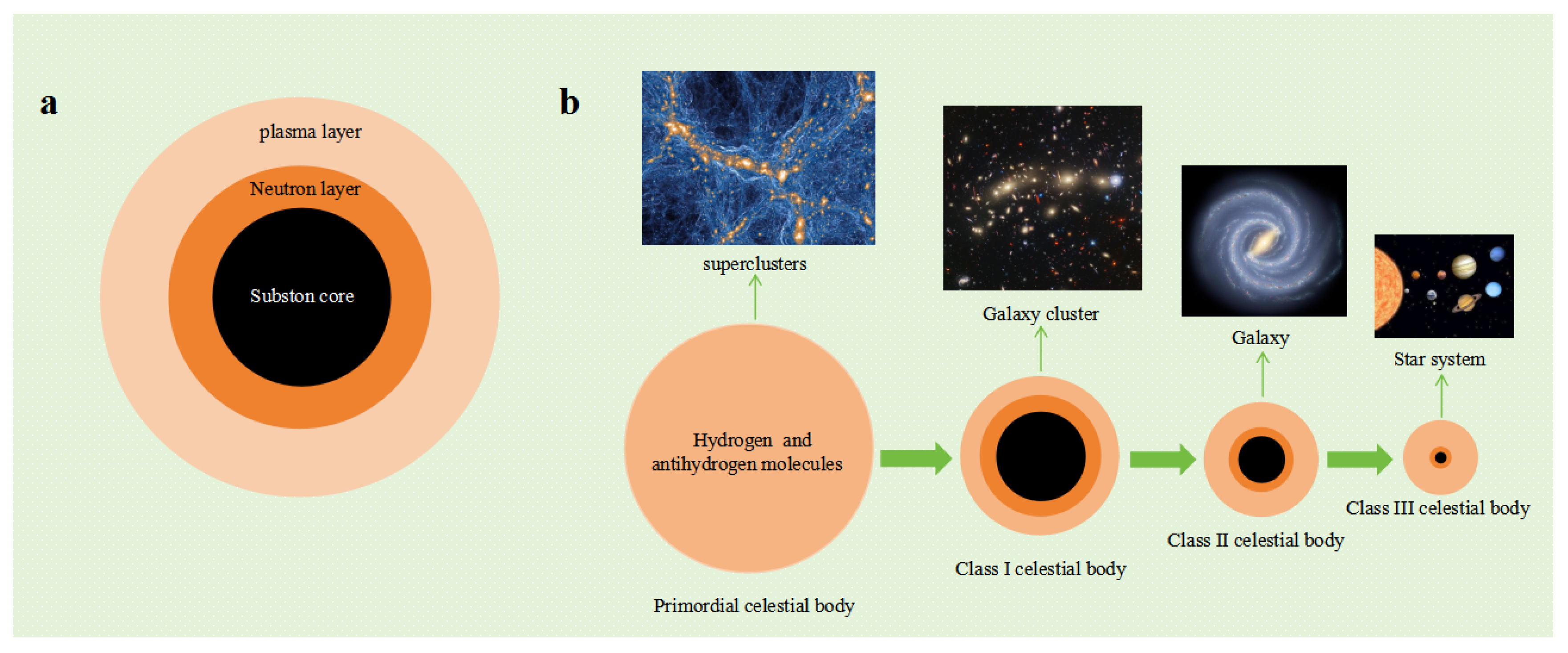
After universe forms vast hydrogen and anti-hydrogen molecules, after extremely long time, under gravitational attraction they gradually aggregate forming enormous gaseous celestial bodies. We call these huge gaseous celestial bodies composed of mixed hydrogen and anti-hydrogen molecules primordial celestial bodies. Since space infinite, such primordial celestial bodies countless, uniformly distributed in universe.
In these primordial celestial bodies, hydrogen and anti-hydrogen molecules continuously aggregate, reaching critical density, then undergo violent, large-scale RC reaction, net reaction:
(9) Hydrogen molecule + Anti-hydrogen molecule → 4 Neutrinos + 4 Subston + Radiation energy
This process releases unimaginable enormous energy — observed Big Bang.
Figure 7.
Structure of celestial bodies and evolution of the universe.
6.2. Formation and Evolution of Celestial Bodies
Due to slight asymmetry in charge and mass spatial distribution of three elementary particles initially, inevitably leads to local regions at certain large scales where hydrogen and anti-hydrogen molecule numbers unequal. Thus after RC reaction concludes, residual hydrogen or anti-hydrogen molecules remain. This means after primordial celestial body undergoes Big Bang, will form positive matter universe or anti-matter universe. This theoretically predicts existence of multiple different universes, some dominated by positive matter, some by anti-matter.
After primordial celestial body Big Bang, produced vast subson and residual hydrogen molecules (assuming forming positive matter universe) violently ejected into cosmic space. Under gravity, these subson and hydrogen molecules again aggregate, forming countless Class I celestial bodies (corresponding to supercluster scale). Since Big Bang produced subson constitute vast majority of cosmic mass, they become Class I celestial body's core region — subson core region. Due to Class I celestial enormous mass and gravity, hydrogen molecules outside core region under immense temperature and pressure undergo collapse, forming neutron layer. Under extreme high temperature high pressure, neutrons in neutron layer may decompose into electron, positron, subston, undergo isomerization forming antineutrons. Neutron and antineutron exist in dynamic equilibrium, can combine forming crystal-like stable structures lowering system potential energy.
Outside neutron layer, hydrogen molecules under high temperature high pressure form electron-proton plasma, this region called plasma layer. Inside Class I celestial body, complex dynamic equilibria exist:
(1) Between neutron layer and plasma layer, free neutrons and proton-electron plasma mutually convert.
(2) Free neutrons and antineutrons unstable, decay or undergo RC reaction, forming neutrinos and subson, releasing vast radiation energy. This is essence of "hydrogen burning" mechanism in stars.
(3) At interface between neutron layer and plasma layer, free neutrons and protons can combine forming atomic nuclei (e.g., deuterium, tritium, helium etc.), then combining with electrons forming various elements. This is fundamental mechanism of stellar nuclear fusion.
Since Class I celestial mass enormous, internal temperature and pressure sufficient to drive nuclear fusion synthesizing all elements in periodic table. "Hydrogen burning" and nuclear fusion produced enormous energy accumulating to certain extent, again causes Class I celestial undergo violent explosion, matter again ejected, forming countless Class II celestial bodies (corresponding to galaxy cluster scale) and abundant cosmic dust (containing hydrogen molecules and various heavy element matter).
Class II celestial mass smaller than Class I, but internal structure similar, also have subson core, neutron layer, plasma layer. Class II celestial continue "hydrogen burning" and nuclear fusion, then again explode, forming countless Class III celestial bodies (corresponding to galaxy scale) and new cosmic dust.
Class III celestial also have similar layered structure, but subson core and neutron layer scale further reduced. In Class III celestial, since mass insufficient to produce extremely high internal temperature and pressure, fusion reactions beyond iron difficult to sustain, thus mainly "hydrogen burning", nuclear fusion usually terminates near iron.
If Class I or II celestial after explosion remnant mainly composed of subson, it becomes dark star (physical essence different from general relativity predicted "black hole"). If remnant mainly composed of neutrons, becomes neutron star. Massive neutron star interior under high temperature high pressure produces free neutrons and antineutrons, decay products continuously undergo RC reaction, forming subson and neutrinos, releasing enormous energy, eventually may evolve into dark star. Low mass Class III celestial (like Sun), mainly "hydrogen burning", final evolutionary fate may be red giant or white dwarf.
From primordial celestial, to Class I, II, III celestial, cosmic structure presents picture of progressive explosion, hierarchical formation. This model naturally explains observed cosmic large-scale structure (supercluster-cluster-galaxy). Since each level celestial explosion provides kinetic energy for sub-level celestial recession, this makes entire universe appear accelerating expansion, thus no need introduce mysterious "dark energy" concept. Additionally, since cosmic space infinite and countless primordial celestial exist, they eventually evolve into many different universes (multiverse model). These secondary universes each expand, causing adjacent universes' frontier galaxies distance increasingly smaller, gravitational interaction increasingly stronger, this also overall manifests as cosmic accelerating expansion trend.
7. Discussion
7.1. The Great Tao Model Deepens the Understanding of the Elementary Particle Concept
First, the Great Tao Model closely links the concept of elementary particles with the profound philosophical question of the origin of the universe. The model posits that the ultimate existence of the universe is the existence of elementary particles, whose essence lies in the existence of their fundamental physical quantities. The inherent properties of these quantities fully conform to the fundamental law of the Tao—the Yin-Yang Law. The Great Tao Model is imbued with a deep philosophical foundation regarding the origin of the universe, directly inheriting and developing the thought of the ancient Chinese sage Laozi. In contrast, the Standard Model of Particle Physics itself lacks a philosophical foundation concerning the origin of the universe; it relies on the Big Bang theory, whose "singularity" origin lacks both a philosophical basis and a clear scientific mechanism.
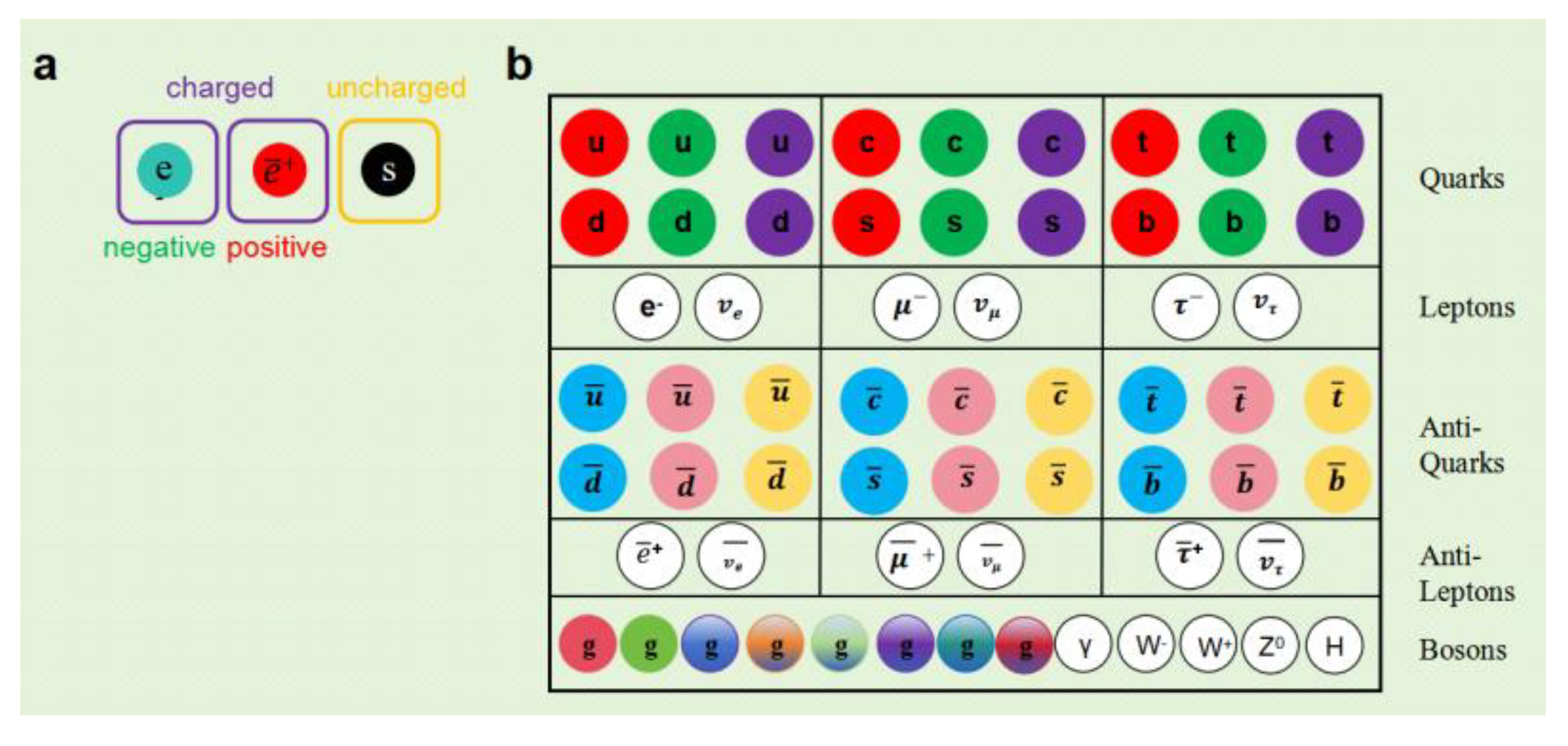
Second, the Great Tao Model reveals the most essential characteristics of elementary particles: they possess the simplest, fixed fundamental physical quantities and have eternal, unchanging, and stable properties. In the Great Tao Model, there are only three elementary particles and two fundamental physical quantities, all of which are eternally unchanging and stable, perfectly meeting the core requirements of the "elementary particle" concept. However, in the Standard Model, many entities labeled as "elementary particles" do not actually meet these core requirements. For example, some so-called elementary particles (e.g., photons, gluons) lack rest mass, failing the requirement of being the minimal unit constituting a material entity. The number of elementary particles is as high as 61 types, introducing a multitude of physical quantity types (e.g., color charge, weak isospin, hypercharge), many of which are theoretical constructs difficult to observe directly. This not only violates the principle of simplicity but also renders the theory exceptionally complex. Furthermore, many particles in the Standard Model are extremely unstable with very short lifetimes, and even their mass is considered to be "acquired" through interaction with an external field (the Higgs field), rather than being an inherent property of the particle itself.
Finally, the Great Tao Model clearly reveals the essence and laws of composite particle formation from Yin-Yang elementary particles. In the Great Tao Model, Yin-Yang elementary particles combine via electrostatic or gravitational attraction to form various composite particles, which then constitute all things in the universe. The physical mechanism—from the interaction of elementary particles to the formation of composite particles and ultimately all cosmic phenomena—is simple and unified. In the Standard Model, the meeting of opposite-charge "particle-antiparticle" pairs is considered to undergo an "annihilation reaction", where matter completely disappears and converts into energy. The formation of composite particles relies on various interaction theories that are extremely complex and lack unity, making it difficult to explain the formation and evolution of all things in the universe within a single theoretical framework.
Figure 8.
Comparison between the Great Tao Model and the Standard Model a: elementary particles in the Great Tao Model; b: elementary particles the Standard Model.
Figure 8.
Comparison between the Great Tao Model and the Standard Model a: elementary particles in the Great Tao Model; b: elementary particles the Standard Model.
7.2. The Great Tao Model Deepens the Understanding of Physical Fields
First, the Theory of Existence Field profoundly reveals the essence of physical fields. The theory posits that the existence of fundamental physical quantities produces a physical influence on the surrounding space; that is, fundamental physical quantities possess the inherent property of continuously and uniformly diffusing their physical information into the surrounding space. Thus, the essence of a physical field is the inherent property manifested by the existence of fundamental physical quantities, not an abstract mathematical concept independent of particles. Based on this understanding, we reveal the basic characteristics of the existence field: its propagation direction is from the elementary particle towards infinity, and its propagation speed is the inherent constant c of physical information diffusion. Elementary particles transmit physical information through their existence fields and produce corresponding physical responses (interactions) by receiving physical information emitted by other elementary particles. Crucially, only physical information emitted by the same type of fundamental physical quantity can be mutually received and produce physical effects. Therefore, only the same fundamental physical quantities can interact. This implies that there is no direct interaction between the gravitational field (mass field) and the electromagnetic field (charge field).
Second, the Theory of Existence Field clarifies the essence of the "constancy of the speed of light", correcting a core assumption deviation in relativity. Relativity defines the "constancy of the speed of light" as "constant relative to any inertial frame". This assumption violates the principle of velocity relativity—velocity is essentially a description of motion relative to a reference frame. If it is constant for all inertial frames, it breaks the spacetime logic of classical mechanics. According to the "motion law of massless objects" [3] and the Theory of Existence Field, the root of light speed constancy is the "inherent invariance of physical information diffusion": the physical information propagated by the existence field belongs to massless objects, and its diffusion speed c is an inherent motion property of massless objects, constant only relative to an absolutely stationary reference frame, not relative to any arbitrary inertial frame. This explanation conforms to the relative nature of velocity, allows for the logical derivation of propagation laws for electromagnetic waves, mass-momentum waves, and other massless field waves, avoids the conflict between relativity's assumption and classical physical logic, and simultaneously provides a traceable physical mechanism for the constancy of the speed of light, moving beyond a mere theoretical presupposition.
Third, the Theory of Existence Field redefines the physical essence of vacuum permittivity (ε0) and vacuum permeability (μ0), resolving a logical contradiction in traditional electromagnetism. Traditional theory treats these two physical quantities as inherent properties of the vacuum itself. However, the core characteristic of a vacuum is "emptiness, containing nothing". To ascribe physical properties (such as hindering or promoting field propagation) to it is essentially self-contradictory—a "vacuum" devoid of any material carrier cannot produce actual physical effects. Within the framework of the Theory of Existence Field, the essence of ε0 and μ0 is "the efficiency coefficients for converting the physical information of fundamental physical quantities into existence field intensity when propagating in a vacuum": vacuum permittivity corresponds to the efficiency coefficient of the charge field (ke=1/ε0), and vacuum permeability corresponds to the efficiency coefficient of the electro-momentum field (kP,e=μ0). Their values are related only to the inherent properties of the fundamental physical quantity (charge) and have nothing to do with the vacuum itself. This delineation avoids the logical contradiction of "vacuum possessing physical properties". Furthermore, through the unified relationship of existence field constants (kP=kQ/c²), it achieves theoretical self-consistency for the efficiency coefficients of electric and magnetic fields, transforming electromagnetic constants from isolated experimental data into quantities derived from the essence of fundamental physical quantities.
Concurrently, the Theory of Existence Field proposes and unifies a series of physical quantity concepts, correcting some erroneous understandings in existing theories. According to the Theory of Existence Field, the motion of fundamental physical quantities produces motion physical quantities (i.e., momentum), including translational momentum , rotational momentum r, and spin momentum s. People are familiar with mass-momentum (m=m) and orbital angular momentum((i.e., rotational mass-momentum r,m=mr), but they are almost entirely unaware of or hold misconceptions about electro-momentum (e=e), rotational electro-momentum ((r,e=er, i.e., orbital magnetic moment , spin mass-momentum (s,m, i.e., spin angular momentum s), and spin electro-momentum (s,e, i.e., spin magnetic moment s)).
In reality, electro-momentum eis the product of charge e and velocity e, and the electro-momentum field is the magnetic field. Therefore, mass motion produces mass-momentum, and its mass-momentum field is a physical field analogous to the magnetic field. The rotational momentum produced by the rotational motion of mass m is orbital angular momentum mr. Consequently, the rotational electro-momentum produced by the rotational motion of charge e, er, naturally is the orbital magnetic moment. This represents an important correction to the current concept of magnetic moment. The current magnetic moment concept originates from Ampère's molecular current hypothesis. For a planar current-carrying loop, its magnetic moment is defined as=i, where i is the current intensity and is the "directed area" vector of the loop. Area itself is a scalar; in the definition of magnetic moment, it is treated as a vector, artificially creating the concepts of "directed area" or "pseudovector", leading to confusion between scalar and vector concepts. Both current intensity i and area S are scalars, and forcibly adding a unit vector to determine the direction of the magnetic moment is also highly unnatural. This indicates that the current magnetic moment concept has logical flaws. Based on the current magnetic moment concept, the relationship obtained between the electron's orbital magnetic moment M and orbital angular momentum L is . However, experimental results show that a correction factor g (whose value is usually 2) needs to be added, i.e., . Based on the Theory of Existence Field's corrected orbital magnetic moment concept (rotational electro-momentum), we obtain the relationship , requiring no additional correction factor g.
In quantum mechanics, electron spin is considered an intrinsic property of the electron, not an actual rotational motion. Its spin state is not measured by rotation speed but is represented by the so-called spin quantum number ±1/2. This statement, which defies classical physics intuition and is difficult to comprehend, has been enshrined as a core concept of quantum mechanics. According to the Theory of Existence Field, electron spin is the rotational motion of the electron, producing spin momentum, i.e., spin angular momentum s and spin magnetic moment s. From this, we derive the relationship between spin angular momentum s and spin magnetic moment s as . Just like the relationship between the electron's orbital magnetic moment M and orbital angular momentum L, no correction factor g is required. This indicates that our corrected concepts of orbital magnetic moment and spin magnetic moment are correct, while the so-called correction factor g and spin quantum number ±1/2 in quantum mechanics are artificial results arising from the adoption of an erroneous magnetic moment concept based on "directed area".
Since the spin state of an elementary particle is related only to its fundamental physical quantity Q and spin angular velocity we propose the concept of the elementary particle's spin quantity =Q. The charge spin quantity produces a charge spin quantity field, which is the magnetic field generated by charge spin motion (spin magnetic field). Mass spin motion will similarly produce a mass spin quantity field analogous to the spin magnetic field. The attractive force between two electrons with opposite spins is the interaction force between their charge spin fields, which we term the electron spin magnetic force. This physical mechanism of electron spin pairing provides a new theoretical basis for understanding electron pairing phenomena in atomic and molecular structures [9].
The Theory of Existence Field also clarifies the essence of core concepts in classical electromagnetism. The expression in classical Maxwell's theory that "electric and magnetic fields mutually excite each other" lacks a complete logical causal chain. In reality, the electric field is the static source of the charge existence field, and the magnetic field is the distortion effect of the electric field in uniform motion (electro-momentum field). The core of electromagnetic wave propagation is the unidirectional causal chain: "charge acceleration → accelerated distortion of the electro-momentum field → vortical response of the electric field". The "displacement current" has no real charge carrier; its essence is the equivalent mathematical description of the "time rate of change of the charge existence field (electric field)". Its effect is equivalent to the magnetic field effect produced by conduction current and can be explained by the dynamic distortion effect of the existence field without additional hypotheses. Faraday's law of electromagnetic induction essentially describes how the time variation of the electro-momentum field (magnetic field) excites a vortical distortion of the charge existence field (electric field). The conduction current term in Ampère's circuital law corresponds to the collective superposition of the electron translational momentum field, and the displacement current term corresponds to the magnetic field vortical effect caused by changes in the electric field. Both describe the spatial distribution laws of the electro-momentum field.
Finally, the Theory of Existence Field clearly reveals the physical mechanism by which accelerated motion of elementary particles produces electromagnetic waves and mass-momentum waves. Since the existence field propagates massless physical information, its propagation conforms to the motion law of massless objects, i.e., moving in a straight line at constant speed c relative to an absolutely stationary reference frame in a vacuum [3]. This characteristic dictates that any motion of an elementary particle will cause distortion in the propagation morphology of its existence field. The uniform motion of elementary particles causes a stable, time-invariant distortion of the existence field. This distortion effect can be described by the momentum field (electro-momentum field and mass-momentum field). The propagation of the momentum field can be regarded as a type of existence field wave (charge field wave or mass field wave), but since it is a uniform distortion, it is not accompanied by net energy transfer. When elementary particles undergo accelerated motion under the action of a force, the degree of distortion of their existence field changes with acceleration over time, manifested as a non-zero time rate of change of the momentum field. This time-varying momentum field (i.e., momentum field wave, such as electro-momentum field wave—electromagnetic wave, and mass-momentum wave) propagates through space, thereby conveying the information of work done by the force, i.e., energy.
Electromagnetic waves and mass-momentum waves are unified as the "propagation of existence field changes from accelerated particles". Both satisfy the same unified wave equation form and propagate at speed c, achieving a unification of the mechanisms for electromagnetic radiation and gravitational radiation. Compared with classical theory, electromagnetic waves in the Theory of Existence Field are a propagation phenomenon resulting from the accelerated distortion of the electro-momentum field (magnetic field) caused by electron acceleration, with energy transferred through the accelerated distortion of the field, without the need for a material particle mediator. Only accelerating electrons can form electromagnetic waves; a uniformly distorted magnetic field from uniform motion has no time variation and does not transfer energy. The mass-momentum wave is the phenomenon of accelerated distortion of the mass-momentum field caused by accelerated mass motion, with the carrier being the mass existence field of subson. Its propagation speed c is an inherent property of massless objects, sharing the same origin as the speed of electromagnetic waves, requiring no additional assumption. The "gravitational wave" signals observed by LIGO are actually mass-momentum waves produced by the accelerated motion of subson.
Starting from the propagation laws of the existence field for elementary particles in stationary, uniform motion, and accelerated motion states, this theory not only explains the propagation speed of the existence field, the essence of the magnetic field, and the formation of electromagnetic waves but also predicts new physical fields such as the mass-momentum field and spin field, perfectly demonstrating the logical coherence and internal consistency of the theoretical framework.
7.3. The Establishment of the Great Tao Model Unravels Many Long-Perplexing Mysteries in Physics
First, the Great Tao Model reveals the essence of dark matter and black holes.
Extensive astronomical observations indicate that the universe contains a large amount of matter that does not emit light, does not absorb light, and does not interact with electromagnetic waves—dark matter [10,11,12,13,14]. One of the most likely dark matter candidates speculated is the Weakly Interacting Massive Particle (WIMP) [15]. In the Standard Model, there is no particle that simultaneously satisfies these properties, meaning the dark matter particle must be a new physics particle beyond the Standard Model. Due to the lack of corresponding theoretical guidance, the global physics community has searched for dark matter particles for over half a century without success. In the Great Tao Model, subston is an elementary particle with only mass and no charge. Since it has no charge, its accelerated motion does not produce electromagnetic radiation, and electromagnetic radiation cannot directly cause it to accelerate or be absorbed. Clearly, subson shares completely consistent physical characteristics with the descriptions of dark matter in cosmology. We believe that the so-called dark matter particle is subson. According to our theory, technological methods to detect dark matter particles (subston) can be designed. For example, using cosmic ray dark matter particles (subston) colliding with electron beams (or positron beams) produced by ground-based accelerators may generate antiprotons or protons. By detecting these secondary products, dark matter particles (subston) can be indirectly detected.
In the Great Tao Model, the mass of subson is approximately 1835 times that of the electron or positron, providing over 99.9% of the mass of ordinary matter composed of electrons, protons, and neutrons, and is the primary source of cosmic mass. In the process of cosmic formation and evolution, the products of the RC reaction between hydrogen molecules and anti-hydrogen molecules in primordial celestial bodies are mainly subson and neutrinos, with subson constituting the vast majority of the total cosmic mass. This theoretical picture is qualitatively consistent with the basic conclusion revealed by astronomical observations that "dark matter mass in the universe far exceeds that of ordinary (visible) matter".
Subston plays an important role in cosmic evolution, such as influencing the formation of large-scale cosmic structures. Subson is the source of the primary mass at the centers of superclusters, clusters, and galaxies. They exist in the form of dark matter within the core regions of stars or independently as celestial bodies called "dark stars". The so-called "black holes" observed in astronomy are actually "dark stars" condensed from subson. "Black holes" are predictions of Einstein's general relativity, referring to a "singularity" with infinite density and infinitesimal volume, where spacetime is extremely distorted near the singularity. The event horizon of a black hole is a key boundary marking the region from which light cannot escape. Clearly, the concept of a "black hole" violates many common-sense principles of physics and such celestial bodies may not actually exist. Although dark stars have immense gravity, since the gravitational field and electromagnetic field do not directly interact, the classical phenomenon of "light being unable to escape" fundamentally does not occur. Dark stars appear dark because the subson composing them carry no charge and therefore do not emit light themselves. However, if ordinary matter is attracted by the powerful gravity of a dark star, the charged particles within it will produce radiation as they accelerate and fall into the dark star. For example, astronomers have observed that the supermassive "black hole" at the center of the Milky Way, Sagittarius A*, produces intense X-ray flares when consuming surrounding matter [16].
Second, the Great Tao Model unravels the mystery of neutrinos.
In the Standard Model, neutrinos are considered elementary particles, including three types: electron neutrino, muon (μ) neutrino, tau (τ) neutrino, and their antiparticles. These three neutrino types can convert into one another during propagation, a phenomenon called neutrino oscillations. The Standard Model initially considered neutrinos to be massless, later acknowledging they have mass, but the magnitude and nature of this mass remain a mystery. Clearly, neutrinos in the Standard Model do not meet the basic definition of elementary particles: their variety is excessive, violating the simplicity principle; the mutual transformation between different neutrino types violates the invariance requirement; and the initial assumption of masslessness contradicts the fundamental meaning of elementary particles as the minimal units constituting material entities. According to the Great Tao Model, neutrinos are not elementary particles but composite particles formed by the combination of electrons and positrons. Therefore, they are electrically neutral particles with a rest mass approximately equal to twice the electron mass, and they interact very weakly with other matter. They do not have independent antiparticles, or rather, their antiparticle is themselves (so-called "Majorana fermions").
In traditional physics, electrons and positrons can form a bound system called positronium [17]. Positronium is divided into ortho-positronium (spin singlet, average lifetime ~125 picoseconds) and para-positronium (spin triplet, average lifetime ~142 nanoseconds) based on its spin state, ultimately annihilating to produce photons. Within the theoretical framework of this paper, we can propose a new understanding of the existence of positronium: it is not the endpoint of electron-positron combination. Instead, positronium (particularly its ground and low excited states) can be regarded as a quasi-stable intermediate or excited state in the process of forming a "neutrino system". This system possesses an energy spectrum based on its binding energy and orbital dynamics:
Excited/Loosely Bound States: Correspond to the various energy levels of positronium with shorter lifetimes as traditionally understood.
Ground Bound State: A stable electron-positron orbital system with tighter binding and potentially longer lifetime than the known positronium ground state.
Tightly Bound State (Neutrino): The electron and positron, through further orbital contraction and energy radiation, reach an extremely deep bound state. At this point, the system radius is extremely small, the binding energy is extremely high, and the overall performance is a stable neutral composite particle—the neutrino as we define it.
This picture naturally suggests that the so-called "neutrino oscillations" may not be conversions between three flavors of neutrinos but rather manifestations of transitions between different bound energy levels (such as the excited, ground bound, and tightly bound states mentioned above) of the same electron-positron composite system. Different "flavors" may correspond to different angular momentum, orbital, or spin configurations of the system. This offers a completely new possibility based on classical orbital dynamics for understanding neutrino physics.
Quantum field theory predicts that the meeting of matter and antimatter will result in the so-called "annihilation reaction", where matter completely disappears and converts entirely into energy. Simultaneously, particle-antiparticle pairs can also spontaneously arise from vacuum fluctuations. The observation of electron-positron meetings producing gamma rays in experiments has often been regarded as direct evidence of matter-antimatter annihilation reactions. Additionally, the observation that gamma rays can produce electron-positron pairs in a vacuum is also often considered direct evidence of vacuum fluctuations. For a long time, these experimental results and phenomena have been seen as strong validation of the predictions of the mass-energy equivalence equation and quantum field theory. In fact, according to our theory, the meeting of electrons and positrons results in an RC reaction, where the electron and positron accelerate under electrostatic attraction, producing electromagnetic radiation (gamma rays), and ultimately combine to form a neutrino. The universe contains vast numbers of neutrinos, which, when encountering high-energy gamma rays in a vacuum, can be excited and dissociate into electron-positron pairs. The view that matter-antimatter meetings result in matter annihilation converting to energy is primarily based on the relativistic mass-energy equation but does not provide any specific physical mechanism for how matter and antimatter annihilate and convert to energy. Our previous research has posed a disruptive challenge to the theory of relativity [3]. The generation and "annihilation" phenomenon of positive and negative electron pairs precisely confirms that neutrinos are composite particles composed of electrons and positrons, and also proves the fundamental shortcomings of the relativistic mass energy equation and quantum field theory in explaining such phenomena.
The neutrino was first proposed as a hypothetical particle by Pauli (W. Pauli) to address the apparent non-conservation of energy in β decay. He suggested that besides the electron, there was another electrically neutral particle (the neutrino) among the β decay products, which would explain the so-called non-conservation of energy in β decay derived from the mass-energy equation. This hypothesis was later developed by Fermi (E. Fermi) into the β decay theory [18], which posited that β decay was driven by the so-called "weak interaction". In 1956, Reines and Cowan bombarded protons with the hypothesized anti-electron neutrino and observed the predicted positron: p+ → n + e+ [19]. This experiment was interpreted as direct verification of Pauli's neutrino hypothesis or Fermi's β decay theory, thereby confirming the existence of the weak interaction and indirectly corroborating the correctness of the relativistic mass-energy equation. However, the β decay theory has not actually been rigorously proven by experiments, as this experiment did not directly demonstrate that neutrinos are produced by β decay; it only proved that positrons can be produced by the bombardment of protons by possible neutrinos. According to our theory, when a neutrino bombards a proton, the electron within the neutrino combines with the proton to form a neutron, while the positron is released. Clearly, our theory perfectly explains the experimental results of Reines and Cowan, or rather, their experimental results fully confirm our theory. This also implies that the neutrino hypothesis proposed by Pauli and the β decay theory proposed by Fermi are incorrect, and the mass-energy equation and the existence of the weak interaction were not confirmed by this experiment. Nevertheless, despite the errors in Pauli's neutrino hypothesis and Fermi's β decay theory, the tiny neutral particle (neutrino) they predicted does exist—a fascinating coincidence, similar to the situation with Dirac's prediction of the positron.
Currently, it is believed that solar neutrinos primarily originate from the proton-proton chain reaction (PP chain) and the carbon-nitrogen-oxygen cycle [20]. The core of the PP chain is the reaction of two protons to produce a deuteron, a positron, and a neutrino: p+p→2H+e++νe. Its theoretical basis is the β⁺ decay theory (p→n+e++νe). According to our theory, protons are composed of subson and positrons; the collision of two protons absolutely cannot produce a neutron and a neutrino. Therefore, the traditional view that solar neutrinos originate from the PP chain and the carbon-nitrogen-oxygen cycle is invalid. According to our theory, a dynamic equilibrium exists within the Sun involving the isomerization reaction between neutrons and antineutrons, the dynamic equilibrium between bound neutrons/antineutrons and free neutrons/antineutrons, and the dynamic equilibrium between neutrons and electron-proton plasma. Free neutrons and antineutrons are unstable and can disintegrate into electrons, positrons, protons, and antiprotons. Matter and antimatter then combine in RC reactions, forming neutrinos and subson and releasing vast amounts of radiation energy. This is the true physical mechanism for solar neutrino production. Under the high temperature and pressure inside the Sun, protons and neutrons can directly combine to form atomic nuclei, which then combine with electrons to form elements—this is the physical mechanism of nuclear fusion for element formation. Clearly, the deuteron is formed by the direct combination of a proton and a neutron under the high temperature and pressure inside the Sun, not through the so-called PP chain.
Neutron stars are celestial bodies formed by the combination of neutrons and antineutrons. Due to powerful gravitational effects, their interiors exhibit extreme high temperature and high pressure conditions, producing free neutrons and antineutrons. Therefore, RC reactions continuously occur within neutron stars, steadily releasing neutrinos and powerful gamma rays. When neutron stars collide and merge, the immense impact energy and the increased mass lead to even higher internal pressure and temperature, causing more bound neutrons and antineutrons to transition to free states, thereby triggering more violent RC reactions, producing more neutrinos and subson, and releasing more energy. Consequently, we observe more neutrinos and stronger gamma rays. Similarly, our theory can also explain the massive amount of neutrinos emitted during supernova explosions.
Third, the Great Tao Model unravels the mysteries of nuclear forces, atomic nucleus structure, and nuclear radiation, fundamentally negating the necessity for the existence of strong and weak interactions.
For a long time, it has been difficult to understand why protons, despite mutual electrostatic repulsion, can bind tightly with neutrons to form stable atomic nuclei. To solve this puzzle, scientists proposed the concept of the nuclear force, suggesting a special interaction between protons and neutrons (collectively nucleons) with characteristics of short range, saturation, and charge independence [21,22,23,24]. To delve deeper into the nature of the nuclear force, scientists proposed meson theory and the quark model [25,26,27], introducing concepts such as the strong interaction and weak interaction. However, both the phenomenological theory based on meson exchange and its deeper foundation, Quantum Chromodynamics (QCD), still face significant difficulties and challenges in quantitatively and uniformly explaining all properties of the nuclear force (such as short-range repulsive core, intermediate-range attraction, tensor force, etc.) and the saturation of atomic nuclei [28,29]. Even though QCD is considered the ultimate theory of the strong interaction, deriving the nuclear force from it non-perturbatively remains a fundamental challenge in nuclear physics [30]. These unresolved issues indicate that there is still room for deepening and revolutionizing the understanding of the nature of nuclear forces.
We believe the core difficulty facing existing theories lies in the lack of correct understanding of which elementary particles constitute protons and neutrons. In the Great Tao Model, we have clarified that protons are composed of positrons and subson, and neutrons are composed of electrons, positrons, and subson. Based on the charge interaction (electrostatic force) and mass interaction (universal gravitation) between elementary particles, the interaction force between protons and neutrons can be directly calculated. Calculations show that when protons and neutrons are very close, the elementary particles within them can generate an enormously powerful net electrostatic attraction. When the distance exceeds the atomic nucleus scale, this force diminishes sharply. Thus, we completely do not need to introduce the concept of a "strong interaction" between nucleons; electromagnetic interaction alone explains the tight binding of protons and neutrons in atomic nuclei. Furthermore, based on the electrostatic interaction between protons and neutrons, the crystalline structure model of the atomic nucleus emerges naturally, systematically explaining all nuclear radiation phenomena (including α decay, β decay, and γ decay), entirely without the need to introduce the concept of a "weak interaction". Our elucidation of the neutrino mystery also proves that β decay theory is incorrect and the weak interaction does not exist. According to the Theory of Existence Field in the Great Tao Model, only the same fundamental physical quantities can interact. Since there are only two fundamental physical quantities, charge and mass, the basic interactions between elementary particles are essentially only two types: charge interaction and mass interaction. There is no such thing as strong or weak interactions.
Fourth, the Great Tao Model unravels the mysteries of Mercury's precession and "gravitational waves".
The issue of the precession of Mercury's perihelion has long been a significant subject in astronomy and gravitational theory. General relativity attributes Mercury's orbital precession to the curvature of spacetime caused by the Sun's mass. However, this geometric explanation deviates from conventional spacetime concepts and fails to provide an intuitive description of the physical mechanism. According to the Theory of Existence Field, the interaction between masses includes not only static universal gravitation but also dynamic mass-momentum forces (including translational, rotational, and spin mass-momentum forces). Since ordinary objects have relatively small masses, both the universal gravitation and mass-momentum forces between them are extremely weak and difficult to observe. The reason universal gravitation appears significant is primarily due to the substantial interaction between objects and the massive Earth. In fact, several gravitational anomalies have already been observed. For example, spacecraft flying past Earth exhibit slight deviations from theoretical predictions based solely on universal gravitation [31]. This is actually a manifestation of the noticeable mass-momentum force between the high-speed spacecraft and the rapidly rotating, massive Earth. If only the universal gravitation between the spacecraft and Earth is considered while neglecting the mass-momentum force, a discrepancy arises between theoretical calculations and actual observations. Similarly, for a long time, people were only aware of the universal gravitation between the Sun and Mercury and remained unaware of the mass-momentum force arising from their motion. Consequently, they were unable to fully explain Mercury's precession. The Sun possesses an enormous mass, and its rotation generates a very strong rotational mass-momentum field (spin angular momentum field). Other planets in the solar system are farther from the Sun and have slower orbital speeds; thus, the mass-momentum force effect between them and the Sun is not significant. Mercury, being the closest planet to the Sun with the fastest orbital speed, experiences the most pronounced mass-momentum force effect with the Sun. This is the fundamental reason for Mercury's anomalous precession.
"Gravitational waves" are an important prediction of Einstein's general relativity, considered "ripples in spacetime" produced by accelerating masses. Although general relativity predicts the existence of gravitational waves, it does not deeply reveal their physical essence. According to the Theory of Existence Field, the waves produced by accelerating masses are mass-momentum waves. Their essence is the propagation phenomenon of accelerated distortion of the mass existence field in space, completely analogous in physical mechanism to electromagnetic waves produced by accelerating charges. Many violent astronomical phenomena, such as collisions or mergers of compact objects (neutron stars, dark stars) and supernova explosions, involve drastic acceleration of enormous masses and therefore can generate intense, detectable mass-momentum waves. LIGO's observation on September 14, 2015, of signals (GW150914) produced by the collision and merger of two black holes (dark stars in our theory), confirmed as gravitational wave signals [32], actually constitutes the first direct evidence of the existence of mass-momentum waves. Although LIGO discovered evidence for mass-momentum waves, they lacked correct theoretical guidance, making their detection of such signals somewhat fortuitous. According to our theory, employing dynamic detectors optimized for the characteristics of the mass-momentum field in the future could potentially significantly enhance the efficiency and accuracy of detecting mass-momentum waves.
Fifth, the Great Tao Model unravels the mysteries of the origin of cosmic energy and the quantization of microscopic particles.
Current mainstream theories attribute the primary source of cosmic energy to the Big Bang, its energy possibly originating from the immense mass and energy of the singularity. Another viewpoint posits that the Big Bang might have been an extreme quantum fluctuation. However, attributing the origin of cosmic energy to a singularity does not truly solve the problem of energy origin but merely shifts it to the singularity, where all known physical laws completely break down, precluding any scientific explanation. Similarly, although vacuum fluctuations in quantum field theory offer a possible explanation, they also do not fully reveal the true origin of cosmic energy. Within the current scientific framework, we lack a complete and convincing answer to explain the origin of cosmic energy. However, our theory not only unravels the mystery of cosmic energy's origin but also that of microscopic particle quantization. According to our theory, the kinetic energy of moving objects and radiation energy in the universe fundamentally originate from the potential energy released during the combination process of Yin-Yang elementary particles. Precisely because charged particles can continuously release radiation energy during accelerated motion, their speed can decrease to the precise balance where the centripetal force equals the attraction between the Yin-Yang particles, thereby forming stable "Yin-Yang particle pair" systems (such as composite particles or atomic systems). We have revised the basic concept of the "energy quantum" based on the generation mechanism of electromagnetic waves [7,8]. Building upon this, we reveal the physical essence of electron transitions: an electron transition is a continuous dynamical process where the electron moves continuously from one stationary orbit to another, accelerating or decelerating, during which it radiates or absorbs electromagnetic waves (light quanta) of specific energies. This is not the instantaneous, discontinuous, indescribable "jump" depicted by quantum mechanics. The so-called stationary orbits are those where particles orbit in uniform circular motion (or elliptical motion with constant frequency). Between different stationary orbits, the radii, energies, and angular momenta exhibit certain integer multiple relationships—this is termed the quantization characteristic. This is a dynamical equilibrium feature common to all "Yin-Yang particle pair systems", not a mysterious "quantum phenomenon" inexplicable by classical physics.
Sixth, the Great Tao Model unravels the mysteries of the Big Bang, matter-antimatter asymmetry, and the accelerated expansion of the universe.
Astronomical evidence such as galaxy redshift and the cosmic microwave background radiation indicates our universe underwent a hot, dense state and that galaxies are currently receding at an accelerating rate [2]. However, the standard Big Bang theory cannot explain the cause of the Big Bang, cannot explain why dark matter constitutes the vast majority of the total mass in the universe, cannot explain the mystery of matter-antimatter asymmetry, and cannot perfectly explain the physical mechanism of the universe's accelerated expansion. Our Great Tao Model considers elementary particles as the ultimate existence of the universe, thereby avoiding the concept of a universe originating from a "singularity" where physical laws fail. In the Great Tao Model, we assume a reasonable initial state of the universe: elementary particles are infinitely far apart and in an absolute stationary state; thus, density, temperature, and total energy all approach zero. Since the three elementary particles—electron, positron, and subston—cannot simultaneously achieve uniform distribution and force equilibrium in space, they ultimately must combine under gravitational and electrostatic interactions via spiral motion, eventually forming hydrogen and anti-hydrogen molecules. Over an immensely long time under gravity, these molecules gradually aggregate, forming numerous enormous primordial celestial bodies. RC reactions occur between the hydrogen and anti-hydrogen molecules within these primordial bodies, forming substons and neutrinos and releasing enormous energy. This is the true cause of the "Big Bang". Due to slight initial spatial distribution imbalance of the three elementary particles, after RC reactions ("Big Bangs") occur in the vast majority of regions, only small amounts of positive matter (hydrogen molecules) or antimatter (anti-hydrogen molecules) remain. Therefore, the vast majority of cosmic matter is dark matter composed of substons, and the remainder is either positive matter or antimatter—this is the origin of matter-antimatter asymmetry in the universe. Following the "Big Bang" of primordial celestial bodies, many Class I celestial bodies form. These Class I bodies then explode, forming many Class II bodies, which in turn explode to form many Class III bodies. This progressive explosion, hierarchical formation model naturally explains the formation and evolution of cosmic large-scale structures such as superclusters, galaxy clusters, and galaxies. Simultaneously, it explains why sub-level celestial bodies exhibit increased recession speeds relative to the center of their parent body, manifesting as cosmic accelerated expansion. Furthermore, since the universe contains multiple primordial celestial bodies, each evolving into multiple secondary universes, these secondary universes continuously expand. This causes the frontiers of adjacent universes to draw closer together, increasing the gravitational attraction between their frontier galaxies, which further accelerates the expansion of each secondary universe itself. Therefore, without introducing the concept of "dark energy", the phenomenon of cosmic accelerated expansion can be explained, thereby resolving the dark energy problem.
8. Conclusion
Building upon ancient Chinese philosophical wisdom and modern scientific facts, this paper constructs a unified theory concerning elementary particles and their interactions—the Great Tao Model. This theory organically comprises the Yin-Yang Model and the Theory of Existence Field, systematically elucidating the physical mechanisms from elementary particle combination to the formation and evolution of cosmic structures, truly achieving the long-sought theoretical unity. The establishment of the Great Tao Model not only provides a novel, concise, and self-consistent framework for understanding the material world but also unravels many longstanding, perplexing mysteries in physics, demonstrating significant potential as a candidate for a "Theory of Everything". The proposal of this model represents a profound transformation in foundational physics concepts and a fruitful attempt at the confluence of scientific thought, undoubtedly exerting far-reaching influence on the future development of physics.
Data Availability Statement
No Data associated in the manuscript.
Acknowledgements
We sincerely thank Professor Guihua Lu for pointing out the errors and omissions in the preprint of the manuscript, which helped us make revisions.
References
- Cottingham, W. N.; Greenwood, D. A. An introduction to the standard model of particle physics, 2nd ed.; Cambridge University Press, 2023. [Google Scholar]
- Hawking, S. W. A brief history of time: from the big bang to black holes; Bantam Books, 1988. [Google Scholar]
- Zeng, J. Q.; Zeng, T. H. The motion of massless “object” and the physical essence and motion law of light. Physics Essays 2023, 36(2), 216–222. [Google Scholar] [CrossRef]
- Griffiths, D. J. Introduction to electrodynamics, 4th ed.; Cambridge University Press, 2017. [Google Scholar]
- Rabi, I. I.; Zacharias, J. R.; Millman, S.; Kusch, P. A new method of measuring nuclear magnetic moment. Physical Review 1938, 53(4), 318–327. [Google Scholar] [CrossRef]
- Cooper, L. N. Bound electron pairs in a degenerate Fermi gas. Physical Review 1956, 104(4), 1189–1190. [Google Scholar] [CrossRef]
- Zeng, J. Q. Classical physical mechanism of quantum production and its explanation for hydrogen atom structure and photoelectric effect. Physics Essays 2021, 34(4), 529–537. [Google Scholar] [CrossRef]
- Zeng, J. Q. Classical physics derivation of quantization of electron elliptical orbit in hydrogenlike atom. Physics Essays 2022, 35, 147–151. [Google Scholar] [CrossRef]
- Zeng, T.; Zeng, J. A Unified Theory of Atomic and Molecular Structure. Preprints 2025, 2025011033. [Google Scholar] [CrossRef]
- Kapteyn, J. C. First attempt at a theory of the arrangement and motion of the sidereal system. The Astrophysical Journal 1922, 55, 302–327. [Google Scholar] [CrossRef]
- Zwicky, F. Die Rotverschiebung von extragalaktischen Nebeln. Helvetica Physica Acta 1933, 6, 110–127. [Google Scholar]
- Smith, S. The mass of the Virgo Cluster. The Astrophysical Journal 1936, 83, 23–30. [Google Scholar] [CrossRef]
- Babcock, H. W. The rotation of the Andromeda Nebula. Lick Observatory Bulletin 1939, 19, 41–48. [Google Scholar] [CrossRef]
- Oort, J. H. Some problems concerning the structure and dynamics of the galactic system and the elliptical nebulae NGC 3115 and 4494. The Astrophysical Journal 1940, 91, 273–306. [Google Scholar] [CrossRef]
- Bertone, G. The moment of truth for WIMP dark matter. Nature 2010, 468(7322), 389–393. [Google Scholar] [CrossRef] [PubMed]
- Baganoff, F. K.; Bautz, M. W.; Brandt, W. N.; Chartas, G.; Feigelson, E. D.; Garmire, G. P.; Townsley, L. K. Rapid X-ray flaring from the direction of the supermassive black hole at the Galactic Centre. Nature 2001, 413(6851), 45–48. [Google Scholar] [CrossRef] [PubMed]
- Deutsch, M. Positronium. Progress in Nuclear Physics 1953, 3, 131–158. [Google Scholar] [CrossRef]
- Fermi, E. An attempt of a theory of β radiation. Zeitschrift für Physik 1934, 88, 161–177. [Google Scholar] [CrossRef]
- Cowan, C. L.; Reines, F.; Harrison, F. B.; Kruse, H. W.; McGuire, A. D. Detection of the free neutrino: a confirmation. Science 1956, 124(3212), 103–104. [Google Scholar] [CrossRef]
- Bethe, H. A. Energy production in stars. Physical Review 1939, 55(5), 434–456. [Google Scholar] [CrossRef]
- Heisenberg, W. Über den Bau der Atomkerne. I. Zeitschrift für Physik 1932, 77(1-2), 1–11. [Google Scholar] [CrossRef]
- Majorana, E. Über die Kerntheorie. Zeitschrift für Physik 1933, 82(3-4), 137–145. [Google Scholar] [CrossRef]
- Wigner, E. On the saturation of nuclear forces. Physical Review 1933, 43(4), 252–257. [Google Scholar] [CrossRef]
- Wigner, E. On the constitution of atomic nuclei. Physical Review 1933, 44(1), 224–225. [Google Scholar]
- Yukawa, H. On the interaction of elementary particles. I. Proceedings of the Physico-Mathematical Society of Japan 1935, 17(3), 48–57. [Google Scholar]
- Gell-Mann, M. A schematic model of baryons and mesons. Physics Letters 1964, 8(3), 214–215. [Google Scholar] [CrossRef]
- Zweig, G. An SU(3) model for strong interaction symmetry and its breaking; CERN Preprints; CERN, 1964; p. No. TH-401 & TH-412. [Google Scholar]
- Wong, S. S. M. Introductory nuclear physics, 2nd ed.; Wiley-VCH, 1998. [Google Scholar]
- Machleidt, R.; Entem, D. R. Chiral effective field theory and nuclear forces. Physics Reports 2011, 503(1), 1–75. [Google Scholar] [CrossRef]
- Wilczek, F. QCD and natural philosophy. Annales Henri Poincaré 2003, 4 Suppl. 2, S211–S228. [Google Scholar] [CrossRef]
- Anderson, J. D.; Campbell, J. K.; Ekeland, J. E.; Ellis, J.; Jordan, J. F.; Lau, E. L.; Williams, B. G. Anomalous orbital-energy changes observed during spacecraft flybys of Earth. Physical Review Letters 2008, 100(9), 091102. [Google Scholar] [CrossRef]
- Abbott, B. P.; Abbott, R.; Abbott, T. D.; Abernathy, M. R.; Acernese, F.; Ackley, K.; Zweizig, J. Observation of gravitational waves from a binary black hole merger. Physical Review Letters 2016, 116(6), 061102. [Google Scholar] [CrossRef]
Figure 1.
The Yin-Yang Model of elementary particles.
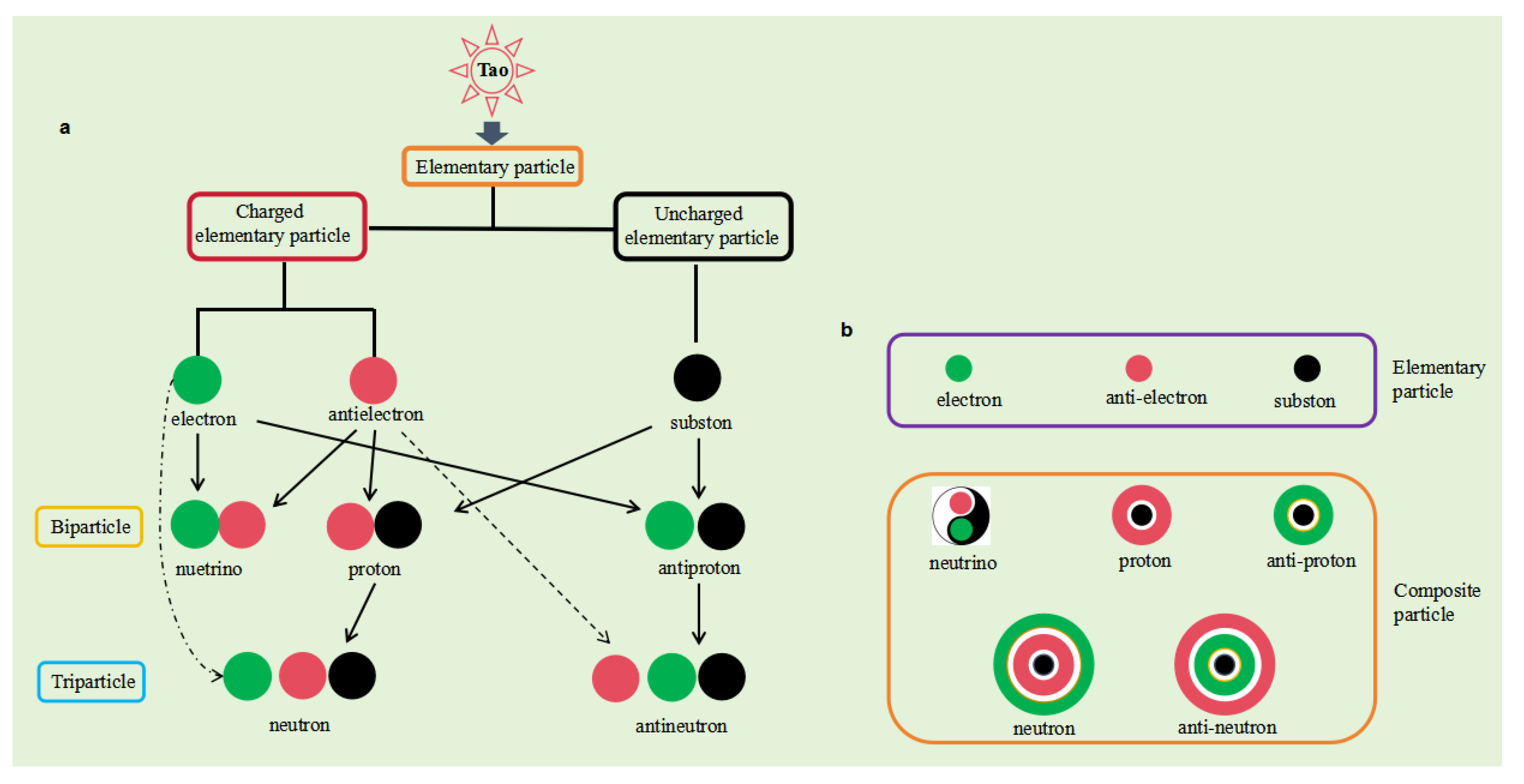
Figure 2.
Existence field of elementary particles. a: Elementary particles continuously and uniformly diffuse their physical information into the surrounding space, with a constant diffusion speed c relative to an absolutely stationary reference frame. The direction of this diffusion is from the fundamental particle towards infinity. b: When a fundamental particle is in an absolutely stationary state in a vacuum, it uniformly diffuses its physical information into the surrounding space, forming concentric spheres nested within each other. c: Changes in the existential field of a fundamental particle moving in a uniform linear motion in a vacuum. d: Changes in the existential field of a fundamental particle accelerating in a linear motion in a vacuum. e: Changes in the existential field of a fundamental particle moving in a uniform circular motion in a vacuum. f: Changes in the existential field of a fundamental particle accelerating in a circular motion in a vacuum.
Figure 2.
Existence field of elementary particles. a: Elementary particles continuously and uniformly diffuse their physical information into the surrounding space, with a constant diffusion speed c relative to an absolutely stationary reference frame. The direction of this diffusion is from the fundamental particle towards infinity. b: When a fundamental particle is in an absolutely stationary state in a vacuum, it uniformly diffuses its physical information into the surrounding space, forming concentric spheres nested within each other. c: Changes in the existential field of a fundamental particle moving in a uniform linear motion in a vacuum. d: Changes in the existential field of a fundamental particle accelerating in a linear motion in a vacuum. e: Changes in the existential field of a fundamental particle moving in a uniform circular motion in a vacuum. f: Changes in the existential field of a fundamental particle accelerating in a circular motion in a vacuum.
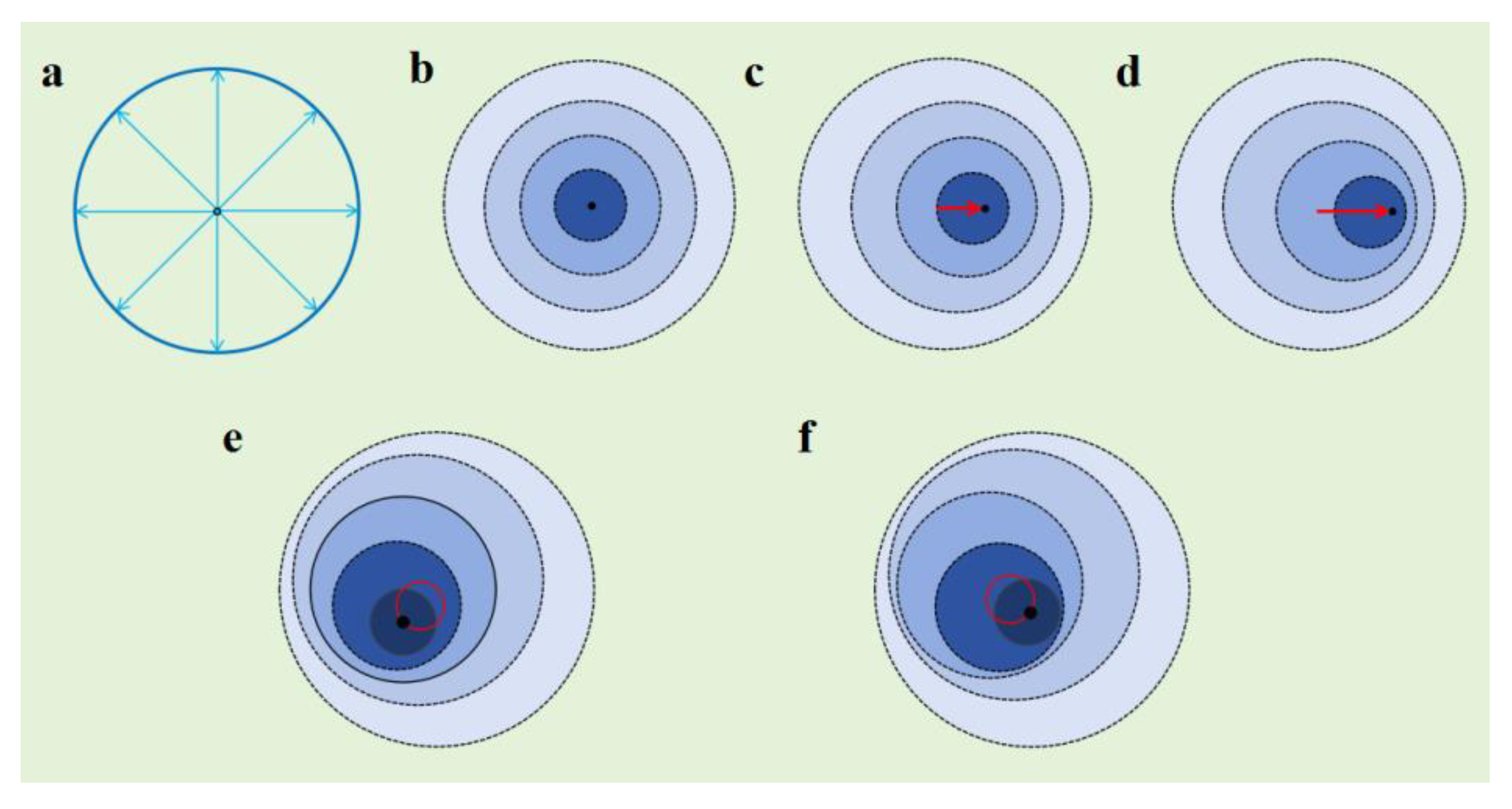
Figure 3.
Momentum and its existence field.
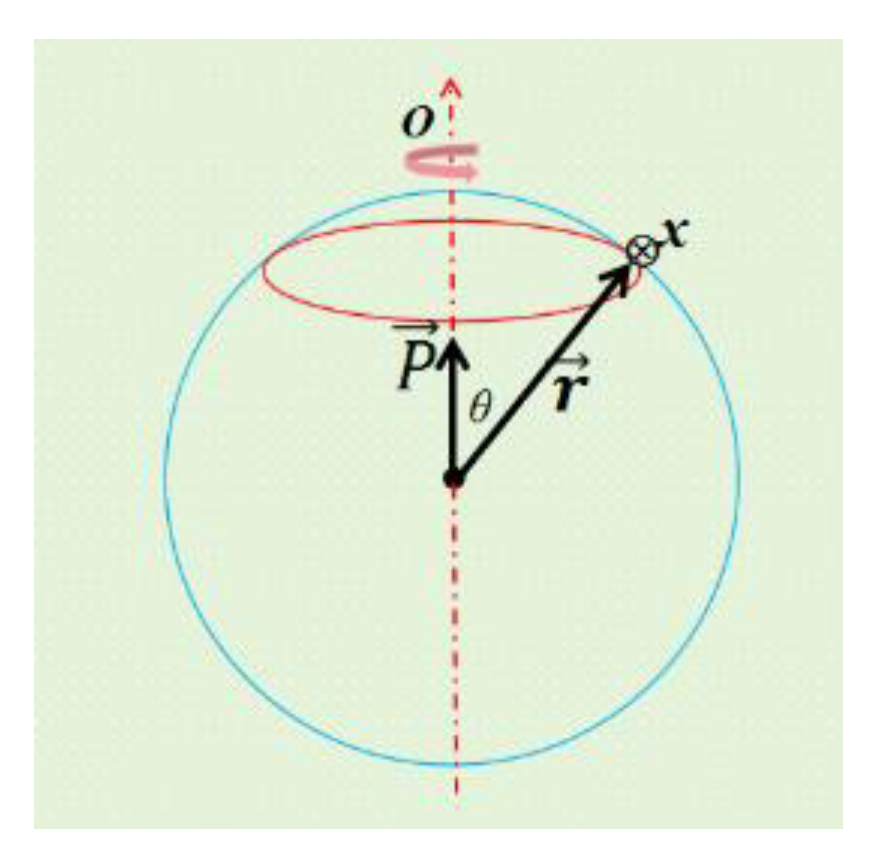
Figure 4.
Direction of rotational momentum and spin momentum a: When a fundamental particle (positive charge or mass) rotates counterclockwise around a center with a position vector
Figure 4.
Direction of rotational momentum and spin momentum a: When a fundamental particle (positive charge or mass) rotates counterclockwise around a center with a position vector
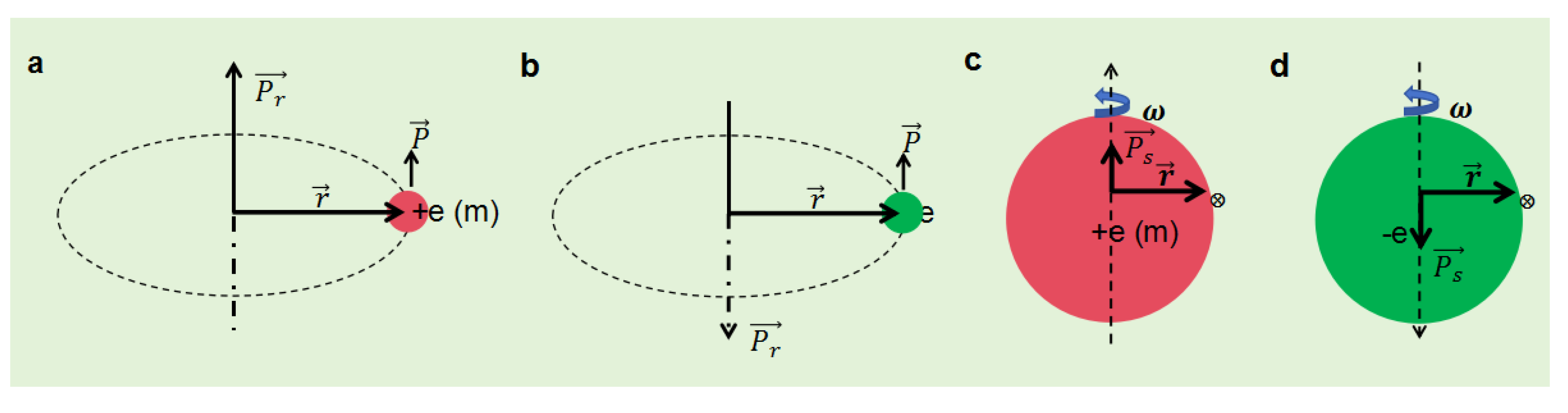
Figure 5.
Combination of elementary Particles.
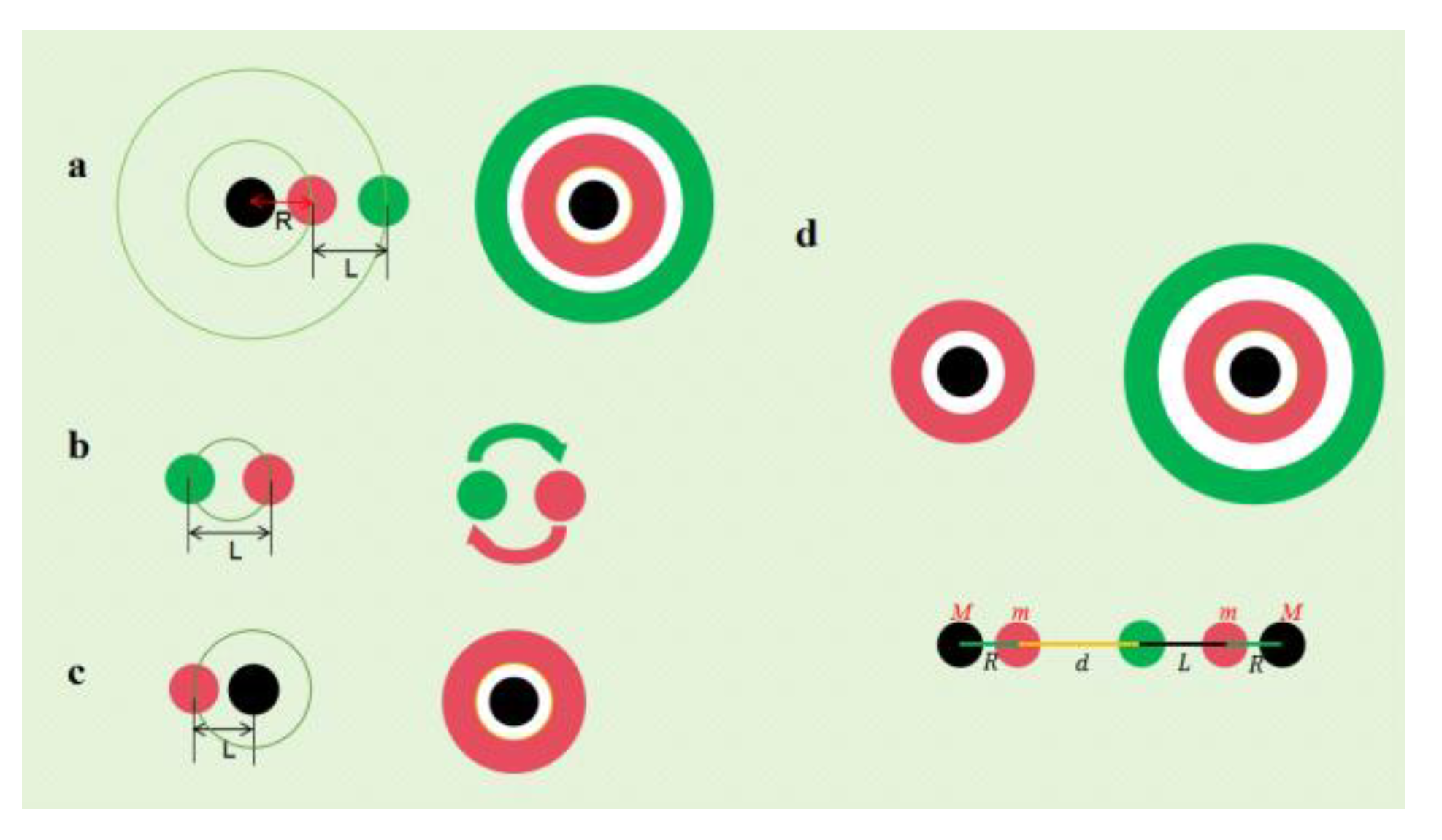
Figure 6.
The combination of Protons and Neutrons and the Structure of Atomic Nuclei. a: The combination of a proton and a neutron; b: The rotation of protons and neutrons; c: The structure of atomic nuclei((protons are represented by red balls, neutrons are represented by green balls)).
Figure 6.
The combination of Protons and Neutrons and the Structure of Atomic Nuclei. a: The combination of a proton and a neutron; b: The rotation of protons and neutrons; c: The structure of atomic nuclei((protons are represented by red balls, neutrons are represented by green balls)).
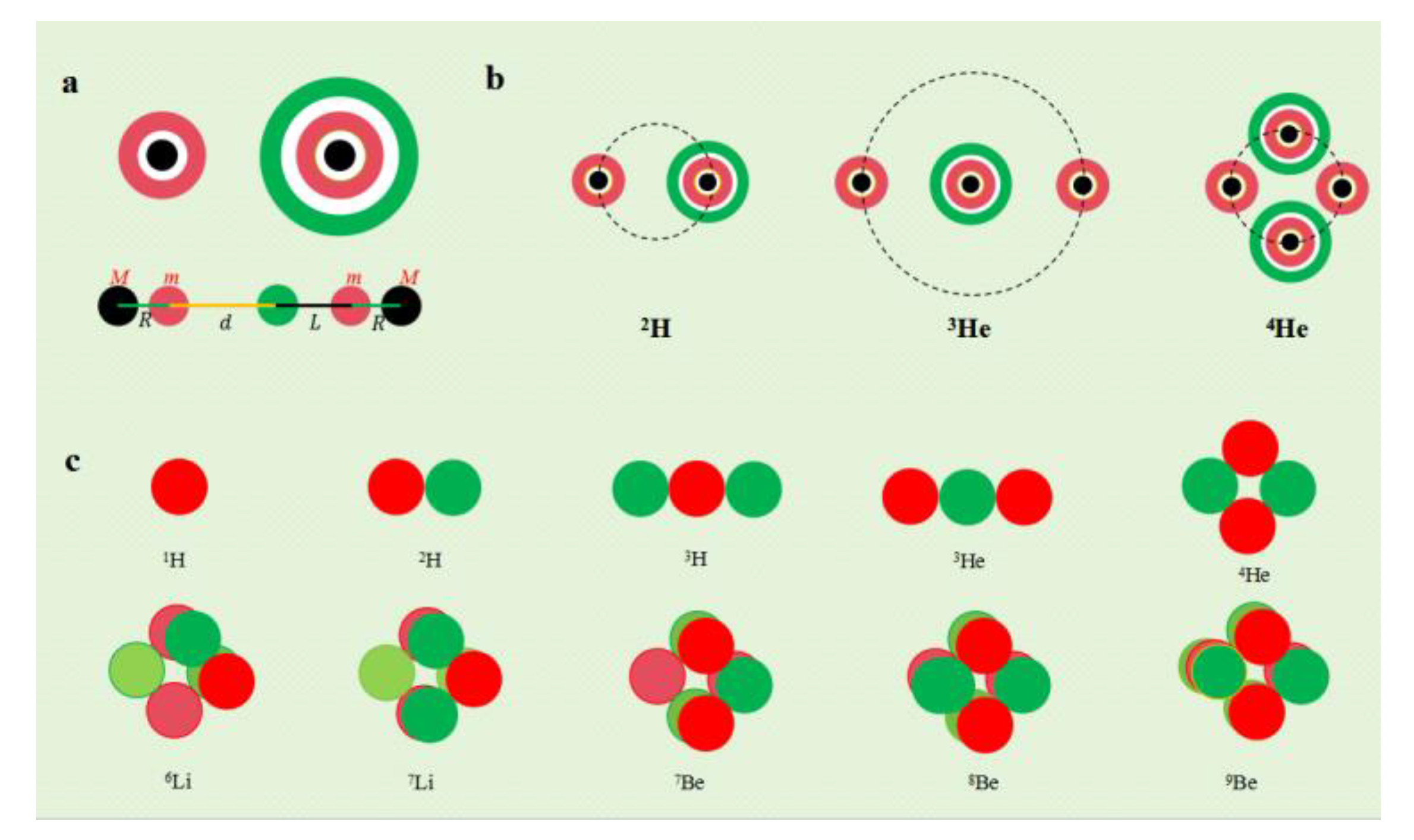
Disclaimer/Publisher’s Note: The statements, opinions and data contained in all publications are solely those of the individual author(s) and contributor(s) and not of MDPI and/or the editor(s). MDPI and/or the editor(s) disclaim responsibility for any injury to people or property resulting from any ideas, methods, instructions or products referred to in the content. |
© 2025 by the authors. Licensee MDPI, Basel, Switzerland. This article is an open access article distributed under the terms and conditions of the Creative Commons Attribution (CC BY) license (http://creativecommons.org/licenses/by/4.0/).
Copyright: This open access article is published under a Creative Commons CC BY 4.0 license, which permit the free download, distribution, and reuse, provided that the author and preprint are cited in any reuse.


